

2018 NBA Playoffs: Ranking the 10 Best Players Remaining in the Postseason
Stop it. That thing you're doing. You're thinking about the end of the NBA season, aren't you? Yeah, that. Stop it.
Look, we get it. The conference finals are here. The fourth installment of the Cleveland Cavaliers-Golden State Warriors championship epic is just weeks away. You know Klay Thompson has started conditioning his hair with champagne to prepare for the eventual title parade.
Everything seems inevitable. The end feels near. We'll have the draft and free agency and summer league and Kawhi Leoanrd trade rumors to get us by over the coming months, but it won't be the same. You'll miss actual basketball. All of us will.
But this is not the time for fears and tears. That comes later. Right now, we have conference finals player rankings to get through.
The ground rules haven't changed since we did this to tip off the playoffs. Players are being evaluated as if we're acquiring them for the rest of the postseason. That's it. Regular-season performances matter very little. Everything comes back to what we've seen in the playoffs and what we still expect to see in the games that have yet to be played.
Let's do this.
10. Jaylen Brown, Boston Celtics
1 of 10
Age: 21
2018 Postseason Per-Game Stats: 16.9 points, 4.8 rebounds, 1.4 assists, 0.8 steals, 48.7 percent shooting, 41.5 percent three-point shooting
Let's get out in front of the unavoidable complaints now: Choosing the last player to make this cut wasn't easy.
Jayson Tatum could just as easily be here. He's morphed into the Boston Celtics' offensive hub with both Gordon Hayward and Kyrie Irving on the sidelines.
Kevin Love could have a stake in this space. He has the built-in cachet and second-round shooting slashes to make a benefit-of-the-doubt case.
Terry Rozier deserves a mention. He's channeled his inner Kyrie Irving on a regular basis, right down to unabashed confidence in his stop-and-pop jumper. (In the interest of full disclosure, that aplomb has resulted in a 29.5 percent clip on pull-up threes.)
Andre Iguodala, Kyle Korver and PJ Tucker could all be fair game, depending on the day. Joel Embiid would totally make the cut...if his team was still playing.
Landing on Jaylen Brown is a calculated risk. A hamstring injury has limited his availability, and he doesn't carry the from-scratch shot creation or playmaking burden of a Rozier or Tatum. That's fine. He doesn't need that self-sufficient flash. His game is instead approaching universal-fit status.
More than 40 percent of Brown's shots are coming off the catch, on which he's posting 64.5 effective field-goal percentage—second-best on the team. When he has done some work off the bounce, he's fared pretty well. He's shooting 45.5 percent on drives and 44.4 percent on pull-ups. The Celtics' offensive rating has actually jumped when Brown plays without Al Horford, a rarity in Boston, even when it comes at the expense of the defense.
And speaking of which: Brown's defensive assignments earn him the swing vote. He sees time on guards and wings and just about anyone who's a primary ball-handler. The Celtics will invariably throw him on LeBron James during the Eastern Conference Finals to try limiting the help they need to send.
Brown isn't always be effective in these matchups, but his value lies in the details. He makes point guards and small-ball 4s alike go through hell and back for their shots. Some even elect to defer possession altogether. And someone with that brand of omnipresence is worth top-10 placement around these parts.
Honorable mentions: 11. Jayson Tatum, Boston Celtics; 12. Kevin Love, Cleveland Cavaliers; 13. Terry Rozier, Boston Celtics; 14. Andre Iguodala, Golden State Warriors; 15. PJ Tucker, Houston Rockets
9. Clint Capela, Houston Rockets
2 of 10
Age: 23
2018 Postseason Per-Game Stats: 14.4 points, 12.2 rebounds, 1.6 assists, 1.0 steals, 2.8 blocks, 63.4 percent shooting
Clint Capela has a strong case to be higher.
Catch-all metrics love him, and he's pushing the bill on everything he did during the regular season. His finishing out of the pick-and-roll has suffered during the postseason, but he still lives to set screens and is making quicker passes on the catch.
Bigger, burlier centers will sometimes overpower him on the block, yet he's steadily improving at holding his ground. Monitoring minutes isn't an issue anymore. His conditioning looks fine. He's averaging over 30 ticks per game, and teams are slightly harder-pressed to force him off the court down the stretch when he's hitting more than 50 percent of his free throws. (Ugly? Yes. But true.)
The Rockets haven't played themselves into a ton of crunch-time situations, but their second-round victory served as a billboard for how much they need Capela. The Utah Jazz averaged under 0.9 points per possession whenever he defended Rudy Gobert, and Houston's offensive rebounding rate plunges by nine percentage points with him on the bench.
Keeping Capela on the floor against the Golden State Warriors will be tougher—hence the sort of conservative placement. The Rockets didn't have to worry about matchup problems against the Minnesota Timberwolves' frontcourt, and they went away from smaller arrangements at times versus the Jazz so he could line up opposite Gobert.
Leaving him in the game when Kevon Looney, JaVale McGee or David West jumps center is fine. But what happens when the "Hamptons Five" runs the show? Can Capela keep up with Draymond Green? Can he be stashed on Andre Iguodala? Will he be small-balled out of the game?
It bodes well for the Rockets that Capela is easier to move around than most non-unicorns. He has guarded 32 possessions more off switches than anyone in the league, per Action Network's Matt Moore. But the Warriors are a different beast—especially now that Capela won't get the chance to "rest" on Zaza Pachulia. The Western Conference Finals will be a true gauge of his value to Houston.
8. Klay Thompson, Golden State Warriors
3 of 10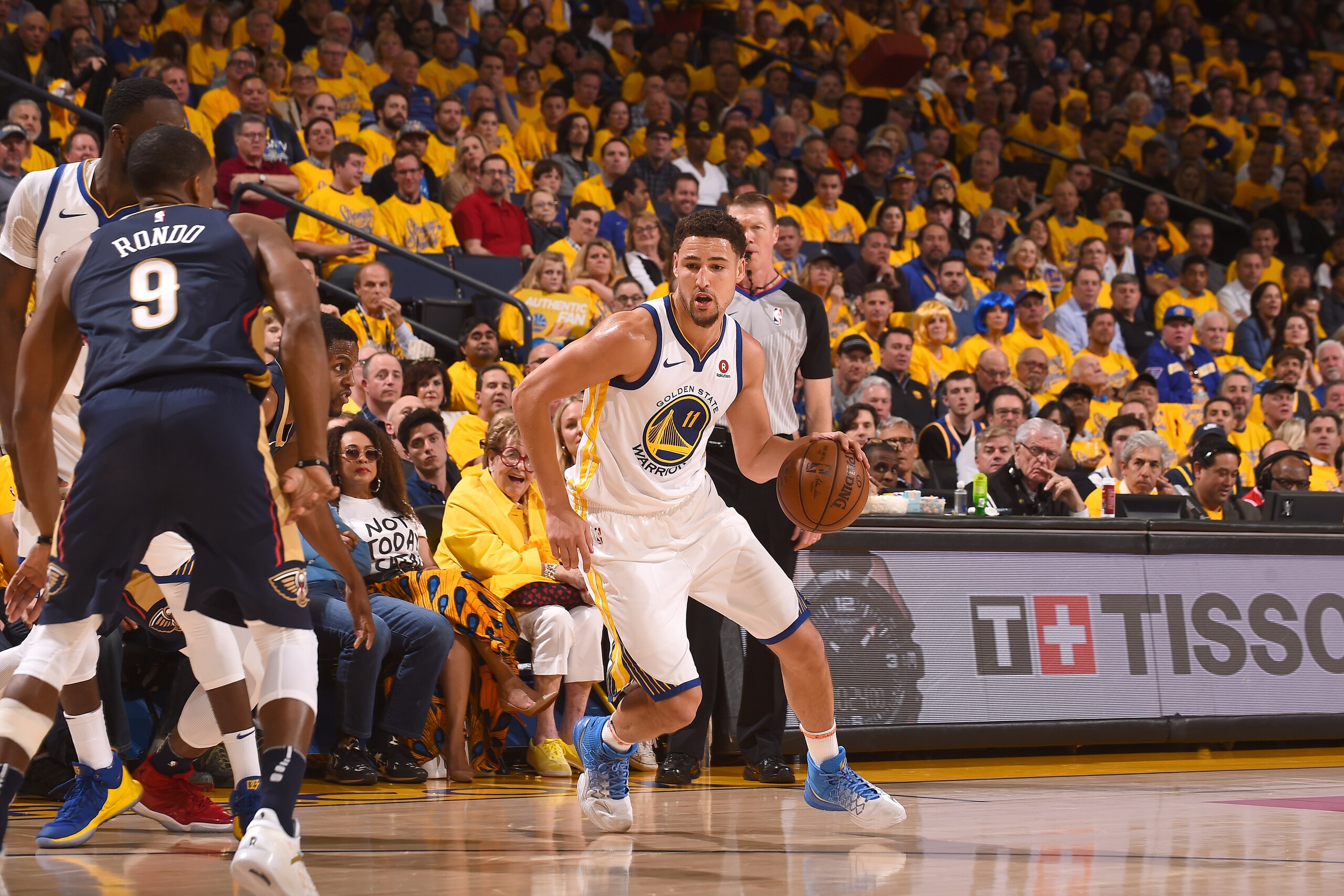
Age: 28
2018 Postseason Per-Game Stats: 21.2 points, 4.7 rebounds, 2.3 assists, 0.3 steals, 45.2 percent shooting, 37.8 percent three-point shooting
Advanced Stats: 13.3 PER, minus-8.68 TPA, 0.1 VORP
Is it weird that this feels like a hot take?
Klay Thompson juuust edges out Clint Capela—not for the #hateclickz or to meet a nuclear-notion quota but to send a message: He's fast becoming underappreciated.
Kitchen-sink numbers won't show the same regard for Thompson that they do most stars. He doesn't grab a ton of rebounds or dish out a bunch of assists, and his 27.9 percent three-point clip during the Pelicans series isn't doing him any favors.
Still, the Warriors cannot put a price on his low-key volume scoring. He has the capacity to hunt his own shots, but their system asks for him to stay in near-neverending motion off the ball. And he embraces it.
Almost two-thirds of his offensive possessions are ending in spot-ups, off screens or on cuts. Close to 80 percent of his shot attempts come without using more than one dribble. Who's cool with that? Like, seriously: What other All-Star in the heart of his prime bear-hugs a glorified complementary role? It's not easy. Carmelo Anthony is washed and couldn't do it with the Oklahoma City Thunder.
Thompson's outlook on the defensive end is a little more complicated. His reputation has been turned inside-out and back again, not unlike Avery Bradley's resume. But the Warriors defense works in large part because Thompson can chase around any type of guard.
Rajon Rondo is playing with a little sass? Throw Thompson in his face. Jrue Holiday isn't facing enough resistance? Get him, Klay. Patty Mills and E'Twaun Moore exist? Hop to it, Splash Bro.
Having Thompson at their disposal allows the Warriors to put both extra pressure on primary ball-handlers and spare Stephen Curry from possessions and entire matchups against players they'd rather not have him on. So whereas Capela, his rival for the No. 8 spot, might get played off the floor, Thompson is more under-sung safety net than exploitable.


7. Al Horford, Boston Celtics
4 of 10
Age: 31
2018 Postseason Per-Game Stats: 17.0 points, 8.7 rebounds, 3.3 assists, 1.2 steals, 1.3 steals, 57.8 percent shooting
Points-per-game zealots are running out of ammunition for their anti-Al Horford bazookas. He's still letting the box-score police down by not matching Kobe Bryant's shot volume, but his 17.0 points per game are a playoff career high.
Defensive-rebounding sticklers still have plenty to gripe about—particularly with Tristan Thompson on deck—but even those jokes fall flat nowadays. Horford's modest totals are almost methodic. He generally plays hooky on the glass to get back in transition.
Soldiering on without Kyrie Irving—and, like he has all year, Gordon Hayward—unleashed an oft-unseen version of Horford. Go back and watch the tape from Boston's second-round romp over the Philadelphia 76ers. Horford ripped Joel Embiid outside his comfort zone, forcing him to defend not only pick-and-pops but also drives off pump-fakes.
Range and mobility don't always go hand-in-hand for bigs. Horford leverages both into relative unguardability. He's shooting almost 45 percent when he's 16 or more feet away from the basket and better than 52 percent on drives.
Good luck neutralizing all that. Horford is not the guy who gets played out of the game; he's the forward-center who mandates stylistic terms.
This extends to the defensive the end, where Horford, unlike most traditional towers, hasn't incurred a lineup combination he cannot hack it against. Only Semi Ojeleye(!) averaged more time on Giannis Antetokounmpo in Round 1, and no one saw more reps opposite Ben Simmons during the semifinals.
Hanging with primary playmakers is a tick easier when they're not established outside threats. The Cavaliers pose a tougher test with their LeBron James-Kevin Love pairing. But that may not deter the Celtics from using Horford as their be-all mishmash.
"Of course, the Celtics could throw a curveball at Cleveland and have Horford defend LeBron, much as he defended Ben Simmons last round," Jared Dubin wrote for the Step Back. "LeBron obviously presents far different and far greater challenges, but if the Celtics want to stay big while Cleveland goes small, that seems like a matchup we’re going to see a whole lot of."
That the Horford-on-LeBron matchup can even be talked about as a hypothetical approach says a lot—more than his scoring and rebounding totals ever could.
6. Draymond Green, Golden State Warriors
5 of 10
Age: 28
2018 Postseason Per-Game Stats: 13.1 points, 11.5 rebounds, 9.0 assists, 1.9 steals, 1.3 blocks, 42.3 percent shooting
Most of the doubt expressed in the Warriors during the regular season rested on their defensive interest and Draymond Green's shooting. Yes, they placed ninth in points allowed per 100 possessions, but that was down from second the year before, and almost no one played with the same obsessive edge.
Toss in Green's 30.1 percent success rate from downtown, and the questions wrote themselves. Were the reigning champs vulnerable? Was something off with Green? How about Andre Iguodala (28.2 3PT%)? Would this team flip a switch for the playoffs?
Consider Green's switch flipped.
Watching him now compared to the regular season is almost night and day. He's back to teleporting on the defensive end. His rebound and steal rates have both jumped, and he's erasing looks around the basket. Opponents are shooting 54.1 percent against him at the rim—seventh-best mark among 50-plus players to challenge at least three point-blank attempts per game.
Even Green's outside touch has spiked. He's canning 33.3 percent of his threes for the postseason but downed 40.0 percent of his deep balls against the Pelicans. That long-range efficiency paired nicely with the triple-double he averaged through the second round, all while making life measurably more difficult on Anthony Davis.
Stephen Curry and Kevin Durant corner the market on Warriors appreciation. They should. But Green is similarly integral to their way of life.
Just as they don't work without Klay Thompson conceding touches, they wouldn't be the same without Green's aloof view of scoring in general. He doesn't need to shoot. He's content to fling passes and set screens. He's assisting on more than 30 percent of Golden State's buckets when he plays, with a usage south of 18. Jason Kidd is the only player to do the same over the past decade.
Dismissing Green's offensive contributions takes barely any effort. He runs with dudes who move well off the ball and hit shots. Big whoop.
Playing that card is weak sauce. Look past the unfair oversimplification of Green's playmaking duties, and you'll still find an irreplaceable defensive anchor. His minutes in the middle can displace treasured bigs from the rotation and set the tenor for a whole series—or, in the Warriors' case, an entire era.
5. Chris Paul, Houston Rockets
6 of 10
Age: 33
2018 Postseason Per-Game Stats: 21.8 points, 5.5 rebounds, 6.4 assists, 2.1 steals, 48.5 percent shooting, 37.7 percent three-point shooting
Chris Paul has seldom been one to underperform in the playoffs. He's underachieved by failing to make a Western Conference Finals for the first 12 years of his career, but he's almost always delivered pretty stat lines.
To be caught off-guard by his 2018 postseason performance reads too much into the now-defunct legacy trope.
Of course he's shooting 37.7 percent from deep. Obviously he's hitting more than 55 percent of his long twos. Why wouldn't he take over Games 4 and 5 against the Jazz when James Harden went face-on-a-milk-carton? That's why the Rockets traded for him.
And yet, he's 33. And playing about one-third of his minutes without Harden. And defending his butt off. And continuing, on occasion, to carry the offensive workload for a title contender.
That's not normal, folks. He shouldn't be going 8-of-10 from downtown en route to dropping a postseason career-high 41 points in a series-clinching victory over the Jazz. He shouldn't be scoring more efficiently in one-on-one situations than Harden. He shouldn't be the Rockets' best option to chase around or call out switches against Stephen Curry...and have that sound OK.
Here we are, though. Paul is all those things, and then some more.
4. James Harden, Houston Rockets
7 of 10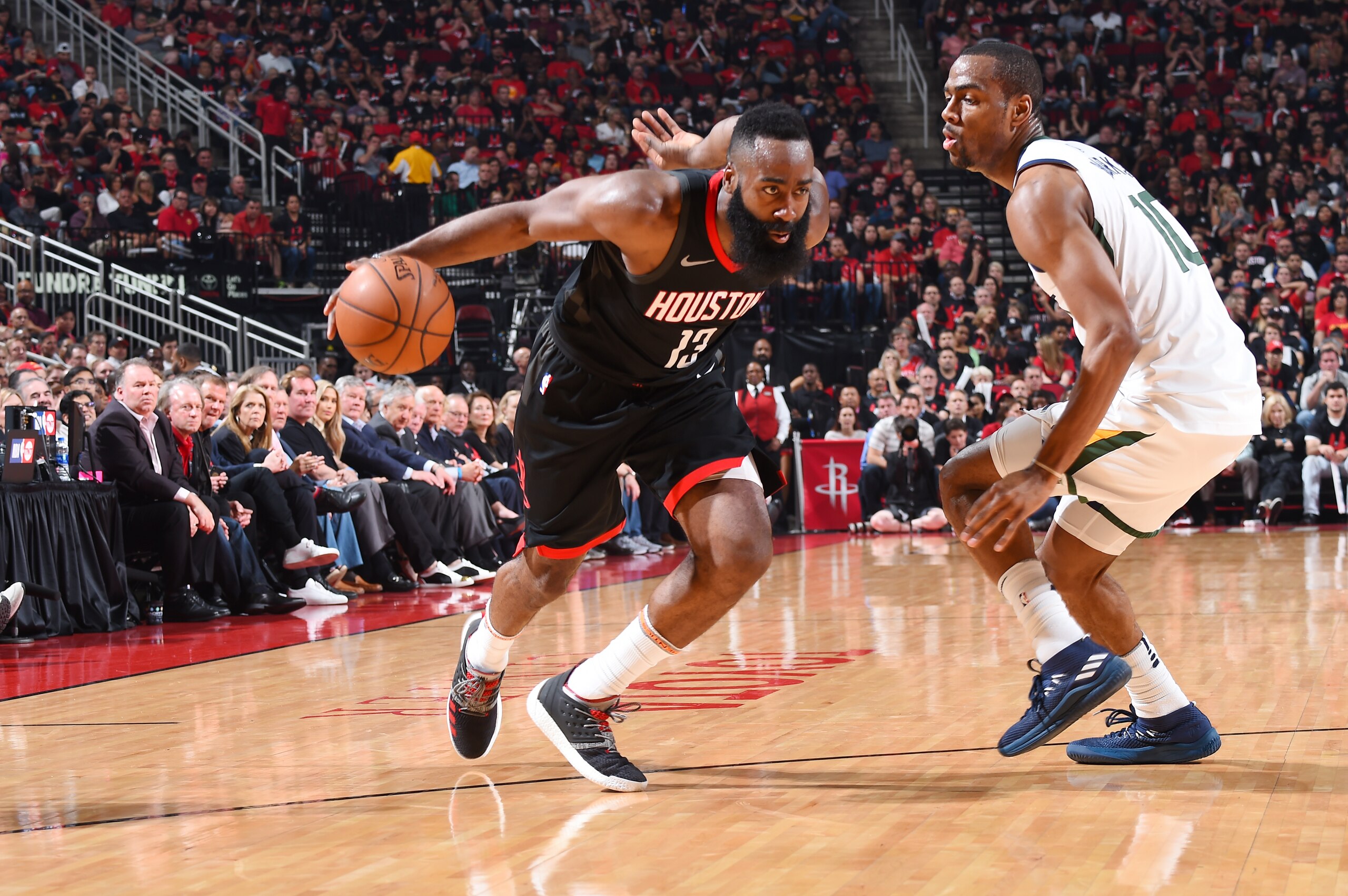
Age: 28
2018 Postseason Per-Game Stats: 28.5 points, 5.0 rebounds, 7.4 assists, 2.3 steals, 40.7 percent shooting, 34.4 percent three-point shooting
Don't interpret this as a slight against the probable league MVP. Nor should it be viewed as a knee-jerk reaction to his ice-cold shooting through the final two games of the Jazz series. Extenuating circumstances seem to explain his 34.1 percent clip, replete with a 2-of-14 showing on threes.
"He was hurting tonight," head coach Mike D'Antoni said of James Harden after Houston put the finishing touches on Utah, per ESPN.com's Royce Young.
Fatigued, sick, injured—it doesn't matter. Harden remains indispensable. He sends defenses into a tizzy just by handling the ball and leveraging the threat of his attack.
Sure, his shooting percentages currently reside with the mole people. But the offense's output plummets by 11.7 points per 100 possessions when he catches a breather—the largest drop-off on the team. And while the Rockets are a net minus in the time Paul plays alone, they're a plus-7.8 points per 100 possessions during Harden's solo stints.
Propping up that value amid suboptimal efficiency speaks to a certain growth. Harden isn't blindly forcing the action as often. He's posting the second-best postseason turnover percentage of his career while floating sizable assist and usage rates, but he's also recognized the value of occasionally handing off the reins.
Paul attempted one more shot than Harden through Houston's final three second-round tilts. This, despite a mini kerfuffle between the two during Game 3. Harden has never displayed such a pronounced trust in a teammate while repping the Rockets. Paul is different than anyone they've ever paired with him, but Harden has clearly changed himself—even if only slightly.
None of which completely negates his persisting warts. Harden's devil-may-care assaults on the hoop are not inviting as many whistles. His foul percentage on drives has fallen by seven points compared to the regular season, and his free-throw rate has never been lower.
Navigating this dryish spell wouldn't seem so impossible if Harden's step-back jumper was finding the net. It's not. He's splashing in 31.7 percent of these looks (30.4 percent on threes), down from 44.2 percent during the regular season (44.6 percent on threes).
Something needs to give during the Western Conference Finals. The Rockets won't survive the Warriors leaning on Paul's detonations alone. And if they go down without one of Harden's hallmark offensive tricks tilting the other direction, his postseason play style will be subject to another piping-hot batch of summer scrutinty.
3. Kevin Durant, Golden State Warriors
8 of 10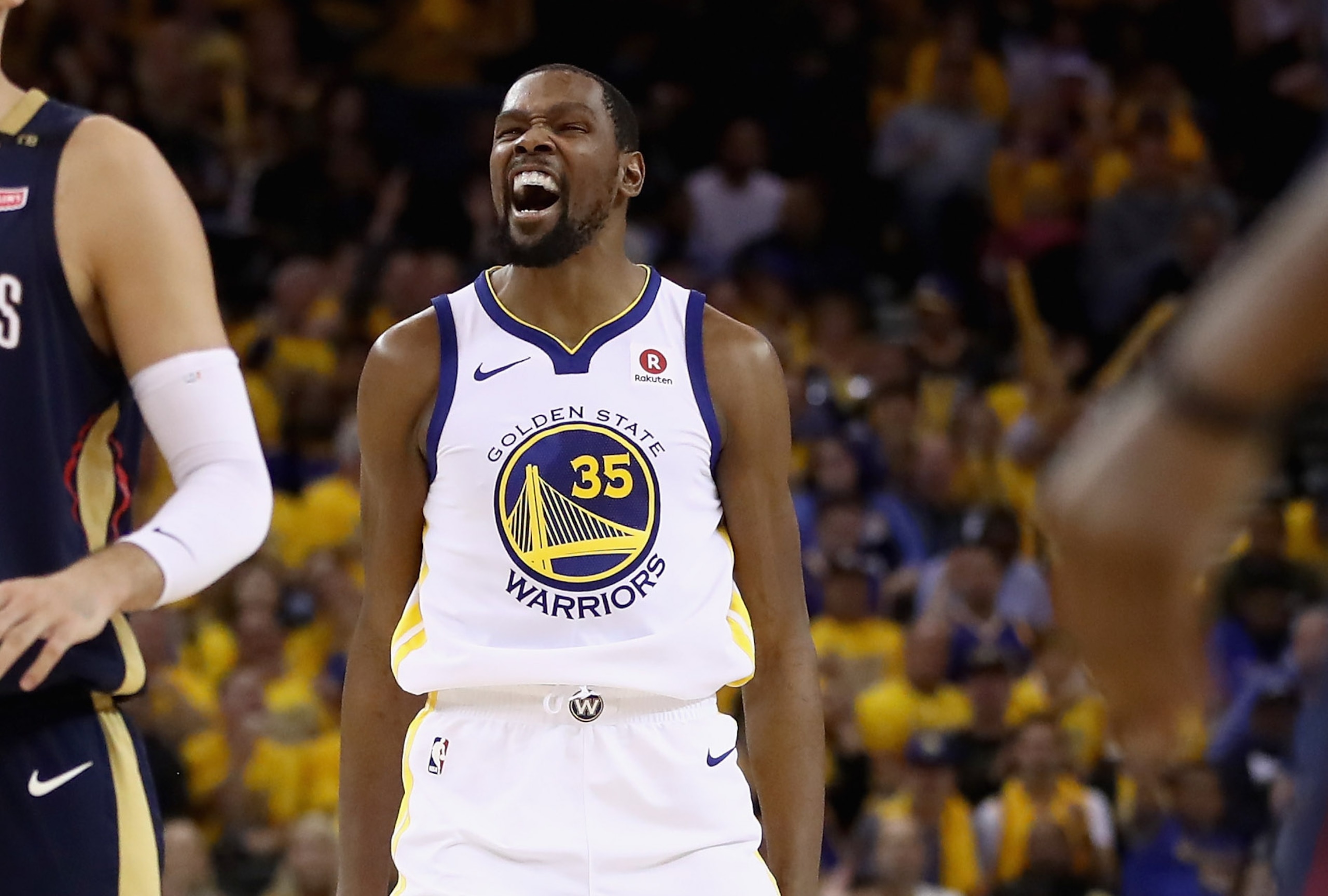
Age: 29
2018 Postseason Per-Game Stats: 28.0 points, 8.0 rebounds, 5.0 assists, 1.0 steals, 1.0 blocks, 49.3 percent shooting
Kevin Durant remains the NBA's ultimate trump card. The Warriors don't need him. He makes treading water without Stephen Curry for weeks at a time convenient, not possible.
He is, simultaneously, an all-time great and the greatest accessory of all time.
This isn't said to chop down or minimize Durant in any way. It's just a fact. He is the cherry atop the already cherry-topped ice cream sundae. The Warriors have gone from unfair to unsolvable with him in the fold. He makes every possible hiccup feel utterly pointless and every matchup seem like a simulation of a game and series and ending we've already seen.
As SI.com's Andrew Sharp wrote:
"I want to believe in Rockets–Warriors. I really do. You can convince me that Harden and Paul can play the Golden State backcourt to a draw, particularly if Steph isn't 100% healthy. I'm even willing to suspend disbelief and talk myself into Clint Capela's shot blocking and rim-rolling as a viable counterpoint to Draymond Green's playmaking on both ends. Sure. Fine. Whatever. But Durant ... Are we really pinning our hopes to Luc Mbah Moute and PJ Tucker? Trevor Ariza is supposed to hold serve here? Unless Mike D'Antoni is bringing 28-year-old Tracy McGrady off the bench, this matchup seems like it will be a problem."
This sense of inevitability persists even with Durant shooting 27.9 percent from three. That shouldn't happen. If the Warriors' second-highest-usage player is dropping in just 20 percent of his wide-open treys, they shouldn't be entering the conference finals with only a pair of losses and as the unreachable favorites.
But they do. They're that talented and deep. And Durant, their leading scorer, is an extension of that. He doesn't need to have all of his superpowers clicking at the same time. He overshadows an uncharacteristically bad three-point clip with 61.5 percent shooting on long twos, a 76.2 percent knockdown rate at the rim and the second-best postseason assist rate of his career.
2. Stephen Curry, Golden State Warriors
9 of 10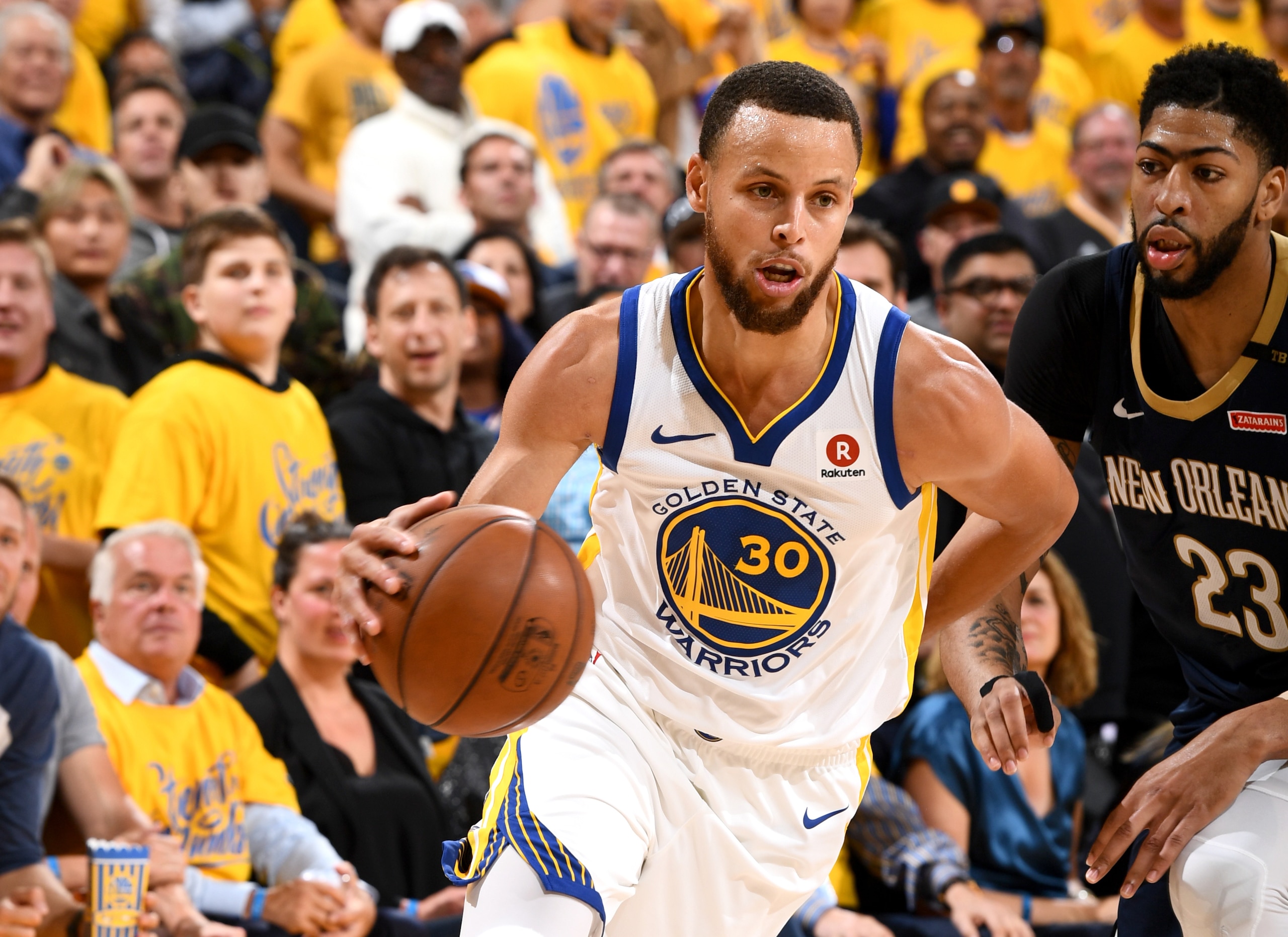
Age: 30
2018 Postseason Per-Game Stats: 24.5 points, 5.5 rebounds, 3.5 assists, 2.0 steals, 47.8 percent shooting, 44.1 percent three-point shooting
Remember when Stephen Curry shot 6-of-19 against the Pelicans in Game 3, his second appearance of the postseason? You know, when you could just feel professional skeptics getting ready to launch into a barrage of I-told-you-sos? When his triumphant return in Game 2 became but a footnote?
When, maybe, you personally started to wonder whether Steph would be Steph in time for the Warriors to elude 2016 comps and memes?
Perhaps you don't. And fair enough. That momentary lapse seems like it unfolded forever ago.
Curry threw a welcome-back party for himself to close the series against New Orleans, pouring in 28 points and eight assists on 10-of-16 shooting. Somehow, though, his passing the 35-minute market felt like an even bigger victory.
"You see when you let the dog off the leash what happens," Kevin Durant said, per the San Francisco Chronicle's Connor Letourneau. "We're going to need him to continue to be aggressive, and we'll live with anything after that."
Some of Curry's on/off splits remain weird; the offense is hardly suffering when he sits. That happens over a four-game sample. We know better than to question his importance to the Warriors. He warps defenses just by being on the floor. They have to concurrently account for his infinite range and clinics inside the arc. Guarding him isn't a pick-your-poison scenario; you're forced to sit through your own funeral on a loop.
Curry's game is no longer dependent on the success of any one facet. He doesn't have to reach the foul line. Take away his air space, and, well, he might shoot anyway. Or he'll duck inside and feast upon a steady diet of floaters.
Envelop his drives with bodies and limbs, and he'll adjust the arc of his runner or finish off the glass at impossible angles. Coax the ball out of his hands, and he'll run through a maze of screens until authoring the slightest separation.
No one else in the league can juggle Curry's offensive functions. Durant may invariably ferry a heavier crunch-time workload; not because he's better or more valuable (he's not), but because he has an easier time shooting over opponents in the half court. And even then, Durant will be benefiting from the Curry effect. He wouldn't see so many skeleton-crew defensive schemes or unmanned driving lanes without him.
After all this time, alongside all these stars, Curry is still the Warriors' identity. Durant and everyone else around him maximizes it and amplifies it, but no one else is the architect of it. The most valuable player from, perhaps, the greatest team ever assembled cannot fall lower than No. 2 on this totem pole.
1. LeBron James, Cleveland Cavaliers
10 of 10
Age: 33
2018 Postseason Per-Game Stats: 34.3 points, 9.4 rebounds, 9.0 assists, 1.5 steals, 1.0 blocks, 55.3 percent shooting
Imagine not having LeBron James as the best player in the world, let alone still in the playoffs.
Every so often people try to make "Kevin Durant is better!" or "Giannis Antetokounmpo is catching up to the King" or "Kawhi Leonard would be the GOAT if San Antonio was Los Angeles!" happen. And every time, without fail, James delivers an unassailable rebuke.
Career skeptics, to their credit, didn't begin this postseason by doubting his place among today's stars. But truckloads of people wondered whether he could drag this iteration of the Cavaliers anywhere special—as in, out of the first round.
James has naturally responded with one of the best playoff campaigns of his career. Look at where his numbers this postseason rank for his career:
Oh! And because Year 15 is apparently no time for regression, James is creating 54.7 percent of the Cavaliers' total offense after accounting for the points he generates with his assists—the largest share of his career.
So how about, from now on, we agree to skip the second-guessing and parallels to Michael and just celebrate James for what he is: the very, very best at what he does. Deal?
Unless otherwise noted, stats courtesy of NBA.com or Basketball Reference and accurate leading into games on Sunday.
Dan Favale covers the NBA for Bleacher Report. Follow him on Twitter (@danfavale) and listen to his Hardwood Knocks podcast, co-hosted by B/R's Andrew Bailey.


.jpg?w=2560 "Love's Body Already 'Tired'")
.jpg?w=2560 "Tyreek Deal May Come Soon")
.jpg?w=2560 "Ward Nearly Walks Out of Presser ▶️")



.jpg?w=2560 "NFL investigating 2 referees for separate viral exchanges")