

Chris Paul Bringing Rockets' Vision to Life, and Other Tuesday NBA Takeaways
This is why the Houston Rockets needed Chris Paul and vice versa.
The Rockets knew there would come a time when James Harden alone wasn't enough. They knew he'd struggle on occasion, whether fatigue set in or the sheer weight of being the other team's central focus became too much.
They knew, because they collided with that nightmare scenario during their second-round letdown against the San Antonio Spurs last season.
TOP NEWS

Buzz: Knicks' KAT Offer Revealed

Surprise Dubs Trade Idea 💡

Projecting New-Look Lakers Rotation 🧐
Similarly, Paul knew he needed someone like Harden and a team like the Rockets. He knew his postseason track record could be less of an annual meme if he played beside another primary ball-hander with whom he could split traditional playmaking burdens.
He knew, because he never had that type of teammate throughout his tenures in New Orleans and Los Angeles and never made it to the conference finals in the first 12 years of his career.
Few could still doubt the merits of Paul's partnership with Harden and Houston before Tuesday's series-clinching 112-102 victory over the Utah Jazz. Insofar as trace elements of skepticism even existed, they are now gone, fully replaced by not only validation and absolution but also deferred awe.
This is why the Rockets needed Chris Paul.
Game 5 typified everything Houston wanted and needed when it traded for the future Hall of Famer last June. He torched the Jazz to the tune of 41 points, a postseason career high, and 10 assists while shooting 13-of-22 overall, including a sizzling 8-of-10 from beyond the arc.
Paul dealt the lion's share of his damage in the fourth quarter, with the Jazz attempting to stave off the seemingly inevitable. He dropped 20 points on a 7-of-9 clip (4-of-4 from deep) without catching a breather. And he wasn't so much set up for success as he was unconsciously perfect.
With his first-ever conference finals cameo in sight—R.I.P. to early May CP3 jokes forever—Paul could do no wrong:
All the while, Harden struggled to find his groove. He shot 7-of-22 from the field, including 1-of-7 from deep, en route to scoring fewer than 20 points for just the second time this postseason.
To his credit, Harden was apparently under the weather. Paul mentioned it during his postgame interview with TNT's Kristen Ledlow, and head coach Mike D'Antoni said the same soon afterward:
On most nights, Harden's performance would be worthy of choke-job hashtags. It doesn't matter that he was battling through an illness. Social media hot-take artisans don't care.
But the Rockets won, because Paul gives them more than enough to survive the occasional Harden dry spells.
Make no mistake, Houston did not advance under ideal terms. The goal is to have Harden and Paul dominate together, not independent of one another.
At the same time, the Rockets have essentially planned their entire season around this hiccup. They didn't treat Paul as an in-case-of-emergency safety net; instead, they tapped into his track record as a lifeline and took staggering to an extreme.
Both Paul and Harden played ample time without the other during the regular season. That hasn't changed in the playoffs. Houston, on average, is playing fewer than two minutes per game without one of its two superstars on the court.
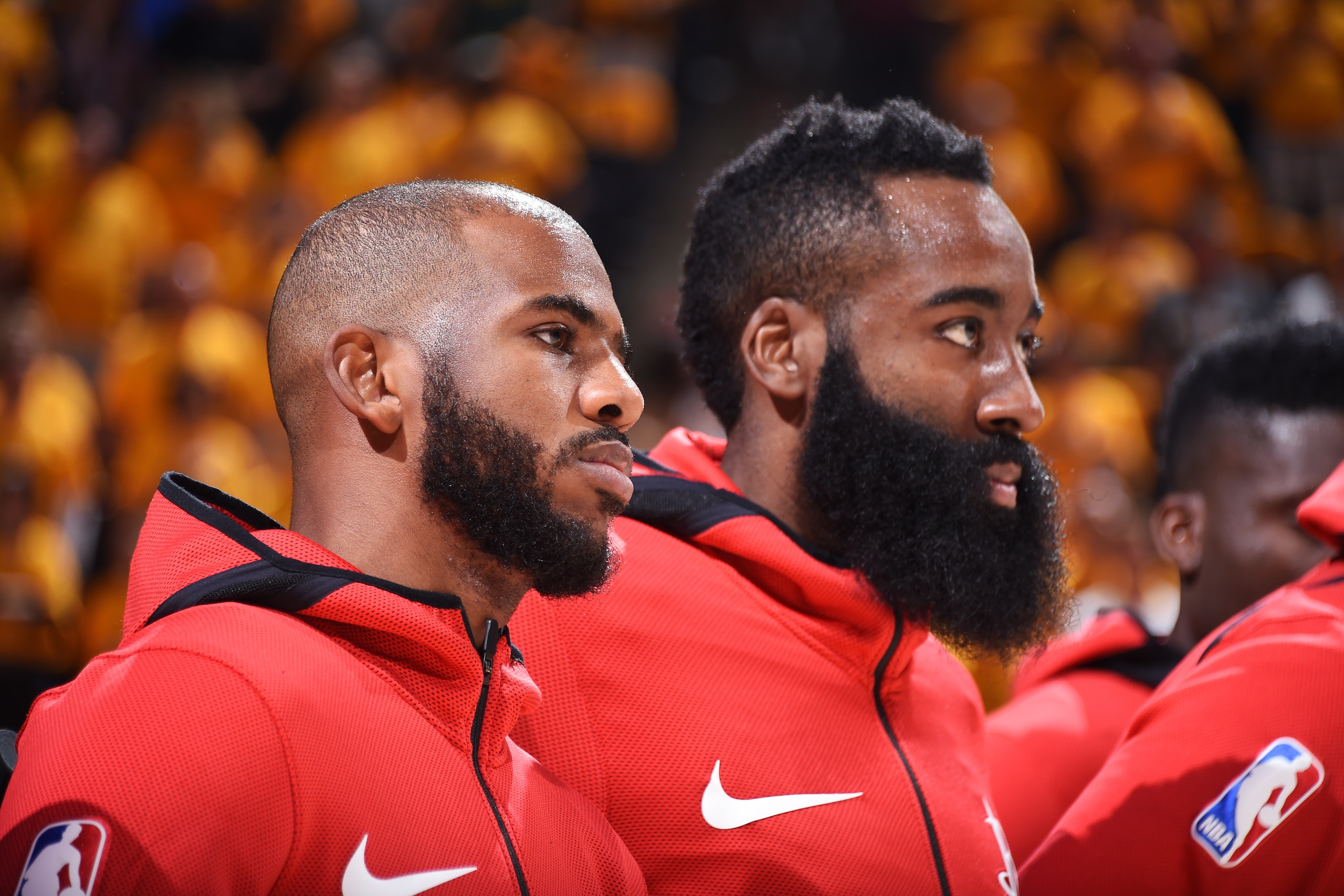
No other team outside Oakland has that option—not to this magnitude. The Cleveland Cavaliers need LeBron James to log more than 40 minutes every night. Teams like the Philadelphia 76ers or the fallen Toronto Raptors and Washington Wizards cannot rest one of their two best players and still have a top-10 talent leading the charge.
That the Rockets have this luxury at their disposal cannot be overstated. Their next man up would likely be your favorite team's best player. And they pose a unique threat to the Warriors because of it.
For all of the jokes and criticism made at Paul's expense in postseasons past, he isn't someone who shrinks in the moment. Tuesday's detonation may have been the peak of his powers, but it was closer to his default setting than a blip:
Paul entered Game 5 with career playoff averages of 21.2 points and 9.1 assists and a 48.3/36.9/84.9 slash line—numbers either right in line or better than his regular-season marks. Also:
We don't have to go far back to find another herculean effort from Paul. Rewinding to Game 4 will do the trick.
Harden once again struggled. It took him 22 shots to net 24 points, and he put down just one of his seven three-point attempts. Paul picked up the slack, pairing his 12 rebounds and six assists with 27 points, all but six of which came in the second and third quarters.
Yes, the Rockets are at their peak when their two stars go it together. They're outscoring opponents by 17.8 points per 100 possessions for the playoffs when they share the floor. And they were comparably dominant with both of them during the regular season (plus-13.6).
To that end, the Rockets are a net minus through 10 postseason tilts when Paul runs solo. But they were a demonstrative plus during his me-time in the regular season and, more critically, they just sealed their trip to the Western Conference Finals by leaning on him, both with and without Harden.
That doesn't mean they'll overthrow Golden State in the next round. It doesn't even necessarily guarantee they'll push the reigning champs to six games. The Warriors have four All-NBA talents, each in the heart of their primes. They are a different brand of juggernaut.
But the Rockets' one-two punch is enough to wonder whether they have a shot at doing the seemingly unthinkable. They have the supporting cast—shout-out to Clint Capela for his second-round heroics and PJ Tucker for his Game 5 shot-making—to make their own history when everything's clicking, but the superstar depth to survive when it isn't.
Anything less wouldn't stand a remote chance of dethroning the Warriors.
Which is why the Rockets needed, and will continue to need, Chris Paul.
Injuries Suck, But...
Just a reminder that injuries suck:
Like, really, ridiculously stink:
But postgame hug-a-thons are the absolute best:
We'll see you bright and early next year for your spectacular sophomore encore, Mr. Mitchell.
Fare Thee Well, Utah
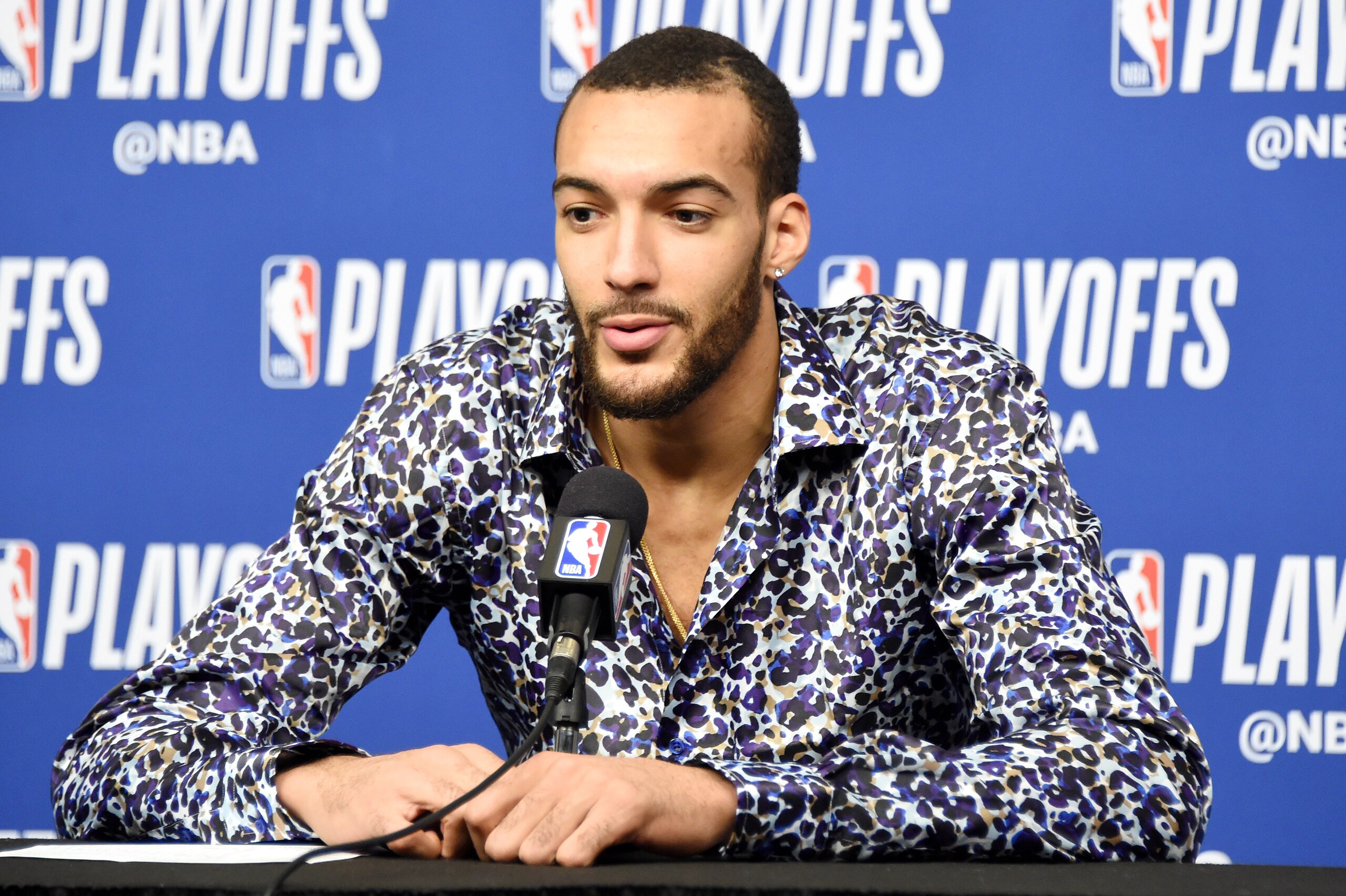
Major ups to Utah for getting this far.
Falling in five games usually isn't something to celebrate, but the Jazz weren't supposed to be here, scrapping with the Rockets after dispatching the Oklahoma City Thunder. Not after the offseason they had, and most certainly not following the midstream roadblocks they encountered:
These feel-good vibes will invariably be short-lived. The Jazz have a complicated offseason in front of them.
Both Dante Exum (restricted) and Derrick Favors (unrestricted) are slated for free agency. Exum, who didn't play in Game 5 due to a hamstring injury, likely won't command a hefty offer sheet after dealing with injuries for much of his career. But Utah has to decide whether he warrants a long-term investment at all, even if his price point doesn't break the bank.
Favors presents a different kind of issue. He was considered a goner coming out of the trade deadline. Then his synergy beside Rudy Gobert reappeared. Then the Jazz started closing games with Jae Crowder at the 4. Then Favors proved pivotal in their first-round victory over the Thunder. And then they were reminded of his limitations against switchy teams like the Rockets.
How much is a player like Favors worth to them?
Running it back has appeal. The Jazz need to renounce Exum and Favors while waiving the non-guaranteed salaries of Jonas Jerebko, Thabo Sefolosha and Ekpe Udoh just to enjoy meaningful cap space, and this summer's market isn't teeming with talent worth all-in dice rolls. It also behooves them to make sure Donovan Mitchell's rookie-year excellence, along with their midseason tear, isn't some anomaly.
Then again, Utah is set up nicely to make a splash in 2019, when wings like Jimmy Butler (player option), Kawhi Leonard (player option), Khris Middleton (player option) and Klay Thompson will all be available. Re-signing Exum and Favors knifes into that malleability.
Does Utah invest in the status quo? Does it try to get Exum and Favors on overpriced placeholder deals to preserve flexibility? Does it play its best cards this summer instead of next?
Tough calls await the Jazz. They're happy to tackle them considering where Gordon Hayward's departure could have left them, but that won't make navigating the offseason any easier.
Happy Trails, New Orleans
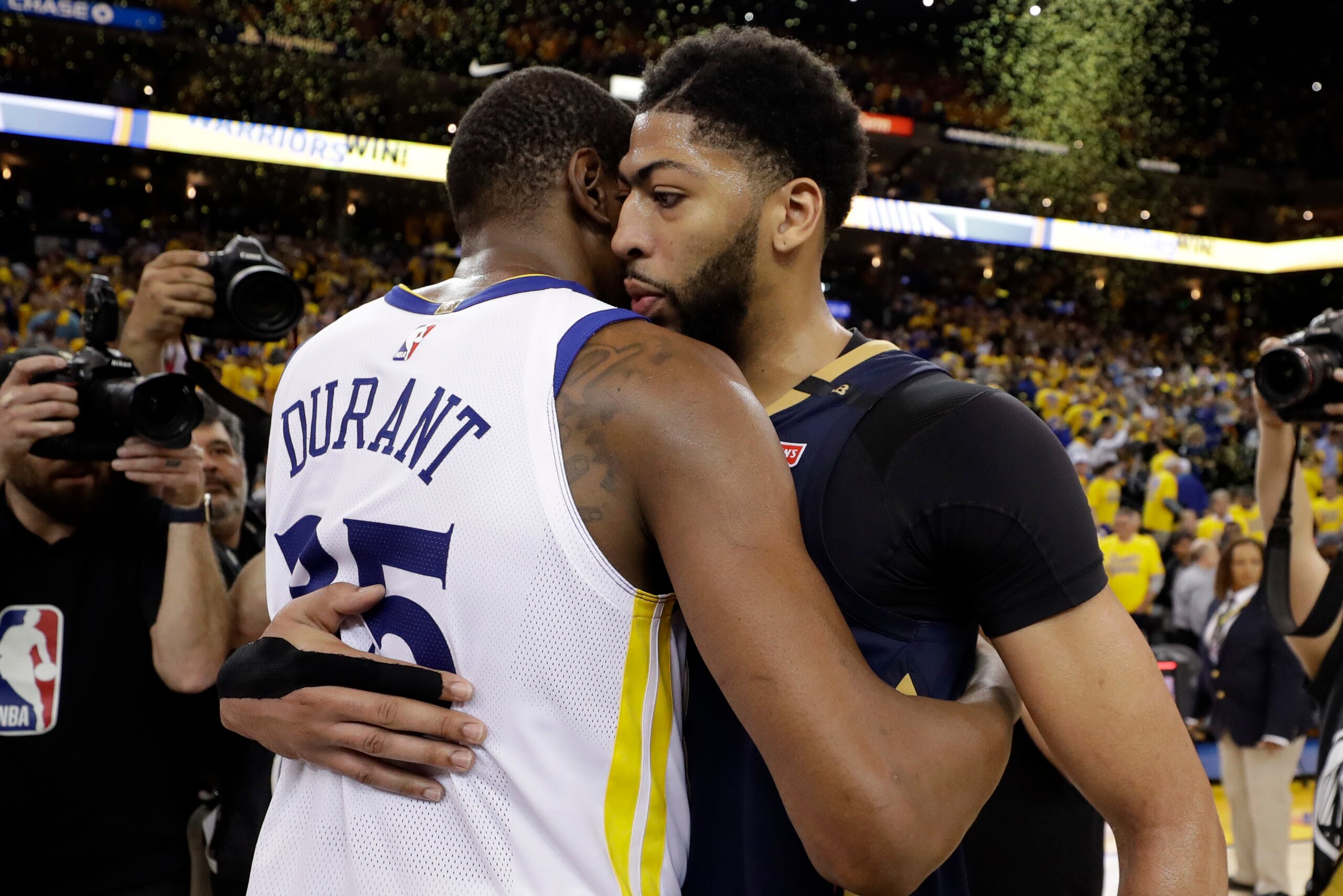
Allow us to pause for a moment and admire the New Orleans Pelicans for making it to the second round despite losing DeMarcus Cousins at the end of January, and also for playing host to Anthony Davis' latest leap:
Moment's over.
The Pelicans have a pivotal offseason of their own on the horizon. They don't have cap space or their first-round pick, but they do have an awkward situation with Cousins brewing.
Re-signing him was at one time a given. It still might be a formality. The Pelicans don't have the flexibility to offer his money to someone else, and the idea of turning away incumbent star power with Anthony Davis two years away from a possible foray into free agency (player option) feels blasphemous.
But this isn't so cut-and-dry. Cousins is working his way back from a typically career-altering Achilles injury. And the Pelicans unleashed a small-ball dynamo with Davis playing the 5 beside Nikola Mirotic at the 4. Their alliance felt natural, was statistically dominant and opened the door for both Jrue Holiday and Rajon Rondo, a free agent himself, to more frequently operate in their on-ball wheelhouses.
Letting Cousins walk also sets up the Pelicans to make some noise in the summer of 2019. Mirotic and Alexis Ajinca will come off the books, and Solomon Hill should be dumpable as an expiring contract. Playing that game is dangerous, but it allows New Orleans to try to marry Davis to a starry wing one year before he enters free agency.
Finding common ground with Cousins is still the most likely outcome. Few teams can let a player like him leave without getting anything in return, and the Pelicans are no exception. But they have to leave themselves an out. Retaining him on a deal that runs the risk of becoming immovable hamstrings them in a way that could turn off Davis and leave general manager Dell Demps fielding hourly texts, calls, emails and snaps from Boston Celtics president Danny Ainge.
The Pelicans, mind you, must juggle this Cousins pickle while sussing out bargain-bin moves on the margins that beef up their spacing and wing depth.
Good luck, New Orleans.
Postseason Day-Day>>>
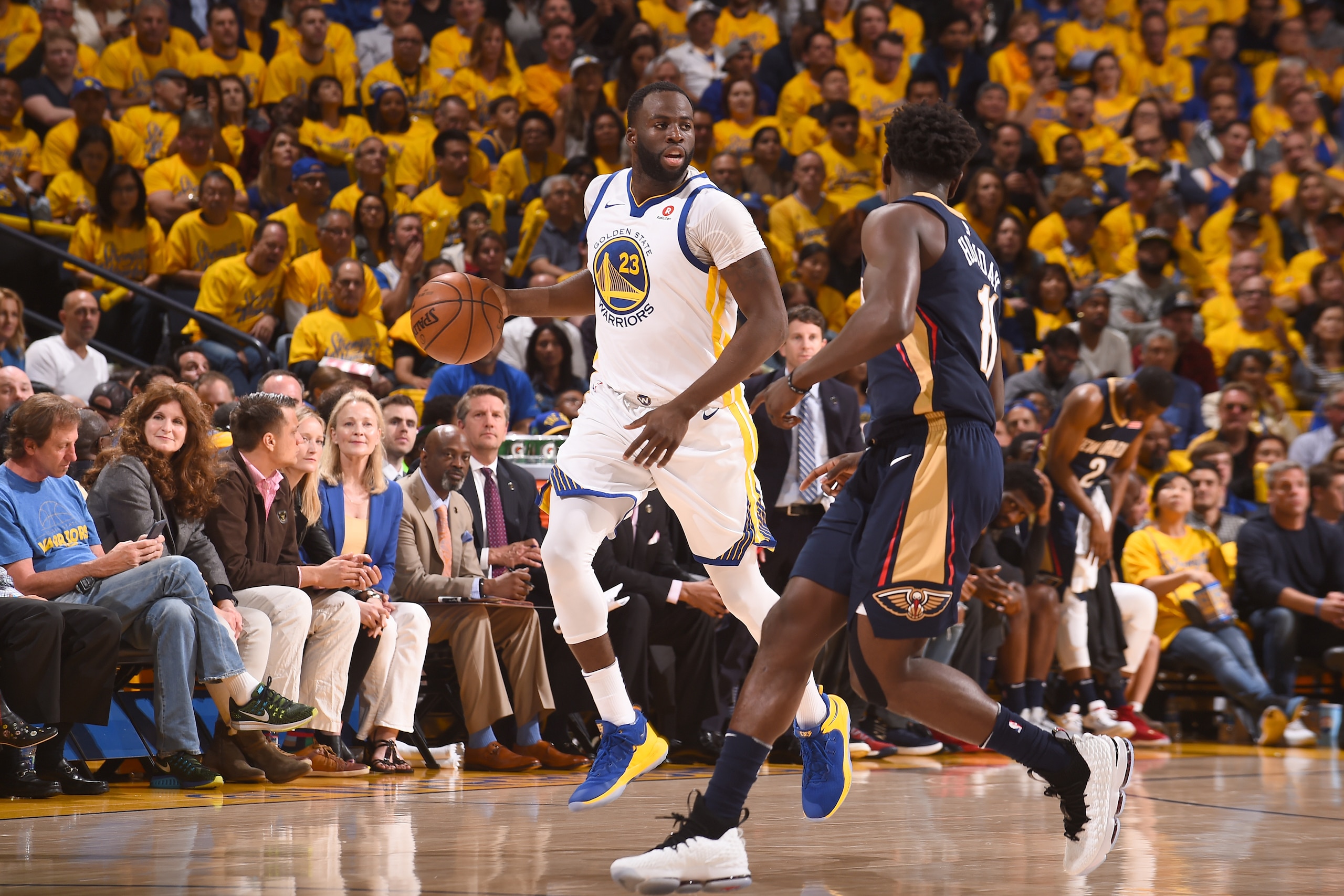
Consider Draymond Green's switch flipped.
Through five games against the Pelicans, he averaged a triple-double (14.8 points, 11.8 rebounds, 10.0 assists) to go along with 2.4 steals, 1.6 blocks and a higher net rating than Kevin Durant and Klay Thompson. His defense has also perked up; he's all over the place these days, including enemy huddles:
Sticking this version of Green along the equally locked-in Andre Iguodala is unfair. The Warriors are holding opponents to 94.1 points per 100 possessions when they play together—tied for the fourth-best defensive rating among the 152 duos to clear 125 minutes of playoff action.
Stephen Curry and Kevin Durant will receive much of the credit for Golden State's march into the conference finals and beyond, as they should. But Green is a larger source of comfort and calm more than anyone.
His play thus far is proof the Warriors' next gear exists, and that they're capable of reaching it when the games start to matter.
SOON...
As in, Monday.
Unless otherwise noted, stats courtesy of NBA.com or Basketball Reference and accurate leading into games on Tuesday. Salary and cap-hold information via Basketball Insiders and RealGM.
Dan Favale covers the NBA for Bleacher Report. Follow him on Twitter (@danfavale) and listen to his Hardwood Knocks podcast, co-hosted by B/R's Andrew Bailey.


.jpg?w=2560 "Love's Body Already 'Tired'")
.jpg?w=2560 "Tyreek Deal May Come Soon")
.jpg?w=2560 "Ward Nearly Walks Out of Presser ▶️")



.jpg?w=2560 "NFL investigating 2 referees for separate viral exchanges")