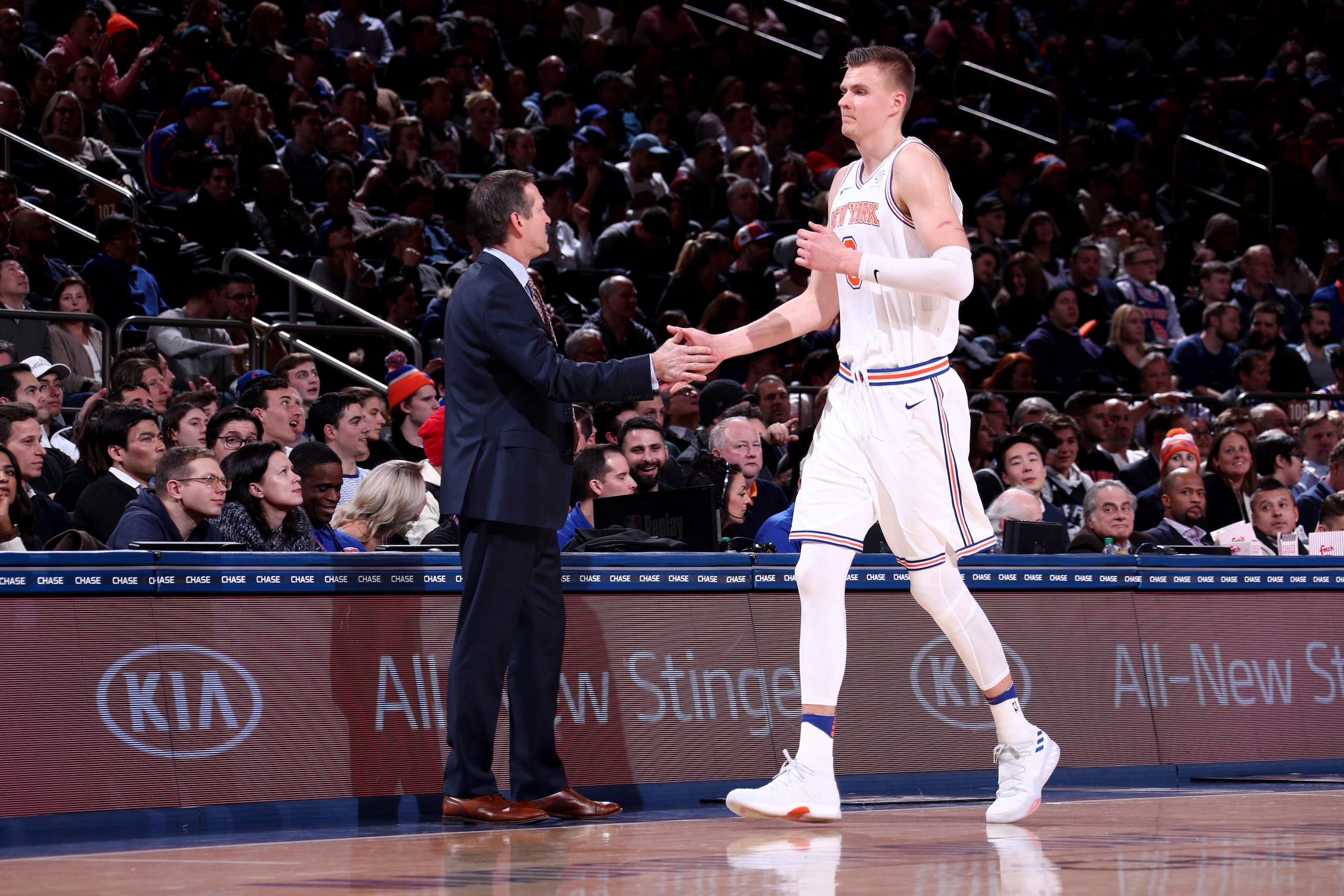

New York Knicks: 5 Goals for the 2nd-Half Stretch
Tim Hardaway Jr. wore a unicorn pin on his lapel to the New York Knicks' battle against the Miami Heat Friday—a lovely gesture of support from one teammate to another. But New York's tired, tired, so tired unicorn, Kristaps Porzingis, would surely prefer his broken wingman to be wearing a uniform than a sparkly brooch.
New York has finally provided a tentative return date for Hardaway: another five games away, at best, per Marc Berman of the New York Post. As Porzingis' body weakens under the added pressure, so does his team's ability to elbow its way into the playoff picture. If the Knicks are going to survive January (and the trade deadline hatchet), they need to shore up the weak spots on their defense and help Porzingis produce more while relying on his production less.
Nine more road games will rob the team of valuable practice time, but there are a few things head coach Jeff Hornacek could call out from the sidelines that could power the Knicks through to the playoffs.
Backcourt Scoring
1 of 5
Hardaway's absence is affecting not just the Knicks record but Porzingis' body directly.
Without Hardaway, KP is drawing even more double-teams than before. More importantly, though, without Hardaway drawing defenders out toward the perimeter, the defenses are able to turn more of their attention to their interior, squashing Porzingis and Enes Kanter and making every one of KP's forays into the paint more treacherous.
KP needs space.
The answer is not to ask Kanter to take a hike. They need him near the hoop, cleaning up his team's failures; a third of Kanter's 13.4 points per game come on second-chances. Instead, they need to create more for backcourt players, particularly near or behind the arc to spread the floor and give Porzingis a safe space to work.
Courtney Lee is a more efficient three-baller than even Tim Hardaway Jr., averaging 42.7 percent for the season to Hardaway's 31.5 percent. However, since moving from the 3 spot to the 2 in Hardaway's absence, Lee hasn't significantly increased the number of threes he's shooting. He's upped his attempts from 3.6 per game to 4.2 threes per game, but that still falls short of Hardaway's 7.2.
Off-Ball Movement and Scoring off Cuts
2 of 5Scoring off cuts and moving off the ball is something the Knicks have already shown they can execute well, and the more they take advantage of it, the less they would ask Porzingis to wear himself out in the post.
The Knicks score a higher percentage (65.5 percent) and points per possession (1.32) off cuts than from any other type of play and are one of the most proficient in the league at scoring off cuts. They just need to use the skill more often.
When the Knicks have their off-ball movement cooking, it leads to KP cutting slams off of Jarrett Jack's over-the-shoulder dimes. It leads to an unending highlight reel of Kyle O'Quinn-to-Doug McDermott backdoor layups. It leads to O'Quinn wowing with his bounce passes, Ron Baker impressing with screens and all manner of thrilling team play that discombobulates competitors and gets buckets.
Shutting Down Ball Reversals
3 of 5
The Knicks defense generally focuses on locking down the paint and forcing opponents to the more difficult, lower-percentage shots at the perimeter. It's been a largely successful strategy but becomes less so when the opposing team shoots long balls more easily than layups and when the Knicks' principal rim protector is "so tired."
The San Antonio Spurs' LaMarcus Aldridge and the Washington Wizards' Marcin Gortat recently exposed and exploited the cracks that exist in the Knicks' paint defense when a weary KP is pitted against a powerful big man.
So it's even more important for them to protect the perimeter. And one component of that is to prevent the ball movement that results in open men on the weak side sinking wide-open corner threes or making baseline drives to the hoop that are clear as a country lane.



Sustained Transition Defense
4 of 5
It's a puzzler. Any team that makes offensive rebounds a priority, like the Knicks, is going to put its transition defense at risk. New York's tactic has largely been to let the big men handle the glass while the guards hang back and get ready to stop fast breaks.
That technique has worked successfully when the players make enough effort. Friday, in New York's 107-103 loss to the Miami Heat, they made several great stops in transition: Lance Thomas chasing down Tyler Johnson and stripping the ball, Thomas and Jack teaming up on a trap and the entire team hustling to prevent a Jack turnover from resulting in a Miami bucket.
Other nights, however, the transition defense is sloppy at best. While the Washington Wizards eagerly hastened to get back on offense Jan. 3, New York defenders were sluggish, arriving just in time to commit clumsy fouls on John Wall and Co. The Knicks too often have let teams have numbers or routinely responded with poorly considered fouls.
Drawing Fouls on the Road
5 of 5
Every road team gets singed by referees' home cookin' or rattled by opposing fans' catcalls now and again, but the Knicks make a habit of it. They're only 23rd in the league in free-throw attempts on average (20.0), and while the numbers are mediocre at home, they are truly hideous on the road. Since Hardaway's injury, those numbers are 22.5 and 17.3, respectively.
So first things first: Everyone in a Knickerbockers uniform needs to tune up their pump fake.
Since Hardaway went down, the Knicks have driven less, and that reduction in drives is a big part of the issue. Putting the ball in Lee's hands more often, as well as Michael Beasley's, would partially make up for the absence.
However, the fact the team averages 4.5 fewer free-throw attempts per game can only be explained by the one X-factor: aggression. They need to be more aggressive on the road. That's the only way to get calls.
Disagree with Sara Peters on Twitter @3FromThe7.
.jpg?w=2560 "Raiders Could Start Mendoza")

.jpg?w=2560 "Rodgers Iced Out on Plane 💎")

.jpg?w=2560 "🚨 Week 8 AP Top 25 Poll")