

Ranking Los Angeles Lakers' Trade Assets Ahead of 2017 NBA Draft
The Los Angeles Lakers are starving for star power. It's been that way at least since Kobe Bryant walked away, probably even longer.
President of basketball operations Magic Johnson has no problem vocalizing that desire. Of course, it's not like it would otherwise be a secret, with the club constantly connected to trade talks involving stars of all types.
With the 2017 NBA draft looming on June 22, the rumor mill won't slow down anytime soon. This franchise not only covets current stars; it also possesses a small army of prospects and draft picks that could help facilitate a front-page exchange.
L.A.'s top trade chips have been assembled here and ranked in order of attractiveness—upside, production, contract status, pick value, etc.—to other suitors.
8. Larry Nance Jr., PF
1 of 8
There's not a lot of volatility with Larry Nance Jr. Whether that's a good thing depends on the evaluator.
He shows a steadiness most players are still searching for after only two NBA seasons. He's bought into an energizing role, which utilizes his instincts and athleticism to help him impact several areas at once.
He was one of the few bright spots on L.A.'s last-ranked defense, while his explosive hops and fearlessness around the rim made him an asset in transition.
However, it's possible he's already approaching his ceiling. While the 24-year-old could continue developing as a defender, his offense hasn't suggested it has much growth potential. Lacking handles, shooting range and a go-to move, he'll struggle to shed his complementary label as a scorer.
His jumper has the best chance to change that conversation—which isn't saying much since he's a career 23.9 percent perimeter shooter. Still, his three-point percentage jumped nearly 18 percent last season (from 10.0 to 27.8), and his success rate on jump shots climbed from 33.6 percent to 41.2.
"I'm glad they told us to let them fly," Nance said, per Mark Medina of the Los Angeles Daily News. "Getting the opportunity to shoot some and being confident about it has done quite a bit for me."
But there hasn't been enough improvement yet to bolster Nance's trade stock. He could sweeten a Lakers' offer, but he couldn't anchor a package for anything substantial.
7. Jordan Clarkson, SG
2 of 8
Jordan Clarkson's ranking might feel low to some, and certain sections of the stat sheet would agree. The 6'5" combo guard paced this season's club in minutes (29.2 per game) and was second in points (14.7), so why is he only its seventh-ranked trade chip?
For starters, the majority of this list can offer upside and hope. Clarkson looks light from both angles. His player efficiency rating has backtracked each of the past two seasons, making his early-career success seem more of a mirage in hindsight.
"After so much early promise, the 2015 NBA All-Rookie First Team honoree may have plateaued," Bleacher Report's David Murphy wrote. "There hasn't been a consistent improvement. He still overdribbles, gambles unnecessarily and gets killed on picks way too often."
It's also still unclear what Clarkson's best role is. Spark-plug scorer seems the obvious choice given his 14 games of 25-plus points, but he ranked just 122nd among this season's 149 double-digit scorers in true shooting percentage (52.6). But it's hard to call him even a secondary playmaker when he almost wiped out his 2.6 assists per game with 2.0 turnovers.
Clarkson's defensive numbers are atrocious—89th out of 91 point guards in defensive real plus-minus, per ESPN.com—and the three years and $37.5 million left on his deal seem steep if he's going to be an offense-only reserve. He's also older than Tobias Harris, Evan Fournier and Cody Zeller, so considering him a prospect at this point isn't easy.
Slashing, scoring guards with size still have value, and Clarkson is no exception. But his sales pitch isn't easy. Add in his awkward fit with D'Angelo Russell and multiple reports suggesting the Lakers might be ready to move him, and it's hard to envision L.A.'s netting a great return.
6. The 28th Pick
3 of 8
For as splashy as the front-office hire of Magic Johnson was, his first order of business barely felt like a drop. The freshman executive flipped scoring guard Lou Williams to the Houston Rockets at the deadline in exchange for a late first-round pick.
Fast-forward a few months later, and that selection only enhances the current asset collection. With this draft class looking more loaded than recent years', the talent pool should be deep enough to make even the 28th overall pick look intriguing.
Bleacher Report's Jonathan Wasserman has Oregon's Jordan Bell going there, lauding the former Duck as "an energizer and enforcer around the basket." DraftExpress saved the slot for Syracuse's Tyler Lydon, a 6'9" sniper. ESPN Insider Chad Ford has the Lakers landing Michigan's D.J. Wilson, a 6'11" high-flyer who shot 37.3 percent from deep last season.
Cal's Ivan Rabb (potential lottery pick last year), UNC's Tony Bradley (7'5" wingspan) and Oklahoma State's Jawun Evans (dynamic pick-and-roll point guard) could all be on the board. There's plenty to like about all the players mentioned in this range.
Whether they pan out is another story, of course, and history presents a mixed bag at No. 28. R.J. Hunter was taken there in 2015, and he's already out of the league. But the slot has also delivered the likes of Tony Parker, Leandro Barbosa, Ian Mahinmi and former Laker Wayne Ellington.
Between the freedom to target different areas, the caliber of players on the table and the cost-controlled rookie contract, the Lakers will have no shortage of selling points should they move the pick.


5. Ivica Zubac, C
4 of 8
Last summer, Ivica Zubac was the 32nd player selected in what looks to be an awful draft. The 7'1" Croatian center split the first half of the season between staring in the NBA Developmental league and handling mop-up duties for the varsity squad.
But he cracked the regular rotation by January and made 10 starts in March. His per-36-minute marks included 16.8 points (on 52.9 percent shooting), 9.4 rebounds, 2.0 blocks and 1.8 assists.
Was the sample size too small to trust the production? Not if you ask Lakers general manager Rob Pelinka.
"He's a very promising player and had incredibly strong minutes for us, especially in the second half of the year," Pelinka said on 710 ESPN's Mason and Ireland, via Medina. "Really, he is someone we consider to be one of the pillars for the future."
Zubac has tremendous size, soft hands, sound instincts and the fluidity to capitalize on his physical gifts. Though not incredibly explosive, he provided an above-the-rim presence at both ends. He has also flashed a promising jump shot (44.2 percent), which could become a potent weapon if he can expand his range past the three-point arc.
He's as raw as sushi, but he's also 20 years old and oozing potential. With back-to-the-basket skills, shot-blocking and soft shooting, he's almost a synthesis of centers past and present.
4. Julius Randle, PF
5 of 8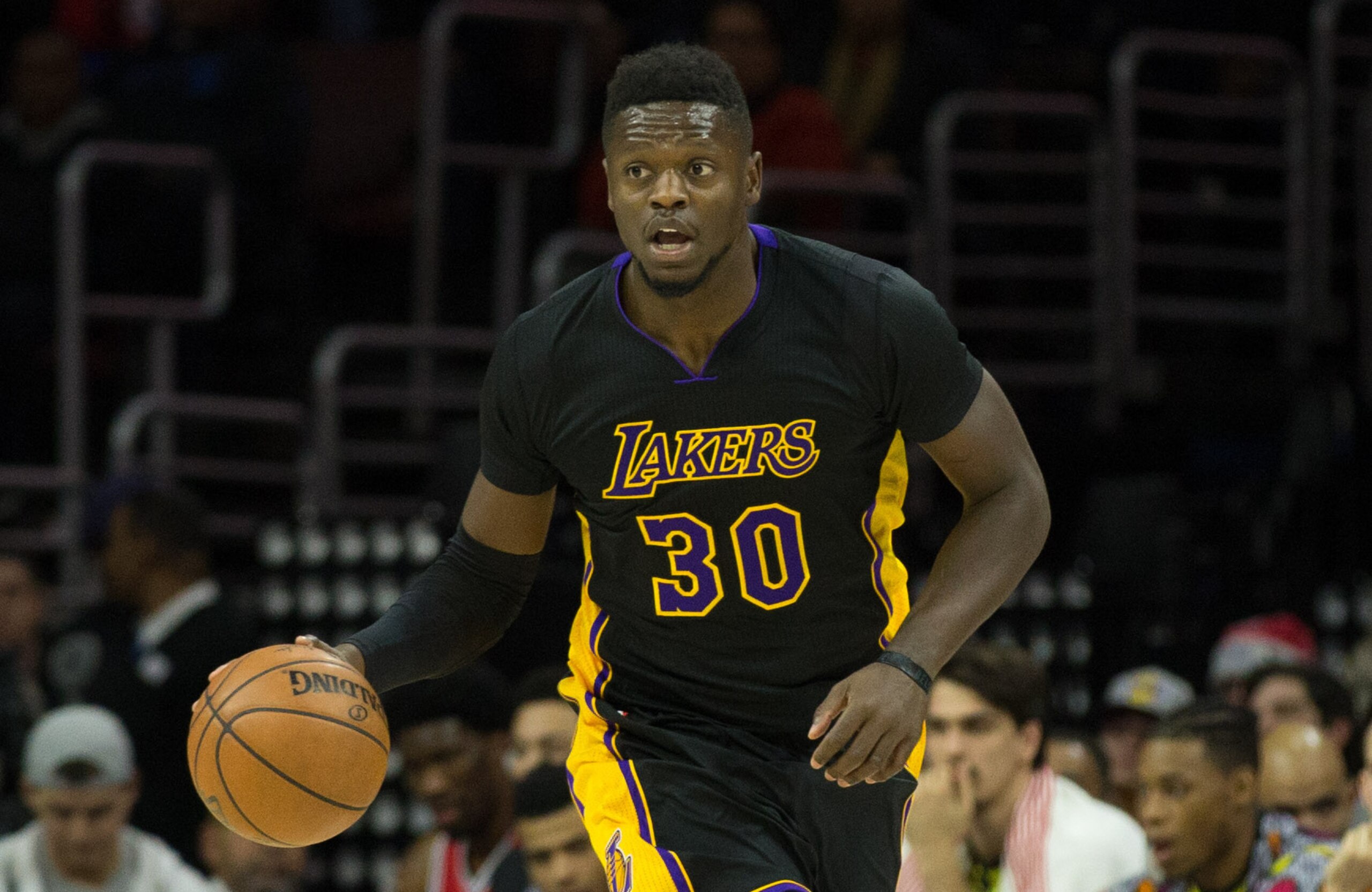
At one point in the not-so-distant past, Julius Randle was the face of the Lakers' youth movement. It was a default status, since the 6'9" forward was their highest drafted player since 1982, but his encouraging combo of size, strength and quickness made it work.
His current status and future projection are both difficult to decipher. There's a unique nature to his skill set—he was one of only nine players to average at least 13 points, eight rebounds and three assists—but there are also clear weaknesses threatening to cap his potential.
The good Randle looks like a modern big. He's quick and agile, capable of cleaning the glass at one end and orchestrating the offense at the other. But he's not a floor-spacer, nor particularly discerning with his shot selection. He's a capable passer for his position but not an offensive fulcrum. His motor runs hot and cold, and he's yet to show an advanced awareness on defense.
"His talent tantalizes even if it doesn't materialize in ways that always inspire fawning," Forum Blue & Gold's Darius Soriano wrote. "In many ways, then, the idea of Randle is currently better than the actualization of him."
That's not a fatal flaw on the trade market. If suitors like Randle's foundation, they can convince themselves they know the right way to mold the 22-year-old into something greater. But since he's yet to set his ceiling and basement, he's difficult to evaluate—not just in a trade, but in the non-rookie deal he'll start in 2018-19.
3. D'Angelo Russell, PG
6 of 8
Among the current group of up-and-comers, no Laker has had more star-ish moments than D'Angelo Russell.
For a 21-year-old, he's right where he needs to be with the primary counting categories. His per-game averages of at least 15 points, four assists and two triples placed him in statistical company of only 10 other players—eight current All-Stars, Chris Paul (a nine-time selection), Damian Lillard (a two-time honoree) and Mike Conley (who inked the league's most lucrative contract ever last summer).
Russell's post-All-Star numbers were even better. He averaged 18.5 points on 42.5 percent shooting and 5.0 assists. Over those 21 contests, he had five games with 28-plus points, including a 40-point, six-assist gem against the then-defending champion Cleveland Cavaliers.
"He's a great young player," Kyrie Irving said afterward, per ESPN.com's Baxter Holmes. "I've been playing against him for a few years in the league, and I understand what he means to the Lakers."
However, there are significant barriers to stardom in front of Russell. Some may come with time, assuming improved awareness brings better shot selection and decision-making. But his average athleticism could always be a two-way hindrance.
He's the first player on the list who feels like he has some superstar potential. However, the odds of his realizing it are small enough to make him only L.A.'s third-best trade chip.
2. Brandon Ingram, SF
7 of 8
Dealing with these Lakers requires trade partners to focus on the future. And no purple-and-gold player appeals more to prognosticators than the impossibly long, incredibly underdeveloped Brandon Ingram.
His rookie season was a testament to his raw nature—which probably should have been expected given his pencil-thin 190-pound frame. He cleared 2,000 minutes but had the worst true shooting percentage (47.4) and second-worst player efficiency rating (8.5) among the 109 players to do so. He was 459th out of 468 in ESPN.com's real plus-minus.
Clearly, there's a lot of work to do. But he's 19 years old and possesses freakish physical gifts. If you're going to embrace a developmental hoops project, there aren't many better starting points than 6'9" with a hawkish wingspan, effortless athleticism, smooth mechanics and positional versatility.
Just ask Magic.
"I would say probably the only player that we would say, hey, we would probably not move is Brandon Ingram," Johnson said, per Holmes. "I think that we're excited about Brandon, his length, his size, his agility, his athleticism. ... He really has a high ceiling, and we're excited about what he can possibly turn into."
Ingram's NBA story is essentially a bunch of blank pages. But his best-case scenario betters anyone else's on the roster. He could be basketball's version of a five-tool player, electric on offense and impenetrable on defense.
That said, if you're trading for a No. 2 pick from the Lakers, you should target the one from the best draft class.
1. The 2nd Pick
8 of 8
The options at No. 2 aren't quite endless, but the Lakers—or their trade partners—will likely have their choice of everyone in this class not named Markelle Fultz. Considering this class is being praised for many reasons beyond the presumptive No. 1 pick, it's easy to think multiple game-changers might be on the board at No. 2.
Maybe it's UCLA's Lonzo Ball, who Ford writes "makes others around him better." It could be Kansas' Josh Jackson, who Sports Illustrated's Andrew Sharp called "a new-age [Andre] Iguodala who can play every game at 120 mph." Or Kentucky's De'Aaron Fox, who has "special speed...a complete extra gear," as an Eastern Conference scout told CBS Sports' Reid Forgrave.
And it doesn't have to stop there. B/R's Wasserman called Florida State's Jonathan Isaac "a big man with guard skills." Duke's Jayson Tatum has been seen by some as the draft's top player, according to CBS Sports' Gary Parrish.
Save for a center, just about every potential need could be addressed here. And the ceilings sit high enough that any of these players could go down as the class' peak performer.
The flexibility to use the selection however you want holds value. So, too, does the cost-controlled contract that will come along with the prospect.
The Lakers may consider all of the above and just keep the pick for themselves. But if they're eager to make a blockbuster trade, this is the asset that will command the greatest return.
Statistics used courtesy of NBA.com and Basketball Reference.
Zach Buckley covers the NBA for Bleacher Report. Follow him on Twitter: @ZachBuckleyNBA.

.jpg?w=2560 "Grading WWE Raw 🔠")

.jpg?w=2560 "Viral Rams Coach Vid 🖕")

