
Biggest Challenges Facing New York Giants in 2017 Offseason
This week, the New York Giants began the process of remaking their roster for 2017.
Gone are a pair of 30-something veterans, running back Rashad Jennings and receiver Victor Cruz, in moves that were expected. The departure of those experienced players yields $10 million in additional salary-cap space, which gives the Giants an estimated $34 million in cap space for the start of free agency on March 9, per Spotrac.
More recently, the Giants tendered all but one of their Exclusive Rights Free Agents (receiver Ben Edwards), according to SNY's Ralph Vacchiano.
Vacchiano also reported that the tight end Matt LaCosse and defensive tackle Robert Thomas signed their ERFA one-year tenders.
As the Giants' front office and coaching staff continues to its free-agency strategy, there are some larger scale challenges facing them in the coming months.
Let's look at some of them.
Fixing the Offensive Line
1 of 6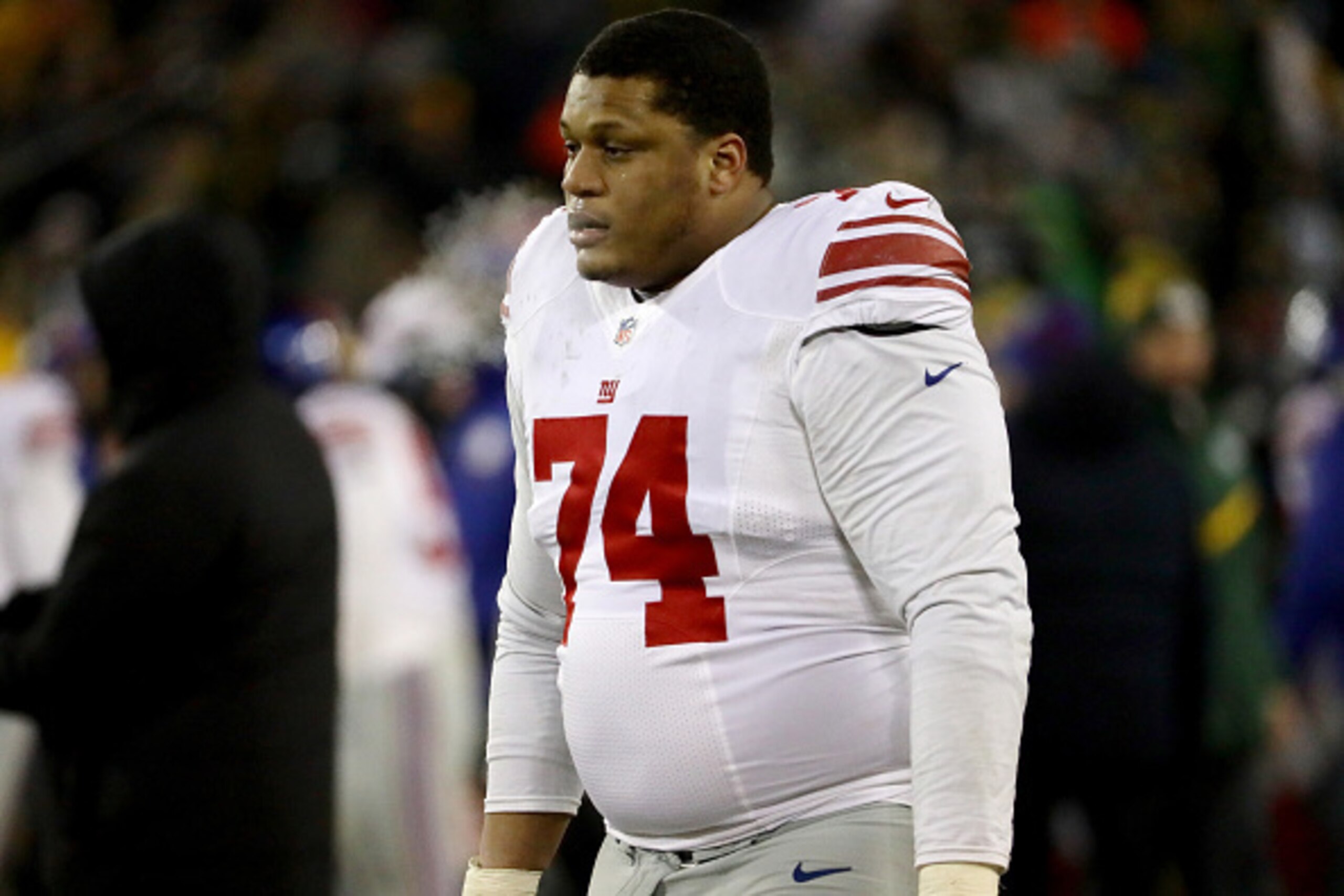
For those who not aware, the AFC West—Oakland Raiders, Denver Broncos, Los Angeles Chargers and Kansas City Chiefs—is on the Giants' 2017 schedule.
Why is this significant? Because on each of those four teams resides a pass-rusher who, in 2016, recorded double digit sacks.
Those would be Von Miller (Broncos, 13.5), Defensive Player of the Year Khalil Mack (Raiders, 11.0), Defensive Rookie of the Year Joey Bosa (Chargers, 10.5) and Dee Ford (Chiefs, 10.5).
That lineup is not a good look for the Giants' offensive line as was configured last year, where left tackle Ereck Flowers and the right tackle duo of Bobby Hart and Marshall Newhouse combined to allow 9.0 sacks and 88 quarterback hits, according to Pro Football Focus.
If that isn't scary enough, with Newhouse, Will Beatty and John Jerry all likely to hit free agency, the Giants depth on this unit sorely lacks in experience among those still under contract.
Assuming that Flowers, Justin Pugh, Weston Richburg and Hart are four of the five starters for 2017, the only other offensive linemen on the roster with any regular-season experience are Brett Jones (82 snaps in 2016) and Adam Gettis (97 career snaps).
The Giants need to come up with a better solution for their offensive line, otherwise it won't really matter what skill-position players they add in free agency and the draft.
With that said, it all comes down to the identity of the best five offensive linemen. Pugh and Richburg are locks to be two of the five. Will Flowers and/or Hart join them? Will it be someone not yet on the roster?
The safe bet is that one of the Giants' starting five offensive linemen for 2017 is currently on another team's roster.
As for Flowers, once the Giants figure out where he might have the best success—so far, that hasn't been at left tackle—the rest of the offensive line should fall into place, though it remains to be seen if the pieces will finally be able to get the job done on a consistent basis.
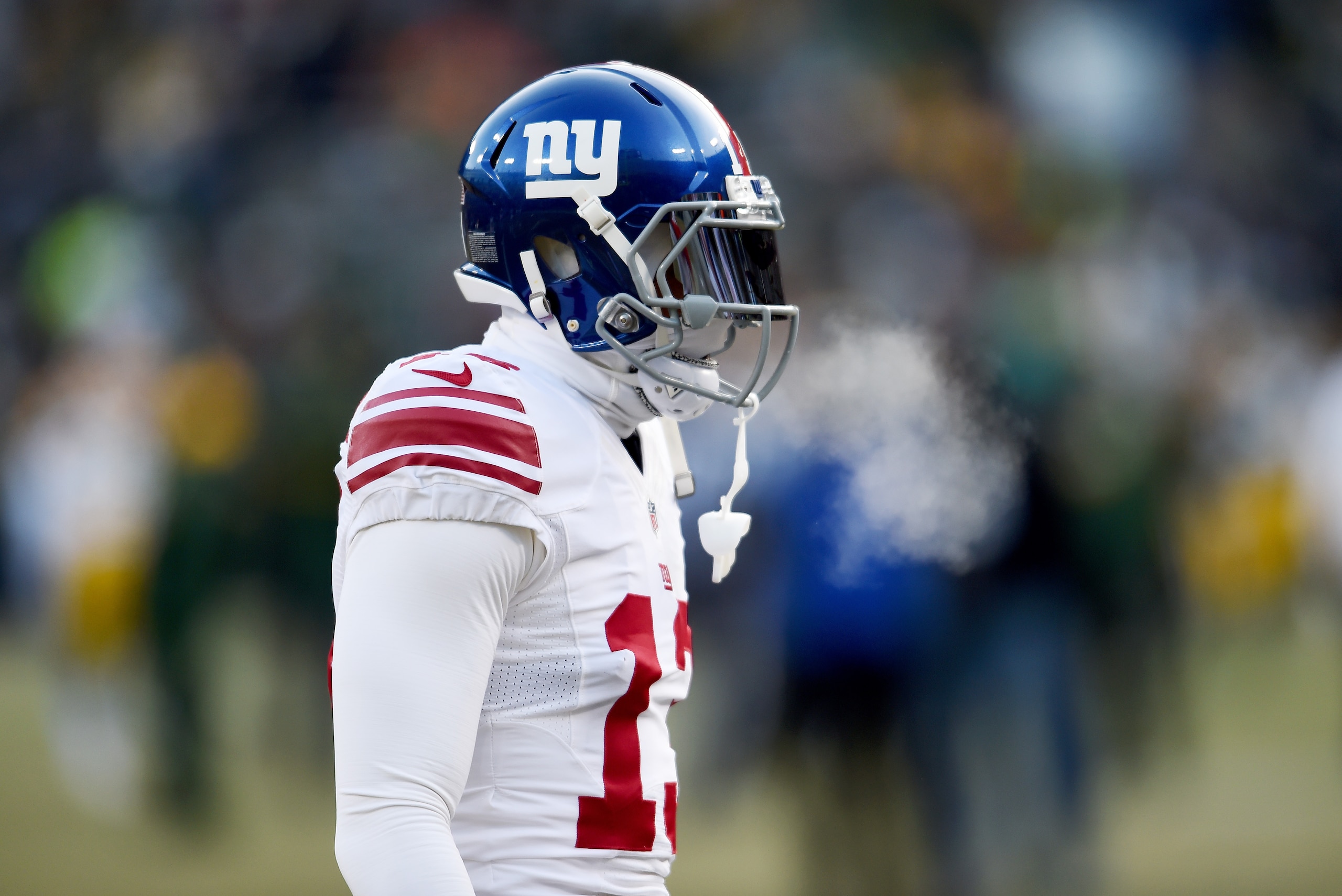
Odell Beckham Jr.
2 of 6
While everyone was entertained by the one-handed catches made by receiver Odell Beckham Jr., the fancy pre-game cleats he wore, and the choreographed handshakes with his fellow receivers that seemed to be his idea, the receiver's numbers in 2016 slipped.
Per PFF, the 24-year-old posted his lowest career totals in pass targets caught (61 percent), average yards per reception (13.3), average yards after the catch (5.2) and touchdowns (10).
At the same time, Beckham's dropped passes shot up to a career-high 11, up from four in 2015 and two in 2014.
To be fair, the offensive play-calling left something to be desired given its predictability. It also didn't help that the Giants lacked a tight end who could roam up the seam and take some of the pressure from Beckham (though an argument could be made that this has been the case for each of his three seasons).
And let's not forget about the thumb injury Beckham had midway through the season, something he tried to work through and which may or may not have been a factor in the dropped balls.
Regardless, Beckham needs to be better. He knows it and the Giants know it.
Performance aside, there were the off-field issues which saw the fiery receiver's judgement clouded by his strong desire to dominate.
These factors led to general manager Jerry Reese's candidness when asked what he sees in Beckham after having a three-year sample on which to form a solid conclusion.
"I see a guy who needs to think about some of the things that he does," Reese said the day after the Giants were eliminated from the postseason.
"Everybody knows that he is a gifted player, but there are some things that he has done that he needs to look at himself in the mirror and be honest with himself about, and I think he will do that."
He didn't stop there.
"We all have had to grow up at different times in our lives, and I think it is time for him to do that," Reese said. "He has been here for three years now and is a little bit of a lightning rod because of what he does on the football field.
"The things he does off the football field, he has to be responsible. I know he is a smart guy, and I believe he understands that he has a responsibility being one of the faces of this franchise, and I think he will accept that responsibility."
Even with the "drop" in his numbers, Beckham is still better than most receivers out there. He also has the talent to be an all-world receiver.
If he's not fully cashing in on his talent, if he's not making that the central part of his brand, then it's time for a serious gut check.
If Beckham can lay low in the offseason, get in some serious training and come back more focused on his craft and less worried about the extracurricular activities, then good luck to opposing defenses trying to stop him.
Building on the Defense
3 of 6
Last year, the Giants invested almost $200 million in new contracts to upgrade a defensive unit that was the worst in the league (420.3 yards/game) in 2015.
The investment paid off handsomely. In addition to rising into the top 10 league-wide, the Giants pass defense—ranked at the bottom of the league in 2015—improved to the 10th best passing defense (251.1 yards/game) in 2016, and tied for the third-best run defense with the Patriots (88.6 yards/game) and was the second-best scoring defense (17.8 points/per game).
Now comes the hard part—adding to that foundation.
They can obviously start by keeping their defensive front together—defensive end Jason Pierre-Paul and defensive tackle Johnathan Hankins are both set to hit free agency.
They will also probably look to upgrade the linebacker corps. Kelvin Sheppard, last year's starting inside linebacker, is not expected to be re-signed; he'll probably be replaced by B.J. Goodson, a draft pick from last year.
The Giants are also probably hoping that Darian Thompson, who quickly locked up the starting free safety spot last year as a rookie before a season-ending foot injury did him in, picks up where he left off before he went on the shelf.
While the spotlight glare will be squarely on the offensive line (as it should), expect the defensive side of the ball to get some maintenance dollars pushed its way to help ensure the foundation remains solid.
.jpg?w=2560 "Colts Football")
.jpg?w=2560 "Commanders 49ers Football")
.jpg?w=2560)
Recharging the Running Game
4 of 6
It's been a long time since the Giants had a running game that scared anyone.
How long? You would have to go back to 2012 when the Giants averaged 116.4 yards per game (14th in the league) for a unit that ranked in the top half of the league, and to 2010 (137.5 yards/game, 6th place) if you are looking for a unit ranked in the top-10 league-wide.
To be fair, the Giants did win their last Super Bowl despite their 32nd-ranked rushing game, a year they averaged just 89.2 yards per game.
In the three years since Ben McAdoo installed a new system, the Giants' running game has digressed in terms of attempts (449 in 2014, 403 in in 2015, and 398 in 2016); yardage (1,603 in 2014, 1,609 in 2015 and 1,412 in 2016), and average yards per game, their 88.2 yards in 2016 being worse than that 2011 Super Bowl winning year.
The absence of a consistent running game has made the Giants offense too one-dimensional. It has also minimized the option of play-action and has helped expose some worrisome flaws in the offensive line.
That all needs to change in 2017 as does the team's philosophy of assigning the run-game snaps on some sort of rotation, a staple of the last three years where running backs have had trouble getting into a groove.
The Giants might be on their way, though, to finally getting a good-enough running game. Paul Perkins, the team's fifth-round draft pick finished with a 4.1 per-carry average (456 yards on 112 carries), the best average rushing total (based on a minimum of 100 carries) since Rashad Jennings posted a 4.4 mark (195 carries for 863 yards) in 2015.
The Giants also figure to add a lot of new faces around Perkins this offseason, where the running back competition is shaping up to be one of the marquee ones of the forthcoming summer training camp.
Getting Eli Manning Back on Track
5 of 6
One of the most hotly debated questions to emerge from the 2016 season concerns quarterback Eli Manning and if, at age 36, he is on the downside.
Since peaking with a completion percentage of 63.1 in 2014, Manning's figures have slightly dipped every year since (62.6 percent in 2015 and 62.3 percent in 2016).
As part of the debate, some will argue that his decision-making has left a lot to be desired, but what Manning showed in 2016 is pretty much how he's always been—a risk-taker who believes so strongly in his receivers that he doesn't seem to think twice about those high-risk, high-reward throws.
A closer look at Manning's numbers might provide a better perspective into his "decline." Again, using 2014 as the starting point (because that is the first year of the current offensive system), Manning's average yards per attempt have decreased, from 7.3 in 2014 to 6.7 in 2016.
With that, his average time to throw, 2.39 seconds, was the second-fastest release time, behind Drew Brees' 2.37 seconds.
Manning also continued to be victimized by dropped balls, the 33 drops by his receivers tying him for fifth place with Philip Rivers of the Chargers and Alex Smith of the Chiefs. Manning's primary target, Odell Beckham Jr., scoring the fifth-highest drop rate in the NFL (7.34 percent) among receivers targeted at least 75 percent of the time.
There's plenty of blame to go around regarding the struggles of the Giants offense, but with that said, Manning needs to help himself by being more judicious with some of those high-risk throws that either came close to or got him into trouble last year.
Get More from the Play-Calling
6 of 6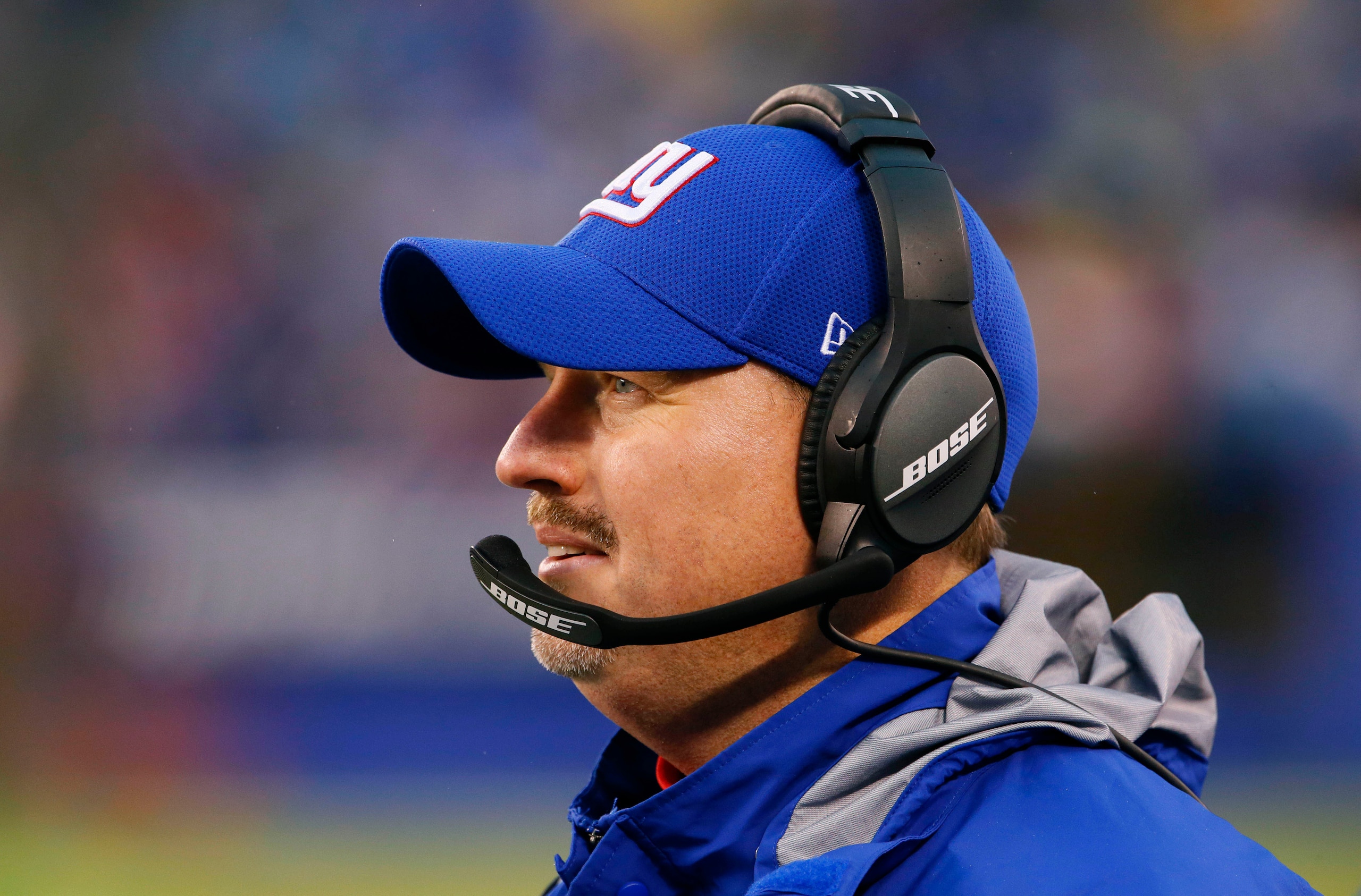
One of the greatest mysteries of the 2016 NFL campaign is why the Giants offense—a unit that was in its third year in the same system with the same play-caller and with most of the same personnel—fell from its top-10 status in average yards per game, scoring, and passing yards.
A logical place to start in trying to answer this question is with the play-caller himself, head coach Ben McAdoo.
McAdoo's play calls and personnel usage were often as predictable as the sun rising in the east and setting in the west.
What changed? In 2014 and 2015, McAdoo had Tom Coughlin, an offensive-minded coach, there to overrule the first-time play-caller. This would be a good theory to explain why the Giants weren't in 11-personnel nearly as much in 2014 and 2015 as they were in 2016.
As the new head coach, McAdoo had no one above him to answer to and was thus able to stick with what he was most comfortable running—the 11-personnel package.
The problem is that the personnel issues severely limited what they could accomplish with that personnel grouping. Because of that and McAdoo's inexperience calling plays, the Giants offense sputtered.
So where do the Giants go from here?
With the front office potentially set to spend financial and draft resources to improve the offense, don't be surprised if McAdoo, who watched defensive coordinator Steve Spagnuolo benefit from a major infusion of talent in 2016, retains the play-calling duties in 2017 to prove he is still capable of replicating the success he had in 2015.
Unless otherwise noted, advanced analytics are from Pro Football Focus.
Patricia Traina covers the New York Giants for Inside Football, the Journal Inquirer and Sports Xchange. All quotes and information were obtained firsthand unless otherwise sourced.
.jpg?w=2560 "DOLPHINS-AIKMAN")




.png?w=2560 "Week 8 Winners & Losers 📊")
.jpg?w=2560 "Malik Beasley Negotiating Plea Deal (AP)")