


SACRAMENTO, Calif. — Diagnosing symptoms isn't a problem for the Sacramento Kings.
But curing the disease sure is.
That's a serious issue for a team struggling in the present and facing looming questions about its future, because what good is accurate self-assessment if it doesn't lead to change?
TOP NEWS

Brown with an all-time summary of relationship with Tatum

Heat, Giannis were down by 20+ in each of their 3 losses

Power Ranking Every NBA Team's Starting Lineup 🔢
A crummy 3-6 stretch since Nov. 25—marked by inconsistent defensive effort, a lack of ball movement and haphazard rotations—has the Kings slotted ninth in the Western Conference. And with the trio of wins coming against the Brooklyn Nets, Dallas Mavericks and Los Angeles Lakers, it's been weeks since Sacramento logged a quality victory.
After each recent defeat, the Kings offered mostly accurate analysis.
"I don't understand these starts to games," DeMarcus Cousins told Bleacher Report after getting blown out in the first quarter of a 117-104 loss to the Houston Rockets. "We have to have multiple efforts in the beginning of the game or we're going to continue to lose these games."
Based on this emblematic clip, Cousins nails it:
"We all understand how to play, but there's times throughout the game where it doesn't seem like we're really sacrificing for one another," Darren Collison said after Sacramento's offense ground to a halt in the fourth quarter of a three-point loss against the New York Knicks on Friday. "Whether it's spacing or making the extra pass...we're just not locking in and trying to play the right way."
Right again:
It's been that way after most losses: Sacramento's best players, generally Cousins and Collison, calling it as they see it and accepting blame.
Whenever asked about the reasons for the team's game-to-game shortcomings, Cousins has been right—poor execution, snoozy first quarters leading to deep holes, the lack of multiple-effort plays—and always willing to lump himself into the collective.
You won't hear criticisms without some version of "it starts with me" or an "I include myself" qualifier.
This is either a case of Cousins maturing into the kind of leader teammates respect, one that doesn't elevate himself above the group...or an example of someone learning to say the right things.
It's true Cousins has been candid and, again, almost always dead right about the reasons for his team's struggles. But Sacramento would be better served if, instead of repeatedly taking the blame, its star would stop playing in a blameworthy way.
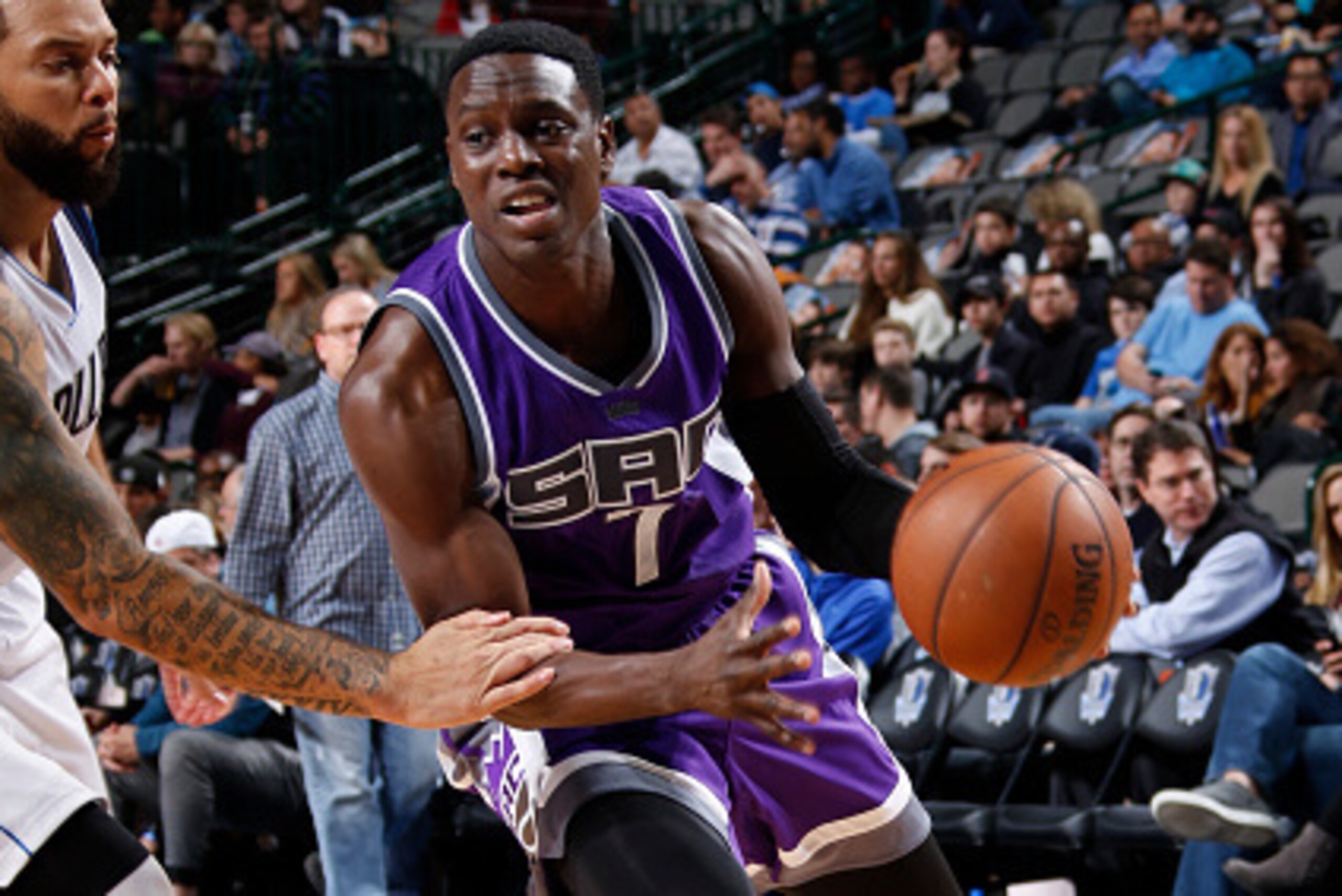
This is dangerous territory because Cousins has been a statistical beast this season. He's third in points per game (28.3), ninth in rebounds (10.9) and sixth in player efficiency rating (27.4), per Basketball-Reference.com. Asking him to do more for his team is, in some ways, unfair.
In other ways, it feels justified because he's admittedly culpable for inconsistent effort and focus. And when the team's best player and tone-setter isn't changing bad habits, it resonates more.
Wherever the blame belongs and however the Kings plan to mend their ways, time is short.
"We can't sit there and say we'll figure it out and lose these games because the West is not going to wait for us," Collison said.
A tough conference isn't the only source of urgency.
Hamstrung by the desire to fill a new arena and compete for a playoff spot with a roster unfit to do so, Sacramento has several tough decisions looming.
Every day that passes without a Cousins trade costs leverage. The closer he gets to the end of his contract (he's inked through next season), the harder it becomes to extract fair value from a buyer.
And if the Kings don't turn things around this year, after adding a respected coach in Dave Joerger, several veterans to the roster and preaching about a fresh start, Cousins' status as the common denominator through years of losing only becomes more conspicuous.
Plus:
- What to do with restricted free-agent-to-be Ben McLemore and last year's lottery grab, Willie Cauley-Stein, who have both spent weeks at a time without significant game action?
- And how about Rudy Gay, who made clear his desire to leave over the summer and has a player option (his ticket to exit for nothing) in 2017-18?
- Not to mention Collison and Omri Casspi, unrestricted free agents this summer. Or Matt Barnes (player option). Or Arron Afflalo and Anthony Tolliver (non-guaranteed).
Kosta Koufos and Garrett Temple are the only rotation players without impending contractual uncertainty.
The distinct lack of information from this first quarter of the season make all of these personnel questions, led by the Cousins quandary, trickier.
Is building around Cousins viable? Can he anchor a respectable defense? Is Collison a starting point guard for a playoff team? If so, how much should the Kings pay to keep him?
What shape should the roster take? How fast should the pace be?
Nothing from the early season clarifies those murky issues, and that makes planning for the future even harder. Because without answers, the Kings can't formulate a free-agency plan or evaluate draft needs.
If you don't know what you've got, how do you know what to get?
The simplest solution is viewing the lack of answers as negative responses. If building around Cousins hasn't worked, assume it won't. If McLemore, Cauley-Stein or any other keep-or-move talent hasn't emerged yet, don't expect it to happen.
That's a dangerous approach for a capricious franchise, but there's a difference between pivoting wildly in pursuit of a foolish end (a low playoff seed) versus cutting bait to start fresh.
The problem there, of course, is the Kings don't have the best clean-slate tools available. Free-agent cash isn't as valuable in Sacramento, and the team's draft-asset deficit is disastrous.
According to RealGM, the Kings can't replenish their empty war chest through the lottery:
| 1st | 2017 | To CHI, 1-10 protected |
| 1st | 2017 | To PHI, swap, protected 11-30 |
| 1st | 2019 | To PHI, unprotected |
And that's the scariest thing about a potential acquisition of picks or young talent via a Cousins trade, as ESPN.com's Zach Lowe noted: "Trading Cousins for a bounty of young guys and first-rounders would not give Sacramento extra bites at the lottery apple, or a half-dozen intriguing prospects. It would give them a ground-zero level amount of those things—a normal amount. To trade a star and end up with that? Egads."
And the longer the Kings wait for answers, the more their options and leverage diminish.
This is the result of long years of short-term thinking; the Kings built this roster to win in the present. So now, there's a backward kind of urgency. One that compels them to set up a stable, big-picture vision in a hurry.
Kings Insider's Notebook
Plumbing the Depths
There's a fine line between depth and not having enough players who deserve minutes over the rest of the roster. The latter is more like the illusion of depth.

Behind Cousins, Collison and Gay, Sacramento has what appears to be a glut of rotation-level talent.
Joerger played 10 bodies in the first half of the Knicks loss, and that was with Barnes sitting out and Afflalo—once a regular member of the starting lineup—logging a DNP-CD.
At the beginning of the season, it seemed like one of the Kings' strengths was a roster laden with viable NBA contributors—something of a rarity in recent years. There was the potential for versatility, too. But now it's feeling more like Sacramento lacks top-end talent capable of seizing big minutes from the rest of the roster.
Breaking Barnes

Barnes hasn't played a home game since the New York Daily News reported police were "closing in on" arresting him for a Dec. 5 incident at a New York nightclub that involved an alleged assault.
Joerger explained Barnes' absence as "scheduled rest," and the veteran forward saw the court for 15 minutes during Saturday's 104-84 loss to the Utah Jazz.
Joerger insisted the team wasn't thinking about the incident involving both Barnes and Cousins before playing the Knicks last Friday: "It hasn't come up," he said.
Third Quarter's the Charm

"If we get those," Cousins said of early chances at defensive rebounds and loose balls, "instead of being down 30, we're down 10, and we don't have to fight an entire game to get back from 30. By the time we get into the fourth, we're dead, because we've been fighting the entire game...If we played the way we played in the last five minutes of every game this season from start to finish, we'd probably be undefeated."
Close, but not exactly.
The Kings aren't great in clutch situations, but they're the second-best third-quarter team in the league, as measured by net rating. During the 12 minutes after halftime, Sacramento pounds opponents by 17.1 points per 100 possessions, a figure that leaps out in contrast to its performance in the other three quarters, all of which are in the negative.
This aligns with what Cousins said, as the Kings fall into holes, dig out of them in the third and then run out of energy to close the game. Their eight-point fourth quarter against Utah on Saturday was a perfect example.
All quotes obtained firsthand unless otherwise noted. Stats via NBA.com and accurate through games played Dec. 13.


.jpg?w=2560 "Jonathan Taylor Landing Spots 📍")



