
7-Round New York Giants Draft Do-Over
Wouldn’t it be nice if the NFL gave teams do-overs in past drafts?
The closest thing to a do-over for teams is free agency, which seems to be what is happening with the New York Giants.
This is a team that, because of some draft picks not working out, has had to reach deep into free agency to add players from other teams who are now coming into their primes as they approach their second contracts.
These players have replaced Giants draft picks who would have been coming into their primes right about now—except...well, you know the story.
But let’s pretend for a moment that the teams could have a mulligan. Which picks would the Giants like to do over knowing now what they didn’t know then?
There are probably a lot of choices, but let’s try to narrow it all down to one pick per round in the Jerry Reese era (2007 to present).
In the process, we’ll take a guess as to who, in retrospect, might have made a better choice for the Giants than their initial picks in each round.
Round 1: RB David Wilson (2012)
1 of 7
If there’s one thing that teams have zero control over, it’s career-ending injuries, and that was the case with running back David Wilson, who the Giants chose with the 32nd overall pick in 2012. Concerns related to his neck forced him to retire in the summer of 2014.
In Wilson, the Giants were hoping to complete their offensive backfield by adding a shifty, dynamic player who could be a threat in space.
What’s more, considering they were picking last in the first round after winning the Super Bowl the year before, they probably viewed Wilson as a borderline first- or second-round pick.
There was just one problem with their plan.
In an ideal scenario, a team’s first round draft pick should get on the field as soon as possible as a rookie—if not right out of the chute.
That wasn’t the case for Wilson, who played in 16 games as a rookie, starting only two—those two games coming when those in front of him on the depth chart were sidelined by injuries.
As a rookie, Wilson carried the call 71 times for 358 yards and four touchdowns.
He also added six receptions for 42 yards and a touchdown, but he had some early-season issues with ball security that didn’t sit well with then-head coach Tom Coughlin, who also wasn’t too pleased with Wilson’s pass protection.
The following season, Wilson played in five games, including four starts, before what turned out to be a career-ending neck injury left the Giants with little to show for from their first-round pick of 2012.
The Mulligan: ILB Bobby Wagner
Given the Giants' ongoing search for a long-term fixture at inside linebacker, imagine what might have been if they had taken Bobby Wagner, a two-time Pro Bowler and durable stalwart in the middle. Wagner went to the Seattle Seahawks with the 15th pick in the second round (No. 47 overall).
Round 2: LB Clint Sintim (2009)
2 of 7
The one thing that a team shouldn’t do in the first three rounds of the draft is take gambles on project players; that’s what the lower rounds are for.
But that’s exactly what New York did in 2009 when, with two picks in the second round, it went for a pass-rushing linebacker after earlier selecting offensive tackle Will Beatty.
That linebacker was Clint Sintim, a 3-4 defensive end from Virginia and a pick that came about thanks to the Jeremy Shockey trade the year before.
Selected 45th overall, Sintim showed the occasional flash, but he never looked comfortable as he tried to adjust to a 4-3 scheme.
To further compound matters, two ACL tears would hasten Sintim’s exit from the NFL two years after he came on board.
Sintim, who is now a coach at his alma mater, finished his brief career appearing in 23 games over two seasons with one start.
The Mulligan: C Max Unger
Yet again, the mulligan is a player who initially entered the NFL with Seattle. That would be center Max Unger, a two-time Pro Bowler chosen 49th overall.
Unger played six years with Seattle before being shipped to the New Orleans Saints in a trade for tight end Jimmy Graham.
Although the Giants would find their center for the future in Weston Richburg, if Unger had been the Giants’ pick in that round, they would have had a better succession plan following Shaun O’Hara than the duo of David Baas and J.D. Walton, two free-agent signings who couldn’t quite fill O’Hara’s shoes.
Round 3: WR Ramses Barden (2009)
3 of 7
Remember what I said in the previous slide about taking gambles on players in the first three rounds? Well, the Giants’ 2009 draft class had more than one such gamble.
The other would be receiver Ramses Barden, the man who tried to make No. 13 famous before Odell Beckham Jr. permanently etched his name on that jersey number.
Barden, the 85th overall pick, had everything a team could want in a receiver—outstanding size at 6’6” and 224 pounds, above-average speed and the college production.
Not to mention his record-setting ways drew comparisons to former Denver Broncos great Shannon Sharpe, according to his NFL.com draft profile, and there was no way he could't be a hit.
Barden was such a promising prospect, in fact, that the Giants, anxious to find a replacement for Plaxico Burress, moved up six spots in the third round to get him.
There was only one problem. While Barden's college production at Cal Poly made him a man among boys against his competition, that production didn’t transfer to the NFL.
What kind of college production are we talking about? Barden had at least one touchdown reception in 20 consecutive games, topping Hall of Famer Jerry Rice’s record of 17 games set in 1983-84.
He also became just the eighth player in FCS history at the time to gain over 4,000 yards receiving in a career.
That was all well and good, but Barden proved that he wasn't ready for the big stage despite the Giants' assessment.
"He's got a lot to learn, but he has a huge, huge upside," Giants general manager Jerry Reese said, per Ralph Vacchiano of the New York Daily News.
"We think he can come in and contribute right away as a threat down in the red zone. He's one of those guys that if you get a little corner, he's a real matchup problem."
When Barden got to the Giants, the bubble quickly burst.
Plagued by injuries, Barden didn’t make it through an entire 16-game schedule in the four years he was with the team. He played in just 29 games with one start, recording 29 receptions for 394 yards and zero touchdowns.
While injuries played a part in Barden’s demise, his limited snaps were likely a result of him not grasping the offense, which at the time was Kevin Gilbride’s system.
In short, Barden might have had all the physical tools to replace Burress, but in this case, looks turned out to be deceiving.
The Mulligan: CB Jerraud Powers
The Giants could have saved themselves the second of their two fifth-round picks (No. 164 overall) that they spent to move up and get Barden. If that were the case, they could have come away with cornerback Jerraud Powers, who went seven picks later at No. 92 to the Indianapolis Colts.
Powers, who the Giants had hoped to sign to be their slot cornerback, has 380 career tackles, two sacks, 69 passes defended and 11 interceptions (one for a touchdown) in his seven-year career, which included four years with the Colts and the last three with the Arizona Cardinals.
Although the Giants were fairly set at cornerback at the time with Corey Webster, Terrell Thomas and Aaron Ross, the latter started having problems with injuries that season, playing in just four games before his hamstring knocked him out for the rest of the way.
While Ross would return to play two more seasons for the Giants, Thomas would go on to miss the 2011 and 2012 seasons with ACL injuries, proving the old adage true that you can never have too many corners.


Round 4: G/T James Brewer (2011)
4 of 7
If you want to know why the established depth on the Giants offensive line is thinner than paper, look no further than failed draft picks such as James Brewer, a hulking man who the Giants hoped could be a solid guard or tackle but who ended up as neither.
Brewer, chosen 117th overall, lost his rookie campaign due to a season-ending elbow injury suffered during training camp. The following year, he played in just eight games, doubling that total in 2013.
While he did start eight games for the Giants in 2013, per Pro Football Focus, six of those starts were at left guard (for David Diehl), one was at right guard (for Chris Snee) and one was at right tackle (for Kareem McKenzie). However, he allowed 16 quarterback disruptions in those starts.
While Brewer should have been ready to step in for Diehl after the longtime Giant retired following the 2013 season, the Giants instead went to the free-agent market, where they signed Geoff Schwartz to play left guard, with Brewer appearing in just two games in 2014, his final season.
Brewer did try to hook on with the New York Jets after receiving zero interest from the Giants as a free agent, but he didn’t make it out of training camp and remains unsigned.
The Mulligan: TE Julius Thomas
The Denver Broncos, who traded with the Green Bay Packers to move into the 129th slot, snatched up Portland State tight end Julius Thomas, who, at 6’5” and 260 pounds, had the prototypical size New York tends to favor in its tight ends.
A two-time Pro Bowler, Thomas, who last year played in his first season with the Jacksonville Jaguars after signing there as an unrestricted free agent, has appeared in 48 games over his career, catching 155 passes for 1,737 yards and 29 touchdowns.
Besides being a threat in the receiving game, Thomas was strong as a blocker. Per Pro Football Focus, he has allowed just seven quarterback disruptions in his career.
As a receiver, Thomas has forced 18 missed tackles while running with the ball in his hands.
Instead of being tormented by tight ends, the Giants might have been able to do some tormenting.
Round 5: QB Rhett Bomar (2009)
5 of 7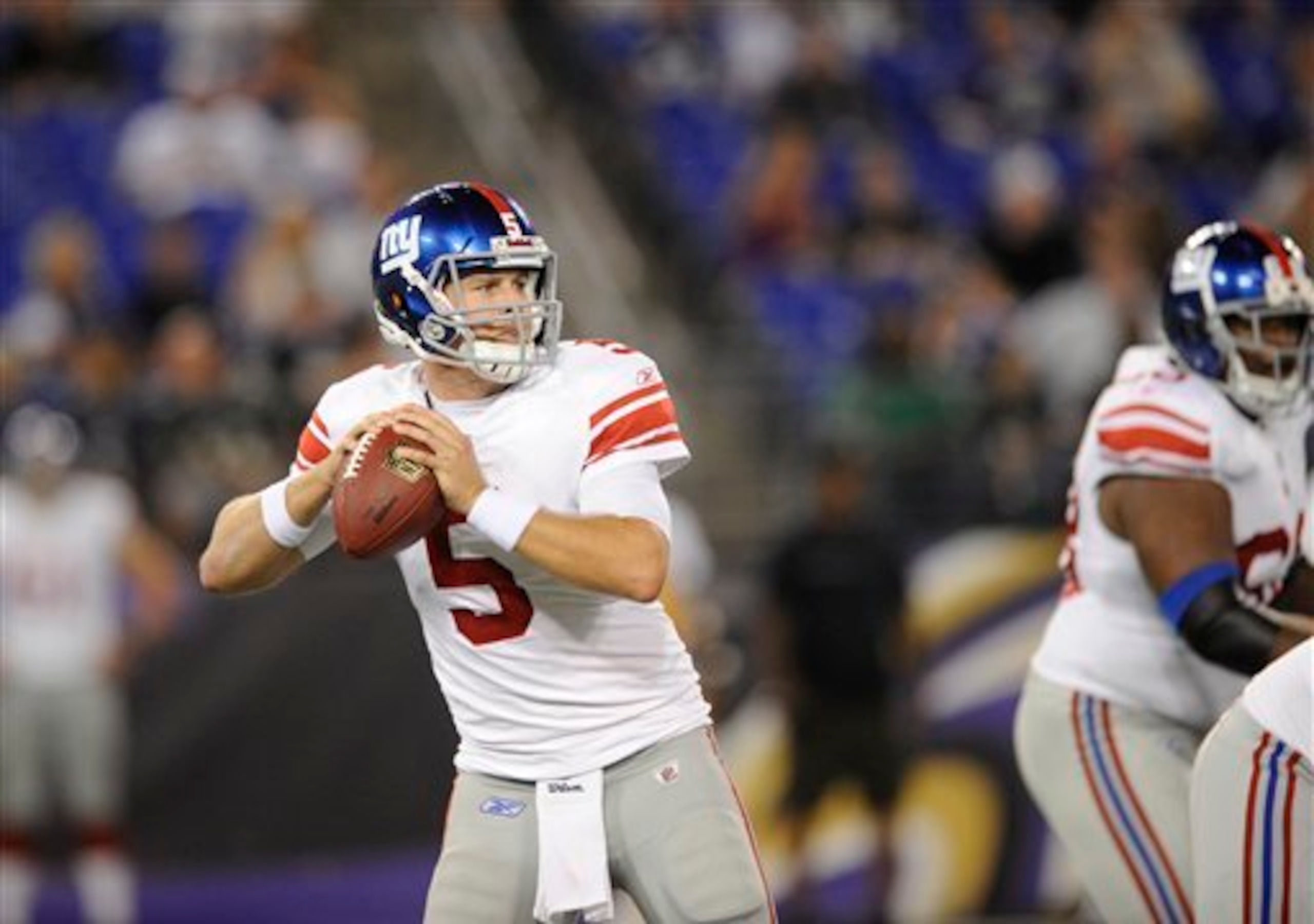
Long before Reese and the front office were hoping that a backup quarterback selected in the draft (Ryan Nassib, 2013) would never have to play in a game, there was Rhett Bomar, the team’s fifth-round pick (151st overall) in 2009. Unlike Nassib, though, he couldn’t stick on the 53-man roster—let alone get on the field.
In two NFL seasons, one with the Giants as ironman Eli Manning’s backup and one with the Minnesota Vikings, Bomar appeared in no games.
In looking back, the Giants might have been concerned about losing David Carr, then the backup to Manning, in free agency.
Their concerns came to fruition, as Carr played 2010 with the San Francisco 49ers, though he would return to the Giants for 2011 and 2012.
Still, one can’t help but wonder if Carr’s return was hastened by the failure of Bomar to take root in New York.
Granted, when talking about a Day 3 prospect, you’re generally looking at draft picks who are projects.
However, if a project is worth keeping, teams usually find a way to keep him on the 53-man roster rather than leave him exposed on the practice squad where another team can sign him.
So next time you think Nassib was a wasted draft pick, just remember that it was Bomar who was the original throwaway pick.
The Mulligan: P Thomas Morstead
If Bomar was a luxury pick, a fitting “luxury” mulligan would have been punter Thomas Morstead, chosen with the 164th overall pick by the New Orleans Saints, for whom he’s played his entire career.
A 2012 Pro Bowler, Morstead would have been a nice and timely transition from Jeff Feagles, who would retire after the 2009 season.
Had the Giants landed Morstead, they wouldn’t have had to suffer through the 2010 season with the man who earned my vote (spoiler alert) for being the worst seventh-round Giants draft pick in the Reese era.
Round 6: MLB Greg Jones (2011)
6 of 7
This one was a difficult decision, as there were several eligible candidates.
In the end, middle linebacker Greg Jones, the first of three sixth-round draft picks for the Giants in 2011 (the other two were safety Tyler Sash and linebacker Jacquian Williams, both supplemental picks), emerged as the winner.
Why Jones, who was chosen 185th overall?
After starting three out of four games at middle linebacker and going on to play 161 snaps in the first eight games of the season, per Pro Football Focus, Jones hit a wall and would be cut after his rookie campaign.
He appeared in just 44 defensive snaps the rest of the way before finally yielding to Mark Herzlich, an undrafted free agent that year.
When Herzlich suffered an ankle injury, rather than go back to Jones, the Giants called Chase Blackburn out of a classroom somewhere in his home state of Ohio to carry the defense through the Super Bowl.
To be fair, Jones, drafted out of Michigan State, didn’t exactly have ideal size—he was listed as 6’0” and 242 pounds, according to his NFL.com draft profile.
However, the same could be said about Jon Beason (6’0”, 232 pounds), who would ultimately come in and, for one brief moment in 2013, look as though he was the answer at middle linebacker after Herzlich struggled to replace the injured Dan Connor that season.
Regardless of where a rookie is drafted, the goal is for him to see his workload increase. When it decreases, that’s not a good sign.
In Jones’ case, add him to a long list of patchwork attempts to fill that middle linebacker spot that hasn’t enjoyed any kind of stability since Antonio Pierce retired after the 2009 season.
The Mulligan: C Jason Kelce
Although David Baas made it through the 2011 season, injuries would shorten his stay with the Giants. When he was cut after the 2013 season due to medical concerns, New York brought in J.D. Walton, who wasn’t the answer.
If the Giants needed a center and had passed on my earlier mulligan suggesting Max Unger, 2014 Pro Bowler Jason Kelce, chosen by the Philadelphia Eagles with the 191st pick, would have done just fine.
Round 7: P Matt Dodge (2010)
7 of 7
The seventh round of the draft is pretty much a hit-or-miss round. While it’s rare that a team will uncover a diamond that goes on to be a Pro Bowler or, at the minimum, a quality player, it does happen on occasion.
Of course for the Giants, their batting average hasn’t been anything to write home about in this round, with the exception of running back Ahmad Bradshaw (2007).
One seventh-round pick who can’t make a case for being anywhere close to decent is punter Matt Dodge (2010), taken 221st overall. Dodge’s selection came just weeks after longtime punter Jeff Feagles announced his retirement.
Although Dodge gave it his all, he struggled in so many ways that the Giants might have been better off pulling in a punter from off the street.
Dodge couldn’t kick with any type of consistency, and despite being assigned to hold for then-kicker Lawrence Tynes, he soon lost that job as well.
Dodge will be most remembered for his major blunder in kicking the ball down the center of the field to DeSean Jackson, a punt that Jackson returned for a game-winning touchdown in a 38-31 decision that came to be known as the “Miracle at the New Meadowlands,” in which the Eagles rallied from a 21-point deficit to win the game.
After the game, Dodge, who caught an earful from a visibly irate Tom Coughlin before they left the field, admitted his gaffe.
"Everyone on that sideline [told me]. I knew it," Dodge said, per Ian Begley of ESPN.com. "[Giants coach Tom Coughlin] didn't have to tell me. It wasn't rocket science not to kick it to him with [14] seconds left. But sometimes you don't execute as well as you'd like."
That blunder was the final straw in a frustrating and short career for Dodge, who was replaced the following season by veteran Steve Weatherford.
The Mulligan: DT Ricardo Mathews
Chosen 238th overall by the Indianapolis Colts, defensive tackle Ricardo Mathews doesn’t have eye-popping production, but as a rotational guy, he’s been steady.
Mathews, who played four years with the Colts and the last two seasons with the San Diego Chargers, has 94 career tackles, according to his NFL player page.
Pro Football Focus has him down for just nine career missed tackles and 51 stops for zero or negative yardage, which isn’t bad for a guy who has averaged 37.2 percent of his teams’ defensive snaps.
Patricia Traina covers the Giants for Inside Football, the Journal Inquirer and Sports Xchange. All quotes and information were obtained firsthand unless otherwise sourced. Advanced stats courtesy of Pro Football Focus.
Follow me on Twitter @Patricia_Traina.
.jpg?w=2560 "LA Premiere of \"Chad Powers\"")