Well, so much for that, then.
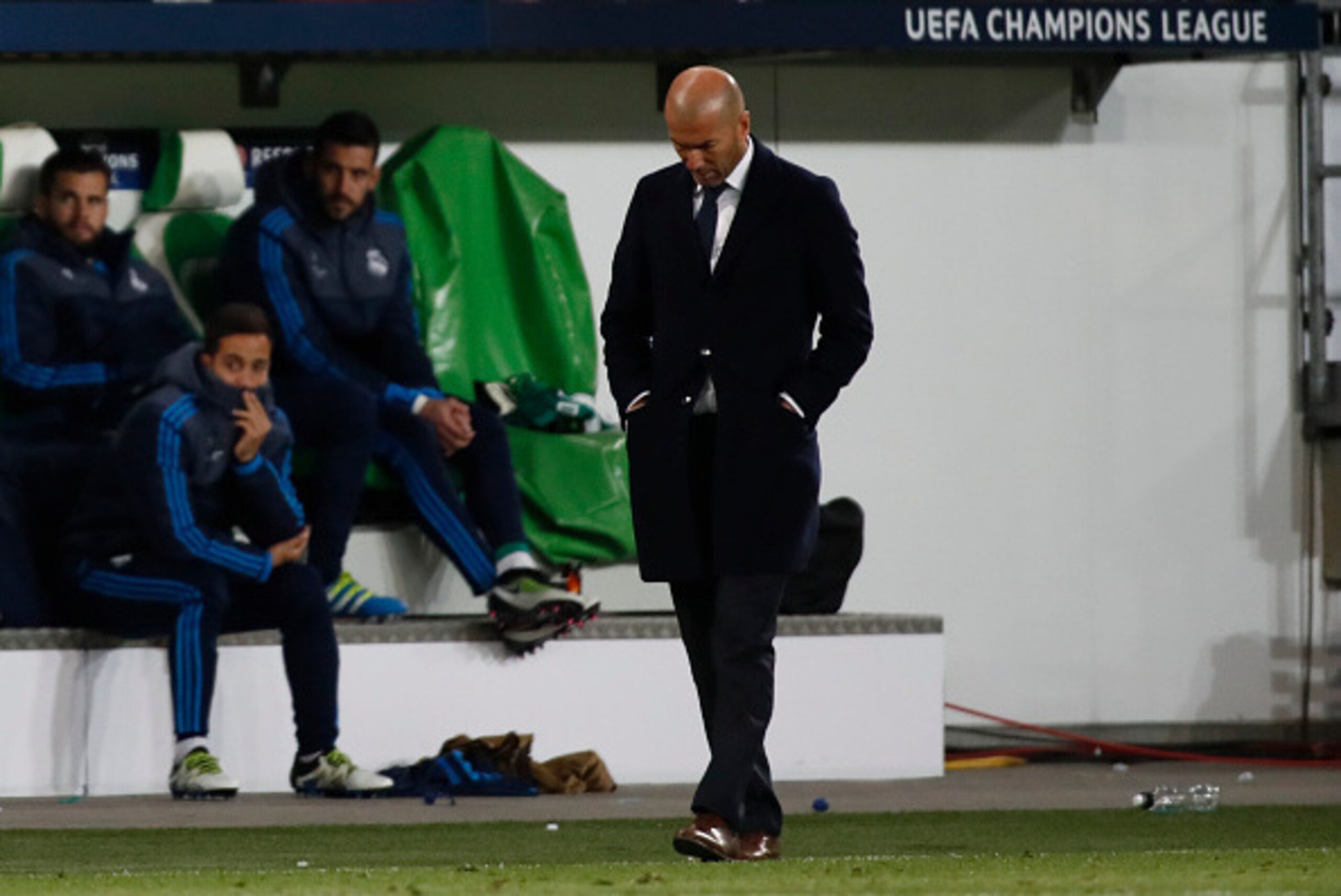
It was late on Wednesday night at the Volkswagen Arena, and 90 perplexing minutes had just passed that had left behind bemused expressions, disbelieving eyes and hands scratching heads. This wasn’t what had been anticipated, but still the talk was of a confidence and defiance. Of belief. Of spirit. Of fightbacks.
"We know we can come back strong,” said Real Madrid manager Zinedine Zidane.


“We’ll have our fans in the return leg, giving everything,” said Pepe, as reported by AS (via Football Espana).
"In the Bernabeu we're going to play for our lives, for the fans and for ourselves,” Jese told BeIN Sports (via AS).
Fightbacks?
Playing for lives?
Summoning spirit?
Riding fans’ energy?
Well, so much for that, then.

In the wake of Saturday’s Clasico triumph over Barcelona, this was supposed to be a new Real Madrid, a different one. One riding momentum.
At the Camp Nou, Zidane’s men had unearthed a sudden sense of structure and identity in the face of Europe’s finest, toppling the Catalans with a clarity of purpose that had seemingly reinforced them and bolstered belief.
That evening, when Zidane had been asked what he’d liked about his side’s performance, his response had been simple: “everything.” He had the right to say as much, but here, just four nights later, if he’d been asked the same question his response might have been rather different—“nothing,” would have been the only reasonable answer.
In slumping to a 2-0 defeat to Wolfsburg in the first leg of their UEFA Champions League quarter-final tie, Real Madrid emptied an Icelandic glacial lagoon onto the warmth of their post-Clasico glow.
Less than 100 hours after showcasing unity, strength, commitment and a collective conscience in Catalonia, Madrid reverted to type in Germany. Aimless, disorganised, chaotic—shambolic, really—this was the Madrid seen against Malaga. Against Atletico Madrid. Against Villarreal. Roma. Las Palmas. Sevilla (the first time). Barcelona (ditto).
In the build-up to Wednesday’s clash, Zidane had asked for more of what he’d seen on Saturday and had warned of the consequences if he got something else. "In football if you ease off you end up paying for it,” he’d said.
Evidently, no one was listening.
After a strong opening 15 minutes inside the Volkswagen Arena, Madrid fell apart in every sense. In attack, they became directionless following the exit of Karim Benzema; in midfield, Casemiro lacked the bite and intensity of four nights earlier; at the back, they were utterly woeful.
Had they believed their own hype? Had they decided their flaws were no longer? Had they thought it would all fall into place from here?
It looked that way.
Time and again, full-backs Danilo and Marcelo bombed forward with no thought for consequence, leaving the clumsy-on-the-night pairing of Sergio Ramos and Pepe isolated. Relishing the space, Julian Draxler ran at them with conviction. So did Andre Schurrle. So did Maximilian Arnold and Bruno Henrique.
The first goal came when Danilo failed to apply pressure on Draxler, who got to the byline to cross to Schurrle. The subsequent penalty decision and goal was perhaps harsh on Madrid, but the second was anything but—the visitors were cut apart, motionless, absent, inattentive.
It could have been worse, too.
Such a dynamic was hardly anything new, but this was the very worst of Madrid. Here, there was no balance, no diligence, no intensity and no collective. Instead, this was the flawed, individualistic and talent-reliant version that the Clasico had supposedly banished.
“This Real Madrid side goes back and forth like a tango: today a judgment, one day an oath, the next an act of treason,” wrote AS editor Alfredo Relano.
Working for BT Sport, Steve McManaman labelled Madrid as “schoolboy.”
But perhaps Thursday’s blunt cover of AS said it best: “Bad, bad, bad.”
Admittedly, this tie is still far from gone for Madrid; they’ve obliterated teams on their own patch all season. But that they need to do so now is alarming.
This, after all, was the tie they wanted. Avoiding domestic rivals Barcelona and Atletico, avoiding other heavyweights in Bayern Munich and Paris Saint-Germain, Madrid had been given a psychological boost in getting Wolfsburg. When the draw was made, the mood of their season shifted; gloom departed.
Then came the thrashing of Sevilla. Then the Clasico triumph.
In the league, Saturday changed little, but in an emotional sense it felt as though it had changed everything. Suddenly, Madrid had looked to have found clarity, structure, identity, belief and momentum. It was a template for dominance, many thought.
Four days later, what they need is a fightback.
So much for that.




.jpg?w=2560 "Latest Peyton-Colts Rumors")
.jpg?w=2560 "Chiefs, Steelers Eye WR Trades")