
1 Thing Opponents Should Fear About Every Power 5 College Football Team in 2016
Fear is healthy; it helps promote awareness. The absence of fear can lead to overconfidence, which can be a recipe for disaster.
Using fear as a teaching tool might seem counterproductive, but it can work in the sports world. Just look at college football, where despite a clear separation between the top power-conference teams and the rest of the field, there's something to fear about each and every one of them. And when an opponent ignores this, it can get into trouble.
It could be a player or group of players, a coach, a scheme or some intangible that makes every team worth being wary of. We've noted the one thing from each power-conference school (as well as top independents BYU and Notre Dame) that needs to be feared.
Alabama
1 of 66
The depth chart
As impressive as Alabama's starting lineup was during the 2015 season, that's only begins to tell how talented the Crimson Tide are. To better understand this, look at the backups and the third-string players, guys who were blue-chip recruits (and who would be starting anywhere else) but who have to wait in line to get playing time in Tuscaloosa.
The Tide's second-leading sack man, linebacker Tim Williams, was third on the depth chart at his position last season and isn't guaranteed to start in 2016. Bo Scarborough, one of the top running back recruits in the country in 2014, redshirted his first year and got all of 18 carries last season.
Thanks to six consecutive No. 1 recruiting classes, per 247Sports, Alabama's roster will remain stacked for this season and beyond. According to Bleacher Report's Christopher Walsh, it will have 19 former 5-star prospects available in 2016.
Arizona
2 of 66
Tyrell Johnson's speed
Injuries prevented Tyrell Johnson from being able to show off his track-star quickness in 2015, as he was limited to just seven games and 26 touches. That included a receiving touchdown and 16 kickoff returns, where he averaged 25.5 yards apiece, along with a few rushes.
When not hobbled, though, the 5'7”, 160-pound Johnson is as fast as they come in college football. In fact, he's ranked No. 1 among gridiron players for their speed, per Bleacher Report's Justin Ferguson.
Johnson figures to be more involved in Arizona's run game in 2016, per Michael Lev of the Arizona Daily Star.
Arizona State
3 of 66
The blitz
Arizona State has recorded 176 sacks in coach Todd Graham's four seasons, a testament to his penchant for bringing the house on defense as often as possible. Last year this resulted in 46 sacks, tied for third-most in FBS, with the Sun Devils notching at least two in all but one game.
This near-constant pressure forces opposing quarterbacks to seek out the hot route unless their line is able to hold up long enough to go through the progressions. It's hit or miss, though when ASU doesn't get to the passer the results can be disastrous.
ASU had the nation's worst passing defense last year, giving up 337.8 yards per game, with 34 pass plays of 30 or more yards allowed. It also yielded 24 throws for 40-plus yards and 14 that gained 50 or more yards.

_0.png?w=2560)
Arkansas
4 of 66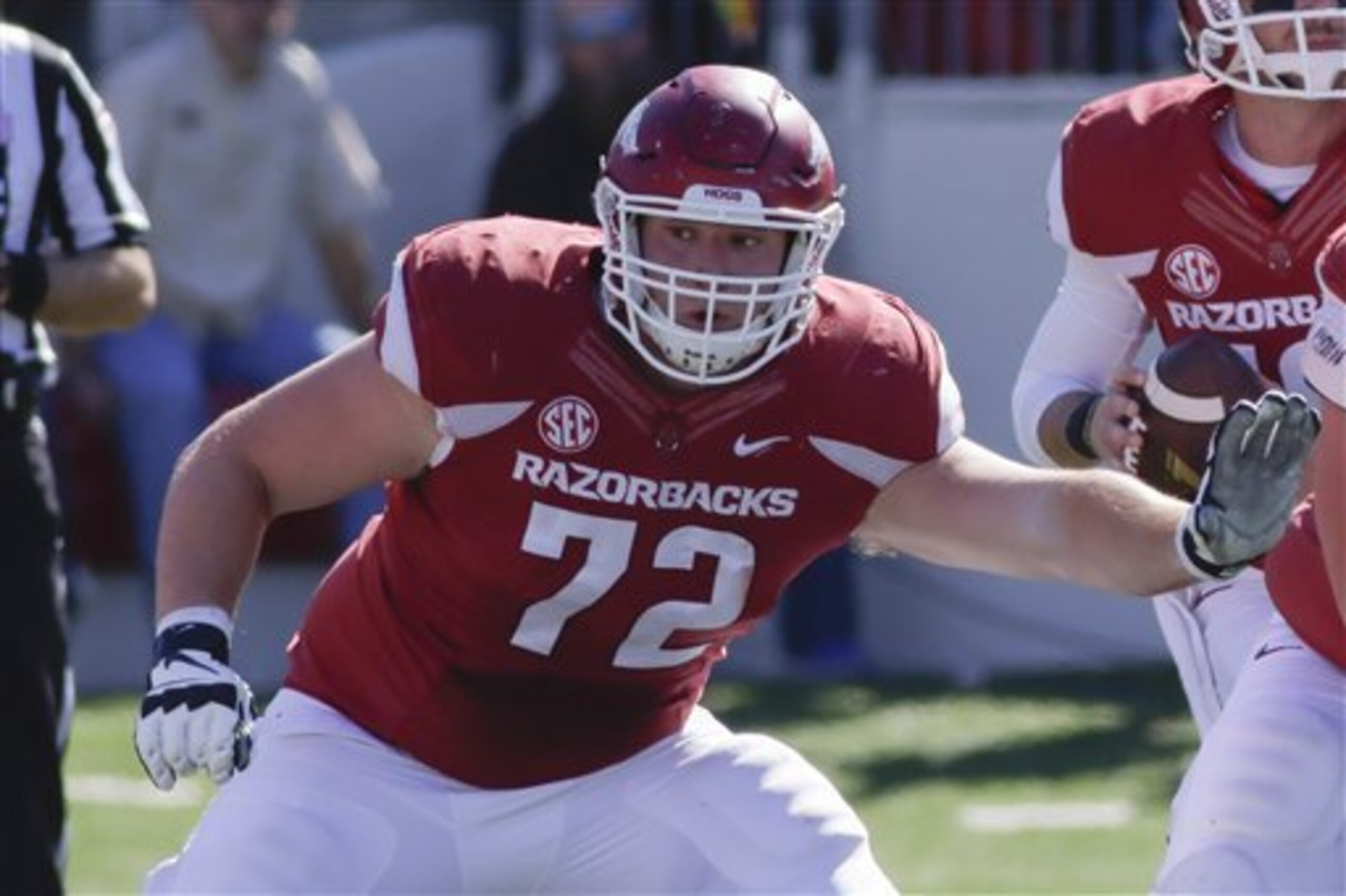
The offensive line
It might not rival professional teams for its overall size, but don't expect Arkansas to suddenly become tiny when it comes to the five big guys blocking up front. The Razorbacks must replace three starters from the 2015 unit that averaged 328 pounds per player, though the reinforcements aren't exactly puny.
Josh Allen, Johnny Gibson and Zach Rogers spent last year as backups on the line, and they averaged 313 pounds. Combined with returners Frank Ragnow and Dan Skipper, Arkansas would average 316.6 pounds across the five starting spots.
To help with this massive group of pro-sized run- and pass-blockers, Arkansas coach Bret Bielema reached out to the NFL for an assistant. Kurt Anderson, who spent the last three years coaching the Buffalo Bills' offensive line, replaces Sam Pittman. Pittman is now the O-line coach at Georgia.
Auburn
5 of 66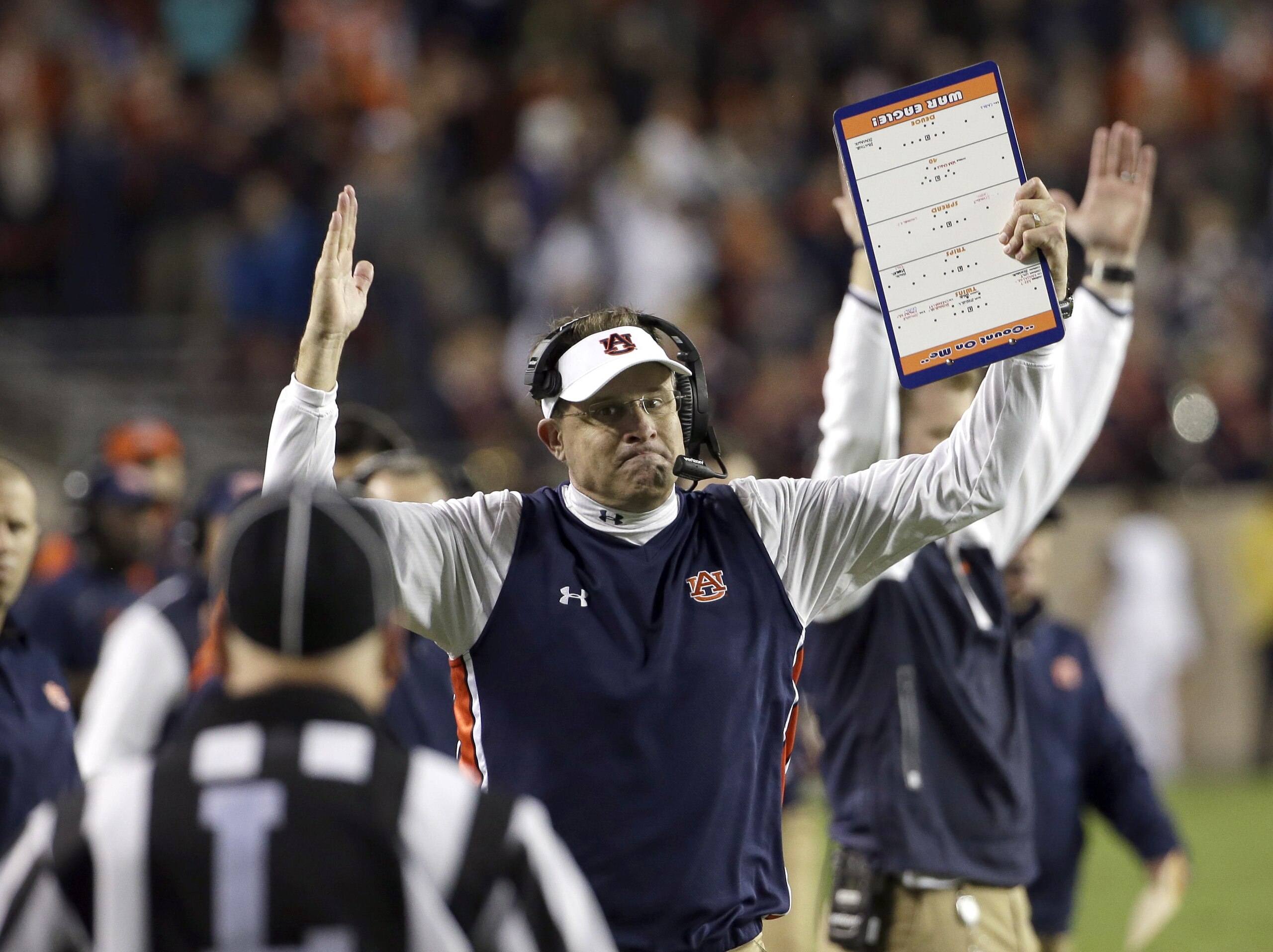
Gus Malzahn's playbook
The numbers didn't bear out this past season, but don't expect Auburn head coach Gus Malzahn to go another year without putting forth a dangerous offense. A return to the old style of running to set up the pass, which was so effective during the run to the 2014 BCS title game, is in store for the Tigers.
The 2015 season saw Auburn make too much of an effort to implement a balanced offense, and the passing portion wasn't able to succeed. Its run game also suffered, averaging 196.3 yards per game after going for 255.5 yards per game the previous season and 328.3 during the title-game run.
A lot will depend on who ends up being the Tigers' quarterback. Neither Jeremy Johnson nor Sean White were effective last year, opening the door for former Florida State passer John Franklin III to step in. Whichever one can best run the spread will get the job.
Baylor
6 of 66
The running back rotation
When injuries all but eliminated Baylor's ability to throw the ball last season, any hope of winning the Big 12 and getting into the playoffs also went away. The Bears lost three of their final four regular-season games, scoring only 31 points in regulation in their final two outings.
If not for their overabundance of capable running backs, though, it could have been worse. Much worse.
Baylor averaged 326.7 rushing yards per game in 2015, and in its final two games it gained 1,040 yards on the ground. That included a bowl-record 645 yards and seven touchdowns against North Carolina in the Russell Athletic Bowl, which was accomplished without leading rusher Shock Linwood.
Linwood was one of two 1,000-yard rushers who will return in 2016 for Baylor, along with Johnny Jefferson. There's also a pair of returning 500-yard rushers and a quarterback (Seth Russell) who ran for 402 yards and six TDs in seven games before getting hurt.
Boston College
7 of 66
Third-down defense
An abysmal 3-9 season in 2015 kept Boston College's impressive defensive performance from getting its due. The Eagles allowed only 15.3 points per game, yielding 20-plus on just three occasions with national runner-up Clemson the only foe to surpass 30 points.
BC was never more dangerous than on third down, when opponents converted only 42 of 174 times for first downs. That 24.1 percent rate was best in FBS, and it kept the Eagles in many games they had no business being alive in with their lethargic offense.
Though BC lost defensive coordinator Don Brown and leading tackler Steven Daniels, don't expect its performance on third downs to worsen in 2016.
BYU
8 of 66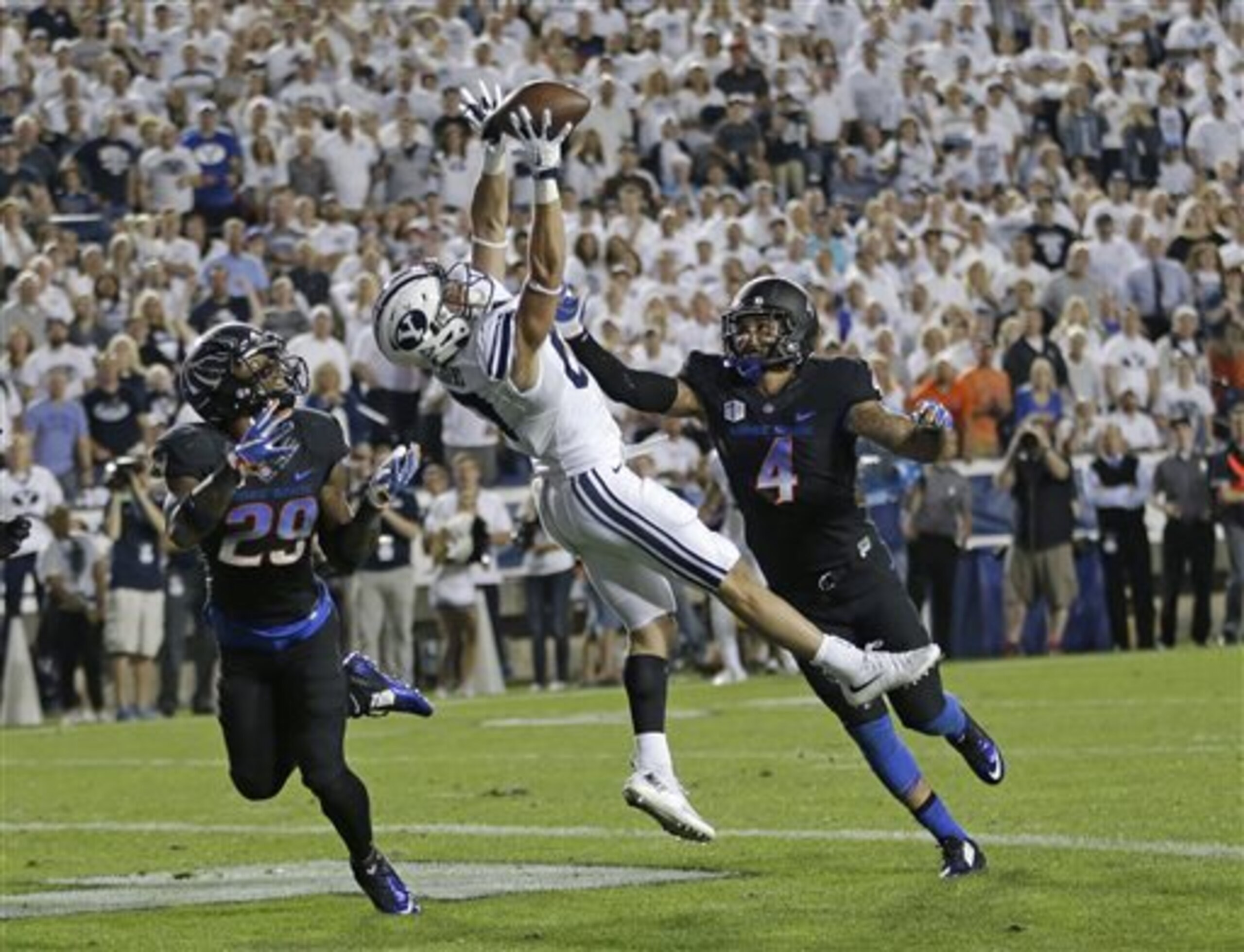
The Hail Mary
A desperation play that usually only works once in a blue moon, BYU made this seemingly a regular part of its offense during 2015. It beat Nebraska on a long touchdown heave as time expired to open the season, and a few weeks later knocked off Boise State thanks to a deep pass in the final minutes that required a little bit of prayer to get completed.
For the year, the Cougars averaged 7.6 yards per pass attempt and 12.8 yards per completion, with 15 throws going for 40 or more yards. Jump balls were a huge advantage for BYU, as senior Mitch Mathews was 6'6” and junior Nick Kurtz is 6'5”.
California
9 of 66
Jake Spavital's motivation
Much of the blame for Texas A&M's offensive woes during the second half of 2015 (as well as the year before) has been placed on the calls made by Jake Spavital, who was Kevin Sumlin's coordinator for three seasons before getting let go in January. Now he's taking over a California unit that's starting from scratch, having lost record-setting quarterback Jared Goff and its top six receivers.
That could make for a very lean offensive year for the Golden Bears, unless Spavital is able to parlay lowered expectations into a breakthrough performance.
"He was raised under the same guys I was raised under or that played for us," Cal coach Sonny Dykes told SiriusXM College Sports Nation (h/t CoachingSearch.com), noting Spavital's experience with the Bears' Air Raid offense. "Jake Spavital just made sense."
Clemson
10 of 66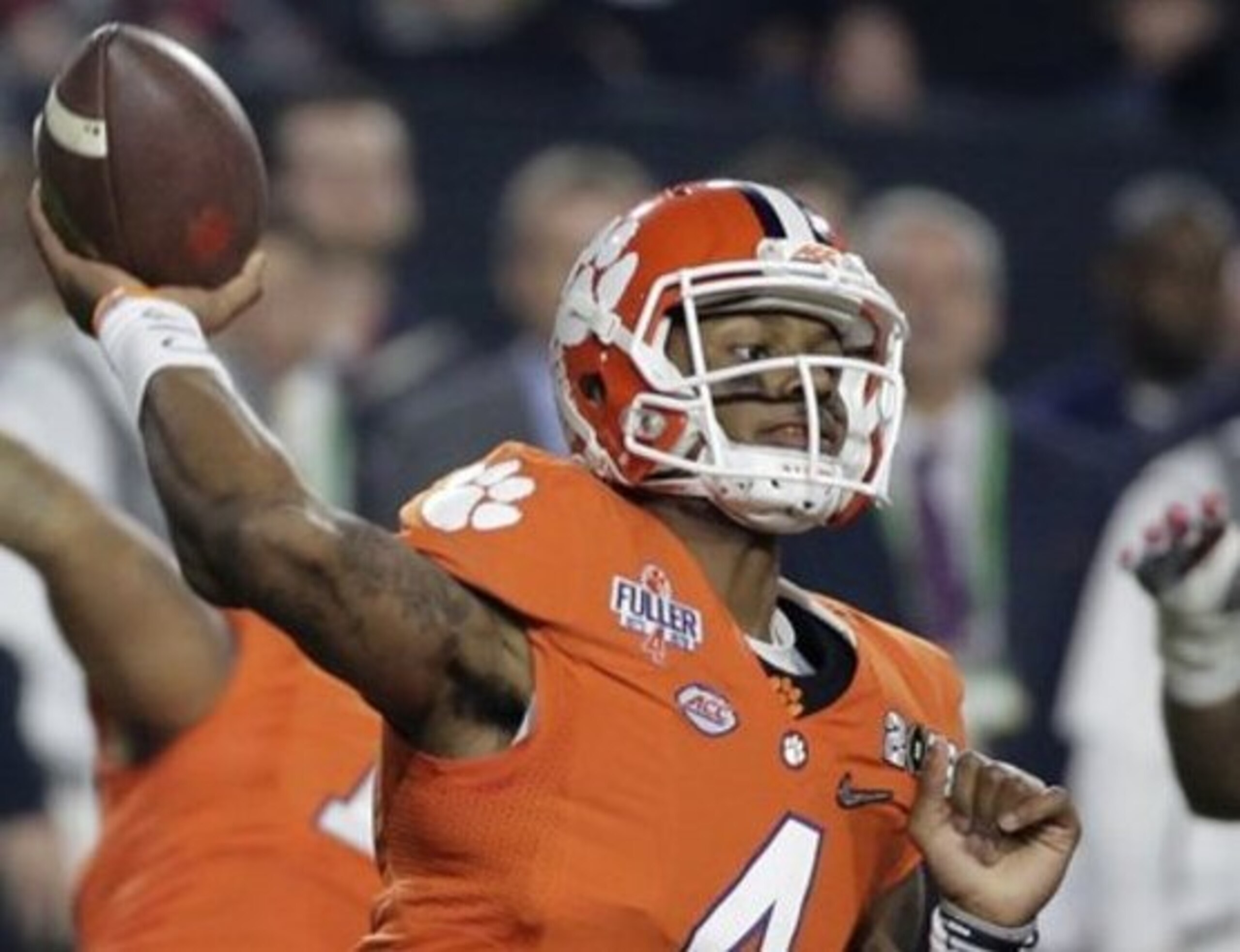
Deshaun Watson
There's a lot to fear about Clemson, which last year came close to being the first team ever to go 15-0 at the FBS level and is on a run of six straight seasons with at least 10 wins. But the single-most worrisome facet of the Tigers, at least for one more year, is the man who is coming off arguably the greatest season ever for a quarterback.
In 2015, Deshaun Watson became the first player to throw for 4,000 yards and rush for 1,000, finishing with 5,209 yards of total offense while accounting for 47 total touchdowns. And that was less than a year removed from a torn ACL, which limited his ability to work out and practice last offseason.
Watson will have a full regiment of preparation time for 2016, and with Clemson breaking in another new defense its offense will need to produce. That responsibility falls first on Watson, the player that no team managed to slow down last year.
Colorado
11 of 66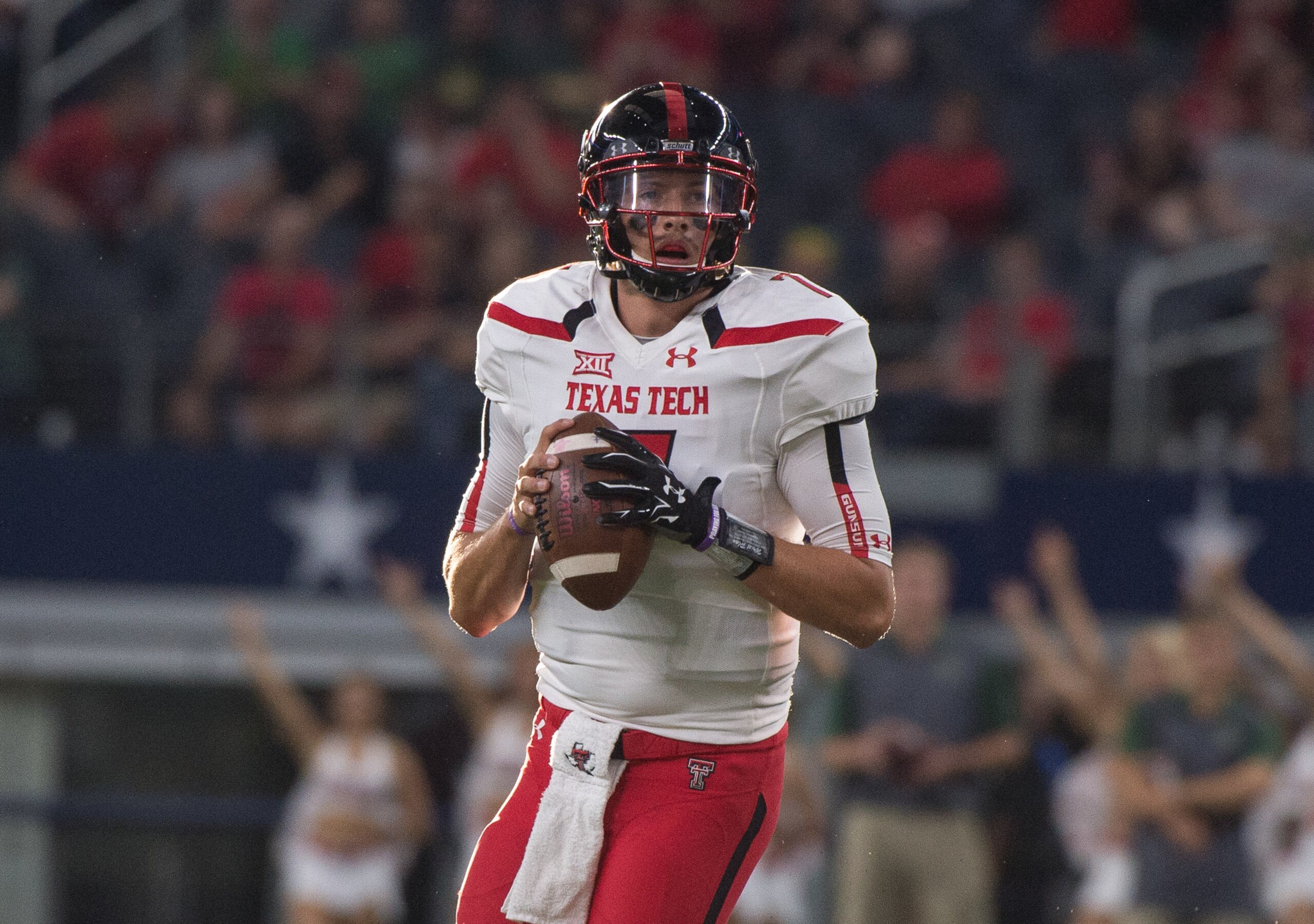
The Air Raid in altitude
Colorado hasn't been able to take full advantage of its home field the last few seasons, going 6-12 in Boulder under coach Mike MacIntyre. But the arrival of transfer quarterback Davis Webb could change that, if he's able to perform like he did early in his career at Texas Tech.
Webb started 14 games in 2013-14 for the Red Raiders, and as a freshman he was MVP of the Holiday Bowl after throwing for 403 yards and four touchdowns against Arizona State. He lost his job late in 2014 to Patrick Mahomes II and didn't play much last season, but he brings more than 5,500 career yards and 46 passing touchdowns with him to Colorado.
The Buffaloes were a better running team at home than they were at passing in 2015, but combining Webb's experience with altitude could make for a potent air attack that will wear defenses out quickly.
Duke
12 of 66
DeVon Edwards' return skills
A starter in Duke's secondary since midway through the 2013 season, DeVon Edwards has been a vital piece of that unit and will be again this fall. Yet that's not where his value has been biggest—or most noticed by opponents—throughout his career.
Instead that would be in the return game. Edwards returned three kickoffs for touchdowns last year, giving him six for his career. He has 2,005 career return yards, averaging nearly 28 yards per attempt.
The FBS career record for kickoff return TDs is seven, done most recently by Houston's Tyron Carrier from 2008-11.
Florida
13 of 66
Antonio Callaway's big-play ability
While Florida's offense as a whole wasn't much to rave about in 2015—especially after quarterback Will Grier was suspended—it did have a wide receiver who was capable of big things when he got the ball in his hands.
Antonio Callaway averaged 19.4 yards on his 35 receptions last season as a freshman, with 11 catches going for at least 25 yards. Callaway's four touchdowns averaged 49.3 yards, including the game-winning 63-yard score against Tennessee in September. He was best when given as much field as possible to work with, averaging 21.8 yards on catches thrown from inside Florida's own 40-yard line.
Throw in a pair of punt return TDs, including one against Alabama in the SEC championship, and Callaway is a big-play threat that opponents should fear.
Florida State
14 of 66
A healthy Dalvin Cook
Even on a bum hamstring for much of last year, Dalvin Cook set Florida State's single-season rushing record with 1,691 yards and 19 touchdowns. It was his second consecutive 1,000-yard season, the first Seminoles rusher to do that since the mid-1990s, and this came after he had to miss much of the preseason while on trial for battery charges that he was acquitted of.
The 5'11”, 202-pound Cook could end up as FSU's career rushing leader by the end of 2016, which will probably also be his last at the college level. He has 13 career 100-yard games, topping 200 yards twice last season, but two of his worst performances have come in bowl games.
Cook lost a critical fumble in the Rose Bowl semifinal loss to end his freshman year, and Houston held him to 33 yards on 18 carries in December's Peach Bowl. Expect him to use those performances as added motivation for another huge year.
Georgia
15 of 66
An ambitious new coaching staff
Kirby Smart has had other opportunities to leave Alabama and take on his own program, but it wasn't until his alma mater came calling that he decided to take the leap. But not until after finishing up his work with the Crimson Tide, winning a fourth national title as a defensive coordinator.
Don't expect Smart and the coaching staff he assembled to be looking to ease into their new jobs, however. That's already been evident with the signing of a recruiting class that 247Sports ranked seventh overall.
Smart is the second coordinator in as many years to go from a national championship team to his own program, but he's got a lot to live up to in order to match the other. Houston's Tom Herman went 13-1 in his first season after helping Ohio State win a title as offensive coordinator.
Georgia Tech
16 of 66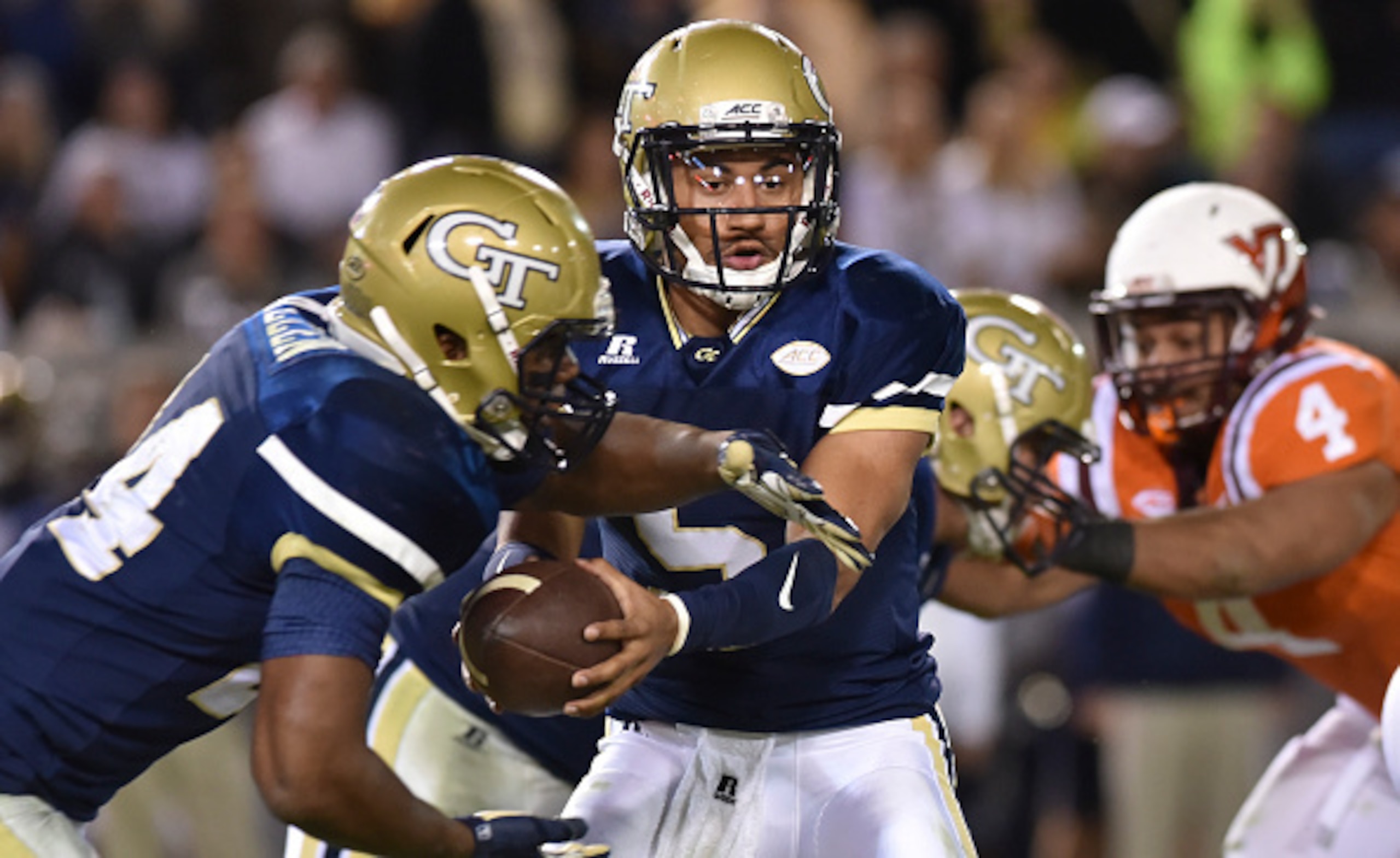
The triple-option
Georgia Tech isn't the only team in FBS that runs this old-school run-based attack, but it's the sole operator among power conferences. That means having to defend against it can have an impact on the division and conference title hopes of the Yellow Jackets' eight league opponents each season.
Last year was a down year for Tech in the run department, but that still resulted in a per-game average of 256.2 and 30 rushing touchdowns. Against ACC foes, the Yellow Jackets averaged 218.6 yards per game.
Justin Thomas is back for his third season at quarterback, and with the offensive line and skill positions more experienced this fall the numbers should go way up.
Illinois
17 of 66
A healthy Mike Dudek
Illinois had to go all of last season without its top offensive weapon in Mike Dudek, who suffered a knee injury in spring practice. This came after a strong freshman year in which the 5'11” wide receiver was second in the Big Ten with 76 receptions.
Without Dudek, the Fighting Illini had no receiver with more than three touchdowns—he had six in 2014—and only two had more than 1,000 yards (compared to Dudek's 1,038 yards the season before).
Indiana
18 of 66
Devine Redding
Indiana made its first bowl game since 2007 thanks to an offense that led the Big Ten in points and yards per game. It was a balanced attack, one that produced a 3,500-yard passer and two 1,000-yard rushers.
Only one of those is back. Devine Redding ran for 1,012 yards and nine touchdowns as a sophomore despite spending most of the year backing up Jordan Howard. When injuries slowed Howard, the 5'10”, 202-pound Redding took over and was nearly unstoppable.
Redding averaged 167 yards per game over the Hoosiers' final three contests, and in the Pinstripe Bowl he went for 227 yards on 35 carries.
Iowa
19 of 66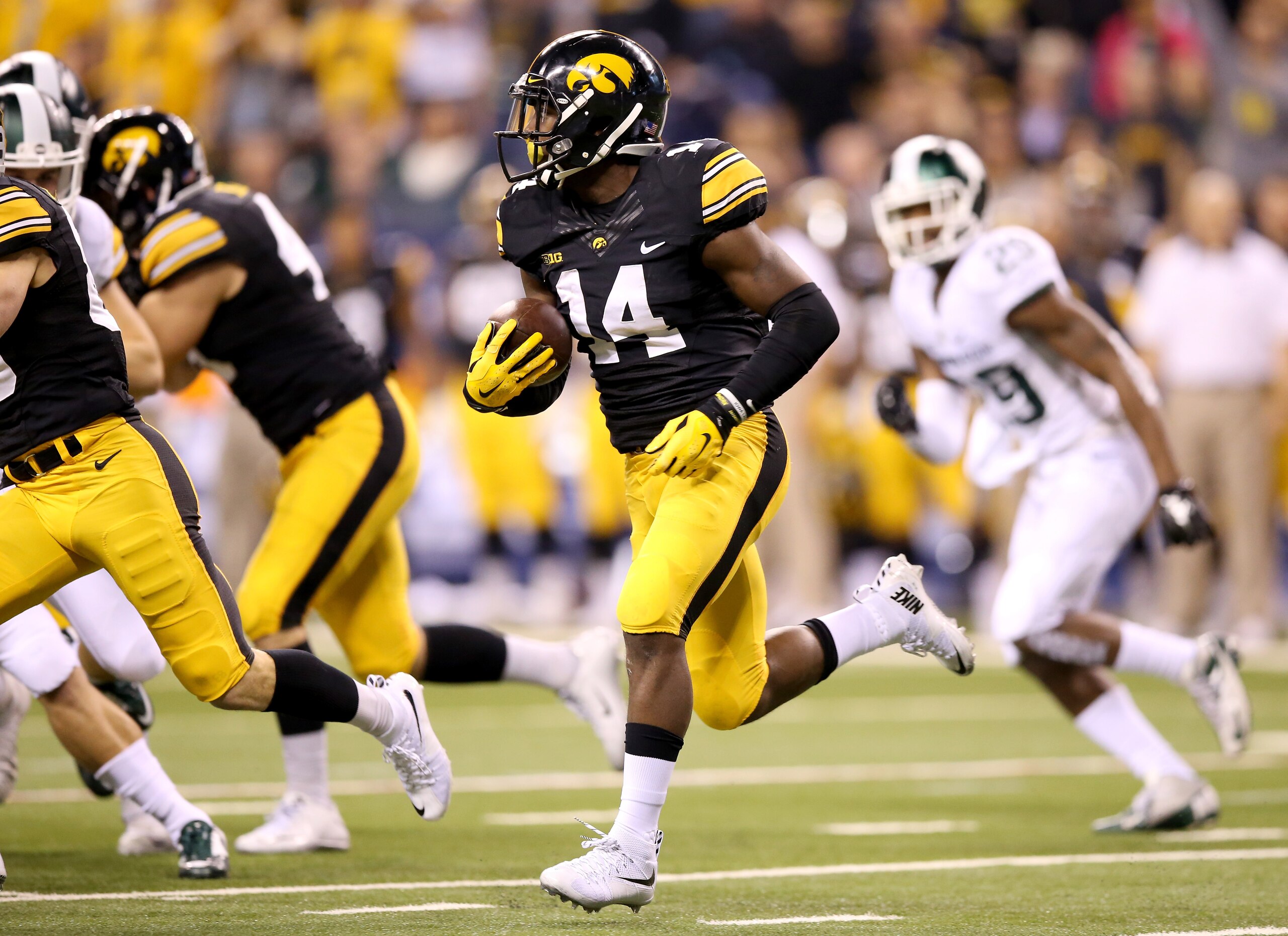
The best defensive back in the country
Desmond King is the reigning Thorpe Award winner, an honor given to the top defensive back in FBS. He had eight interceptions as a junior, giving him 11 for his career with two of those turned into touchdowns. Along with strong numbers as a punt- and kick returner he had more than enough of a resume to turn pro.
Instead, the 5'11” King opted to come back to Iowa for his final season. By doing this he ensures the Hawkeyes won't have to start over in the secondary, where two other starters have graduated.
King also had 72 tackles and was credited with 13 pass breakups in 2015.
Iowa State
20 of 66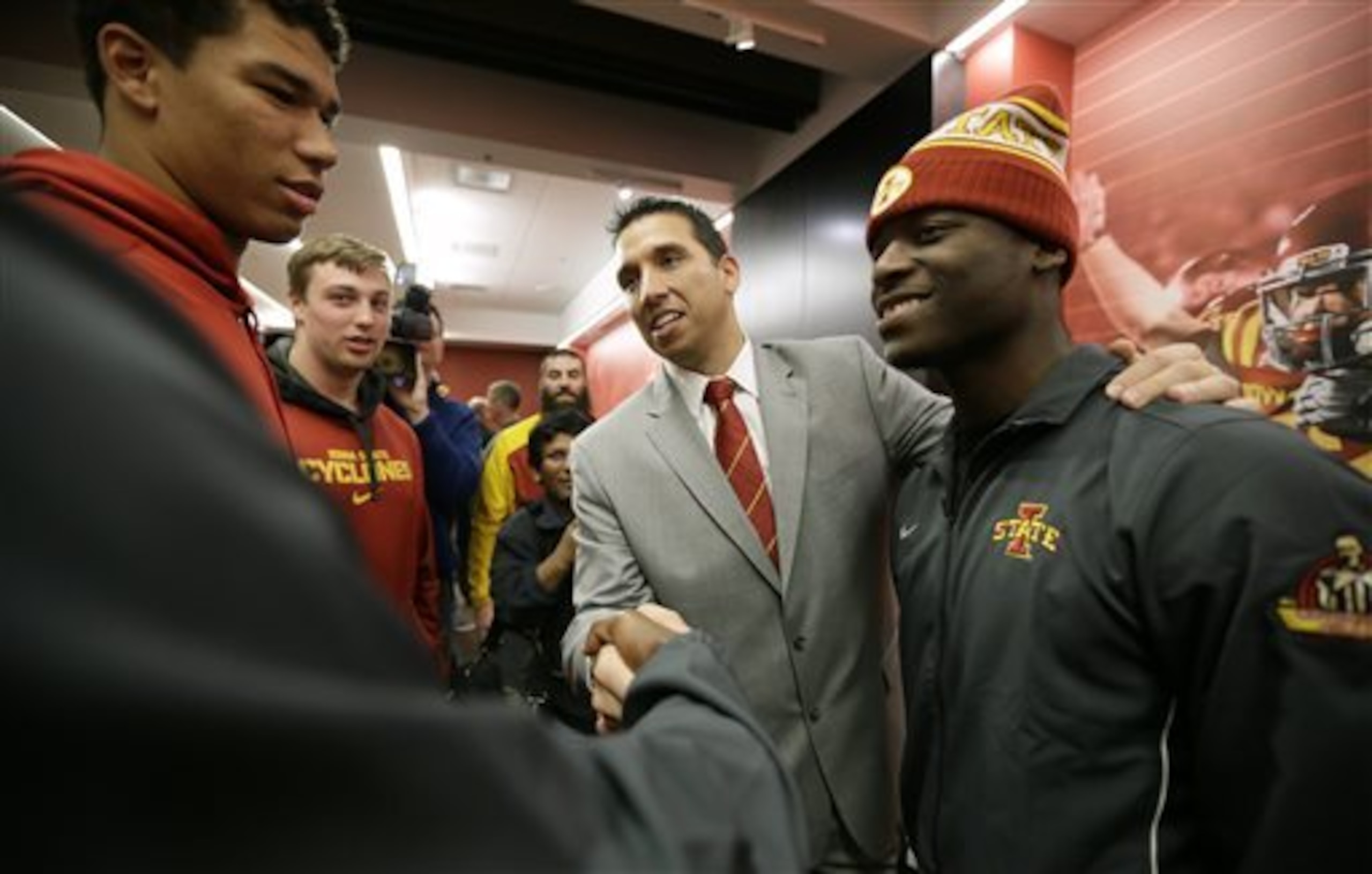
Mike Warren and Matt Campbell working together
Mike Warren was the nation's top freshman running back in 2015, going for 1,339 yards as one of the few bright spots on an Iowa State team that won just two games and fired its coach. Now he's getting paired up with a rising star in the coaching ranks in Matt Campbell, who is only 36 but is already heading into his fifth season as a head coach.
Campbell's Toledo teams won 34 games from 2012-15, last year beating a pair of power-conference teams (including Iowa State). His offenses were prolific both on the ground and in the air, but they were particularly strong running the ball, with two 900-yard rushers last season.
Under Campbell, Toledo ran for 200-plus yards 32 times in four seasons. Iowa State did so just 14 times in that time frame, but eight of those happened last year with Warren involved in the run game.
Kansas
21 of 66
A nothing-to-lose mindset
There are few things more dangerous than a team that has very little to play for other than pride. Just ask TCU, which in each of the past two seasons nearly lost to listless Kansas in November, despite the Jayhawks sporting records of 3-6 and 0-9 at the time.
Kansas didn't win a game last year, and it will bring in an FBS-worst 15-game losing streak into the 2016 season. It can't get any worse this time around, though for any team it manages to beat the result could be disastrous.
The Jayhawks will again be that team that Big 12 opponents overlook, and that could finally lead to a win this fall.
Kansas State
22 of 66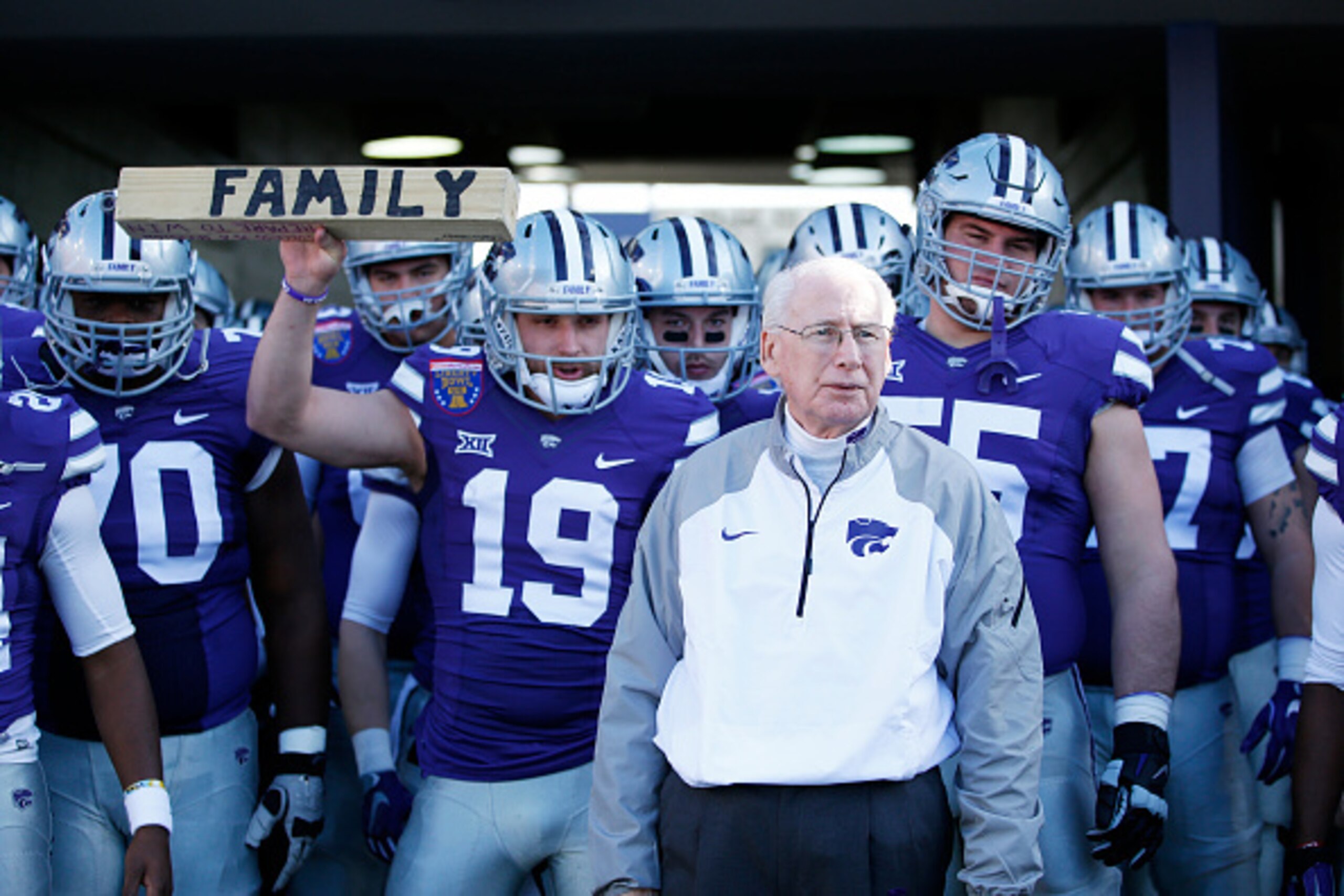
Bill Snyder's wisdom
Bill Snyder will turn 77 midway through the 2016 season, his 25th at Kansas State and eighth since coming out of retirement for a second go-around as head coach. In that time the Wildcats have won 193 games and made bowls 17 times, compared to once before he arrived and once during his three-season hiatus.
A season after we said goodbye to coaching elder statesmen such as Frank Beamer, Larry Coker, Dennis Franchione, George O'Leary, Gary Pinkel and Steve Spurrier, Snyder continues to work as hard as he did in the 1980s.
Snyder also continues to win, though last year's team finished at 6-7 after losing to Arkansas in the Liberty Bowl.
Kentucky
23 of 66
Boom Williams
Had he played every game last season, Boom Williams would have certainly been Kentucky's first 1,000-yard rusher since 2007. Instead, he logged 855 yards in 10 games as a sophomore, averaging 7.1 yards per carry with five 100-yard performances.
The 5'9”, 196-pound Williams doesn't have the size to be a workhorse running back, but his speed and quickness make him a great weapon when used properly. He only got 10 carries on third down, converting 70 percent of the time.
Williams and new offensive coordinator Eddie Gran could form a lethal combination if both can live up to their expectations.
Louisville
24 of 66
Lamar Jackson
Louisville's offense was at its best when Lamar Jackson was lined up at quarterback, though the true freshman struggled to maintain that spot due to his youth-influenced shortcomings. An explosive runner who led the Cardinals with 960 yards and 12 touchdowns, Jackson was in and out of the lineup because he struggled throwing the ball and recognizing defenses.
Jackson was sacked 26 times, somehow unable to avoid pressure and find holes like when on designed run plays. He also threw eight interceptions in 247 pass attempts and completed only 54.7 percent of his throws.
When he was playing well, though, the 6'3”, 196-pound Jackson was nearly unstoppable. He had 453 yards of total offense and four total TDs in the Music City Bowl, and he threw for 307 yards and three TDs against Florida State.
LSU
25 of 66Leonard Fournette
Until he hit a wall—in the form of Alabama's defensive front—in November, LSU's opponents took a variety of approaches to trying to stop or at least slow down Leonard Fournette when he ran the ball. That included throwing as many defenders at him as possible, most of whom were easily pushed aside while others got carried down the field.
Fournette ended up rushing for 1,953 yards and 22 touchdowns, his 162.75 yards per game tops in FBS. That included four 200-yard games and six with at least two TD runs.
Among the favorites for the Heisman Trophy in 2016, per OddsShark.com, Fournette is the player LSU will turn to more than anyone else on offense. Though it needs to get the passing game in order to be successful, having Fournette keeps that from being something that has to improve exponentially.
Maryland
26 of 66
Punting to William Likely
For opponents to prepare for William Likely in 2016, they should concentrate on the film from Maryland's first two games. That's before teams started to figure out the best way to defend the 5'7”, 175-pound junior was to just not kick it to him in the first place.
Likely had 315 yards on 10 returns against Richmond and Bowling Green, scoring a touchdown in each contest. After that he only had 13 more returns, averaging eight yards apiece, as punts were either bounced or angled so as to minimize his return ability.
Maryland attempted to get him involved on offense late in 2015, and more of that will likely happen this fall. But it's as a return man where Likely is the most dangerous.
Miami (Florida)
27 of 66
Mark Richt's motivation
Pushed out of his job at Georgia despite 145 wins, six division titles and two conference titles in 15 seasons, Mark Richt didn't spend much time out of the game before taking the Miami job in December. In doing so, he got the ball rolling on things he alluded to in his final press conference with the Bulldogs.
"If and when I do coach again, I’m looking forward to coaching again in terms of being more hands-on. I miss coaching quarterbacks, I miss calling plays, I miss that part of it. Whether it’s in the role of head coach, coordinator, quarterbacks coach, whatever it is. If in fact I choose to do that I’d be really excited about coaching QBs again and getting in the middle of coaching offensive strategy. Not that I wasn’t in it, but I wasn’t calling it. And I think I’d be more apt to do that again.
"
With Miami, he has a rising junior quarterback in Brad Kaaya, who has thrown for more than 6,400 yards in his first two seasons. More importantly, Richt has a program that needs him and values him, hoping he can return the Hurricanes to the level they were in the 1980s, 1990s and the early part of the 2000s.
Michigan
28 of 66
Jim Harbaugh's next move
Michigan won 10 games in Jim Harbaugh's first season as head coach, doing so with players that were left over from predecessor Brady Hoke's regime along with a graduate transfer quarterback from Iowa. It was a patchwork unit that far exceeded nearly every realistic expectation, and it's just the start of what the former Wolverines passer has in story.
The second year should be even bigger and better in Ann Arbor, both in terms of talent and performance. And also in terms of Harbaugh's intensity level, which was extremely high throughout 2015.
Harbaugh has now been on the job for more than a year, which means he's now settled in and fully able to implement his plan. That should scare the bejesus out of the Big Ten and the rest of the country, and not just because he continues to push the envelope in non-game-day activities as satellite camps, remote spring practices and publicity.
Michigan State
29 of 66
Malik McDowell
After two seasons building up to this point in his career—while making quite an impact in the process—Malik McDowell is ready to become the face of Michigan State's defense in 2016. That means making sure opponents know he's there, no matter where he's lined up.
"He will play everywhere, that’s for sure," defensive line coach Ron Burton told Joe Rexrode of the Detroit Free Press. "No maybes. He will play everywhere."
The 6'6”, 275-pound McDowell has six sacks and 17.5 tackles for loss in his career, including 4.5 and 13 last season, respectively. With the Spartans graduating three starters from the defensive line, that will make McDowell the veteran up front and the one that opponents will be dealing with more than others.
Minnesota
30 of 66
A full season under Tracy Claeys
Though Minnesota was just 2-4 with Tracy Claeys as head coach last season, the energy the Golden Gophers displayed in those six games showed they liked playing for him. This made the school's decision to remove the interim tag an easy one, and it's why 2016 could prove to be a strong year for the program if that intensity can continue.
Claeys, who had been Minnesota's defensive coordinator and had been part of Jerry Kill's staffs at four other schools going back to 1995. By making him the head coach, the school has ensured that what Kill was doing in Minneapolis would continue.
Minnesota may not contend for the Big Ten's West Division this season, but it will factor in who wins it. The Gophers host Iowa and Northwestern this fall.
Mississippi State
31 of 66
Fred Ross' reliable receiving
Quarterback Dak Prescott was the unquestioned leader of Mississippi State's offense last season, responsible for more than 73 percent of the Bulldogs' yardage. His graduation will have a major impact on what they do in 2016, but not as much if Fred Ross continues to be such a valuable target.
Last season Ross led MSU with 88 catches for 1,007 yards, and 650 of those yards came after the catch, per Pro Football Focus. Only eight of his receptions went for 25 or more yards, but of the 13 catches he had on third down, 13 of those led to conversions.
The 6'2” Ross has 127 career receptions, 35 short of the school record.
Missouri
32 of 66
The defensive line
Missouri had seven players record at least eight tackles for loss in 2015, and six of them are set to return this fall. That's not including Harold Brantley, who missed all of last season after injuries from a car accident kept him from playing.
The Tigers have developed a reputation for producing NFL-caliber talent on the defensive line, which has enabled them to recruit so well in that area. And now that Barry Odom—who has been with the program for 10 of the previous 13 seasons—has taken over as head coach, this trend should continue.
Along with Brantley, who will be a junior, Mizzou will send out a lineup of pass-rushers and run-stuffers that includes junior Charles Harris and sophomore Terry Beckner.
Nebraska
33 of 66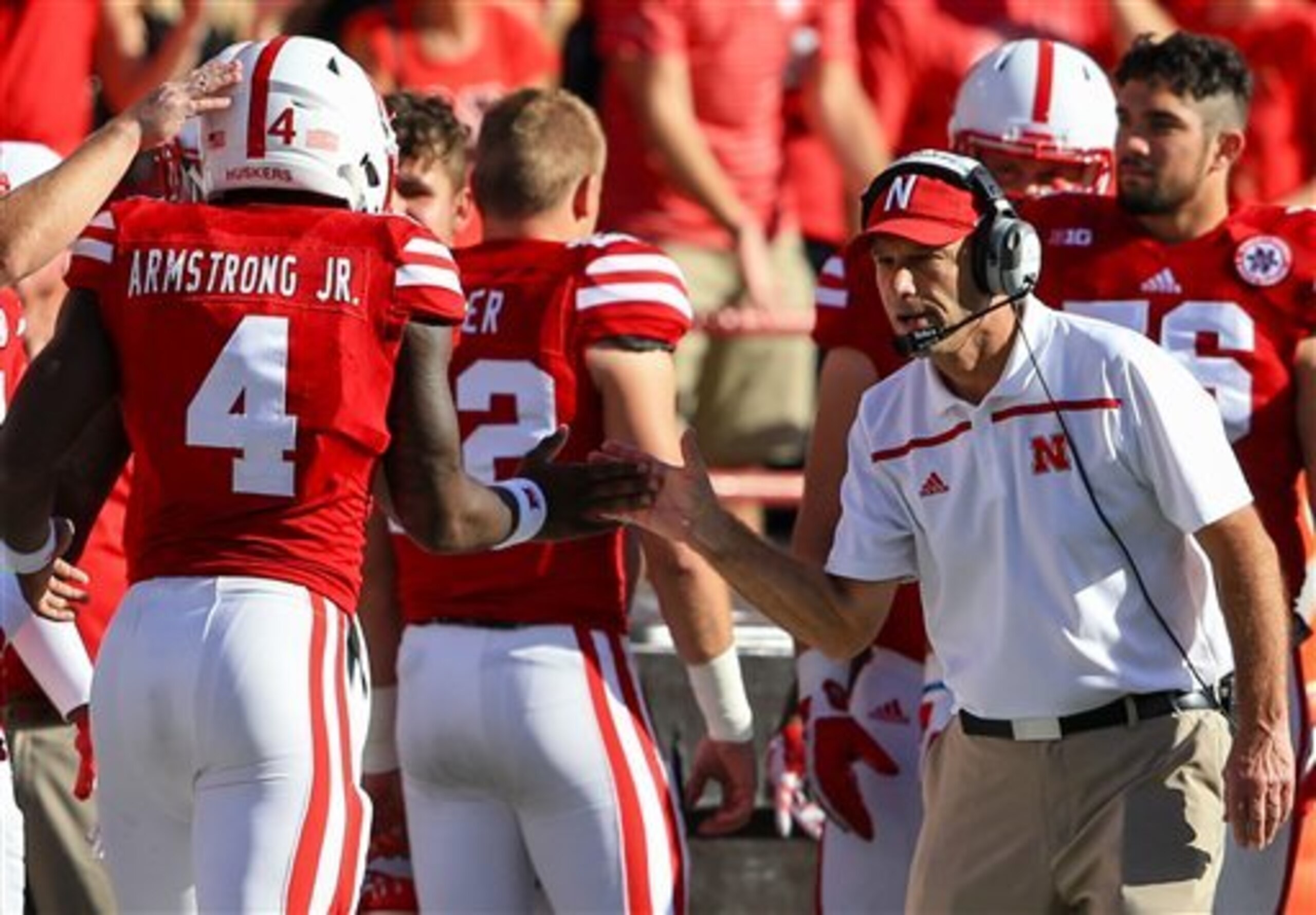
The second year of Mike Riley's offense
Mike Riley's Oregon State teams rarely disappointed on offense, and we got to see the start of what he could do in his first season as head coach of Nebraska. The Cornhuskers averaged 32.8 points and the 3,470 passing yards were their most since 2008, and that was with only one offseason to get things implemented.
Look for quarterback Tommy Armstrong to perform even better in 2016 during his senior year, and if he's able to run the ball more and also get dynamic athlete De'Mornay Pierson-El back from injury, the Huskers will be tough to stop.
Under Riley, Sean Mannion finished as the Pac-12's all-time passing leader.
North Carolina
34 of 66
Ryan Switzer
As a freshman in 2013, Ryan Switzer set the FBS single-season record with five punt return touchdowns. He added two more this past season, putting him within one of the career mark entering his senior year.
But that's not all that the 5'10”, 185-pound Switzer is good at, as he's been North Carolina's top receiver the past two seasons in terms of receptions in addition to his return duties. He has 148 career catches, with 13 TDs, and overall he has 2,860 all-purpose yards in three seasons.
North Carolina State
35 of 66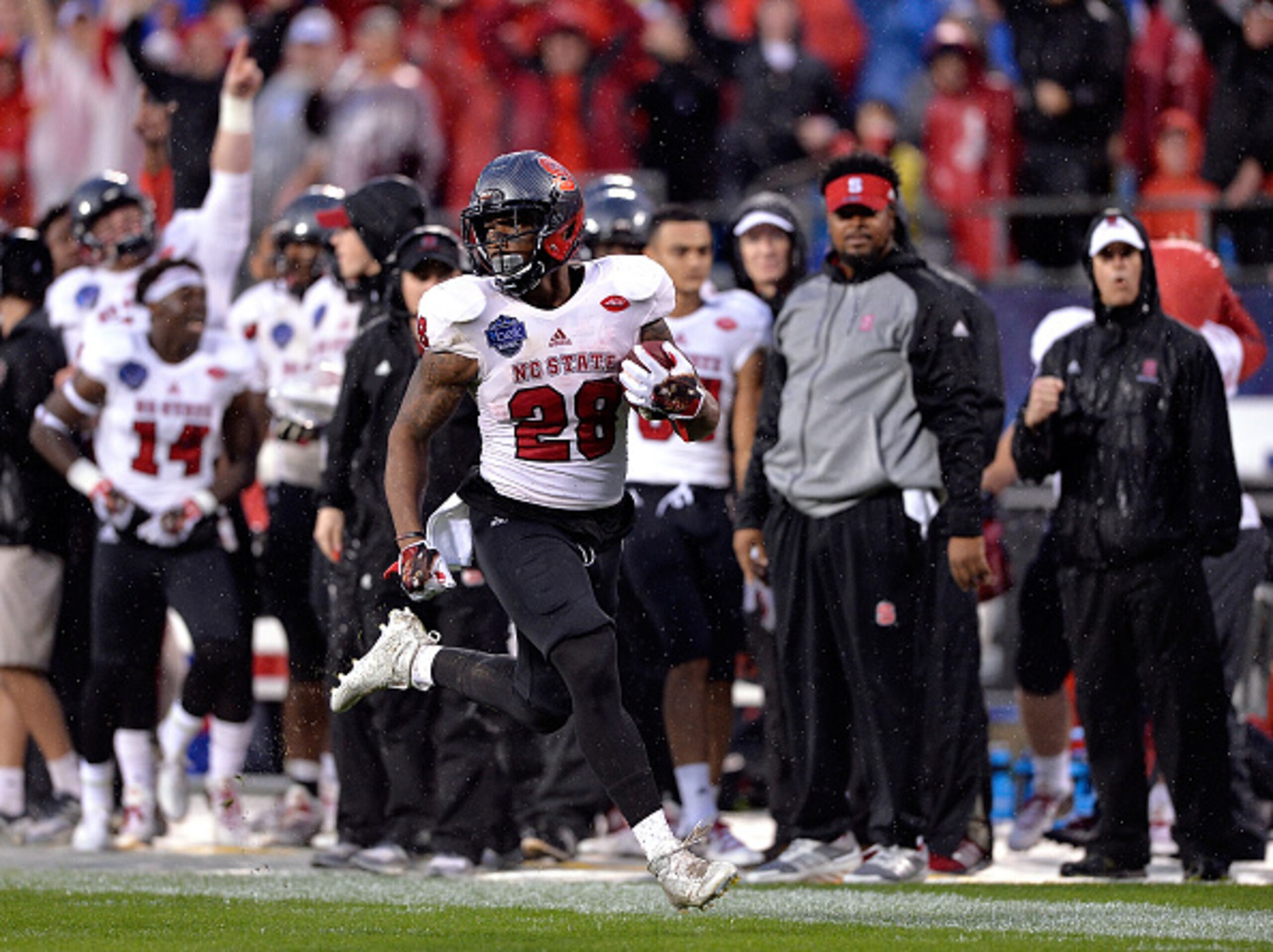
Jaylen Samuels in the red zone
One of 29 FBS players who scored at least 16 touchdowns last season, Jaylen Samuels was North Carolina State's top receiver with 65 catches and nine TDs while also scoring seven times on the ground. Listed as a tight end, the 5'11”, 236-pound sophomore was just as valuable running the ball as having it thrown to him.
And when he got inside the red zone, he was as dangerous as they come.
Samuels caught four TD passes (on nine receptions) and turned eight of his 15 red-zone carries into scores. His play close to the goal line helped NC State scored TDs on more than 72 percent of its red-zone possessions, which was 10th-best in the country.
Northwestern
36 of 66
Anthony Walker
Northwestern ranked 13th in total defense and 12th in scoring defense in 2015, leading to the program's second 10-win season in the last four years. The Wildcats have to replace more than half of their defensive starters, but not the best of the list.
Anthony Walker, a 6'1”, 235-pound linebacker, had 120 tackles and led the Big Ten with 20.5 tackles for loss. He also had four sacks, an interception and two fumble returns, one that he returned for a touchdown in a win over Minnesota.
Now a junior, Walker is one of the most underrated defenders in the country but one who cannot be ignored.
Notre Dame
37 of 66
Brian Kelly's dedication
After a career that had seen him make some quick jumps up the coaching ranks, Notre Dame seems to be where Brian Kelly wants to stay. Despite regularly being mentioned as a candidate for an NFL job, Kelly is headed into his seventh season with the Fighting Irish, as many as he had at previous stops Central Michigan and Cincinnati.
And now Kelly has a new contract, having been extended through 2021.
"By giving Kelly six more years, Notre Dame is going hands off and letting him continue to build his program the way he wants to build it," Bleacher Report's Ben Kercheval wrote. "After taking the Irish to one national championship [game] and within a few points of a playoff appearance, he's earned that much trust."
With 226 career wins, including 118 at the Division II level, Kelly is the winningest active coach in FBS.
Ohio State
38 of 66
A full season of J.T. Barrett
J.T. Barrett has been Ohio State's best quarterback option each of his two seasons in college, yet that's only amounted to 17 starts out of 28 games. He missed the Buckeyes' playoff run in 2014 after breaking his ankle. Last year, he had to split time with Cardale Jones for the first few months before earning back his starting spot.
There are no more hurdles standing in Barrett's way as 2016 approaches, and this above all else is why OSU's losing so many key players isn't causing much worry. In fact, the Buckeyes are considered by Odds Shark as the favorites to win the 2017 national title.
“For the first time since arriving at Ohio State three years ago, Barrett is spending his winter as the undisputed starting quarterback, despite already being one of the program's few known on-field commodities entering 2016,” Bleacher Report's Ben Axelrod wrote.
Barrett did not appear in two games in 2015 and had a total of six runs or passes in two others yet still managed to account for 1,674 yards of total offense and 22 touchdowns. In 10 games as a redshirt freshman, he had 3,772 yards of total offense with 45 total scores.
Oklahoma
39 of 66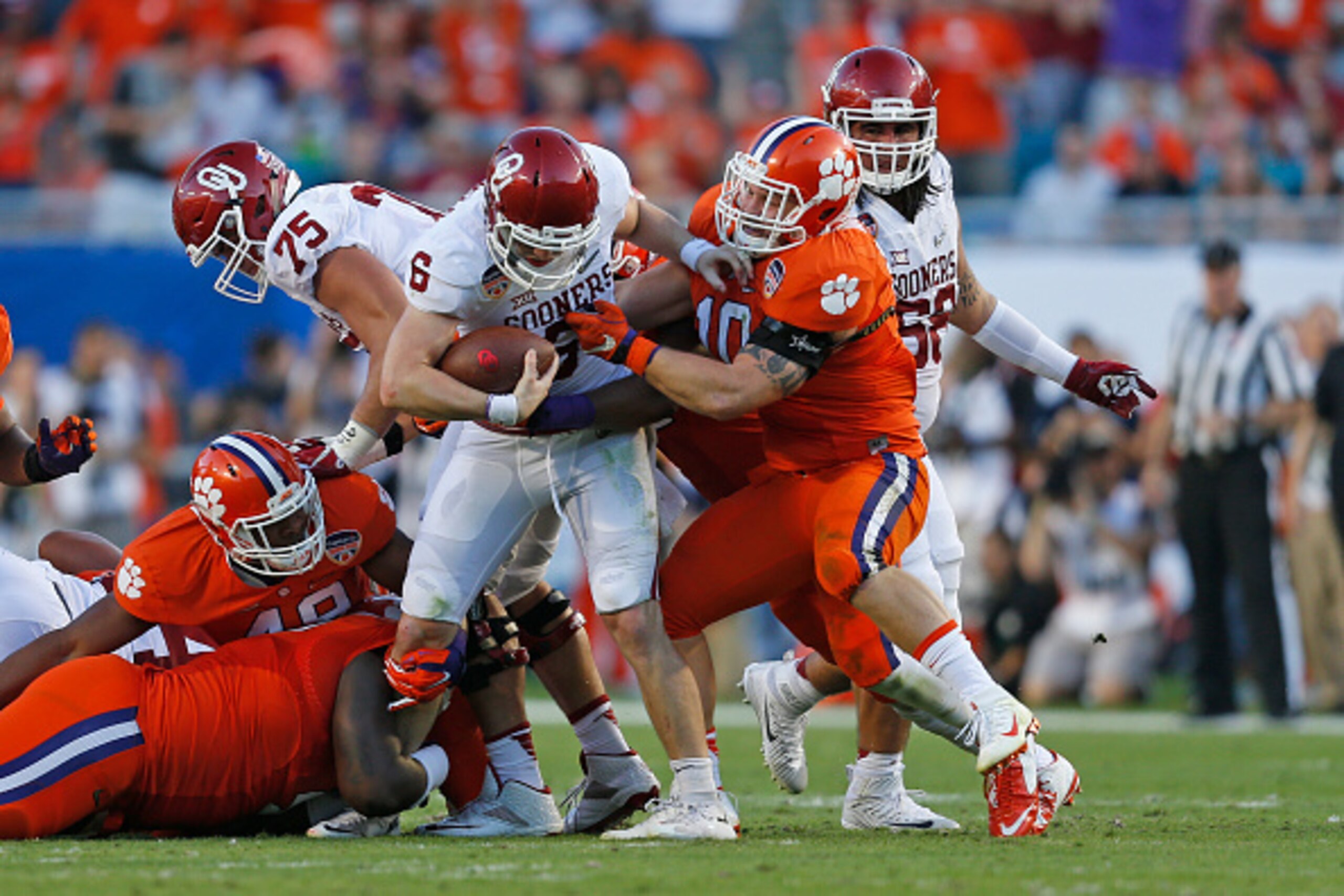
Baker Mayfield's fire
His statistics were great on their own, but Baker Mayfield's most important contribution to the 2015 season was the way he riled up his teammates (and himself) on nearly every play. This often came off as being cocky or arrogant, but he rarely failed to back up the talk with performance.
After having to sit out the 2014 season following his transfer from Texas Tech, Mayfield erupted for 3,700 passing yards, 36 touchdown passes and another seven rushing scores. And when he wasn't throwing the ball or running with it, he was clearing the way for his teammates with the kind of blocks that quarterbacks aren't known for.
Mayfield used his departure from Texas Tech (as well as watching his teammates get blown out by Clemson in the 2014 Russell Athletic Bowl) as motivation for last year, and now he'll use falling to the Tigers in the Orange Bowl as fuel for his final season.
Oklahoma State
40 of 66
Pistol Pete
Oklahoma State averaged 39.5 points and 480 yards per game last season, and similar numbers are possible in 2016. The Cowboys could also strike fear in opponents on the defensive side if they can find replacements for Jimmy Bean and Emmanuel Ogbah up front.
But nothing will be as scary for foes as knowing OSU's creepy mascot lurks somewhere on the sidelines.
In ranking him as the third-scariest college football mascot, CBS Sports' Tom Fornelli wrote that Pistol Pete's face hides a dark secret “that you aren't meant to figure out.”
Add in the fact his game-day duties include riling up an OK State crowd that includes a group of people who smack paddles against a wall, and it's just an all-around harrowing experience when visiting Stillwater.
Ole Miss
41 of 66
Chad Kelly's mobility
It only took one season for Chad Kelly to re-write Ole Miss' record book, setting new marks for passing yards (4,042), total offense (4,542) and total touchdowns (41) while helping the Rebels to 10 wins and the Sugar Bowl victory. What will he be able to accomplish in a second year running the offense?
Much will depend on how much he gets to run with the ball as a senior. Though not a true dual-threat passer, Kelly has the mobility to avoid the rush—he was only sacked 18 times in 2015—and can pick up key yards when necessary. His 500 rushing yards were second-most on the team, and seven of his 10 TDs on the ground came in SEC play.
Over his final four games, Kelly ran for 340 yards and six TDs, accounting for more than 40 percent of Ole Miss' rushing output and more than half of its rushing TDs.
Oregon
42 of 66
The running back corps
Royce Freeman is the big name in the backfield for Oregon, having rushed for 1,836 yards and 17 touchdowns last year and more than 3,200 in two seasons, but he's far from all the Ducks have at their disposal on the ground. In 2015, they averaged 279.9 rushing yards per game, fifth best in the country, thanks to several other capable runners.
And all of them pick up yards in bunches, as Oregon's four most used running backs all gained at least 6.49 yards per carry last season. That was Freeman's rate, while freshmen Tony Brooks-James and Taj Griffin and sophomore Kani Benoit were all at rates of 7.0 or better.
The varied backfield helped make up for the quarterback position not being as mobile as in the past. Vernon Adams Jr. didn't run nearly as much as predecessor Marcus Mariota, but the latest transfer (Montana State's Dakota Prukop) leans back toward dual-threat status.
Regardless of how the QB runs, Oregon has plenty of other options when it comes to the ground game.
Oregon State
43 of 66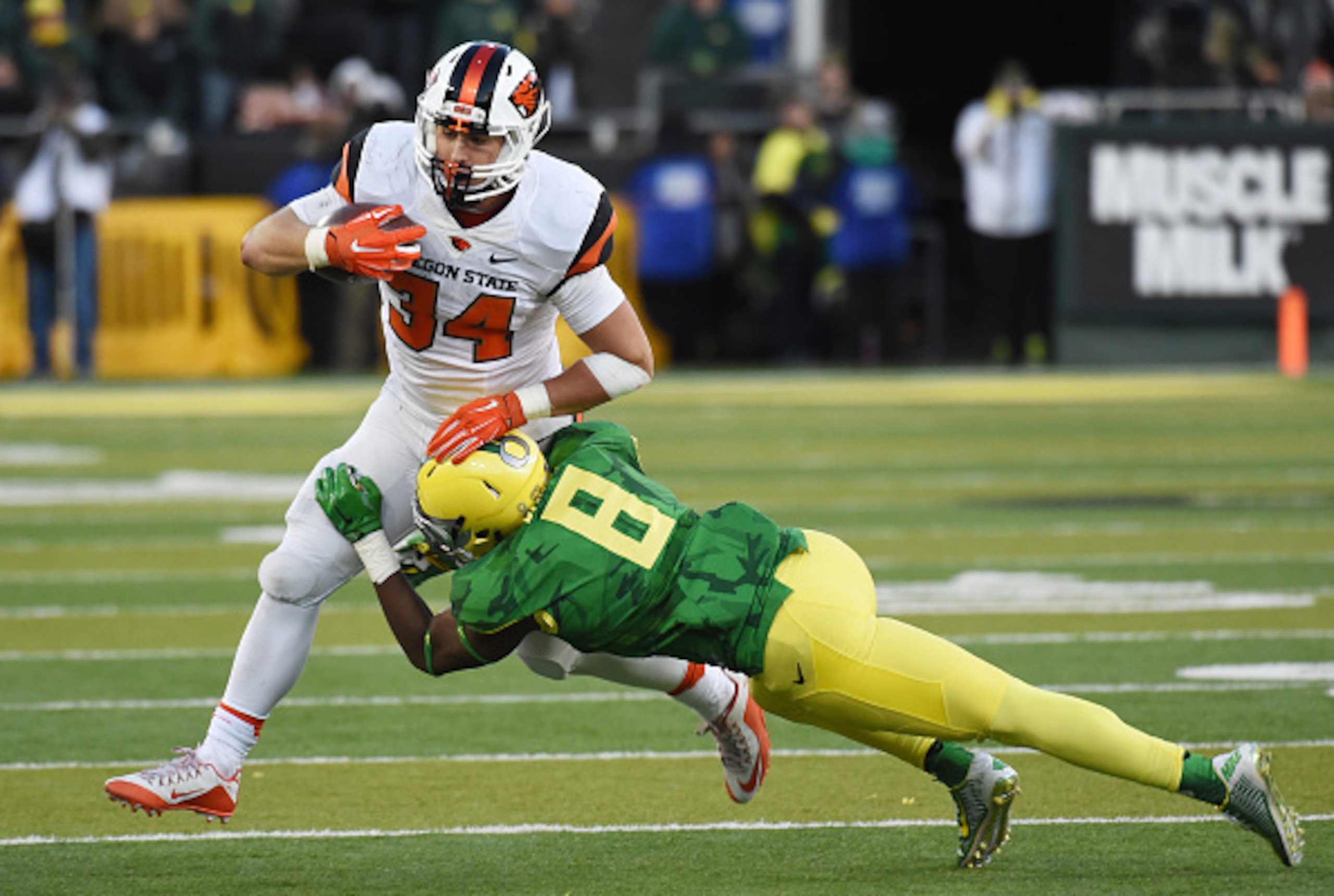
The run-game diversity
Oregon State finished in the middle of the pack nationally in rushing in 2015, with its 177.3 yards per game good for 60th out of 128 FBS teams. What made the Beavers' approach to the ground game unique, though, wasn't how much or how well it ran the ball but who it handed off to.
Only 134 carries last season were by true running backs, with now-graduated Storm Woods getting the bulk of those. The rest was the product of quarterbacks (159), wide receivers (61) or tight ends (73).
No, that last part is not a typo. Ryan Nall, listed as a tight end at 6'2”, 255 pounds, was third on the team in rushing with 455 yards and three touchdowns on 73 carries. Top gainer Seth Collins, a quarterback, has transferred, but the same approach should continue this season and leave opponents having to keep an eye on every bit of pre-snap movement to figure out who might run the ball.
Penn State
44 of 66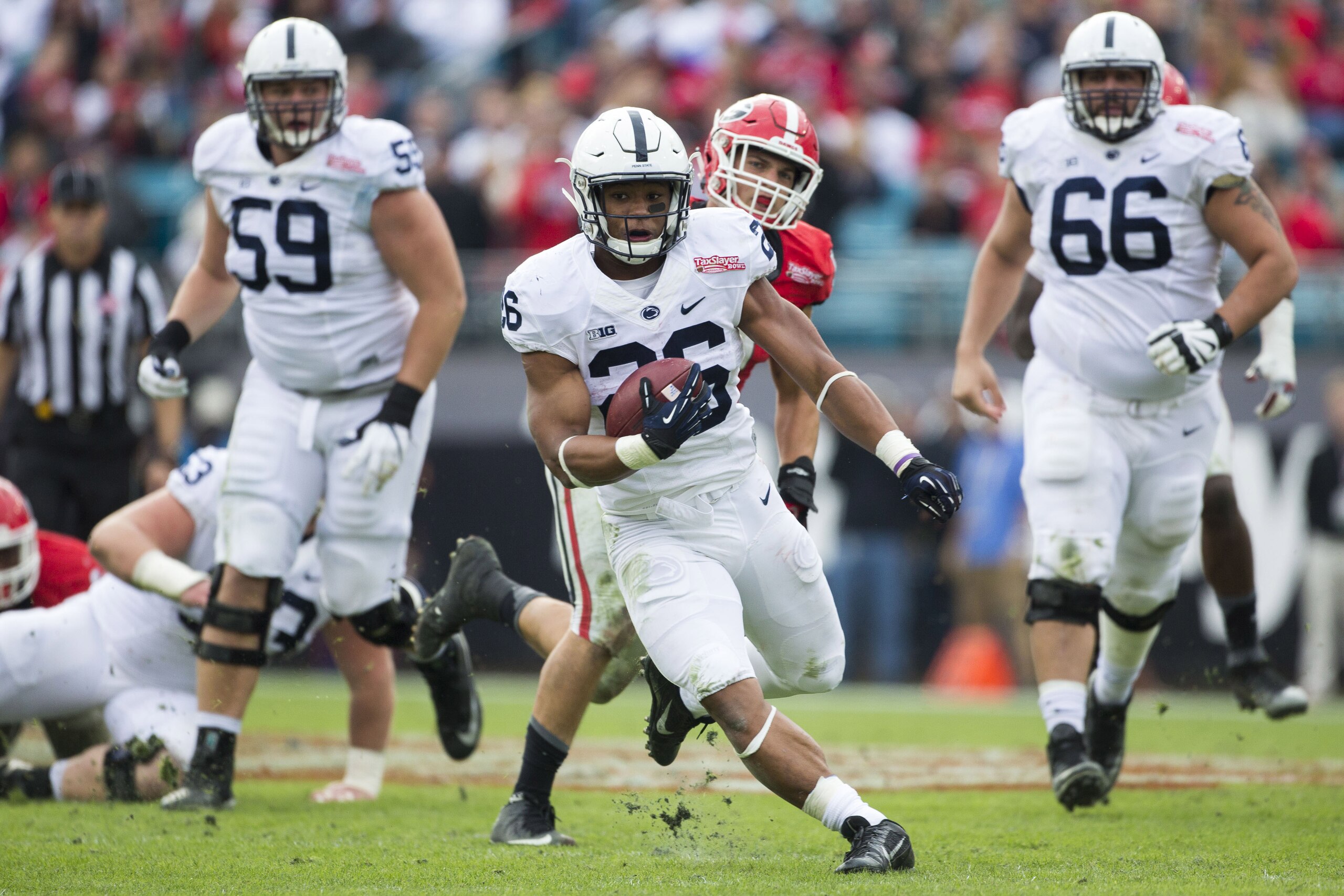
An offense built around the run
Christian Hackenberg has left Penn State, as had been projected since early in his freshman year, so coach James Franklin had to have been planning for 2016 for some time. Indications are this means the Nittany Lions will become more focused on the run game, which has been on the bottom end of the national rankings the last two seasons but is poised for a big jump.
Much of that will be because of the development of Saquon Barkley, who ran for a team-high 1,076 yards with seven touchdowns last season. No other PSU player had more than 282 yards.
Barkley had five 100-yard games as a freshman, but injuries also slowed him. This year, he'll have help in the backfield in the form of Miles Sanders, the top running back recruit from the 2016 class (per 247Sports).
Pittsburgh
45 of 66
A driven James Conner
A knee injury kept James Conner out of the 2015 season, but neither that nor a recent diagnosis of Hodgkin's lymphoma is going to prevent Conner from making his return this fall. That kind of dedication is inspiring to everyone, but it should also strike fear into Pittsburgh's opponents when they have to deal with Conner.
The 6'2”, 240-pounder had his junior year cut short after eight carries and 77 yards last September. Then, in December, he announced his diagnosis. He's now balancing treatment and rehabilitation as he works to come back for 2016, with the hope he can return to the form that saw him lead the ACC in rushing two years ago with 1,765 yards and a school-record 26 touchdowns.
"The doc says most people after chemo lay down and veg on the coach and don’t move," Pitt coach Pat Narduzzi told ESPN's Andrea Adelson. "This guy is a different deal. He’s going to beat cancer's [butt], that’s his goal."
Once he's done with that, expect him to do the same to opposing defenses.
Purdue
46 of 66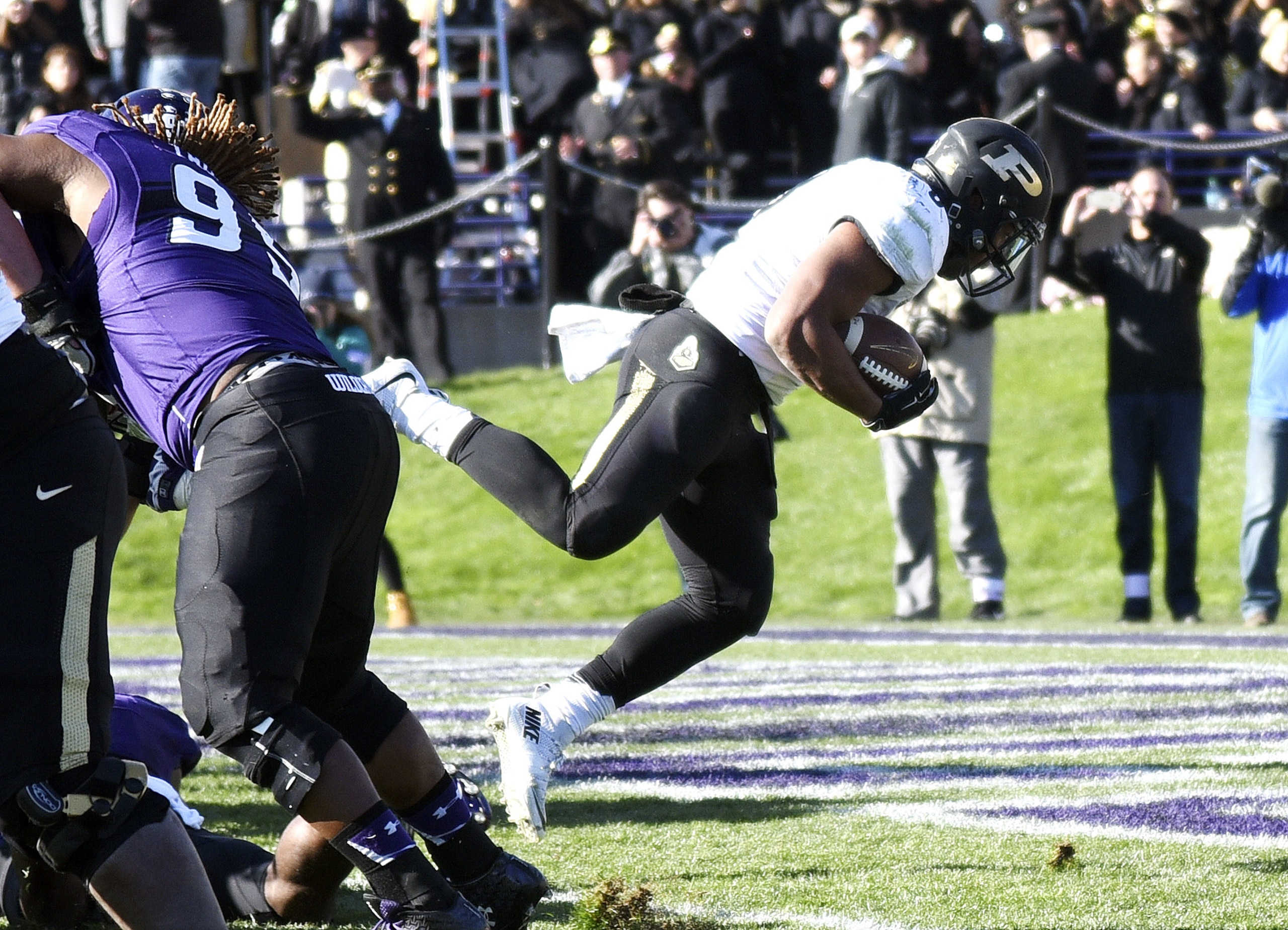
Markell Jones' promise
Amid a 2-10 season, there wasn't much that went well for Purdue in 2015, though Markell Jones' emergence as a go-to ball-carrier at least provides some hope for the future. His effort as a freshman is something the Boilermakers can build on, and something coach Darrell Hazell should try to maximize if he wants to keep his job.
The 5'11”, 207-pound Jones ran for 875 yards and 10 touchdowns while averaging 5.21 yards per carry last season. However, he only got 20-plus carries in three games, as Purdue was constantly playing from behind and had to abandon the run. Jones contributed in that area, too, with 34 catches (third most on the team).
Rutgers
47 of 66
Janarion Grant with the ball in his hands
Janarion Grant was Rutgers' most explosive athlete last season, accounting for more than 1,500 all-purpose yards in a variety of ways. The bulk of his yardage came on kickoffs, but he was just as deadly on offense and also showed a penchant for returning punts.
The 5'11”, 170-pound Grant was responsible for six touchdowns via four different approaches in 2015. He had three kickoff returns, a receiving score, a passing TD and a punt-return TD. In September, he brought back TDs against Washington State on both punt and kick returns, finishing that game with a school-record 337 all-purpose yards.
Grant is Rutgers' career leader in kickoff return yardage, with 2,409 yards to go with four scores.
South Carolina
48 of 66
Will Muschamp's second chance
It was only two years ago that Will Muschamp was entering what would be a lame-duck season as Florida's head coach—his fate decided later that year after offensive woes continued to mount and the wins weren't frequent.
Now, he's back in charge of a program, and with the Florida experience still fresh in his mind, it's hard to imagine he'll not be giving it his all right away at South Carolina.
That includes being dedicated to an uptempo offense—something he witnessed while working in 2015 as Auburn's defensive coordinator.
"The more times you snap it, the better chance you have to score," Muschamp said, per the Associated Press (h/t ESPN). "I have figured that out."
The wins might not be there in that first season, but expect South Carolina to still give opponents a tough fight as it tries to embody its new coach's intensity.
Stanford
49 of 66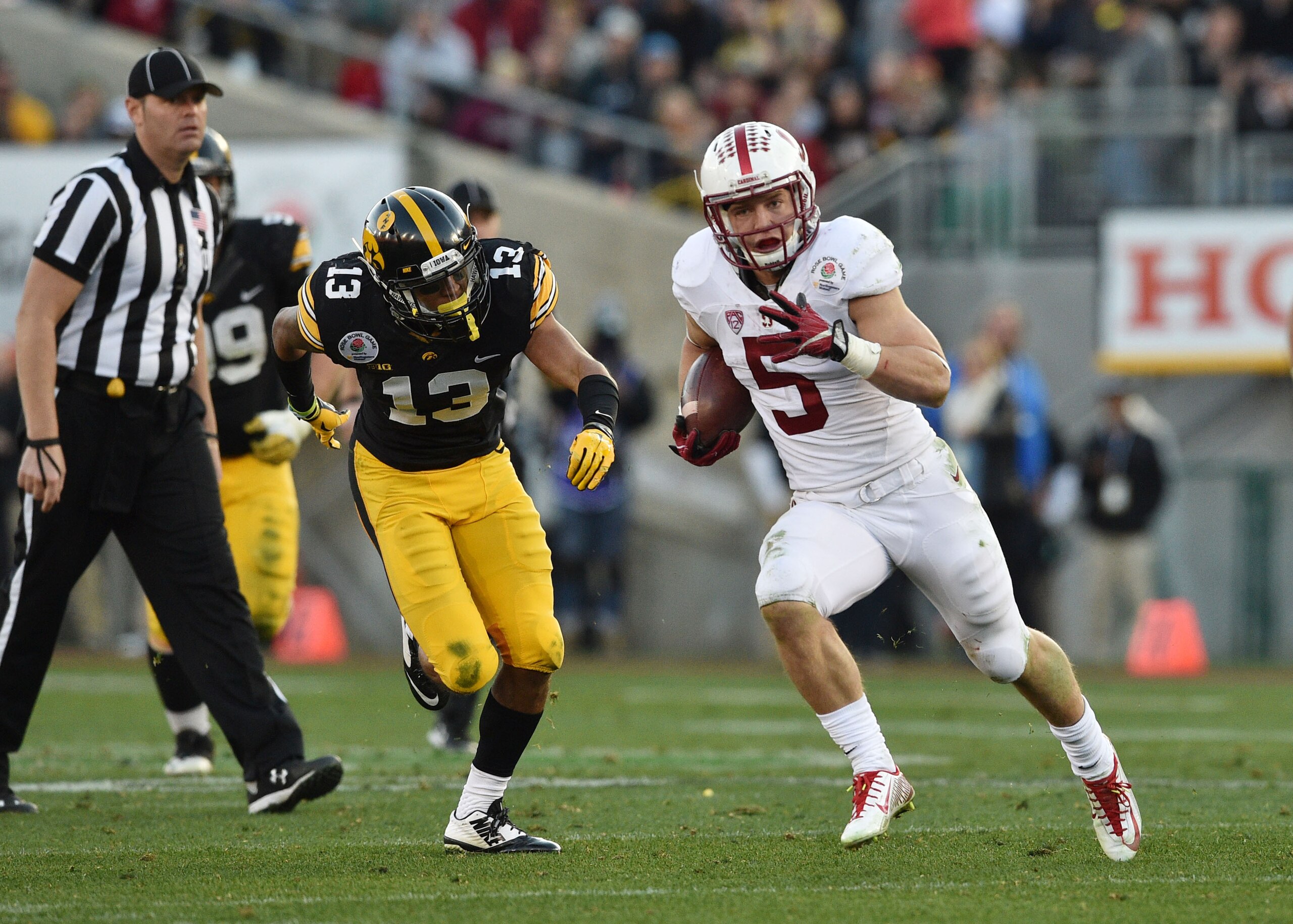
Christian McCaffrey
Far from the most physically imposing player in the country, Christian McCaffrey is listed at 6'0” and 201 pounds but plays much bigger. And faster. And stronger. And scarier.
The sophomore holds the FBS single-season all-purpose yardage record by a wide margin, having gained 3,864 yards last season. He did this most as a running back, going for 2,019 yards, but he was also Stanford's most targeted receiver, with 45 catches for 645 yards, and then there were his exploits as a return man.
McCaffrey had a TD apiece as a punt and kick returner, and to top it all off, he also threw two TDs (including one to outgoing quarterback Kevin Hogan).
Syracuse
50 of 66
Dino Babers' offense in a dome
It has been a fast rise up the coaching ranks for Dino Babers since he earned his first head job. After spending 28 years as an assistant—including the last four with Baylor—he was hired by FCS school Eastern Illinois in 2012. His two seasons there were full of wins and big offensive numbers, as were the next two years at Bowling Green.
That helped him land a power-conference gig this offseason at Syracuse, which hasn't been known for offensive prowess in quite some time. Now the Orange could be in store for a major boom in production, and Babers' explosive scheme could somehow get better now that it will be played mostly indoors.
Syracuse plays its first three games this season in the Carrier Dome, including against bowl teams Louisville and South Florida.
TCU
51 of 66
Kenny Hill
Losing quarterback Trevone Boykin to graduation is a major blow to the TCU offense, but a succession plan has been in place for a while—ever since the Horned Frogs picked up a key transfer who has shown success operating an uptempo offense for another Texas-based program.
Kenny Hill was one of the early darlings of the 2014 season, known frequently as Kenny “Trill” after he led Texas A&M to a 5-0 start that included 511 passing yards in his first start and 23 touchdown passes in his first seven games. But once the Aggies started to lose, he fell out of favor and eventually lost his starting job following a suspension for team rules violations.
He sat out the 2015 season, per NCAA rules, but that meant he had an entire year to get comfortable with the system co-offensive coordinators Sonny Cumbie and Doug Meacham have in place at TCU. Boykin thrived in it for two years, and Hill can do the same if he can regain his old form.
Tennessee
52 of 66
Immense experience at nearly every position
Tennessee will again be one of the most experienced teams in the country in terms of returning starters in 2016, with PhilSteele.com projecting 17 coming back. That number was 18 heading into the 2015 season.
The youth movement that coach Butch Jones has implemented in his three years with the program is such that the Volunteers will get to spend much of this offseason tinkering and improving rather than teaching and tutoring. This should translate into better in-game decision-making, which for Vols fans hopefully means fewer of the problems that plagued the team early last season in the form of several blown leads.
Quarterback Joshua Dobbs will be entering his second season as the full-time starter, though he's been playing since his freshman year. The running back corps is experienced, both lines have depth, and even the secondary—which lost two starters—won't be thin because of players who saw time in 2015 moving into larger roles.
Texas
53 of 66
The third year of Charlie Strong
Former Louisiana-Monroe coach Todd Berry had one of the best quotes ever to describe the process it takes to build a program after taking over. In 2012, he said "the first year it sleeps, the second year it creeps, the third year it leaps" (h/t SB Nation), meaning that the third season of a regime is when the real results should happen.
Berry went 8-5 with ULM in 2012, his third year in charge. That was the Warhawks' most wins ever at the FBS level.
Charlie Strong is entering his third year with the Longhorns, having gone an unimpressive 12-14 to this point, but all of the work so far has been leading to 2016. A third straight strong recruiting class has Texas' roster stocked with talent, particularly on the defensive side, and the culture Strong worked hard to instill early on has become ingrained.
Now all Texas has to do is win, which is certainly the hardest part of the process Berry was describing.
Texas A&M
54 of 66
Myles Garrett and his defensive linemates
Defense isn't what you first think about with Texas A&M since Kevin Sumlin became coach in 2012, unless you're referring to bad defense. The Aggies have yet to rank in the top 50 nationally in total defense during Sumlin's tenure, but under new coordinator John Chavis, the 2015 version was the best yet.
And it's only going to get better, since Myles Garrett is entering what figures to be his final (junior) season in college and he's joined by several other notables from last year.
Garrett was the star with 12.5 sacks and 19.5 tackles for loss, but there's also Daeshon Hall (14.5 TFLs) on the other edge and Daylon Mack (9.5 TFLs) coming off a strong freshman year in the middle. A&M tied for third nationally in TFLs last year, and only 12 of those 111 tackles were made by seniors.
Texas Tech
55 of 66
Patrick Mahomes II
The national leader in total offense last season, Patrick Mahomes tallied 5,109 yards and was responsible for 46 touchdowns. Texas Tech needed every one of those scores just to get to seven wins, since its defense was atrocious.
Mahomes' mobility and arm strength made him a deadly dual-threat player in 2015, though not one without flaws. He was intercepted 15 times, among the most for a full-time starter at the FBS level, and he also lost a pair of fumbles. Many of those turnovers were the result of trying to do too much, knowing the Red Raiders needed to score on every possession to keep up with the defense.
A two-sport athlete, Mahomes is focusing solely on football after having spent last spring going back and forth with baseball. With the extra dedication, his junior year should be the best one yet.
UCLA
56 of 66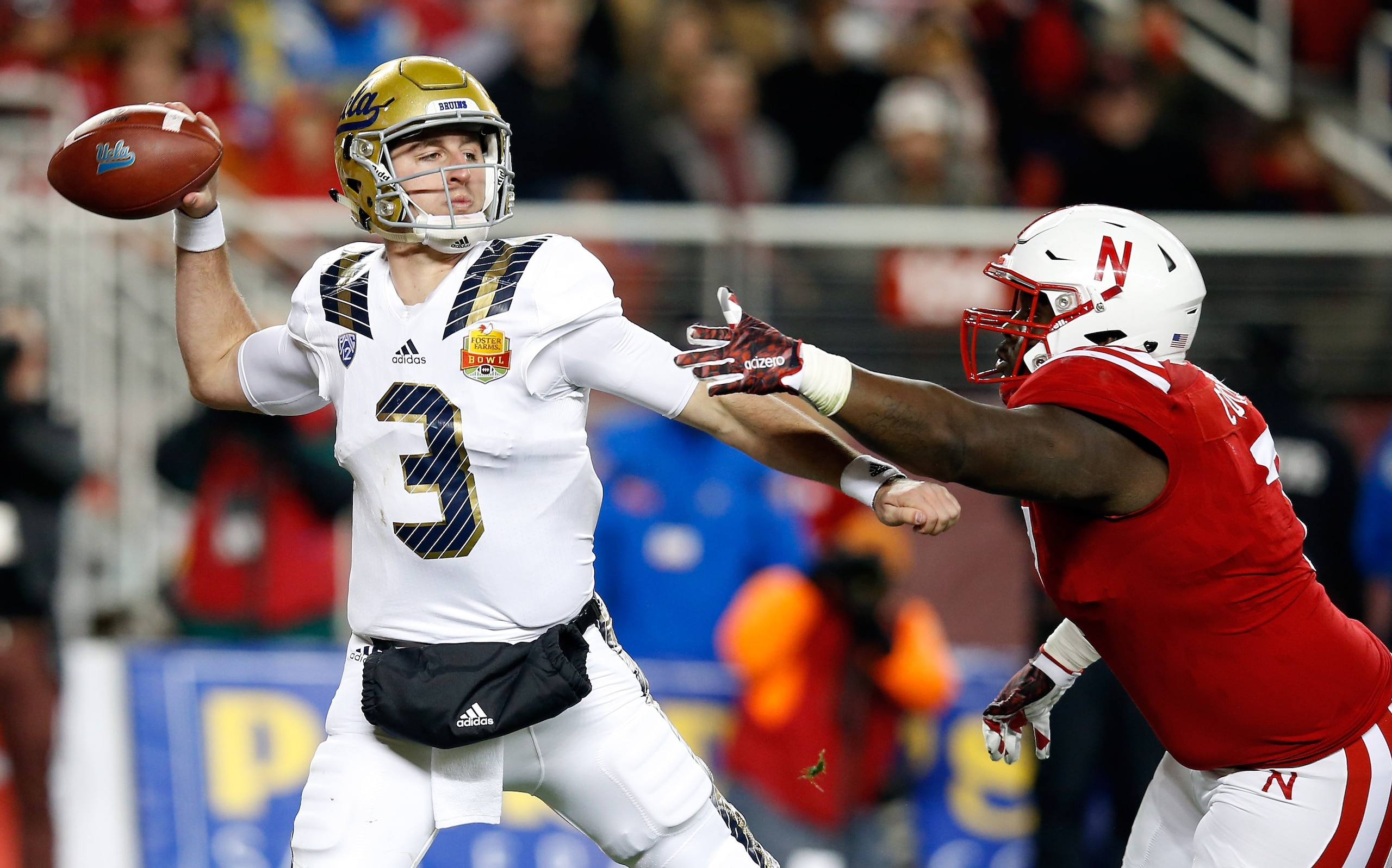
Josh Rosen's sophomore year
Coaches love to say that the biggest improvement usually comes between a player's first two seasons, which has to be absolutely terrifying for the 12 teams on UCLA's 2016 schedule. That means the true freshman quarterback they'll watch on tape of the Bruins, the one who lit up defenses across the country last season, is only going to get better.
Rosen threw for 3,669 yards and 23 touchdowns in 2015, though he did have some freshman moments. He was intercepted 11 times, with four multi-pick games, and four of those interceptions came in UCLA's final two contests (losses to USC and to Nebraska in the Foster Farms Bowl).
There's plenty of room for improvement for Rosen, who was the top-rated quarterback in the 2014 recruiting class, according to 247Sports, and if the old adage about going from the freshman to sophomore year holds up, then UCLA's foes are in for some tough times.
USC
57 of 66
Adoree' Jackson's versatility
Adoree' Jackson hasn't managed to score a touchdown in every way possible, but he's getting there. In two seasons, the two-way star has crossed the goal line 10 times in four different ways: punt return, kickoff return, reception and interception.
Jackson starts in USC's secondary and has also done so at receiver, sometimes in the same game. He also takes the bulk of the Trojans' kickoff and punt returns. Maybe in 2016 they'll have him more involved in the rushing attack, taking advantage of his speed on sweeps and end-arounds, or even test out what his arm is like and have him throw a pass.
USC already knows it can turn to Jackson in a pinch in the kicking game. Last August, he booted a field goal during a practice.
Utah
58 of 66
Andy Phillips' range
Utah's rise to a legitimate contender status in the Pac-12 has come through a variety of improvements, the least appreciated of which was in special teams. Now-departed punter Tom Hackett won the last two Ray Guy Awards, and kicker Andy Phillips has been a semifinalist for the Lou Groza in all three of his college seasons.
Phillips has also been nearly automatic with field goals in his career, having made 84 percent (63 of 75), including 29 of 38 from 40 yards and longer. Push him to 50 yards and beyond, and he's a perfect 4-of-4 with a long of 53 yards.
The Utah offense will be getting an overhaul this season with a new quarterback and new running back, but knowing Phillips can convert from almost anywhere in plus territory is heartening.
Vanderbilt
59 of 66
Nigel Bowden's return
Vanderbilt's leading tackler as a redshirt freshman in 2014, Nigel Bowden suffered a concussion in the second game of last season and never returned. It was a big blow to the Commodores defense, though with Bowden a full go when spring practice started on Monday, that's all in the past.
Bowden won't automatically get his job back, though, as Vandy made do without him in 2015 thanks to the strong play of sophomore linebacker Zach Cunningham. Cunningham had 103 tackles, 16.5 tackles for loss and 4.5 sacks, all of which led the team.
That pairing will work well together and help the Commodores replace the production lost by linebacker Stephen Weatherly's turning pro.
Virginia
60 of 66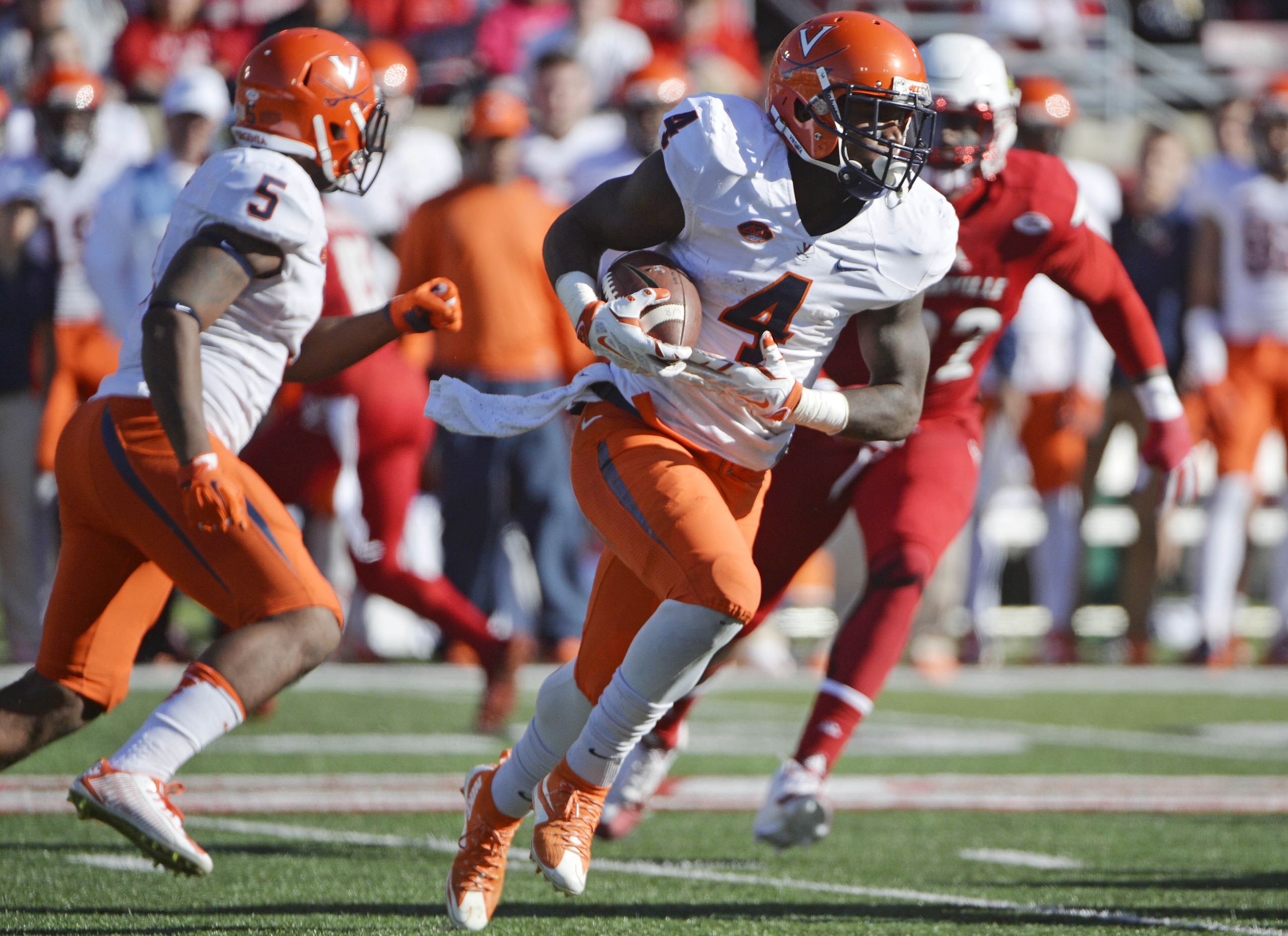
Smoke Mizzell's moves
His real first name is Taquan, but Mizzell is worthy of his nickname for how elusive he's been for Virginia. Last year, he took that to the extreme by serving as the Cavaliers' leading rusher and receiver.
The 5'10”, 195-pound Mizell had 664 rushing yards and also caught 75 passes for 721 yards, scoring four times each way. He had a 100-yard rushing game against North Carolina and topped the century mark in receiving yards two others times.
Mizell should benefit from the offensive scheme that new coach Bronco Mendenhall will be putting in, which means he'll be even more of a nuisance for Virginia's opponents.
Virginia Tech
61 of 66
Bud Foster's defense
Virginia Tech has undergone a changing of the guard, with someone other than Frank Beamer in charge for the first time since the mid-1980s. But it won't be an entirely new staff in Blacksburg, as Justin Fuente wisely retained longtime defensive coordinator Bud Foster to provide consistency on that side of the ball.
Foster has been with the Hokies since 1987 and the program's top defensive assistant since 1995. Many years saw them rank at or near the top in almost every defensive statistic.
"Foster not only ensures Fuente will have a dependable coach managing the defense, which should remain one of the top defensive units in the ACC as long as he stays put," NBC Sports' Kevin McGuire wrote.
With Fuente from the offensive school, the pair can essentially be co-head coaches. With that in mid, Foster's official title in 2016 will be associate head coach along with D-coordinator and linebackers coach.
Wake Forest
62 of 66
Low-scoring games
Wake Forest has only won twice in the ACC since Dave Clawson arrived before the 2014 season, yet in both of those games, the Demon Deacons failed to score a touchdown. They won 3-0 at Boston College last October, and the year before squeaked out a 6-3 victory against Virginia Tech in double overtime after the game was scoreless through regulation.
Defense is all Wake has had to show for itself under Clawson, allowing only 10 opponents in that time frame to top 30 points. Unfortunately, the Deacons have only gotten to the 30-point mark once in the last two years—in their 41-3 win over FCS Elon to open the 2015 season.
Washington
63 of 66
The best young quarterback/running back duo in FBS
Washington started true freshmen at both positions in 2016, a risky move that could have made for a very lean season if one or both didn't produce. There were some bumps, but by year's end, the pairing of quarterback Jake Browning and running back Myles Gaskin was clicking on all cylinders.
And they'll be playing together for at least two more seasons. Let that marinate a little, Pac-12 teams.
Browning threw for 2,955 yards and 16 touchdowns, while Gaskin finished with 1,302 yards and 14 scores. ProFootballFocus named both of them to its True Freshman All-America team even before their strong performances in the Heart of Dallas Bowl, when Gaskin ran for 181 yards and four TDs, and Browning was 23-of-34 for 284 yards.
Washington State
64 of 66
Almost the entire offense is back
Washington State's passing attack averaged an FBS-best 389.2 yards per game last season, with quarterback Luke Falk throwing a school-record 38 touchdowns while completing 69.4 percent of his 644 throws. The Cougars completed 500 total passes, and the recipient of all but 92 of those are back for 2016.
That includes Gabe Marks, who had 104 catches and 15 TDs as a junior, along with six other players who had at least 30 receptions. Three of those were running backs, who contribute more as pass-catchers than rushers but who did help WSU more than double its rushing average from 2014.
Mike Leach's high-flying offense is best when experienced players are operating it, and the Cougars will be among the most veteran teams in the country this year.
West Virginia
65 of 66
Dana Holgorsen's short leash
Dana Holgorsen's job status was up in the air toward the end of the 2015 season, until athletic director Shane Lyons announced in December that he'd be back for another year. His contract is through 2017, and as of now, there aren't any plans to extend it.
According to Mike Casazza of the Charleston Daily Mail, talks between Holgorsen and the school on a new contract have ended. That means the coach can't give future recruits the assurance that he'll be there much longer while also putting this upcoming season in a different light.
One that could go either way, depending on how Holgorsen and his players approach it. If they treat it like an audition, West Virginia could play with a drive that will help it surpass five Big 12 wins for the first time. And if the Mountaineers struggle, then late in the season, they'll have nothing to lose and become an even more dangerous opponent.
Wisconsin
66 of 66
A healthy Corey Clement
Wisconsin had its worst team rushing performance in a decade, gaining less than half it did in 2014 when Melvin Gordon had 2,500-plus yards on his own. Gordon's production was supposed to be mostly filled by Corey Clement, who had nearly topped 1,000 yards as a backup, but injuries wiped out almost all of last season.
Clement only played in four games but still had 221 yards and five touchdowns, going for 115 yards and three TDs against Rutgers on Halloween after having missed the previous seven games.
"Clement’s ability to make people miss with his shiftiness and breakaway speed separates him from the majority of running backs in college football," wrote Erik Buchinger of Fansided.
Follow Brian J. Pedersen on Twitter at @realBJP.

.jpg?w=2560 "NFL investigating 2 referees for separate viral exchanges")
.jpg?w=2560 "Report: Chiefs Contact Hill's Agent")
.jpg?w=2560 "OBJ Calls Out Giants 😳")
.jpg?w=2560 "Tyreek makes another cryptic post amid Chiefs rumors")