Despite High Injury Numbers, New York Giants Not as Bad off as in the Past
It sure is good when a team is on top, isn’t it?
Well, not unless you're talking about injuries, something the New York Giants, who currently sit atop the NFC East after five weeks of play, are all too familiar with.
According to Football Outsiders, the Giants were the undisputed injury champions when it came to average games lost in 2013 and 2014.
TOP NEWS
.jpg?w=2560 "Titans Giants Football")
OBJ Calls Out Giants After Release
.jpg?w=2560 "Saints Lions Football")
Rap: Lions, LaPorta End Contract Talks

Live Live: Updates from every NFL game
Despite the steady increase in the Giants' 2015 weekly injury report, the team is actually not yet on a path toward implosion and is, in fact, better off than some of the other teams in the NFL.
This analysis will look at some key injury-related statistics to determine where the Giants actually stack up against the rest of the league in terms of injuries and attempt to answer the question that seems to be on every Giants fan's mind: Are the Giants an injury-prone team?
Injury Report Designations
Each week, all 32 NFL teams are mandated by the league to report the game status of their injured players using one of the following designations: probable, questionable, doubtful and out.
Here is how the situation looks as of October 15.
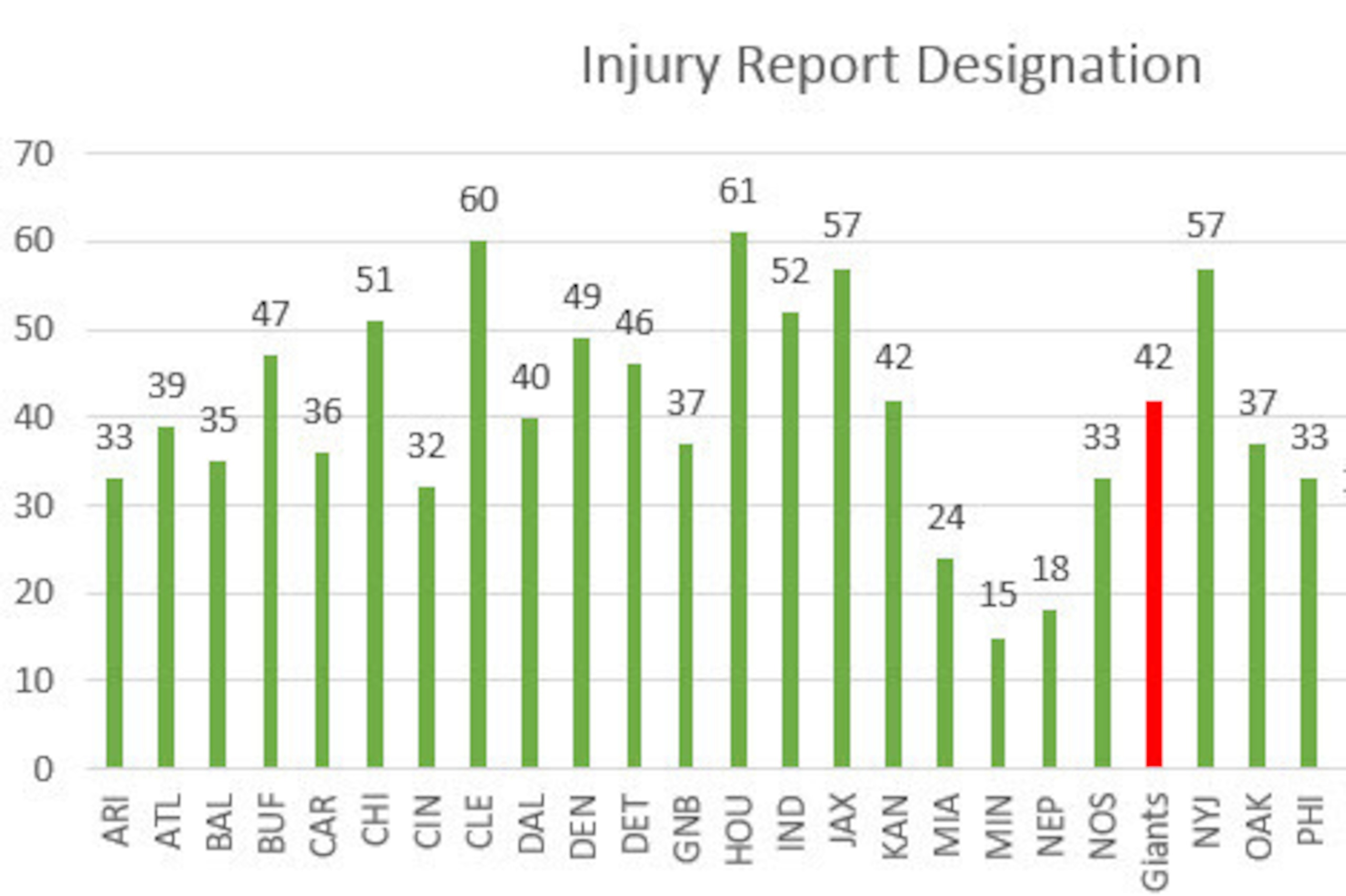
The primary conclusion the data in this chart offers is that the Giants are not the most injured team in the NFL—that honor currently belongs to Houston (61), followed by Cleveland (60) and Jacksonville and the Jets (tied at 57).
Let’s look at the number of games lost by those players who did receive one of the four injury designations:

Again, the Giants are not leading the league in games lost by players appearing on the injury report, though they are third (26) behind Jacksonville (32) and San Diego (27) in this category.
Why might that be? There is obviously the glass-half-empty outlook that subscribes to the theory the Giants' training staff’s treatment methods are outdated.
The problem with this theory, though, is that the players aren’t exclusively trained by just the Giants. Remember, the NFL calendar prohibited teams from opening their strength-and-conditioning programs until April 20 this year.
While players were certainly free to come in and use the team's facilities, so long as they were under contract, a vast majority of them are believed to have spent time training during the months of February and March away from Giants HQ.
When questioning whether the Giants' training methods are outdated, there is a blurred line regarding the methods a player’s private trainer employed and what the Giants employed.
This leads to another question that might just be impossible to answer yet still needs to be addressed.
For those players dealing with injuries who trained with independent trainers, were those trainers experts in preparing football athletes, or were they more generalists who work with a variety of different athletes representing different sports?
Getting back to the “games lost” chart, there is also the glass-half-full theory to explain why the Giants have the third-highest number of games lost by players.
That theory is the Giants medical staff tends to err on the side of caution and not rush a player back onto the field until an injury is fully under control, lest they risk creating bigger and perhaps more permanent issues for the players.
Percentage of Games Played by Players Appearing on the Weekly Injury Report
This next table shows the percentage of players who appear on the team’s injury report who went on to be active in that week’s game.
| ARI | 72.7% | MIA | 75.0% | |
| ATL | 61.5% | MIN | 66.7% | |
| BAL | 42.9% | NEP | 33.3% | |
| BUF | 63.8% | NOS | 42.4% | |
| CAR | 61.1% | Giants | 38.1% | |
| CHI | 52.9% | NYJ | 68.4% | |
| CIN | 78.1% | OAK | 54.1% | |
| CLE | 58.3% | PHI | 54.5% | |
| DAL | 55.0% | PIT | 46.4% | |
| DEN | 71.4% | SAN | 44.9% | |
| DET | 56.5% | SFO | 72.4% | |
| GNB | 59.5% | STL | 52.0% | |
| HOU | 60.7% | SEA | 52.3% | |
| IND | 63.5% | TBY | 45.5% | |
| JAX | 43.9% | TEN | 37.5% | |
| KAN | 85.7% | WAS | 55.6% |
The Giants (38.1 percent) rank among the bottom three in the NFL in this category behind Tennessee (37.5 percent) and New England (33.3 percent).
Of those teams, the Giants and Patriots both have winning records. A couple of teams with the best percentage of getting their injured players on the field, Kansas City (first, 85.7 percent) and San Francisco (third, 72.4 percent), do not.
Injured Reserve
Last but not least, let’s see how the teams currently stack up in the injured-reserve department. According to Spotrac, there have been 192 players placed on injured reserve thus far this season, an average of six per team.
The Giants unfortunately have eight players on season-ending injured reserve.
Spotrac has defensive end Brad Harrah as one of nine Giants players on injured reserve. However, according to the Giants’ official website, Harrah was waived on Aug. 7 with an injury settlement and is thus not on injured reserve, which makes the Giants’ IR count eight.
The Giants’ IR list is the fourth biggest of any in the NFL behind Pittsburgh (13), Baltimore (11) and Arizona and Washington (tied with 10).
However, when evaluating the injured-reserve list, it’s important to determine how many starters and established impact players are included.
| OL Brandon Mosley | 4 | Back |
| TE Daniel Fells | 8 | Ankle |
| S Nat Berhe | 2 | Calf |
| S Mykkele Thompson | R | Knee |
| S Justin Currie | R | Ankle |
| WR Marcus Harris | 1 | Shoulder |
| S Bennett Jackson | 1 | Knee |
| OL Brett Jones | R | Knee |
Of the players listed in the above table, an argument can be made that just one—tight end Daniel Fells—was projected to be a steady contributor in 2015. Also, one of either Nat Berhe and Bennett Jackson might well have won a starting job.
Simply put: The Giants haven’t been hit quite as hard in terms of players lost for the season—a big difference from 2014, when nine of their 24 listed injured reserves were either starters or key backups.
What Does This All Mean?
Firstly, every NFL team has injuries, and those injuries are affecting the same body parts—calves, knees, concussions, pectorals, etc.—that are affecting the Giants’ injured players.
Secondly, the changes the Giants have made to their schedule this season, which include tweaks to how they train and recovery days, seem to be working as the majority of the injuries that are occurring to players are happening during games, which are violent by nature.
The two main exceptions to this are offensive lineman Will Beatty, who tore his pectoral muscle lifting weights, and receiver Victor Cruz, who was injured during a training camp practice.
Thirdly, while injuries are not fun to read about, before writing a season off as finished, it’s important to look at the players on the IR list.
In 2007, the Giants had 13 players on IR; of those, six (tight end Jeremy Shockey, fullback Jim Finn, defensive end Mathias Kiwanuka, long snapper Ryan Kuehl and running back Derrick Ward) were expected to play significant roles on that team.
One last point needs to be made, and that is the importance of the draft and personnel moves. Using that 2007 team, the Giants had quality alternatives to each of those players.
For example, the draft yielded Ahmad Bradshaw for Ward, Zak DeOssie and Jay Alford for Kuehl, and Kevin Boss for Shockey.
Pro personnel (free-agent and waiver pickups) yielded Madison Hedgecock for Finn and receiver Domenik Hixon.
Those solid moves, combined with key personnel decisions from the previous years, meant the 2007 Giants were more than able to withstand the injuries they had and not miss a beat.
This was not the case in 2013 or 2014, which was due to the poor draft classes—a big part of the reason why the Giants tanked in those seasons.
The 2015 season is still young, and there’s no telling what the numbers are going to look like when it’s all said and done.
Thus far, the Giants are in much better shape than they were at this time last year, meaning that contrary to popular belief among the fans, the Giants are not the most injured team in the NFL.
Unless otherwise notes, all data reflected in the charts is from the various team pages at Pro Football Reference, whose data is current as of October 15, 2015.
Patricia Traina covers the Giants for Inside Football, the Journal Inquirer and Sports Xchange. All quotes and information were obtained firsthand unless otherwise sourced.
Follow me on Twitter, @Patricia_Traina.
.jpg?w=2560 "Vikings Buccaneers Football")