
Play That Man: NBA Players Who Deserve Way More Burn in 2015-16
The start of a new NBA season brings fresh perspectives, which can be a very good thing for players who spent more time than they should have on the bench last year.
Coaches can sketch out their rotations from scratch, setting aside rotational habits and last year's norms...ideally speaking, of course.
In some cases, players who deserve increased roles still need a little advocacy in their favor.
It seems so obvious sometimes: There's a glaring on-court deficiency that could, if only the head coach would relent, be addressed by a player languishing on the sidelines. Maybe it's a lack of rim defense, or perhaps it's a stalled-out scoring attack. The fix is often on the pine.
In other instances, a young talent needs court time to grow, and his team simply isn't in a position where it makes sense to forestall that process. Those are the most frustrating, and we'll point out the obvious ones here.
Finally, there will be cases where one player should see more playing time for the sole purpose of keeping a teammate off the court—almost like a lesser-of-two-evils thing.
These are the players who need to see minutes spike and roles expand in 2015-16.
John Henson, Milwaukee Bucks
1 of 8
The Milwaukee Bucks' decision to extend John Henson with a four-year, $45 million agreement indicates they recognize his value to the franchise.
Which is good, because he deserves an increase in responsibility.
Aesthetically, Henson fits the Bucks' image: long, rangy, disruptive defensively. Toss him out there with Giannis Antetokounmpo and Michael Carter-Williams, and you've got a tangled thicket of arms that shrinks passing lanes and changes shots inside.
Last year, Henson played just 18.3 minutes per game, averaging seven points, 4.7 rebounds and two blocks. Among players who logged at least 1,000 minutes in 2014-15, Henson's block rate of 9.3 percent was tops in the league, per Basketball-Reference.com—higher than more celebrated rim-protectors like Hassan Whiteside, Anthony Davis, Rudy Gobert and DeAndre Jordan.
Block rate isn't everything, and Henson struggles in other areas defensively. He's rail-thin, and he's miles behind guys like Andrew Bogut and Marc Gasol when it comes to anticipation and positioning. But his shot-blocking and high-efficiency offense give him a pair of very useful skills.
Henson should be the first big man off the bench this season, especially if starting center Greg Monroe's defensive woes prevent the Bucks from sustaining their hard-earned identity on that end. At the very least, Henson should see 20-25 minutes per night, which might be enough for him to lead the league in blocks, crazy as that sounds.
Clint Capela, Houston Rockets
2 of 8The Houston Rockets have Dwight Howard!
Howard missed half the season last year and will turn 30 in December. If ever there were a time to lean on second-year center Clint Capela (if only to preserve Howard's health and keep him fresh for a deep playoff run), it's now.
He shot 67.7 percent from the field, flashed absurd athleticism and got after it on the boards in 127 playoff minutes last spring. Intrigued yet?
Capela can't make free throws!
First of all, neither can Howard. Second, Capela shot 59 percent on 171 attempts from the charity stripe in the NBA D-League last season before joining the Rockets. So while his 4-of-23 effort in the NBA wasn't encouraging, the larger sample suggests it's far from panic time.
But it makes more sense to just go small whenever D12 sits!
That's a tempting argument, especially with Terrence Jones and Donatas Motiejunas being much more polished and versatile offensive options than Capela, who is essentially a dunker at this point. Those two could help supercharge a Rockets offense that quietly ranked just 12th last year, per NBA.com.
Then again, both Jones and Motiejunas are coming off injury-riddled seasons. Does it really make sense for the Rockets to subject them to interior pounding during an 82-game slog? Why not lean on the young, healthy, springy legs of Capela during the year instead?
Jones and Motiejunas could hit the playoffs fresher, and maybe Capela would gain so much from heavy playing time that he'd become a useful postseason contributor. It's a win-win.
Capela should see much more than the 7.5 minutes per game he logged as a late-season call-up last year.
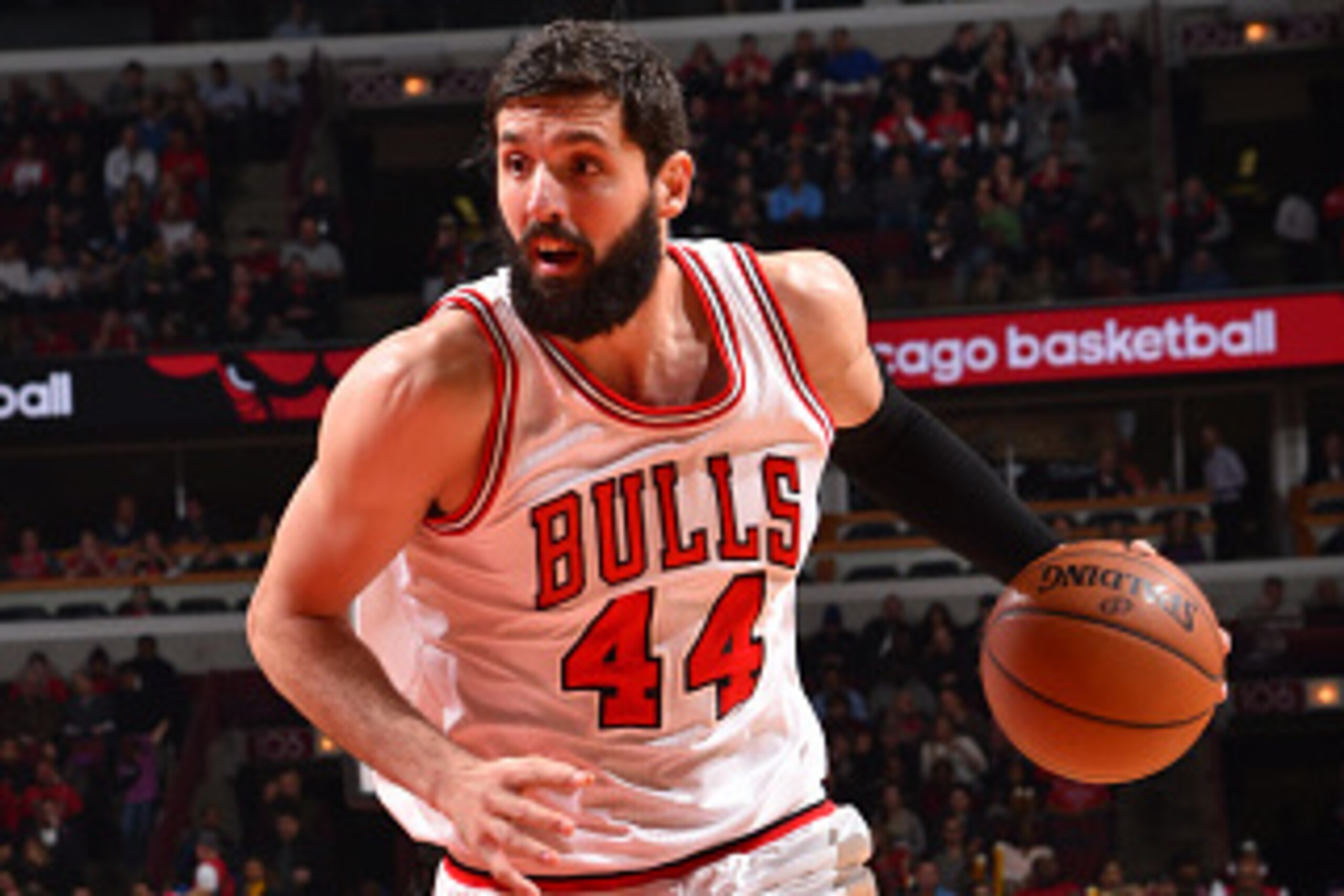
Nikola Mirotic, Chicago Bulls
3 of 8
Nikola Mirotic played just 20.2 minutes per game last year, a shockingly low average that may very well have cost him the Rookie of the Year Award.
In 56 percent as many minutes as winner Andrew Wiggins logged, Mirotic hit 60 more three-point shots, collected 3.6 more win shares (his 5.7 led all first-year players in 2014-15) and did both for a Chicago Bulls team playing in games that actually meant something all season.
Wiggins is a supreme talent, but there's a case to be made that Mirotic was better last year.
And again: 20.2 minutes per game!
That's got to change this season.
Chances are it will for a handful of reasons—not the least of which being that entrenched big men Pau Gasol and Joakim Noah aren't an ideal on-court combination because neither is particularly mobile or capable of spreading the floor.
With Noah and Gasol on the court together last year, the Bulls posted a net rating of plus-2.8. With Gasol and Mirotic, that number jumped to plus-4.4. And when Noah and Mirotic were on the front line, Chicago's net rating reached plus-4.8, per NBA.com.
If new head coach Fred Hoiberg hopes to unlock the potential of an offense that underperformed for years under Tom Thibodeau, he'd do well to start by giving Mirotic a dramatically expanded role however he can.
Sounds like he's considering it: "Niko's a basketball player—and very versatile," Hoiberg told K.C. Johnson of the Chicago Tribune. "He's more comfortable at (power forward) right now because that's where he's getting a lot of reps early on. But we've been sticking around after and getting together early, putting him at (small forward) so he can learn that as well."
Mirotic is a threat from the perimeter, can put the ball on the floor for straight-line drives and has a good feel for how to operate in space. There'll be times when Chicago wants to go bruise for bruise with larger opponents, but in the shrinking NBA, a skilled stretch big like Mirotic should see plenty of court time.


Anthony Morrow, Oklahoma City Thunder
4 of 8
Thankfully, new Oklahoma City Thunder head coach Billy Donovan is leaning the right way on his starting lineup. According to Anthony Slater of the Oklahoman, Andre Roberson started with the first unit in the team's first scrimmage.
"Donovan said the teams weren't split by accident," Slater explained. "That's how they've been divided in practice. So at this point, it seems Roberson is this team's starting shooting guard and (Steven) Adams is the team's starting center."
Anything that limits the roles of Dion Waiters and Enes Kanter is a positive for OKC, but why not go even further?
Anthony Morrow is a singularly talented shooter who played 24.4 minutes per game last season, which makes his inclusion here unusual. That's a solid amount of playing time. But this is a plea for Morrow to play at least that many minutes again, which could be difficult with a full season of Kevin Durant and Dion Waiters in OKC.
Because for all of his limitations, Morrow is about as deadly from deep as anyone in the league. Actually, make that league history. He ranks ninth all-time in career three-point percentage.
Though he won't do much of anything else, Morrow brings one elite skill to the Thunder's rotation...which is one more than Waiters, whose defensive indifference and low-efficiency offense hurt OKC at both ends.
Roberson makes perfect sense as the defensive wing specialist in the first unit, and Durant will deservedly eat into Morrow's minutes. But when Donovan calls to his bench for the first guard substitute, please let it be Morrow.
Plus, he's really good at pumping up Russell Westbrook. And I think we all agree that Russ needs to be a little more intense out there.
James Johnson, Toronto Raptors
5 of 8
There are two cases for playing Toronto Raptors forward James Johnson more in 2015-16.
The first case is statistical: The Raps outscored opponents by seven points per 100 possessions with Johnson on the floor last year, giving him the second-best net rating on the team, according to NBA.com. Though sometimes flighty in team defensive schemes, Johnson was also a shot-blocking phenom who flew all over the court at both the 3 and the 4.
Consequently, Toronto defended much better with him on the court.
Why? Check this out from B/R's Andy Bailey writing for Today's Fastbreak:
"In addition to his ability to cover so much of the floor, Johnson also has very quick hands and feet, thanks in part to his background as a kickboxer. He can put himself in position and get his hands on a ball for a block or a steal in plays where that simply wouldn’t be possible for an average player.
As result, Johnson is one of just nine players in NBA history (minimum 300 games played) with a career Steal Percentage over two and a career Block Percentage over four.
"
The second case is more of an eye-test thing: He competes, he finishes at the rim, he's athletic and he's not Terrence Ross, who basically shouldn't play. Though Johnson's greatest value is probably as a slashing, undersized power forward, using him more often at small forward in relief of DeMarre Carroll (or when Carroll slides to 4) would be fine. Whatever it takes to get the Raptors' best players on the court for as many minutes as possible.
Johnson is one of those players.
C.J. McCollum, Portland Trail Blazers
6 of 8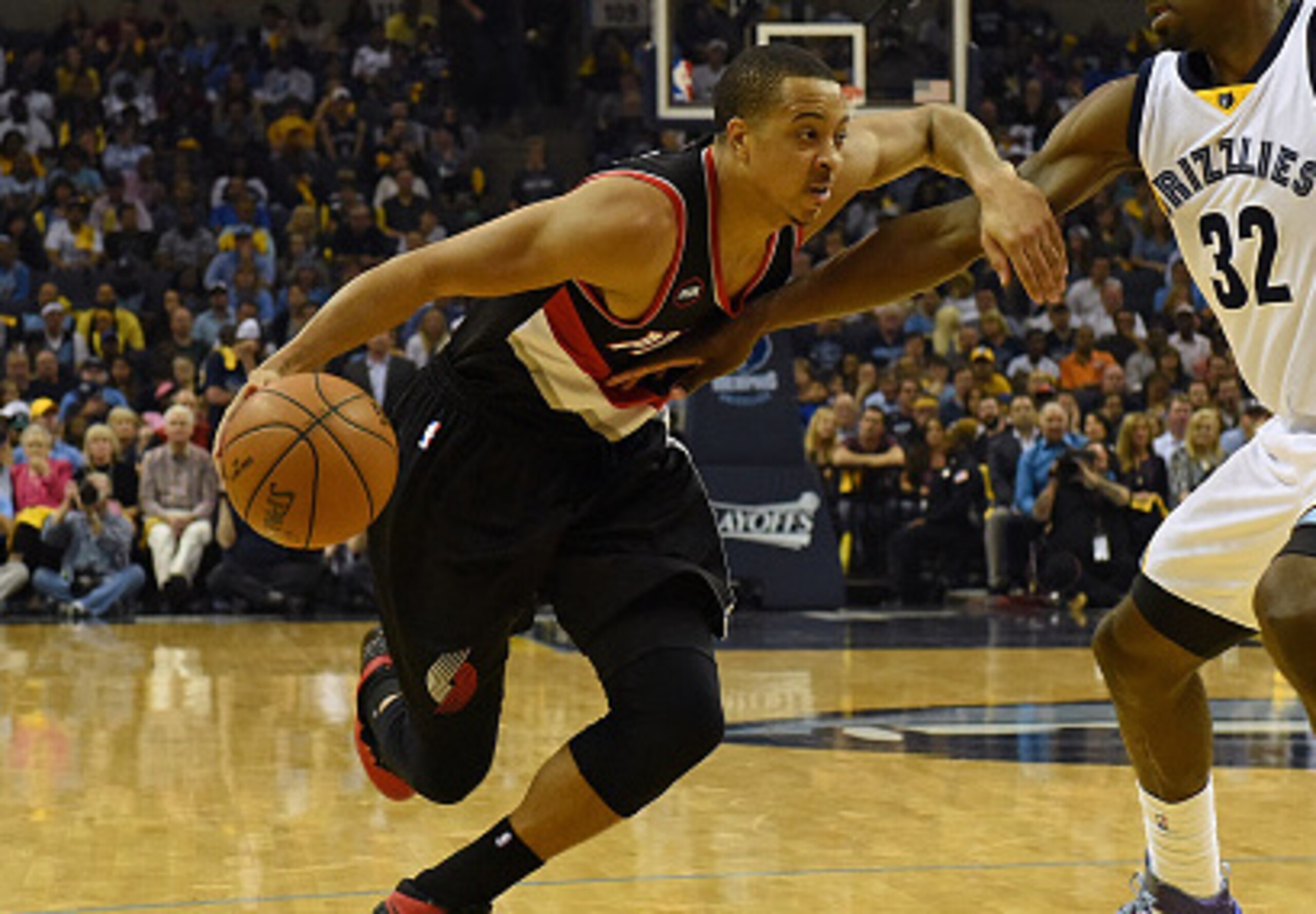
Last year's strong playoff performance (17 points per game on 47.8 percent shooting from the field and from three-point range) makes it simple to suggest Portland Trail Blazers third-year guard C.J. McCollum deserves more playing time this season.
The fact that the Blazers lost their two best wings over the summer makes it even simpler. Without Nicolas Batum or Wesley Matthews in the way, McCollum's path to a starting gig is clear.
A gifted scorer with range, a solid handle and good change-of-pace feel, McCollum made sure to expand his skills by spending three days with Steve Nash in Toronto over the summer, according to Mike Richman of the Oregonian: "Working with Steve Nash helped me slow down the game some more, helped me understand pick and rolls and how point guards think," McCollum said. "Having the ability to manipulate guys with your eyes, use you body to hold guys off and then just make the proper reads."
If, in addition to scoring, McCollum can make enough plays to take pressure off Damian Lillard at the point, he'll be even more valuable.
Injuries have delayed McCollum's rise in each of his first two seasons, but so did established talents ahead of him on the depth chart. If he can stay healthy this year, there'll be nobody to keep his playing time from skyrocketing.
Aaron Gordon, Orlando Magic
7 of 8We haven't played this card yet, but it's probably one of the best when making the case for expanding a young player's role—especially when said young player may not even be ready for more court time.
The Orlando Magic are still in the infancy of their rebuilding efforts, so why not play a kid?
Aaron Gordon has played roughly half of one NBA season so far, and though he sounds like a player who believes he's ready to shine right away ("I’m tired of potential,” Gordon said, per Brett David Roberts of OrlandoMagicDaily.com. “I’m sick of potential. Obviously I appreciate that very much. I’m done waiting.”), the truth is he's still raw.
And that's fine, even if he's still just 20 years old.
The Magic won 25 games last season, and even a drastic 10-win improvement would leave them far short of the playoff picture. In those circumstances, playing and (starting!) veteran Channing Frye at the 4 ahead of Gordon is a little nutty.
Gordon is a raw athlete whose speed and bounce change the game in ways that hearken back to a young Shawn Marion. He's got a lot left to polish, his shooting form is still pretty weird and it's unclear what his best position is, but Gordon needs to be on the floor to sort those things out.
Seventeen minutes per game, his season average last year, won't be nearly enough. Get him out there for at least 30 while the stakes are low, and by the time the Magic are ready to seriously compete in games that matter, Gordon will be better for it.
Ryan Anderson, New Orleans Pelicans
8 of 8
Anthony Davis' future in the NBA is at center...but only if the New Orleans Pelicans want to unlock the most dangerous combination of mobility, perimeter shooting, athleticism and defensive omnipresence in league history.
Which they should.
Based on the Pellies' decision to sign both Omer Asik and Alexis Ajinca (both centers) to contracts over the summer, they're not ready to make the leap to "Davis 2.0: Center Addition" just yet. But Ajinca suffered a hamstring injury that could cost him 4-6 weeks, which means the only thing standing between Davis and more minutes at center is the mercurial Asik.
What's this got to do with Ryan Anderson?
Well, if he could convince the Pelicans he's healthy enough to revive the shooting proficiency he showed earlier in his career while not being a total sieve on defense (that second one's the tough part), perhaps they'd feel more comfortable trusting the entire defensive interior to Davis at the 5.
Imagine what a Pelicans offense could do with Anderson and Davis at the big positions. There'd be nothing but wide-open space in the middle, begging to be attacked by Tyreke Evans, Eric Gordon, Jrue Holiday and any other slash-happy ball-handler on the roster.
The pick-and-roll with Davis at center would be devastating, drawing help from all over the court and inviting passes out to wide-open shooters whose defenders had to dart into the lane to prevent dunks.
If an Anderson-Davis pairing up front seems unlikely, remember that head coach Alvin Gentry has done this before. He played Channing Frye and Amar'e Stoudemire as his 4-5 combo when he coached the Phoenix Suns in 2009. The blueprint for a sharpshooting power forward and a freakishly athletic center is in Gentry's coaching file.
Anderson is quietly a key to the Pelicans this season, and if he plays more, it'll help push Davis toward his destiny.
No harm in advocating for that, right?
Follow Grant Hughes on Twitter @gt_hughes.

.jpg?w=2560 "OBJ Calls Out Giants After Release")


.jpg?w=2560 "Rap: Lions, LaPorta End Contract Talks")

.jpg?w=2560 "Report: Baker May Miss Up to 6 Weeks")