

Rajon Rondo Raises so Many Questions for Sacramento Kings
We've seemingly heard speculation for years that the Sacramento Kings were looking to acquire Rajon Rondo. Now it looks like it's officially true, with Yahoo Sports' Marc Spears reporting the news of a one-year deal on July 3.
The team's decision to sign Rondo is nothing if not intriguing. There's so much that comes along with the enigmatic point guard.
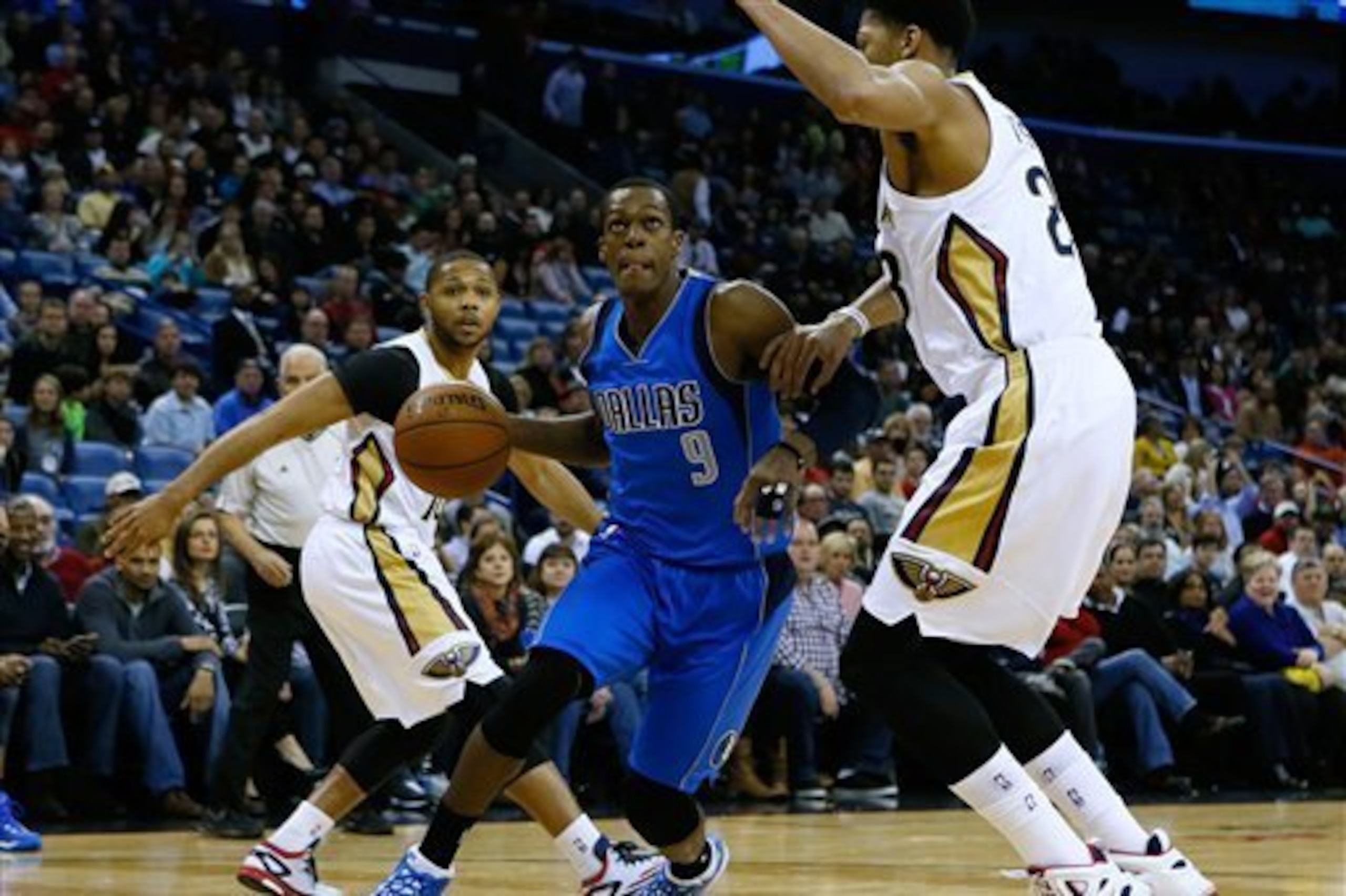
Are the Kings getting the player who averaged 12.4 points, 10.8 assists and 4.7 rebounds from the 2009-10 season through the 2012-13 season? Or the guy who's seemingly been diminished by injury since then, seeing his numbers decrease to 9.8 points, 8.5 assists, 5.5 rebounds and who isn't nearly the same defensive force he once was?
What about his demeanor? Can Sacramento expect the Rondo who repeatedly clashed with head coach Rick Carlisle while with the Dallas Mavericks last season? Or will he be a good soldier after getting the opportunity to play with his good friend Rudy Gay?
That's not even to consider how Rondo fits with head coach George Karl and what he wants to do. On the surface, it would seem like a contrast in styles, which could make the team's ability to get the most out of Rondo a difficult proposition.
Yet Rondo still brings his playmaking to the table. It'll be up to Karl to maximize it.
Rondo Was a Force Before Injuring His Knee...
Prior to injuring his knee during the 2012-13 season, Rondo was one of the game's premier floor generals.
He made four consecutive Eastern Conference All-Star teams. In 2010-11, Rondo was on the All-NBA third team. The former Celtic also provided lockdown defense, making two All-Defensive second teams and two All-Defensive first teams in four straight seasons.
While Rondo was never a great volume scorer, at least he was efficient. During his four-year run, he had an above-average player efficiency rating of 18.0 (15.0 is average).
Rondo's never had much of an outside shot, yet he still managed to make 48.2 percent of his field-goal attempts. That's largely because he attacked the hoop frequently, with 44.5 percent of his shots coming within three feet of the rim. Even though he only knocked down 60.8 percent of his free throws, it was adequate enough to make getting to the line a positive endeavor.
On defense, he held the opposition to 101 points per 100 possessions. Rondo averaged a defensive box plus-minus of 1.2 and posted 14.9 defensive win shares.
...But He Hasn't Been the Same Player Since
Whether it's because of the knee injury effects or something else entirely, Rondo has taken a step back in recent years.
He's still an effective passer, posting 8.5 assists per game over the last two years, including 9.9 per 36 minutes. But even in light of that, the Mavericks were a better offensive team with him on the bench, averaging 101.7 points per 100 possessions while he was on the court and 106.4 when he sat.
He's no longer creating opportunities for himself with regularity. His scoring average has dipped to 9.8 points, largely due to a plummeting field-goal percentage of 41.8, down nearly 7 percent from his pre-injury form. In conjunction, he's posted a below-average PER of 14.1.
A lot of that can be attributed to a less aggressive style of play. Instead of attacking the basket with reckless abandon, Rondo's settling for shots further from the hoop, with only 32 percent coming at the tin. That's a problem considering he's never been much of a shooter.
He also saw his free-throw percentage free-fall last season to 39.7 percent. So even when Rondo does attack to the hoop, he's not capitalizing on his opportunities from the charity stripe.
The player who was once an elite defender has been a mirage. His defensive rating has climbed to 106. Last season with the Mavericks, opponents who shot 44.1 percent overall increased to 45 percent when Rondo was guarding them. The difference became even more acute when players attacked the basket, seeing their field-goal percentage within six feet of the hoop increase from 60.9 percent to 73.1 when covered by Rondo.
It's fair to wonder whether he can ever get back to the productive player he once was. Yet the Kings must have seen something from Rondo—otherwise they wouldn't have signed him.
Getting the Most from Rondo
It would seem Karl's style of offense doesn't fit with what Rondo does best.
The coach likes his offenses to push the pace. After he took over last season, the Kings went from ninth in pace (97.2 possessions per 48 minutes) to sixth (99.1). Karl also wants to move the ball around, whereas Rondo's accustomed to being a primary ball-handler in half-court sets.
But Rondo still has the skill set to work within Karl's system. Here's an example last season where he grabbed a rebound against the New Orleans Pelicans and took it coast to coast for the layup.
Rondo's dribble penetration will also work for Karl. While it's something he doesn't do with as much frequency as in the past, the skill set is still there. He can either find an open teammate, as he showed against the Houston Rockets.
Or he can take the shot himself.
In fact, Comcast California's Bill Herenda thinks Rondo could be a good fit with Karl and the Kings because of his ability to create for others.
"Just looking at Sacramento’s depth chart with Darren Collison coming off the core muscle injury that required surgery, the Kings backcourt, the ability to distribute the ball and protect it is paramount in Karl’s offense," said Herenda. "Those two areas they were bottom five in the NBA last year, turnovers and assists. So he brings a lot to the table despite the analytics that will not look good from the Mavs and the shooting percentages that may be less than stellar. So there’s a clear, definite need."
His ability to collapse the defense also fits with what Karl wants to do. In fact, it's a staple of point guard play in the coach's offense.
"The primary role in the dribble-drive motion offense is to get to the basket," said Herenda. "If you get there in an unabated fashion, your job is to finish. If you don’t, the job is to kick. Remember, it’s a 'three or in the key' scenario offensively. That’s the mantra. So I think he’ll have the ability to play-make in Karl’s offense."
That skill set will work with what the Kings have assembled. With Cousins in the center, there's a premier talent who can convert on Rondo's passes in the key. In Marco Belinelli, Omri Casspi, Ben McLemore and Rudy Gay, Sacramento has shooters who can consistently convert from the outside.
But Rondo also has to learn to work off the ball, especially if the Kings go with a two-point guard lineup at times, as Jason Jones of the Sacramento Bee suggested they might.
"They could play them simultaneously, an option coach George Karl welcomes, or have Collison back up Rondo.
Collison’s injury prevented Karl from using a two-point guard strategy that could have helped the team’s passing. The coach relied on Ray McCallum and Andre Miller to split time.
"
Pairing Rondo with Collison could help the offense by having two playmakers on the court at the same time. That's not a bad thing considering the weapons at their disposal.
"I would have confidence in Rondo’s IQ and his ability to see the floor and just to simply make plays," said Herenda. "That would not necessarily worry me with Collison on the floor and Rondo's ability to play off the ball. It’ll be a collectively shared thing where you go more positionless."
A potential problem if Rondo's playing off the ball could be his lack of a consistent outside shot. He's not much of a threat from three-point range, making only 26.3 percent of his attempts from downtown over his career. Defenders will be able to sag off him without the fear of getting consistently beat on three-pointers.
Having both on the court at the same time could also pose a problem on defense.
At 6'0", 160 pounds, Collison is too small to cover 2-guards on a regular basis. Rondo isn't much better with his 6'1", 171-pound stature. That's not even to mention the regression we've seen from Rondo on defense in recent years.
Nothing to Lose
When it comes down to it, signing Rondo was a no-brainer, and that's coming from someone who's skeptical about the decision. The rewards far outweigh the risks for the Kings.
What's the worst that could happen?
Rondo could clash with Karl and other players in the locker room, but there's already plenty of that going on. He could become a detriment to the team's ability to win games, but Sacramento hasn't won 30 games since the 2007-08 season. There's not much to ruin there.
Worst-case scenario, the Kings could cut him and move on. After all, it's only a one-year deal.
Speaking of which, that it's only one year shouldn't be seen as a bad thing. There's the argument that Rondo could restore his image and bolt after the season. But if that happens, it will mean he's performing like the player we saw for so many years in Boston.
As a side effect, and a rather good one from Sacramento's perspective, it will also mean the Kings are playing better. Sure, they may be without their point guard the following season, but they'll also be in a better place as a franchise.
In that case, signing Rondo will be well worth it.
Unless noted otherwise, all quotes obtained firsthand. All stats courtesy of Basketball-Reference.com and NBA.com.

.jpg?w=2560 "Jaxson Dart Ruled Out of MNF")

.jpg?w=2560 "Ertz Returning to Eagles")
.jpg?w=2560 "Dak Addresses 'Dumb' Old Romo Tweet 🤣")
.jpg?w=2560 "WWE Raw Live Grades 🔠")

.jpg?w=2560 "🚨 Puka Out for MNF")