
How Can Cleveland Cavaliers Force Game 7 in the 2015 NBA Finals?
The Cleveland Cavaliers enter Game 6 of the NBA Finals in full-on crisis mode.
It's not only that a loss would spoil LeBron James' heroic return mere steps from the desired finish line—and extend the city's championship drought that dates back more than 50 years—but also that the club is searching for an identity at the most inopportune time.
Cavs coach David Blatt has to mold his undermanned group into a workable rotation. Over the past two games, he has tried to both overpower the downsized Golden State Warriors with bulky bigs and mimic their small-ball look with the best one left at his disposal.
TOP NEWS
LeBron Scolded Embiid 😯

'Over-Under' Predictions for Every NBA Team's Record 🔮

Trades That Should've Happened During NBA Offseason 🏀
Neither attempt yielded the coveted outcome for Cleveland. The Cavs stayed big in Game 4 and lost by double digits. They went small in Game 5 and suffered the same fate.
Backed into a corner for Tuesday's win-or-go-fishing Game 6, this appears to be a choice between the lesser of two evils. The Golden State Warriors are equipped to dismantle either Cleveland construction.
"Stay big and risk being unable to match all of Golden State's shooting, passing, speed and versatility for the second straight game," wrote Yahoo Sports' Dan Devine. "Go small and risk being unable to protect the paint and clear the glass while also giving [Stephen Curry] the room he needs to tear you apart."
If neither one sounds very appealing, that's because they aren't. With three opening-night starters on the shelf (Kyrie Irving, Kevin Love and Anderson Varejao), the Cavs are stuck in that uncomfortable crevice between the proverbial rock and hard place.
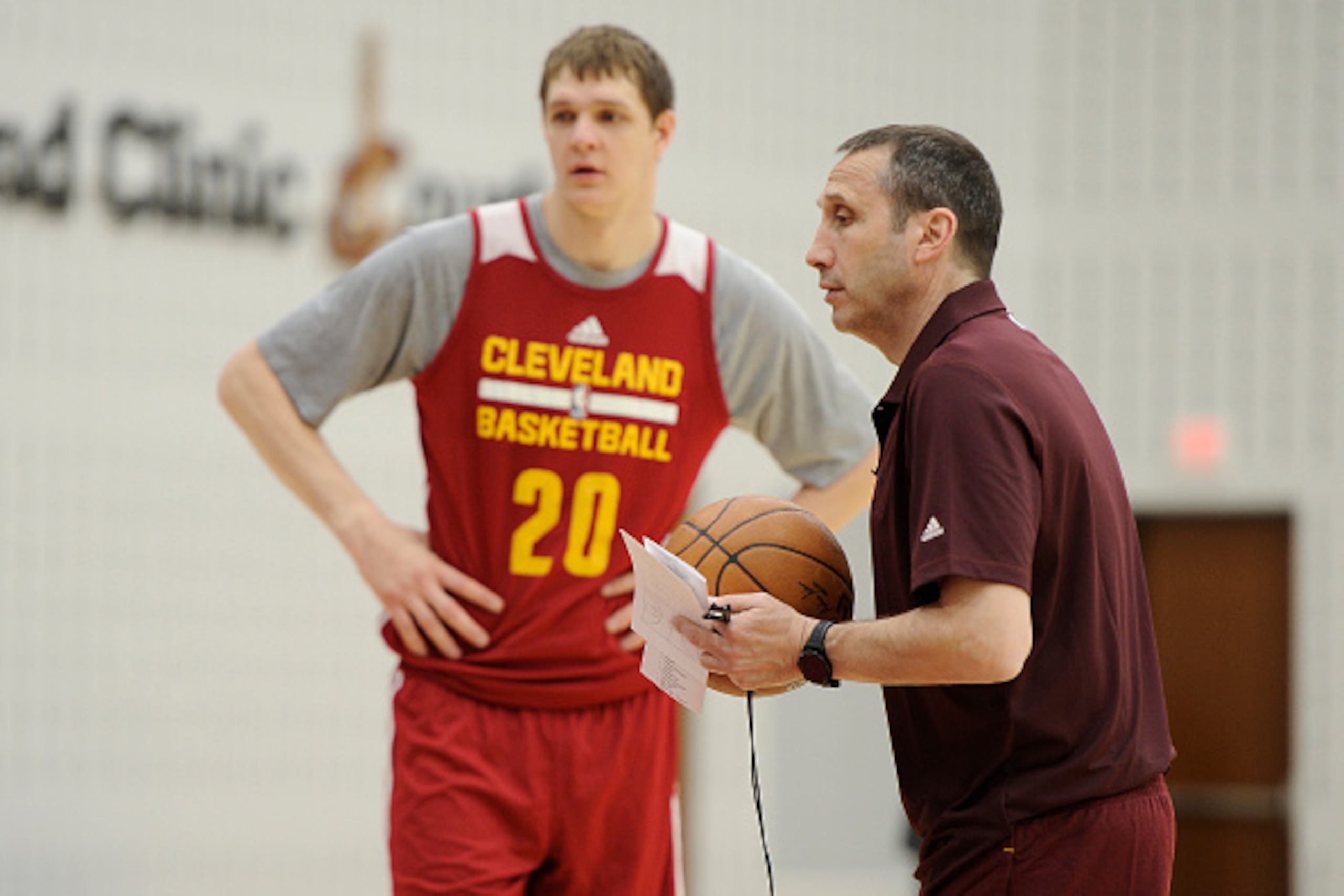
Cleveland's 7'1" center Timofey Mozgov is at the heart of this decision. His floor presence—or lack thereof—is a main feature of Blatt's decision.
The bruising big man logged 33 wildly productive minutes in Game 4. Mozgov paced the Cavs' attack with a season-high 28 points. He corralled 10 rebounds, six at the offensive end alone, which matched the Warriors' total team output on the offensive glass.
But with Golden State essentially trotting out five perimeter players at once—swingman Andre Iguodala replaced plodding center Andrew Bogut in the opening lineup—Mozgov couldn't find a comfortable defensive assignment. He doesn't have the lateral quickness to deny dribble penetration, but sagging back into the paint only meant his matchup would find a number of clean looks.
With Iguodala, Draymond Green and Harrison Barnes shooting a combined 18-of-35 in that contest (51.4 percent), Mozgov's defensive deficiencies were glaring, as ESPN.com's Ethan Sherwood Strauss observed:
Even Mozgov's offensive output was a bit deceptive, as it played right into Golden State's defensive game plan.
"The Cavs' offense doesn't run through Mozgov. If the Cavs wanted to get the ball out of James' hands into Mozgov's, the Warriors weren't about to complain," wrote Northeast Ohio Media Group's Bud Shaw.
On paper, Mozgov looks like Cleveland's second-best player in this series. His 13.4 points per game trail only James' 36.6 among the Cavs' healthy bodies. The team has also fared much better with him (minus-2.1 points per 100 possessions) than without him (minus-21.1 points per 100 possessions).
Since the Cavs are so shorthanded, it seemingly makes sense to question Blatt's call to play Mozgov fewer than 10 minutes in Game 5. Reporters did just that in the postgame press conference, which led to a few terse exchanges between the coach and media (h/t NBC Sports' Dan Feldman).
That being said, it's hard to say how logical it is to examine this series as a whole when it changed so dramatically over the past two games.
These teams are no longer playing the same style they did in the first three contests. As Warriors coach Steve Kerr put it, "it's not a series for bigs right now," via Eric Koreen of the National Post.
Mozgov's own on-court impact reflects that alteration. The Cavs imposed their will with Mozgov over the first three games. But in the last two, they've struggled to keep pace with their smaller, faster, more versatile counterparts.
| Games 1-3 | 103.9 | 100.3 | Plus-3.6 |
| Games 4-5 | 95.6 | 110.5 | Minus-14.9 |
But wouldn't Cleveland's embrace of small ball simply allow Golden State to play its preferred game? That's certainly a concern.
The Dubs can field capable shooters, distributors and creators at all five positions. Leandro Barbosa gives Golden State a sixth option to check off all three boxes. Shaun Livingston can't stretch the floor, but his selflessness, court vision and off-ball cutting add other layers to this offense.
The Cavs don't have those luxuries. All three responsibilities are draped on James' shoulders. In this series, he has 39.4 percent of Cleveland's total points, 38 percent of its field-goal attempts and 54.3 percent of the team's assists.
When Cleveland goes small, it only adds one thing to the offensive equation: shooting. There's no guarantee that Mike Miller or James Jones will find the touch from long distance, but their track records alone make it necessary to find them at the defensive end.
As humbling as this may sound, that's reason enough for the Cavs to stay small in Game 6.
Why? Because it makes life easier for James. And since it's pretty clear that the King is Cleveland's only hope to extend this series, the Cavs have to put him in the best possible position to succeed.
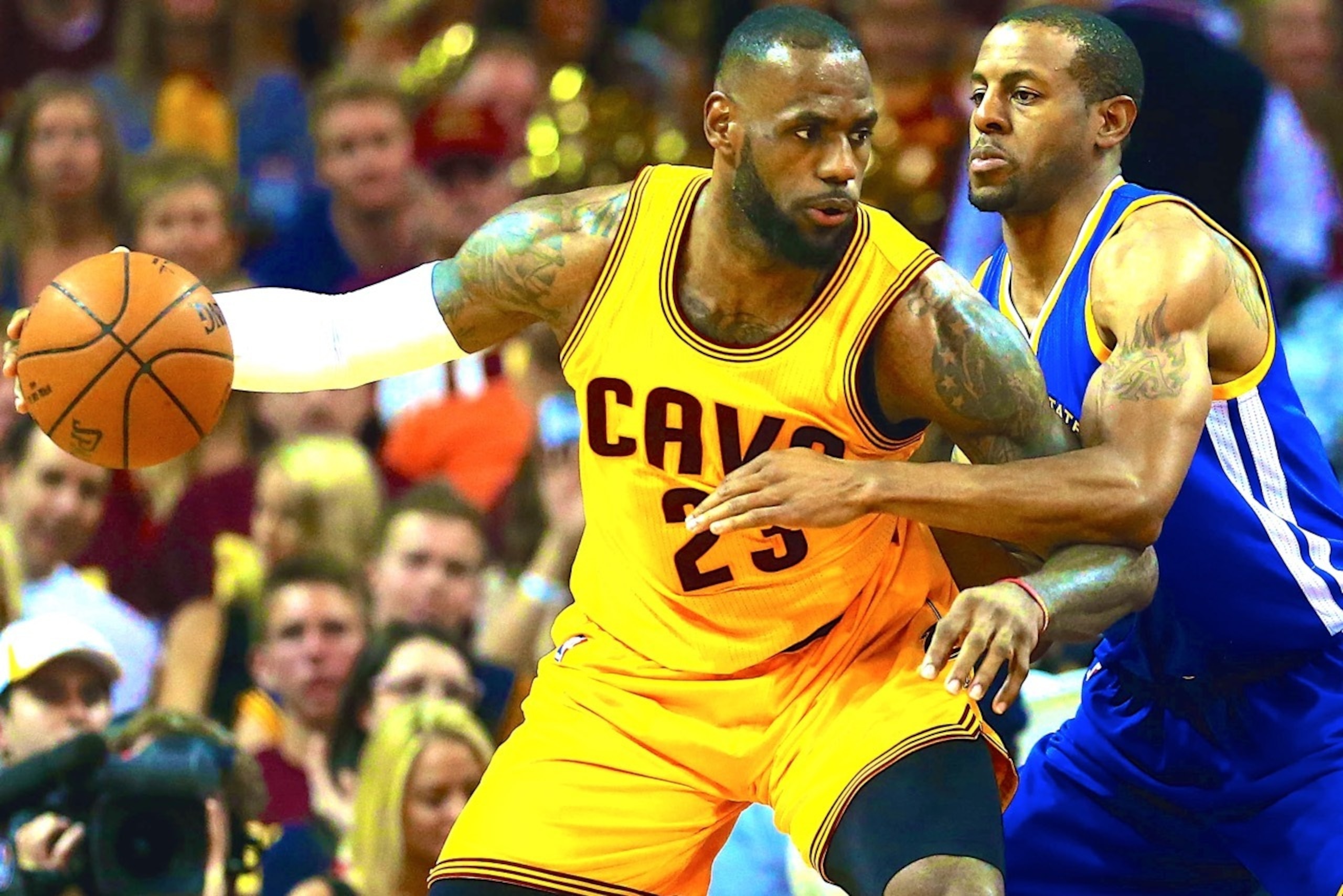
A Mozgov-Tristan Thompson frontcourt is a recipe for a congested paint area. Look at the crowds James has encountered on his drives with those two bigs on the floor.
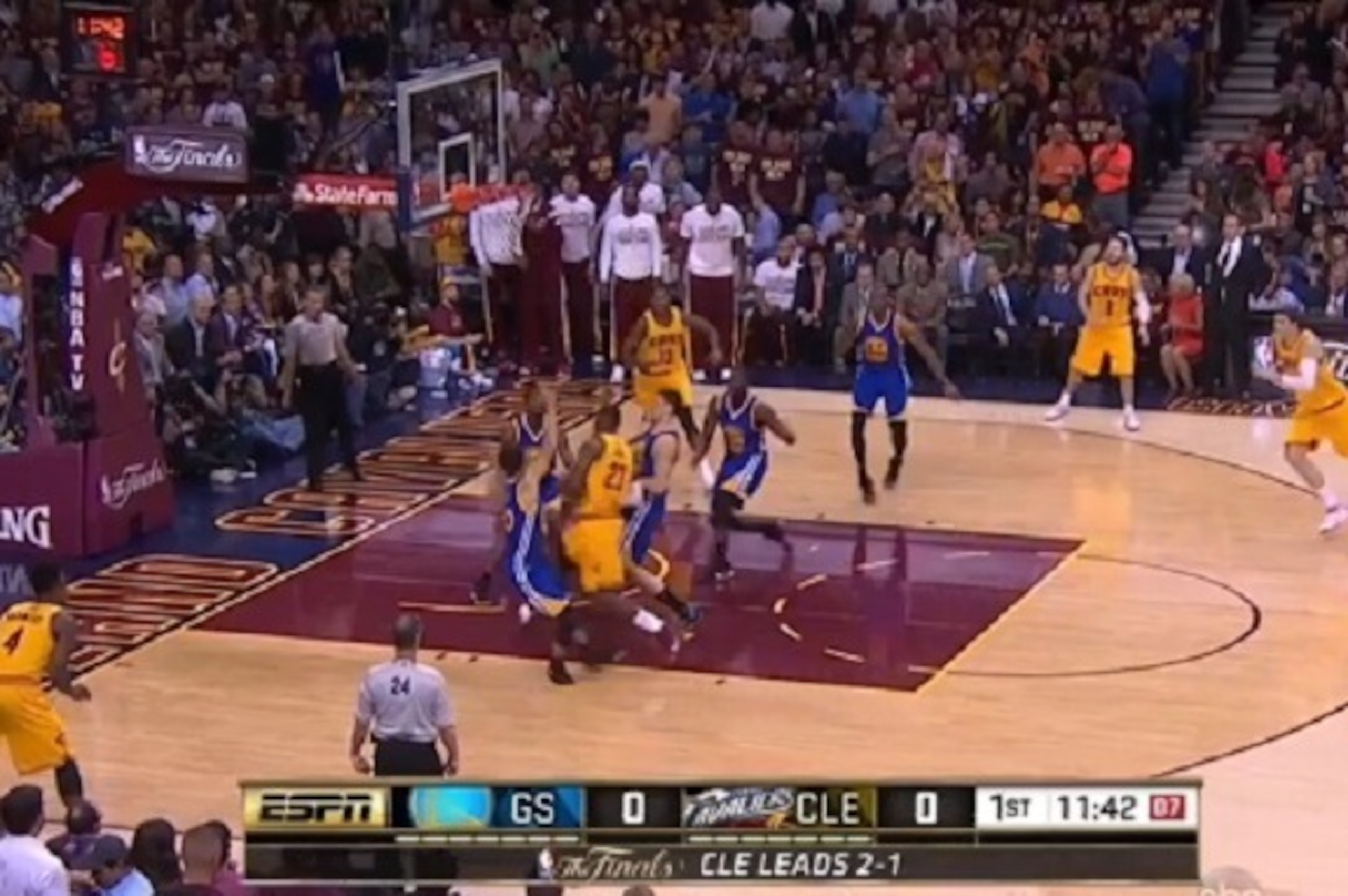
Add more shooters to the mix, and check out how much more breathing room James is able to find on the interior.

The Cavs have to maximize James' offensive production. His individual outbursts might not save Cleveland (the Cavs have lost two of his three 40-point games in this series), but they are easily the best hope this team has.
Improving James' scoring chances means giving him wider driving lanes and better looks around the basket. The Warriors haven't been able to stop him from close range. But if he can't force his way into point-blank range, his efficiency takes a massive hit.
| 5 ft. or Less | 28 | 43 | 65.1 |
| 5-14 ft. | 17 | 60 | 28.3 |
| 15-24 ft. | 11 | 33 | 33.3 |
| 25 ft. or More | 9 | 27 | 33.3 |
By going small, Cleveland gave itself a puncher's chance. The Cavs only trailed by a single point with five minutes, 10 seconds left on the clock, before Curry's late-game eruption helped the Warriors hold on in Game 5.
Not coincidentally, James matched his series high for assists (11) and series low for turnovers (two). He also had his second-best shooting night at 44.1 percent.
The Cavs need to stay small so James can have another shot at a miraculous, series-saving effort. Does that mean holding Mozgov below the 10-minute mark again? Probably not. If nothing else, the Cavs can't afford to pull a competent player out of their injury-riddled rotation.
Besides, Blatt doesn't sound like someone planning to push his center entirely out of the picture.
"Timo will be back, and he will not lose his way or lose his head just because he didn't play a lot tonight," Blatt told reporters. "... He'll be back playing like he always can, I'm sure, because he's got character and he doesn't listen to a lot of you guys."
But Mozgov's minutes should be limited. They might be best staggered with Thompson's to keep one interior presence on the floor without mucking up the middle.
It's a risky ploy. This is how the 67-win Warriors want to play.
But the Cavs ran out of good options a while ago. This is about making the best out of what they have: an otherworldly talent in James and no other reliable options.
Since staying small simplifies things for James, it's Cleveland's best bet to extend this series.
Unless otherwise noted, statistics used courtesy of Basketball-Reference.com and NBA.com.

.jpg?w=2560 "Terrell Owens Being Sued for Defamation")

.jpg?w=2560 "CJGJ Shares Cryptic Post 🤔")