New York Giants: Full Position Breakdown and Depth Chart Analysis at Quarterback
It’s hard to fathom the scenario, but one day, maybe even sooner than later, quarterback Eli Manning will move on and the Giants will have another man standing behind center trying to move the offense down the field.
Manning, who, barring a last-minute contract extension signed before the start of training camp, appears headed into the final year of his deal, will likely retire as a Giant if ownership gets its way.
“I would love Eli to retire from football as a New York Giant,” co-owner Steve Tisch told Gary Myers of the New York Daily News at the NFL owners meeting in March.
.jpg?w=2560 "Rams Raiders Football")

.jpg?w=2560 "Steelers Saints Football")
“It’s my personal feelings, and as one of the co-owners, my professional feelings," Tisch continued. "It would make me very happy. I think it would be very special for the Giants organization, for Eli and for the Manning family. I think that’s certainly a personal goal.”
Tisch’s sentiments mirror those expressed by his business partner, John Mara, who told reporters at the end of last season that he would also like to see Manning retire as a Giant.
"We still think we can win a championship with him, and he is still playing at a high level,” Mara said. “Of course we would like to keep him."
It certainly helped Manning out a lot when Odell Beckham Jr. arrived on the scene. Manning logged a 127.6 NFL rating when targeting the team’s first-round draft pick last year, the third-highest NFL rating in the league between a quarterback and a receiver who took at least 60 percent of their team’s snaps.
Also worth noting is that Beckham quickly became Manning’s go-to guy, especially on the deep ball. Per Pro Football Focus, Beckham was targeted the most on passes more than 20 yards, catching 10 of 27 for 366 yards.
For all the good that Manning accomplished, there are still some areas where he will probably look to improve.
Here are four such areas.
No. 1: Handling the Pressure
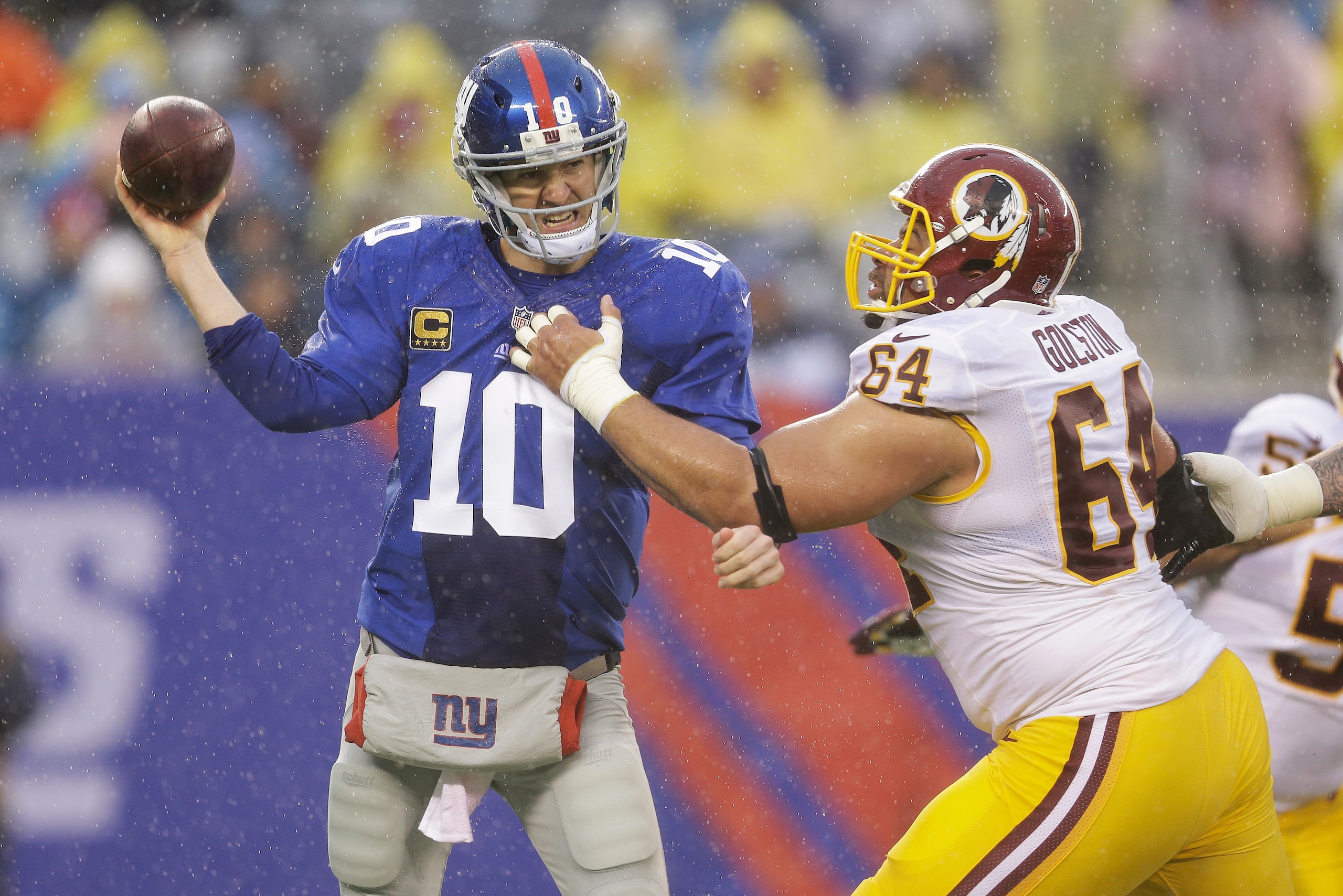
In an ideal world, every quarterback will have as much time as possible in which to scan the field and make the throws.
Such is not the case in the NFL, and for Manning, he has struggled to make the throws when under pressure.
According to Pro Football Focus, Manning was only under pressure 28.6 percent of the time last season (well below the NFL average of 33.4 percent) behind a Giants offensive line that was the 10th-best pass-blocking unit last season, per Football Outsiders.
The bad news is that Manning earned PFF’s worst grade under pressure among the league’s quarterbacks, finishing with a minus-12.1 grade in the face of pressure—the second straight year Manning ranked among the bottom of the league.
Why is this worth mentioning? Because by losing left tackle Will Beatty until at least November, the Giants lost their best pass-blocking offensive lineman.
There is a silver lining, though. With the West Coast offense, Manning and the Giants have cut down on the number of deep shots thrown down the field, instead sticking with the short- to medium-range pass attempts.
Here, Manning has done quite well. Using data from PFF, Manning went 95 of 154 (61.6 percent) last season for 1,567 yards, 15 touchdowns and three interceptions for a 145.1 NFL passer rating.
No. 2: Reducing the Interceptions

The last time Manning had a single-digit interception total as a pro was in 2004, his rookie season, when he threw nine picks in nine games (seven starts).
Since then, the closest Manning has come to having a single-digit season in interceptions was in 2008, when he finished that year with 10.
On a conference call with reporters in late April, Manning is eyeing a return to single digits in the turnover department, saying, “I think the turnovers from interceptions, I had 14 last year. I would like to get that in single digits. … You would obviously like to have zero, but understanding football and funny things can happen, so one every two games (is the) mindset.”
No. 3: Completing 70 Percent of His Pass Attempts
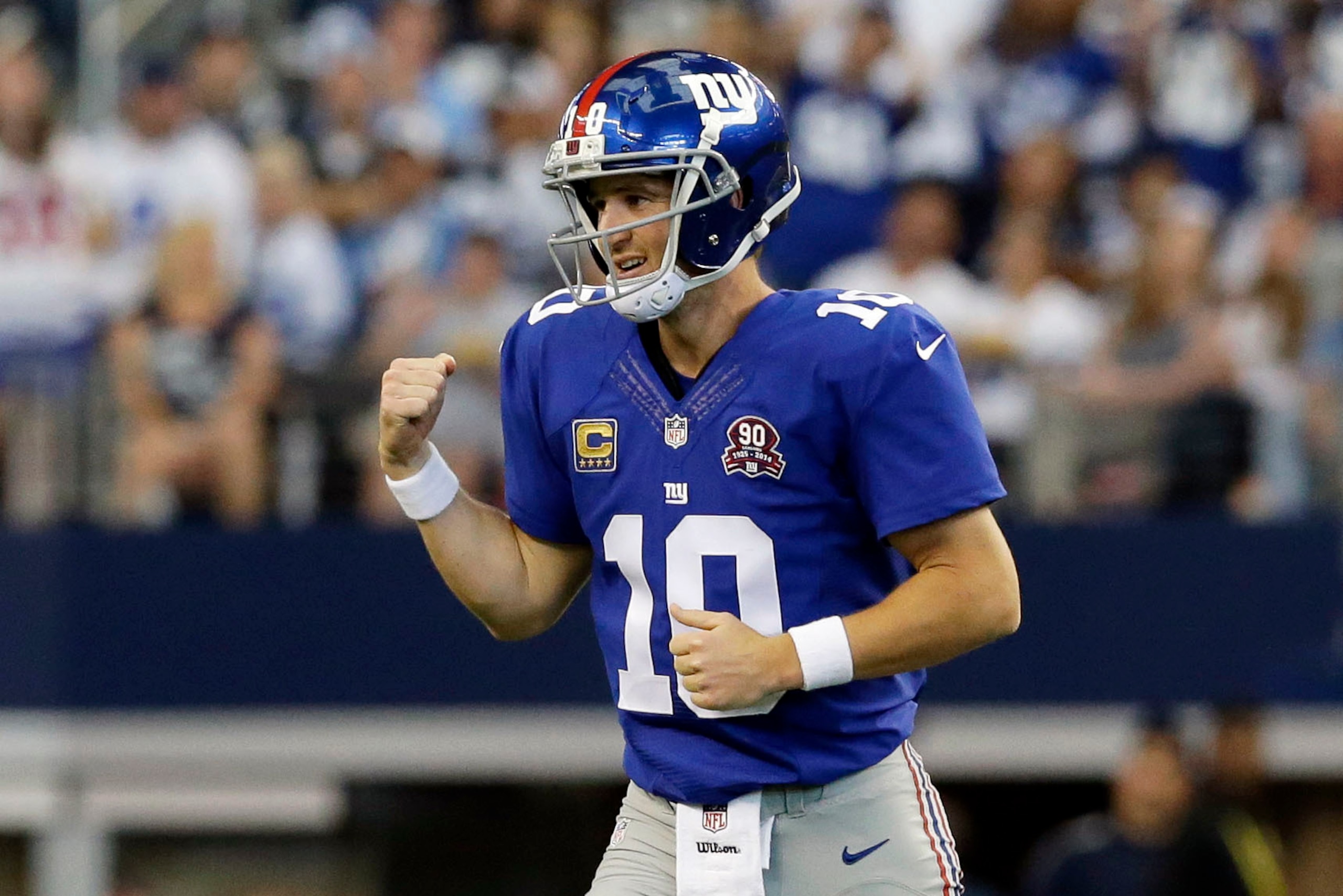
At the start of training camp last year, now former quarterbacks coach Danny Langsdorf identified 70 percent as the target for completions for Manning.
"It hasn't been done very often, so that's the ultimate goal," Langsdorf told reporters during a break at training camp last year. “I think it's been done eight or nine times, maybe? That's an impressive statistic in the history of the league. So that's what we're gunning for, that 70 percent."
Manning didn’t quite make that mark, finishing with a completion percentage of 63.1 percent in 2014, a new career high.
Well, if at first you don’t succeed, try again, and that’s what Manning intends to do in 2015.
“I want to be 70 percent," Manning said. "It might not happen every single game, but if you can go for that by game, sometimes you might not get it, and for the season it might not be 70 percent, but each game shoot for that 70 percent."
It might also help Manning if his receivers held on to the ball. Last year, Manning finished with the 12th-most dropped passes among quarterbacks, with his receivers mishandling 30 such passes of which only three were a result of Manning being hit by a defender as he released the ball.
No. 4: Reducing His Fumbles

One thing that will probably never change when it comes to Manning is his mobility—or lack thereof—in the pocket.
In that regard, Manning’s skill set isn’t a 100 percent fit for the West Coast offense, as his inability to escape from pressure does impose a limitation as to how certain plays can be designed, which is why the Giants have had to tweak the offense a bit to mask Manning’s shortcomings in the system.
The lack of mobility can also leave him more susceptible to having the ball jarred loose by a charging defender, because when Manning does move, he is oftentimes trying to find an open receiver and thus isn’t necessarily protecting the ball.
Manning has had 86 fumbles over the course of his career, finishing with seven fumbles in each of the last two seasons, and hitting double digits twice in his career (in 2007 and 2009).
According to PickingPros.com, Manning had seven fumbles last year, four of which were lost.
While his total number of fumbles fell short of the league lead of 12 held jointly by Andrew Luck of the Colts and Jay Cutler of the Bears, if considering he rushed 12 times and had seven fumbles (some of which might have been as a result of him trying to avoid pressure), that’s still not a very good statistic.
Postscript: What Happens if Manning Goes Down?
If the unthinkable happens and Manning can’t go for any length of time, his backup is Ryan Nassib, who is entering his third season.
Based on his preseason showing last summer, Nassib showed that he made enough progress to where the organization felt comfortable not carrying an extra quarterback, as it had the prior season.
While the preseason is a different scene than that of the regular season, Nassib showed last year that he improved with his decision-making, that he had a strong enough arm to make the deep passes and that he could move with the ball if he had to keep it.
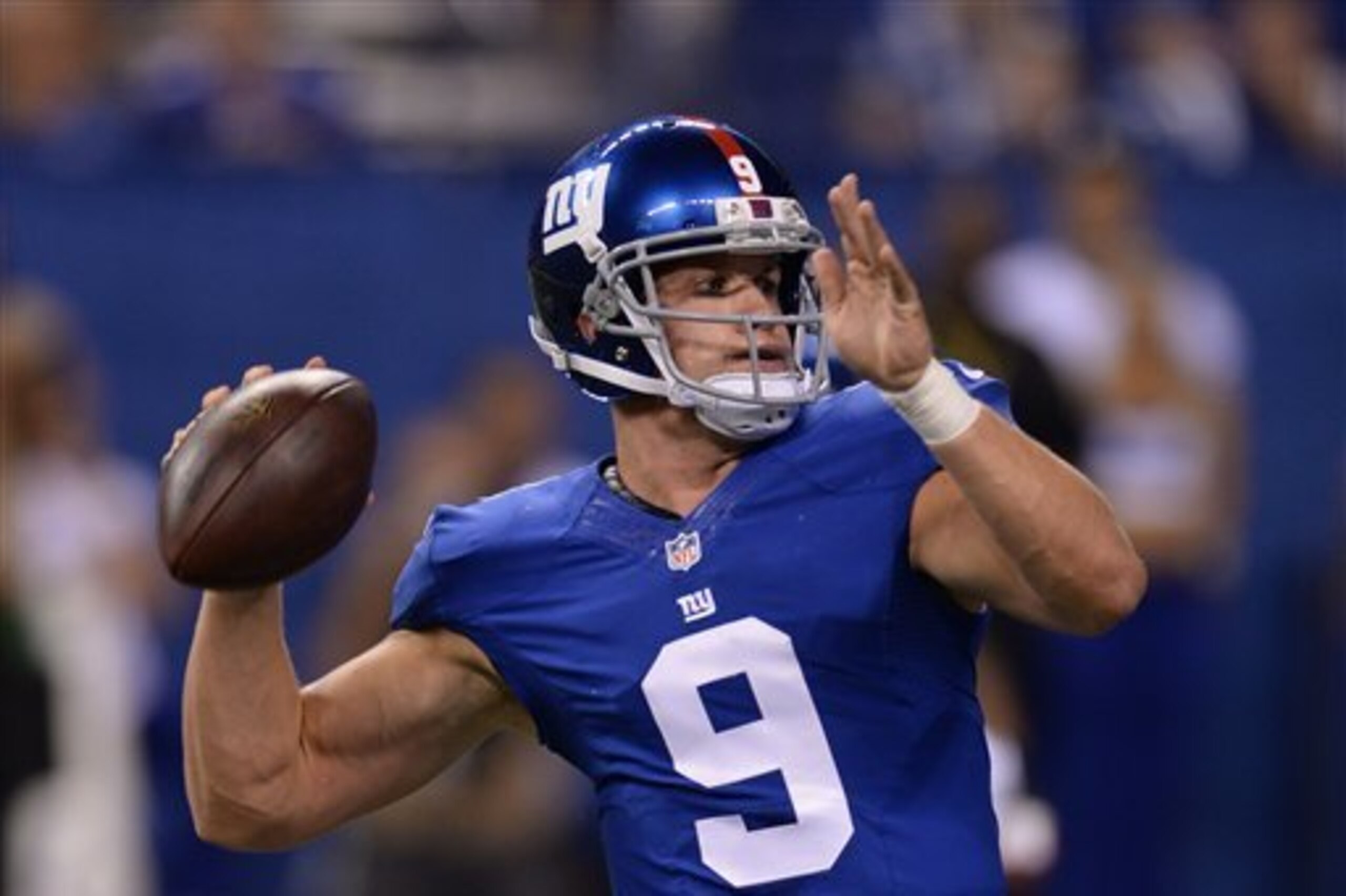
He finished with 588 passing yards, the third-most in the league last summer, behind Tennessee’s Zach Mettenberger (659) and New England’s Jimmy Garoppolo (618).
Nassib also tied for first with Teddy Bridgewater of Minnesota and Garoppolo for most touchdown passes (five), and was, per PFF, one of two quarterbacks who took at least 75 percent of their team’s snaps behind center last summer but didn’t throw an interception (the other being Johnny Manziel of Cleveland).
Nassib, who finished with a league-leading 107.3 NFL rating among quarterbacks who took at least 75 percent of their team’s snaps, has apparently been working hard behind the scenes.
Nassib has drawn praise from head coach Tom Coughlin, who told reporters at the NFL combine earlier this year that the former Syracuse signal-caller has improved:
"Ryan has gotten better. If you studied our preseason, there was no doubt that he improved. I see him continuing to improve. He is a guy that works very hard below the surface and behind the scenes.
He is in the weight room right now, all the time, pretty much four or five days a week. He studies on his own. He is very, very serious about being an outstanding football player and he is willing to pay the price to do it.
"
When asked if he believed Nassib could be a starter in the NFL, Coughlin said, “I do.”
Still, there is a significant difference between running a vanilla offense during the preseason and executing a game plan.
The Giants won’t necessarily know what they have in Nassib until they put him out there for a regular-season game.
Considering Nassib is two years into his pro career—including one year in on the current offensive system—and he has shown significant improvement from year one to year two, there is certainly enough growing evidence to suggest the Giants' quarterback situation is solid.
Unless otherwise sourced, advanced statistics via Pro Football Focus.
Patricia Traina covers the Giants for Inside Football, the Journal Inquirer and Sports Xchange. All quotes and other information were obtained firsthand, unless otherwise sourced.
.jpg?w=2560 "Cowboys Packers Football")




.jpg?w=2560 "🚨 Week 8 AP Top 25 Poll")