Best- and Worst-Case Scenarios for Top 10 2015 NBA Draft Prospects
Isn't the NBA draft all about finding upside while minimizing risk?
Ideally, teams can draft someone with a remarkably high ceiling. But even more ideally, that player simultaneously possesses a high floor, one that will ensure he's still a quality NBA player if he doesn't live up to the expectations.
That doesn't always happen, though.
The draft is essentially a minefield of players who will fail to live up to the breathless hype, as we can't help but get far too excited about all of these untested players with seemingly limitless upside who will soon enter the Association. Teams that can navigate through it successfully tend to do quite well when games are actually played.
When your favorite squad selects a top-10 prospect, you'll want to be aware of the worst-case scenario. Then you can proceed to feverishly root for the best-case one to unfold.
10. Myles Turner, PF/C, Texas
1 of 10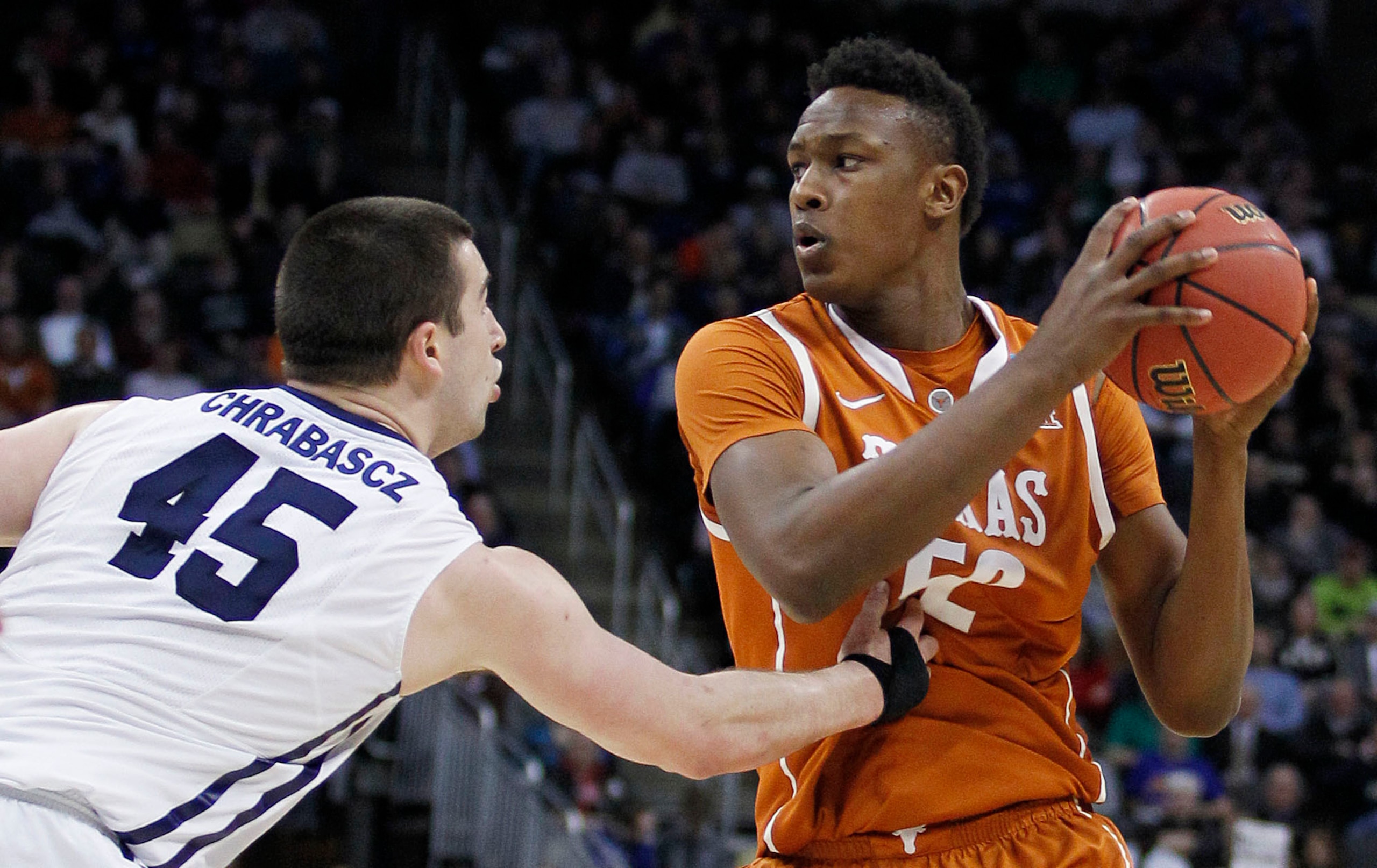
Turner's Per-Game Stats: 10.1 points, 6.5 rebounds, 0.6 assists, 0.3 steals, 2.6 blocks, 25.5 PER
Best-Case Scenario: Three-and-D big
Prospects who played college ball under Rick Barnes haven't always turned out well (Kevin Durant and LaMarcus Aldridge serving as the obvious exceptions), but it wasn't tough to see inordinate amounts of potential when Myles Turner went to work for the Texas Longhorns. The 19-year-old can block shots on one end, then show off his smooth shooting stroke from the perimeter on the other.
He lacked consistency—as evidenced by his poor three-point percentage (27.4) and many ill-timed defensive rotations—but all the tools are there. And if they come together, we could be looking at the rare stretch 5 who legitimately thrives on both sides of the ball.
This isn't a perfect comparison, but think about a player who can have an impact like Serge Ibaka on defense and Ryan Anderson on offense. One day, Turner could be able to protect the rim quite well while challenging for the league lead in blocked shots, and he could space the court as well as any frontcourt contributor at the very same time.
Worst-Case Scenario: No offensive fit and limited playing time
Turner is adept enough at drawing contact and finishing at the charity stripe that he shouldn't ever be too inefficient. But if he's unable to improve his perimeter shooting—especially when he's playing with a deeper NBA arc—and doesn't develop with his back to the basket, it's going to be difficult for him to find much playing time.
And frankly, it may be difficult already, as DraftExpress.com's Matt Kamalsky details:
"Turner's somewhat ginger, choppy running stride was a part of not only our scouting report on him, but of those published by most major NBA Draft outlets as well. As Schmitz notes, Turner is plenty mobile for a 7-footer. He moves better than numerous center prospects we've covered over the years, but with the lamentable history of big men with injury problems over the last two decades and the increased attention to detail in the internet era of scouting, Turner's gait was still viewed as a concern.
"
Turner has plenty of upside, but he's one of the riskier upper-tier prospects.
Though his shooting stroke looks nice, there are plenty of failed players who once boasted pretty form and never saw it develop. Beyond that, health could be a concern down the road if he doesn't change his fundamental running mechanics.
9. Mario Hezonja, SG/SF, Barcelona
2 of 10Hezonja's Per-Game Stats: 6.1 points, 2.0 rebounds, 1.1 assists, 0.6 steals, 0.1 blocks, 13.4 PER
Best-Case Scenario: All-around stud
"If I was in college I'd probably be the No. 1 pick." Mario Hezonja told David Pick of Basketball Insiders in January, prior to officially declaring for the 2015 NBA draft. "I had an offer from Kentucky. I'm European and I need to work harder to break into the U.S market."
He may not be wrong.
If this swingman can put together all of his many tools, there's basically nothing he can't do on the basketball court. He's already putting up stellar shooting performances, swishing jumpers after starting both on and off the ball. He's a 6'8" wing player with plenty of top-notch athleticism and body control in the air. He's a strong ball-handler, as well as a great distributor for his position.
Oh, and he's already prepared to settle in on the point-preventing end and play high-quality defense, especially since he can anticipate offensive sets and use his quick hands to wreak havoc in all situations.
Worst-Case Scenario: Quick flame-out
We've seen uber-talented international prospects before, and not all of them have worked out.
The biggest concern with Hezonja may be his attitude, as it's most assuredly confident and occasionally borders on brash or cocky—take your pick of choice adjectives. While that may make the transition from Barcelona to the Association easier for him, it could also have the opposite effect, leading him to take on too much responsibility early in his career and shoot his way into a hole he can't dig his way out of.
Playing isolation offense is a bit more difficult in the NBA than it is anywhere else, and that's Hezonja's bread and butter right now. If he bricks too many shots early on, he could easily be buried on a bench and fail to see his lofty potential realized.
8. Willie Cauley-Stein, C, Kentucky
3 of 10
Cauley-Stein's Per-Game Stats: 8.9 points, 6.4 rebounds, 1.0 assists, 1.2 steals, 1.7 blocks, 23.8 PER
Best-Case Scenario: Perennial Defensive Player of the Year threat
Maybe Willie Cauley-Stein develops more offensive chops, honing that mid-range jumper he showed off during the second half of the 2014-15 season and gaining enough touch that he can average 15 points per game in the NBA. But even if he doesn't, he has a great chance to compete for Defensive Player of the Year time and time again.
Per NBADraft.net, the big man measured in at just over 7'0" with shoes on, and his wing span was a strong 7'3" at the combine. He has the length necessary to be an interior force in the Association, but his time at Kentucky also showed that he has the defensive desire and smarts necessary to make a huge impact.
Don't be fooled by his lackluster rejection totals as a junior. He blocked 2.1 and 2.9 shots per game during his freshman and sophomore seasons, respectively. Throughout his final collegiate campaign, he ceded the interior spot to Karl-Anthony Towns, instead using his mobility to cover pick-and-rolls and wreak havoc outside the painted area.
It's only going to leave him more prepared for the next level.
Worst-Case Scenario: Solid rotation big
Though the lack of elite offensive upside ultimately pushes Cauley-Stein down the board, he's a relatively safe pick. To be fair, no pick in the draft is ever truly bulletproof, but his defensive prowess and size is going to ensure that he has a lengthy career.
Remember, Kwame Brown, a center commonly called one of the biggest busts ever, spent many seasons playing NBA basketball, and that's not something every failed prospect can claim. Size can't be taught, as the saying goes.
Even if Cauley-Stein's mid-range shooting was merely a mirage, leaving him incapable of scoring when he's not picking up the trash and knocking down second-chance opportunities, this Wildcat product is too strong on defense to be a complete bust.
Worst case, he settles in as the first big off the bench for a competitive team, filling a role similar to the one Kosta Koufos occupies for the Memphis Grizzlies.


7. Stanley Johnson, SF, Arizona
4 of 10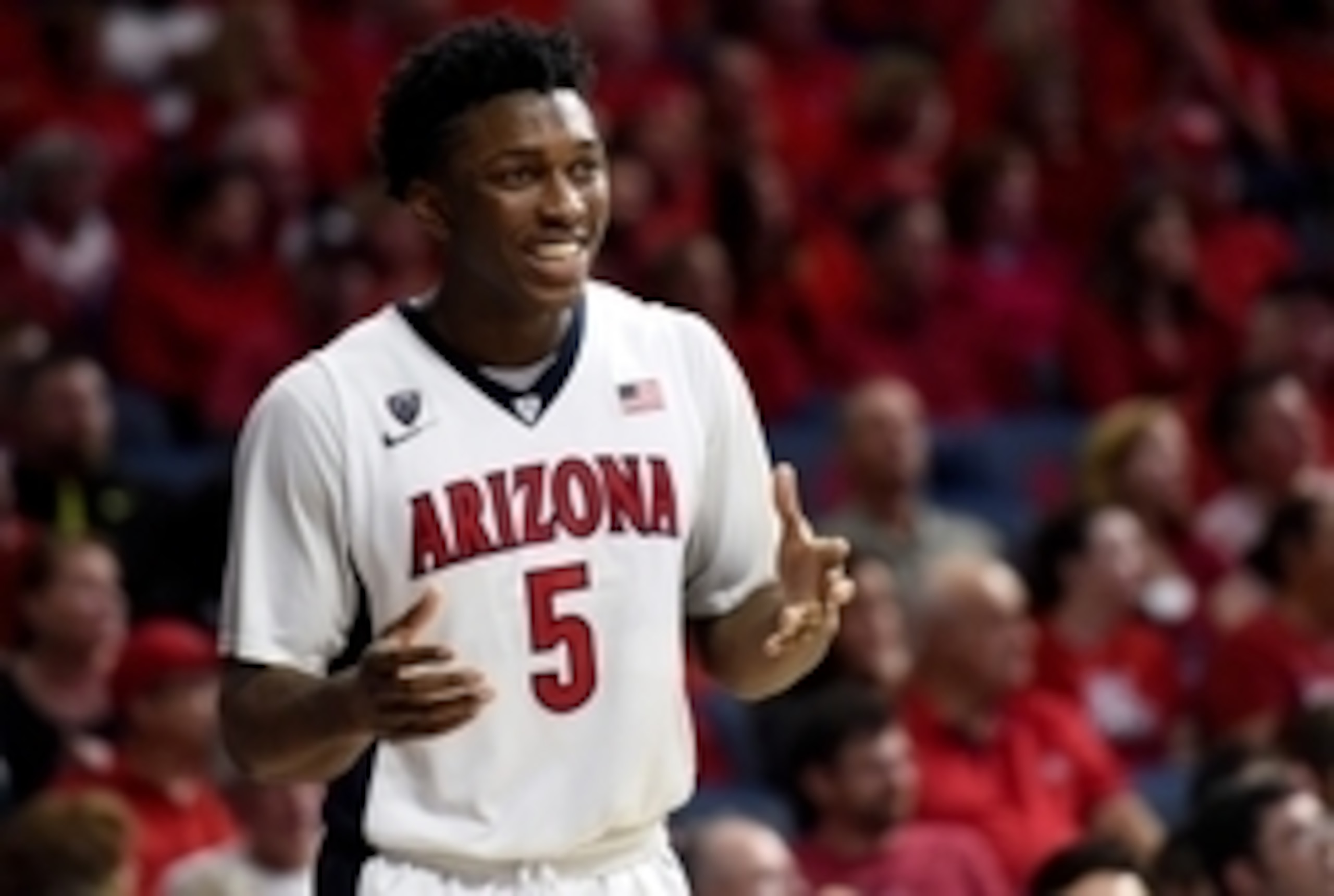
Johnson's Per-Game Stats: 13.8 points, 6.5 rebounds, 1.7 assists, 1.5 steals, 0.4 blocks, 22.5 PER
Best-Case Scenario: He's right
"Because I'm the best player in the draft," Stanley Johnson said at the draft combine when asked why teams should select him, per MassLive.com's Jay King.
He may end up being right, even if that's an exaggeration when looking at each prospect's current level.
Johnson isn't just a remarkable athlete who can thrive as a slashing threat and pull down plenty of boards for his position. He's also a potent three-point shooter who made 37.1 percent of his deep looks as a freshman and has the form and quick release necessary to get even better.
Beyond that, he's a tremendous defender, even at this young age. As Team USA coach Mike Jones explained at the 2014 Nike Hoop Summit when asked about the future Arizona standout by NBA Draft Insider's Kris Habbas (via Arizona Desert Swarm's Kevin Zimmerman):
"Stanley Johnson is one of the best defenders I've ever been around. You can talk about (Arizona target) Myles (Turner) being 7-feet tall and saying he's going to be a pro and things like that, and not to take away anything from anybody else, but Stanley Johnson is an elite defender. He's going to have a long NBA career. He's so strong and so long and moves his feet so well, he's very smart. I think he'll play this game a very long time.
"
Worst-Case Scenario: He's wrong
Even if Johnson's offense stays in the desert—and honestly, I'm not entirely sure why it would—he's still going to be an impactful NBA player. Maybe not a star, but at least a quality contributor who can settle into his defensive stance and make life difficult for everyone he matches up against.
There are certain prospects who you know are going to make it no matter what, simply because they genuinely love playing defense and are already established as suffocating stoppers. Michael Kidd-Gilchrist was one a few years back, and Elfrid Payton filled that role in 2014.
Now, it's Johnson's turn. Even if he's a disappointing lottery pick, he won't be a massive bust, especially with his ever-improving physical profile and increasing positional versatility.
6. Kristaps Porzingis, PF, Sevilla
5 of 10Porzingis' Per-Game Stats: 11.1 points, 4.5 rebounds, 0.5 assists, 0.9 steals, 1.1 blocks, 19.7 PER
Best-Case Scenario: A Dirk Nowitzki clone
This is obviously a lofty comparison, and it's probably a bit optimistic, even if Kristaps Porzingis does indeed reach his true ceiling. After all, the legendary German 7-footer is a surefire Hall of Famer who dominated the NBA for well over a decade, and it's tough to say that any 19-year-old will replicate his career.
Don't think of this as a prediction that Porzingis will have the same level of impact, but rather that he'll play the same way.
He's a smooth-shooting 7'1" big man who thrives making unique shots from all over the court. He has a quick release from the perimeter, but his body control and ability to knock down fadeaways from the elbows has to remind you of a certain lifelong Dallas Maverick.
Unless he gets stronger, thereby developing a better post-up game and more defensive ability on the blocks, he's going to be a stretchy frontcourt player who should spend a lot of time watching tape of one of the all-time international greats.
Worst-Case Scenario: Slow-developing bench player
As Jonathan Givony writes for DraftExpress.com, Porzingis' lack of a clearly defined NBA role might hinder him early on in his career:
"At 7-1, with a frail frame, and the shooting stroke of a guard, Porzingis doesn't have a crystal clear role in the NBA right now, at least not in a traditional sense, and certainly not in the short term. If his first coach in the NBA doesn't appreciate his skill-set, and isn't ready to be patient and work through his limitations, he could struggle badly to get minutes early on. Getting with the right coach, roster and organization who can develop him will play a huge role in the success he has in the NBA.
"
Even if Porzingis is used properly, there's still going to be a long adjustment period. He'll be playing a different style of ball, working with a longer three-point arc and playing in a far more athletic league, one that's going to be able to pick on his lack of NBA-caliber strength.
Continuing to develop is a must here, as this Latvian 7-footer is one of the bigger boom-or-bust prospects projected to go in the 2015 lottery.
5. Emmanuel Mudiay, PG, Guangdong
6 of 10
Muiday's Per-Game Stats: 18.0 points, 6.3 rebounds, 5.9 assists, 1.6 steals, 0.1 blocks, 18.9 PER
Best-Case Scenario: A 2.0 version of a certain All-Star point guard
Here's what Wes Hinton listed as Emmanuel Mudiay's strengths for NBADraft.net before the point guard traveled overseas and played a year in China:
"Emmanuel is a true point guard with dynamic speed and athleticism and great size… Very unselfish player who loves to get his teammates involved … Outstanding ball handler who is equally comfortable attacking right and left … Excels in the open court where his speed hits another gear… Sees the entire floor…Very quick first step and a lethal crossover … Makes great decisions off the pick and roll … Finishes strong at the rim … Has the size and strength to post up smaller guards … Good rebounder for a guard ...
"
Sound like anyone familiar?
I'll give you a hint: He played with five fractures in his left hand and wrist during the Eastern Conference Semifinals against the Atlanta Hawks.
Worst-Case Scenario: Lower-tier starter
If Mudiay flops, he's still going to be a point guard who can start for a handful of teams. When you have his type of physical ability and willingness to serve as a primary distributor, there's relatively little risk of flaming out entirely and failing to find a home in a league that often prioritizes play from 1-guards.
The biggest concern revolves around Mudiay's jumper, as he can go through cold stretches and doesn't often hit shots from the perimeter. During his one season with the Guangdong Tigers, he did manage to knock down 34.2 percent of his triples while taking 3.2 attempts per game, but the NBA three-point line is not the equivalent of the one used overseas.
Plus, the mid-range game can occasionally be problematic for this one-time SMU prospect. If he can't learn how to shoot consistently in the modern NBA, his value will be severely hampered.
4. Justise Winslow, SG/SF, Duke
7 of 10
Winslow's Per-Game Stats: 12.6 points, 6.5 rebounds, 2.1 assists, 1.3 steals, 0.9 blocks, 22.3 PER
Best-Case Scenario: March Madness Winslow
Once Duke made it into the NCAA tournament, Justise Winslow refused to take a back seat to anyone. He was a crucial part of the Blue Devils' run to a title, putting up massive numbers when his star-studded team needed them most.
Over his six games on college basketball's biggest stage, this swingman drew James Harden comparisons with his ability to burst to the basket and score when he wasn't raining in three-pointers at a 57.1 percent clip. He averaged 14.3 points, 8.3 points, 2.7 assists, 1.5 steals and 1.7 blocks, shooting 50.9 percent from the field and spending a lot of time at the charity stripe.
Every part of his game looked exemplary, allowing him to rocket up draft boards with his immense potential.
Worst-Case Scenario: Regular-season Winslow
During the regular season, Winslow averaged only 12.4 points, 4.5 rebounds, 2.0 assists, 1.3 steals and 0.7 blocks. Across the board, those marks were worse than the ones he produced in postseason play, and his percentages followed suit.
Winslow knocked down 47.9 percent of his field-goal attempts, 39.8 percent of his looks from beyond the arc and just 59.8 percent of his free-throw tries. With the exception of that last number, those are still solid percentages, but they don't allow him to vault into the realm of stars.
Worst case, he does the same thing in the NBA, sinking into the background and delivering only the occasional flash of his immense upside.
3. D'Angelo Russell, PG/SG, Ohio State
8 of 10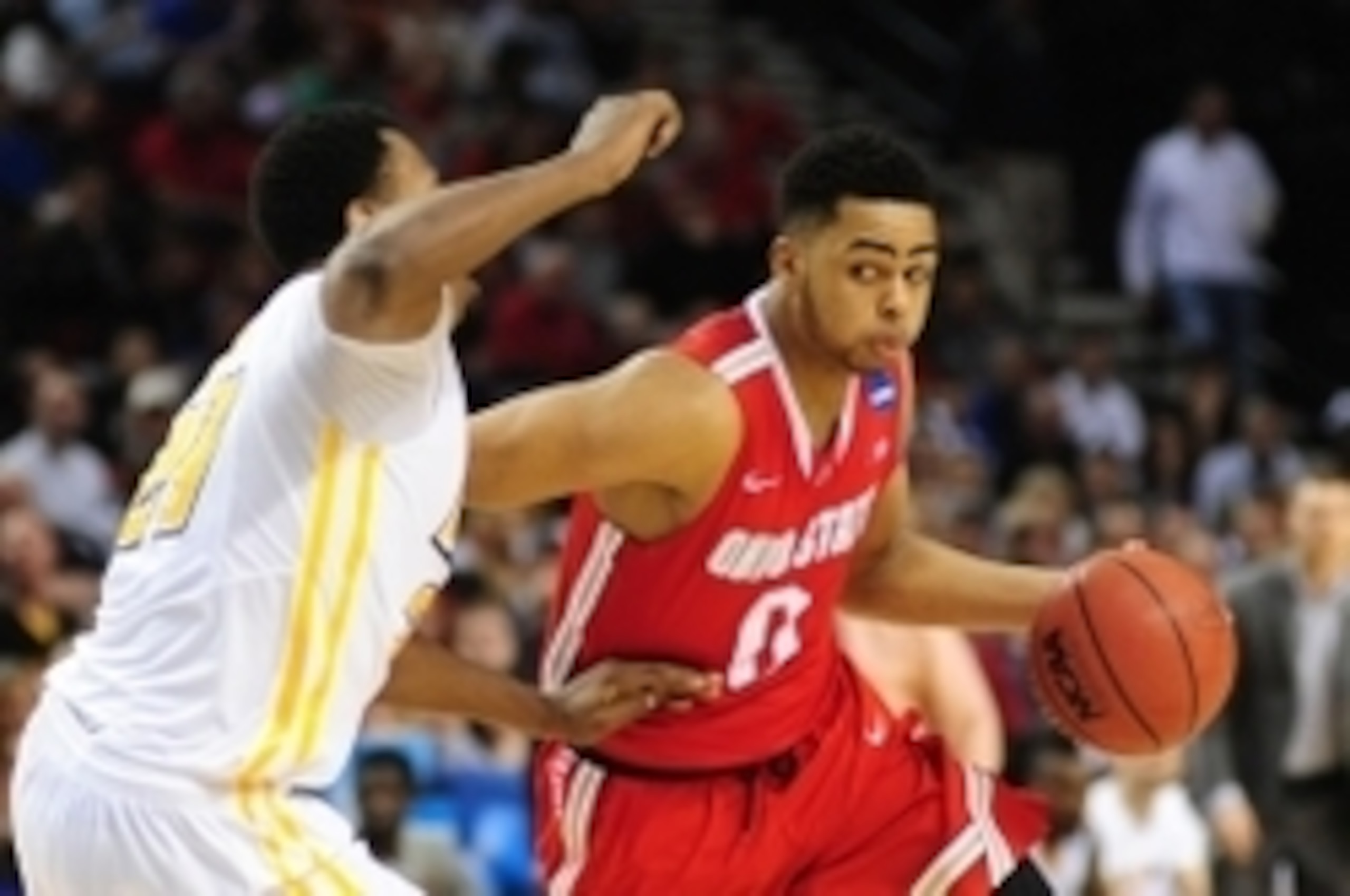
Russell's Per-Game Stats: 19.3 points, 5.7 rebounds, 5.0 assists, 1.6 steals, 0.3 blocks, 26.6 PER
Best-Case Scenario: All-Star combo guard
Bleacher Report's Jonathan Wasserman recently had D'Angelo Russell going at No. 3 in his latest mock draft, highlighting the Ohio State guard's versatility and offensive excellence: "Russell is a world-class passer and ball-handler who also has the size, shooting stroke (95 threes, 41.1 percent from downtown) and scoring ability (19.3 points per game to lead all freshmen) to play the 2."
That type of flexibility is a big deal in the modern NBA, as players are routinely asked to suit up at different positions when they're able to do so. But even if Russell can't play both shooting guard and point guard, he's going to thrive as an offensive creator, capable of earning his own shots and setting up his teammates on a consistent basis.
If you watched Russell throughout his first and only season as a Buckeye, you'd likely have no idea he was just one year removed from playing high school ball. He displayed an astounding level of maturity night in and night out, both with his play and as a leader for a competitive team.
Worst-Case Scenario: Solid starter
Russell is such a talented scorer that it's nearly impossible to see him completely flopping. But two attributes could ultimately hold him back from being a true star at the sport's highest level.
First, he's a relatively limited athlete on the court, rarely displaying the elite level of burst that's necessary to consistently create space in the Association. And that bleeds into the second issue, as his lackluster foot speed and lateral quickness can prevent him from playing strong defense.
Unfortunately, this will be true no matter where he lines up in the NBA. Point guards could expose him in the pick-and-roll game, while shooting guards could have an easy time gaining separation in off-ball situations.
And if you can't play defense, your offense becomes a lot less valuable.
2. Jahlil Okafor, C, Duke
9 of 10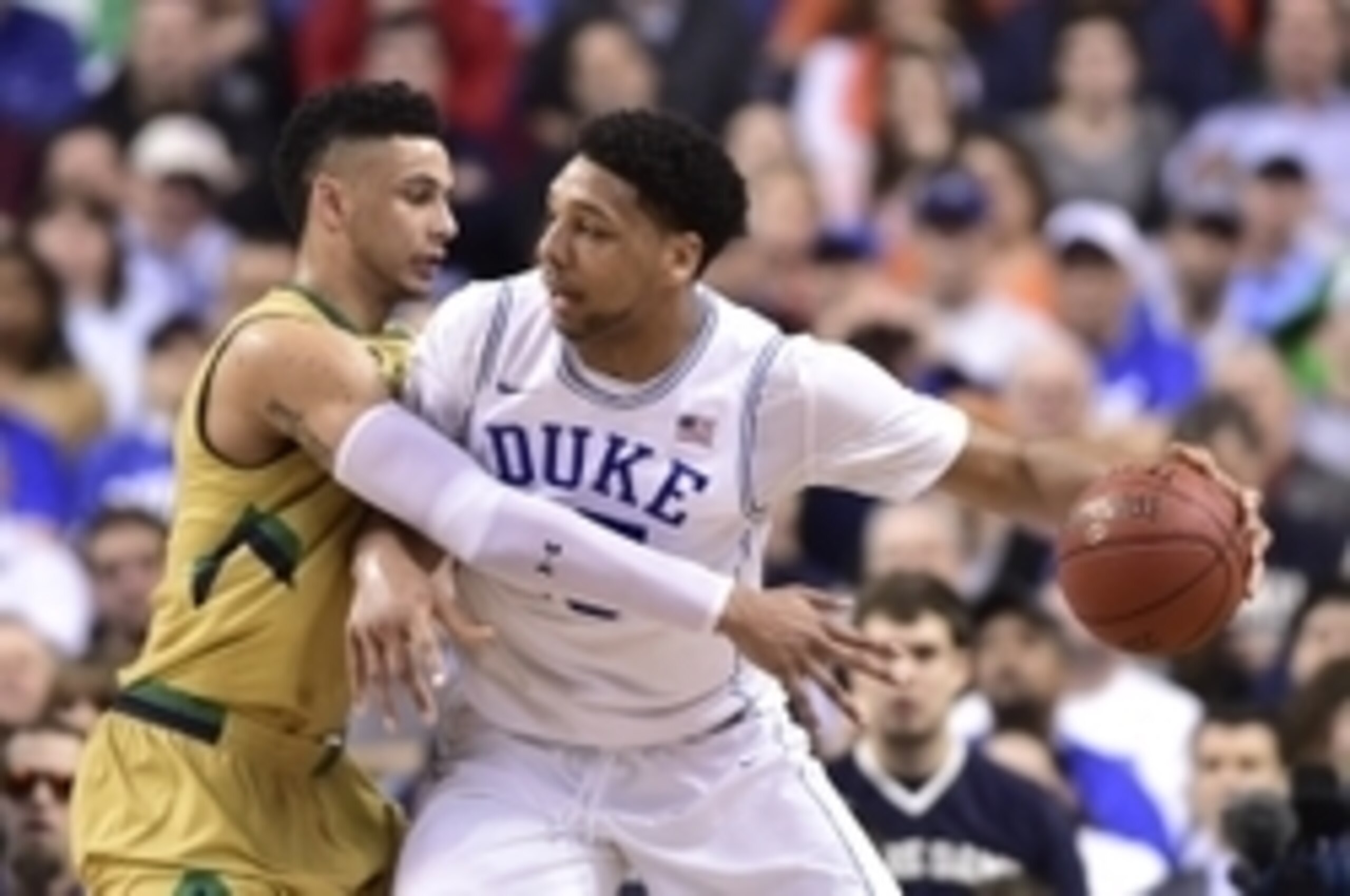
Okafor's Per-Game Stats: 17.3 points, 8.5 rebounds, 1.3 assists, 0.8 steals, 1.4 blocks, 30.7 PER
Best-Case Scenario: Annual All-Star
It's not difficult to see just how talented Jahlil Okafor is on the offensive end of the court.
This young big man has just about every tool in the book, whether he's dazzling with his drop step, using his other back-to-the-basket moves to worm his way around defenders, bullying smaller players from the post or tossing in some mid-range jumpers. Okafor might not have three-point range, and he struggles immensely from the free-throw line, to the point that we might seem some hacking strategies used against him.
But those are about the only weaknesses in his offensive profile.
Though the NBA is trending more toward becoming a spacing-heavy league, there's always going to be a place for old-school studs like Okafor—so long as they're operating in the right system. This particular Duke product will have to play next to a stretchy big or be surrounded by perimeter snipers, but he's going to draw plenty of double-teams when his shot is falling.
There already shouldn't be much doubt about that.
Worst-Case Scenario: Empty-stats big
Okafor might not end up in the right situation, and that could lead to some gaudy offensive stats that hide his true inadequacies—or at least attempt to hide them while his team racks up fewer wins than it should.
This isn't because he might end up on a team bereft of upper-level talent, but because he could wind up playing on a squad that needs an interior defensive presence. He isn't one, and it's unlikely he'll change that after spending his lone season under Mike Krzyzewski failing to protect the rim and either making the wrong rotations or making the right ones but doing so without enough speed.
Givony elaborates for DraftExpress.com:
"The biggest question marks around Okafor revolve around his play on the defensive end, where he was very inconsistent this season. He has the size, strength and length to be more than adequate if he puts his mind to it, and did show some flashes on this end of the floor from time to time, particularly as a post-defender.
"
With that said, Okafor typically looked far too lackadaisical on this end of the floor, jogging back nonchalantly and looking downright lazy in stretches. He gives up deep post-position too often and isn't aggressive enough looking to body his man when he does receive the ball, possibly out of fear of getting in foul trouble.
More concerning is how badly he struggles stepping outside of the paint in pick and roll situations, where he looks sluggish and slow-footed, showing poor awareness and being late to react on the fly. As gifted as he is offensively, he is almost just as poor on the other end of the floor.
Do note that this is only an excerpt of Givony's analysis. There are even more negatives associated with his play on the less glamorous end, and that could be highly problematic.
1. Karl-Anthony Towns, C, Kentucky
10 of 10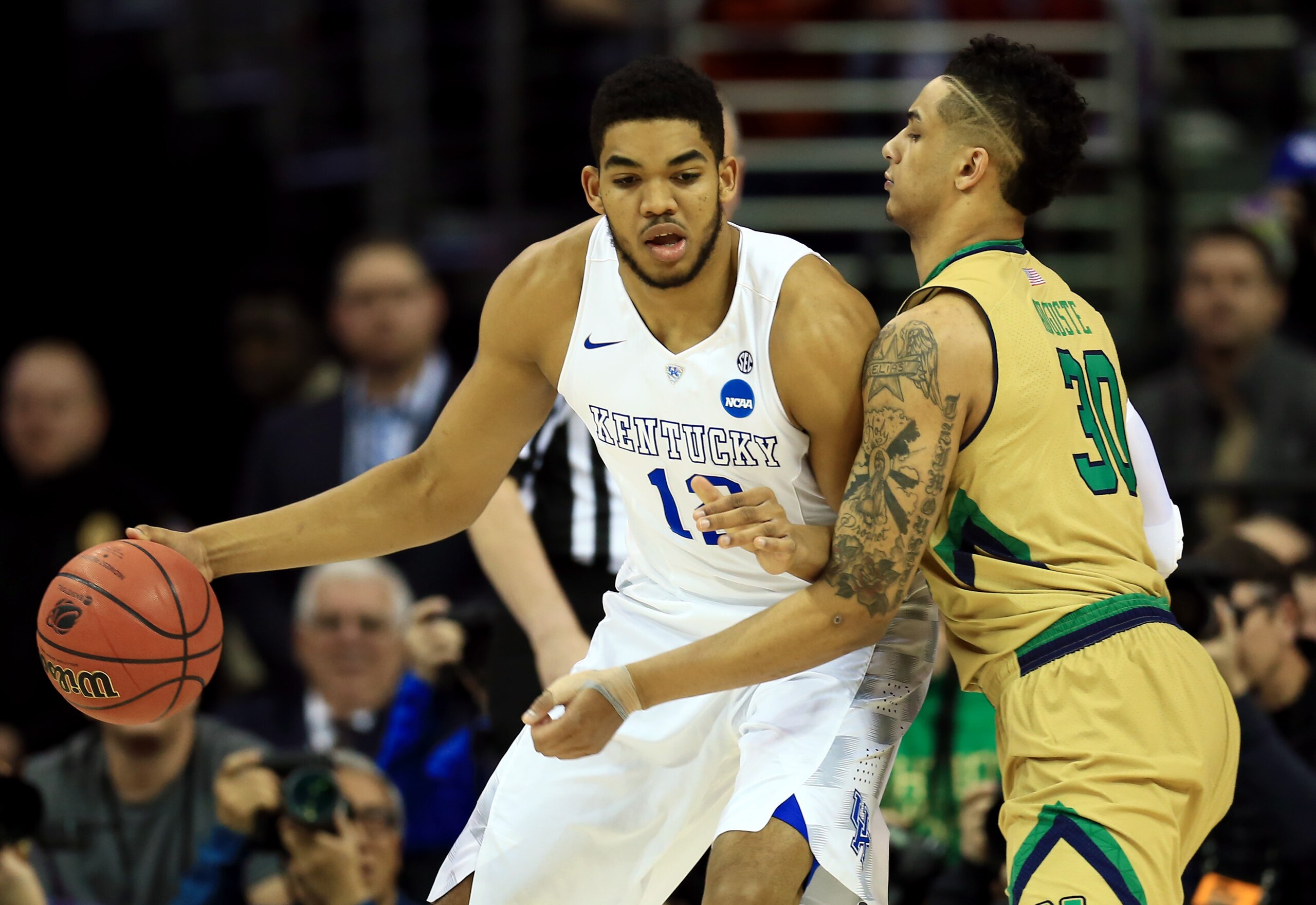
Towns' Per-Game Stats: 10.3 points, 6.7 rebounds, 1.1 assists, 0.5 steals, 2.3 blocks, 31.4 PER
Best-Case Scenario: MVP candidate
We know that Karl-Anthony Towns is going to make an impact on defense. His upside comes on the offensive end, as his late-season improvements offer hope that he's going to be a massive two-way contributor.
During the regular season, the Kentucky big man never once scored 20 points in a single game, instead topping out at 19 on three separate occasions—in early December against Eastern Kentucky, in early February against Florida and two weeks later against Auburn. But once the postseason began, he started becoming a go-to player for the star-studded Wildcats.
He opened the NCAA tournament with a 21-spot against Hampton, then set a new career high a few games later with 25 against Notre Dame. All of a sudden, he was much more effective around the basket, looked comfortable creating his own looks from the blocks and hit some mid-range jumpers.
If he keeps honing his jump-hook and turnaround jumper out of the post, the NBA will have another scoring threat to deal with.
Worst-Case Scenario: One-way stud
Maybe Towns' offensive improvements were fluky. Perhaps he was taking advantage of smaller opponents and less-talented defenders down the stretch, and we're going to see him regress significantly once he makes the trip to the next level.
But even if Towns scores 10 points per game, he could have a Tyson Chandler-like impact on a game. This big man doesn't need to score in order to help his team win, as he's an extremely strong defender who should still thrive on that end.
Size? Check. Strength? Check. Timing? Definitely a check. Mobility outside the paint? Another check.
We could go on, but the trend will only continue.
Note: All stats, unless otherwise indicated, come from Basketball-Reference.com and RealGM.com.
Adam Fromal covers the NBA for Bleacher Report. Follow him on Twitter: @fromal09.

.jpg?w=2560 "Rodgers Iced Out on Plane 💎")
.jpg?w=2560 "Raiders Could Start Mendoza")
.jpg?w=2560 "🚨 Week 8 AP Top 25 Poll")
.jpg?w=2560 "Mahomes Told Teammate to Leave Meeting")
.jpg?w=2560 "Lamar Being Out Shocked Ravens")

.jpg?w=2560 "Packers Safety Slams Refs 🤬")