Breaking the Label: How Blake Griffin Has Gone from Dunker to Complete NBA Star
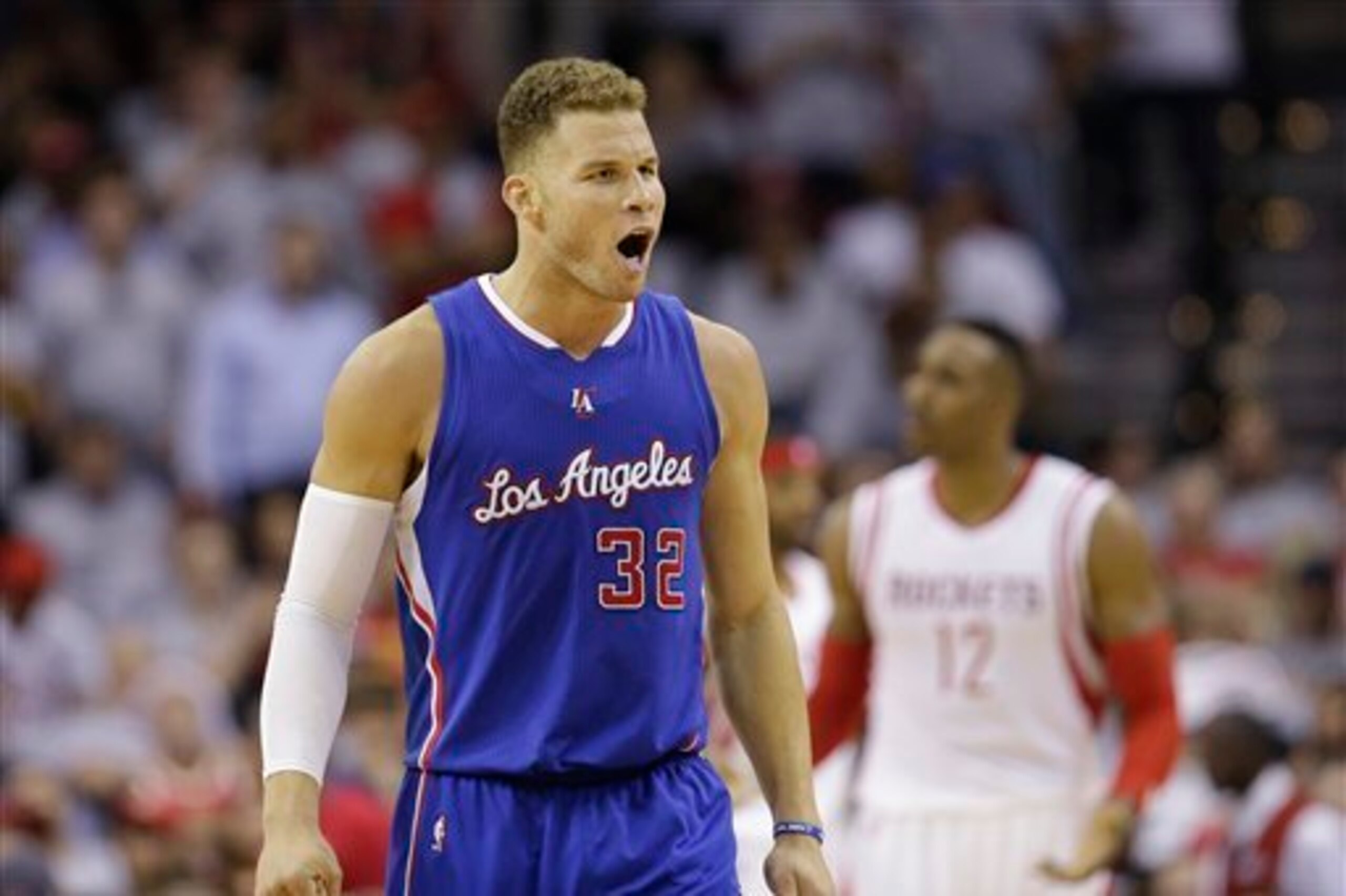
For most of Blake Griffin's career, he's lived in the offensive shadow of Chris Paul and Lob City.
His athleticism, ferocious dunks and ability to overpower his way to the rim clouded the perception of his game. Even though he has quietly developed a solid mid-range jumper and an effective set of moves in the low post, Griffin has always had trouble shedding the reputation of "dunker" and "athlete."
Over the last few seasons, that label has begun to wither away. But in these playoffs in particular, we've arguably seen the most nuanced, all-around and dominant performances of his career.



The points and rebounds—25.2 and 13.3, respectively—have come to be expected. The 6.5 assists per game, however, have seemingly come out of nowhere.
Griffin's 13 assists in Game 1 against Houston held extra weight due to Paul's absence (he injured his hamstring in Game 7 of the previous series against the San Antonio Spurs), but his overall ball movement and facilitation have turned the Clippers into one of the most dangerous offensive units in the league—both during the regular season and the playoffs—according to NBA.com.
After the Clippers' series-clinching win over the Spurs in Game 7, Scott Gleeson of USA Today labeled Griffin's passing as one of the reasons Los Angeles could make a championship run:
"Whether it's in a pick-and-roll set with sharpshooter J.J. Redick (who shoots better than 50% from the field) or on a high-low alley-oop to DeAndre Jordan, Griffin is patient and smart with his reads. His dunks make the highlight reels, but his passing could spell a championship run.
"
Even Paul has noticed what Griffin's ability and willingness to pass have done for Los Angeles (from earlier in the season, via Robert Morales of the Los Angeles Daily News):
"“It’s very valuable,” [Paul] said. “When teams try to send two people at me in the pick-and-roll and different things like that, there are some guys in our league who have to try to pull it and drag it and keep it themselves. But it makes us that much more dangerous that I can just hit Blake and he knows how to make great decisions.”
"
Paul hit the nail on the head regarding what makes Griffin stand out among NBA bigs.
When most people think of pick-and-roll, they think of a two-man game: the big man who sets the screen and the guard who comes off the pick looking to score or hit his rolling teammate with a pocket pass. In some instances, the guard will hit a three-point shooter. Either way, it's a Point A-to-Point B situation: one pass, one assist.
Griffin's success stems from his ability to make the correct secondary reads—that is, when he receives the ball after an initial action and has to quickly react to a rapidly rotating defense.
Many NBA teams have countered the increasing ability of NBA point guards to make the right play in the pick-and-roll by encouraging the player to hit the worst decision-maker on the floor: the big. It's much more difficult for a power forward or center to gather a pass, halt his momentum and possibly take a dribble to make a pass. Most bigs simply do not have this skill.
Against the Clippers, the poison defenses tend to pick is the Griffin-Jordan combination. If Paul can slither his way into the paint to free teammates, the entire offense gets hot, and every player finds touches. If Paul has to get the ball out of his hands quickly, the defense theoretically stands a better chance.
Clippers head coach Doc Rivers understands this tactic and counters by having Griffin, not Jordan, set the majority of their on-ball screens. While the initial action occurs, Jordan lurks along the baseline near the rim in what's known as the "dunker spot." He's waiting for his man, typically the opponent's primary rim-protector, to leave the nest and step up to Griffin.
Here's an example of that from Game 4 in which both Trevor Ariza and James Harden pressure the ball after a Griffin ball screen. Paul makes the sound basketball play by throwing a quick bounce pass, and Griffin has only a split second to gather the ball, wheel his head around and assess his options.

We can already see Howard beginning to abandon Jordan to greet Griffin. Because Jordan is creeping in from Griffin's left, it's only natural that he'll want to squeeze a quick shovel pass to Jordan on that side of Howard.
But Howard is one of the best anticipatory bigs in the NBA, meaning he's able to read actions in real time and reposition his body earlier rather than later. Instead of being late and possibly committing a foul, he's early and planted to contest the next and most likely move: a Griffin finish over the top or a quick dump-off to Jordan.
The genius of Griffin is threefold: his ability to recognize the appropriate play, alter his decision-making on the fly and execute extremely difficult passes in tight quarters. Particularly for bigs who operate within the crowded confines of the paint, it's easy for defenses to deflect passes or alter passing angles.
Here, Griffin shifts the ball from his left to right hand when he notices Howard's positioning, then wraps a pass around his back. Howard stands no chance of defending this, and Jordan finishes with a flush.
This type of skilled interior passing isn't anything new for Griffin. According to Tom Haberstroh of ESPN, via NBA Savant, Griffin actually led the league in lobs thrown at one point in the middle of the regular season. Although the play above isn't finished with an alley-oop, many such situations did end up with a Griffin-to-Jordan lob.
Griffin's other main source of ball distribution has emerged from greater poise during mismatch situations. Many NBA players overreact to what they perceive as an advantage and try to attack one-on-one. Griffin can and will do just that when appropriate, but his greater skill is assessing the entire floor and determining how the rest of the defense is reacting.
Throughout this second-round series, Houston has often switched on Paul-Griffin pick-and-rolls in an effort to minimize Paul's driving lanes while baiting Griffin into poor shots. Griffin, to his credit, has not fallen into this trap.
The Clippers have thrived in this series by screening with the purpose of engineering a Houston switch. They'll then throw the ball to Griffin, who has consistently made the proper read.
It's evident in his play that Griffin considers who's open before settling for an isolation. Sometimes, the Houston defense fully rotates to help. Other times, it doesn't. It's trying to throw Griffin off by varying coverage, but on the whole, it isn't working.
Take this switch from Game 3 in which Pablo Prigioni and Ariza are more than content with trading assignments. Griffin posts up Prigioni at the top of the key, asking for a pass over the top from Jamal Crawford.
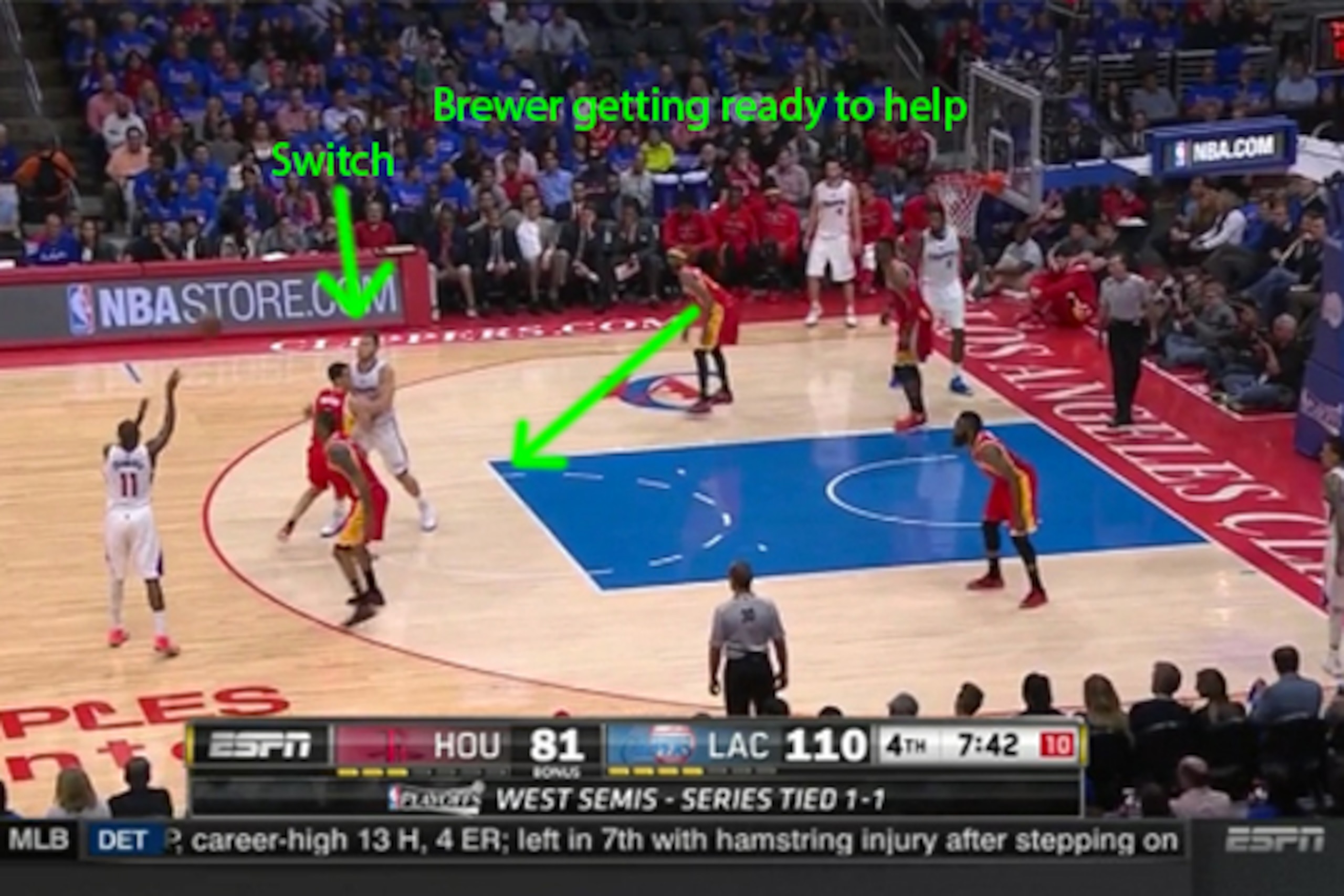
Griffin understands that in any high-low-style pass, the defense will likely be waiting on the low side to deflect the ball. In this instance, it's Corey Brewer who fully rotates.
When Griffin catches the pass, he immediately whips his head around and throws a dart to J.J. Redick in the corner, whom Brewer was just guarding.
Griffin's instincts are on full display here in how he pivots with the ball before the pass. When you watch the video below, notice how he keeps the ball above his waist the entire time and doesn't drop his head.
Griffin knows the help is coming and that there isn't much room for a dribble. Despite the possible avenue for an immediate drive to his right hand, he recognizes that the slapping hands of defensive traffic are likely to swipe the ball away.
Keeping the ball high protects it from prying hands. It also limits the time between the catching, loading and firing of the pass. The moment he realizes Redick is standing alone in the corner, his arms can react instantaneously.
Most NBA bigs can be classified: rim-protector, athlete, low-post scorer, pick-and-pop shooter, distributor, etc.
Griffin is the only big in the league who fits in every single category.
During the course of a game, the Clippers know they can rely on any facet of his game. If they need him to score, they can drop it down to him on the block. If Paul is getting too much attention and the defensive bigs are planted in the paint, he can draw them out with a 20-foot jumper. If he has to become a playmaker, as has been necessary in this series versus the Rockets, he will do just that.
Very few bigs make that final leap from scorer to playmaker. For guards, it's quite simple: They touch the ball more and know that they'll have an opportunity to get their shots up. Bigs, however, are largely at the mercy of their ball-handlers.
The great bigs pass the ball anyway, and in Griffin's case, it's meant more responsibility and opportunities with the ball in his hands.
In past years, it wasn't quite clear whether Griffin and Paul were enough as a duo to lead the Clippers to a title.
Due to Griffin's evolution into one of the league's best all-around players, that is no longer a question.

.jpg?w=2560 "Raiders Could Start Mendoza")

.jpg?w=2560 "Rodgers Iced Out on Plane 💎")
.jpg?w=2560 "Packers Safety Slams Refs 🤬")
.jpg?w=2560 "🚨 Week 8 AP Top 25 Poll")