

Jamal Crawford Is Key to Los Angeles Clippers Escaping 1st Round Alive
Sunday's 114-105 Game 4 win over the San Antonio Spurs was an anomaly for the Los Angeles Clippers.
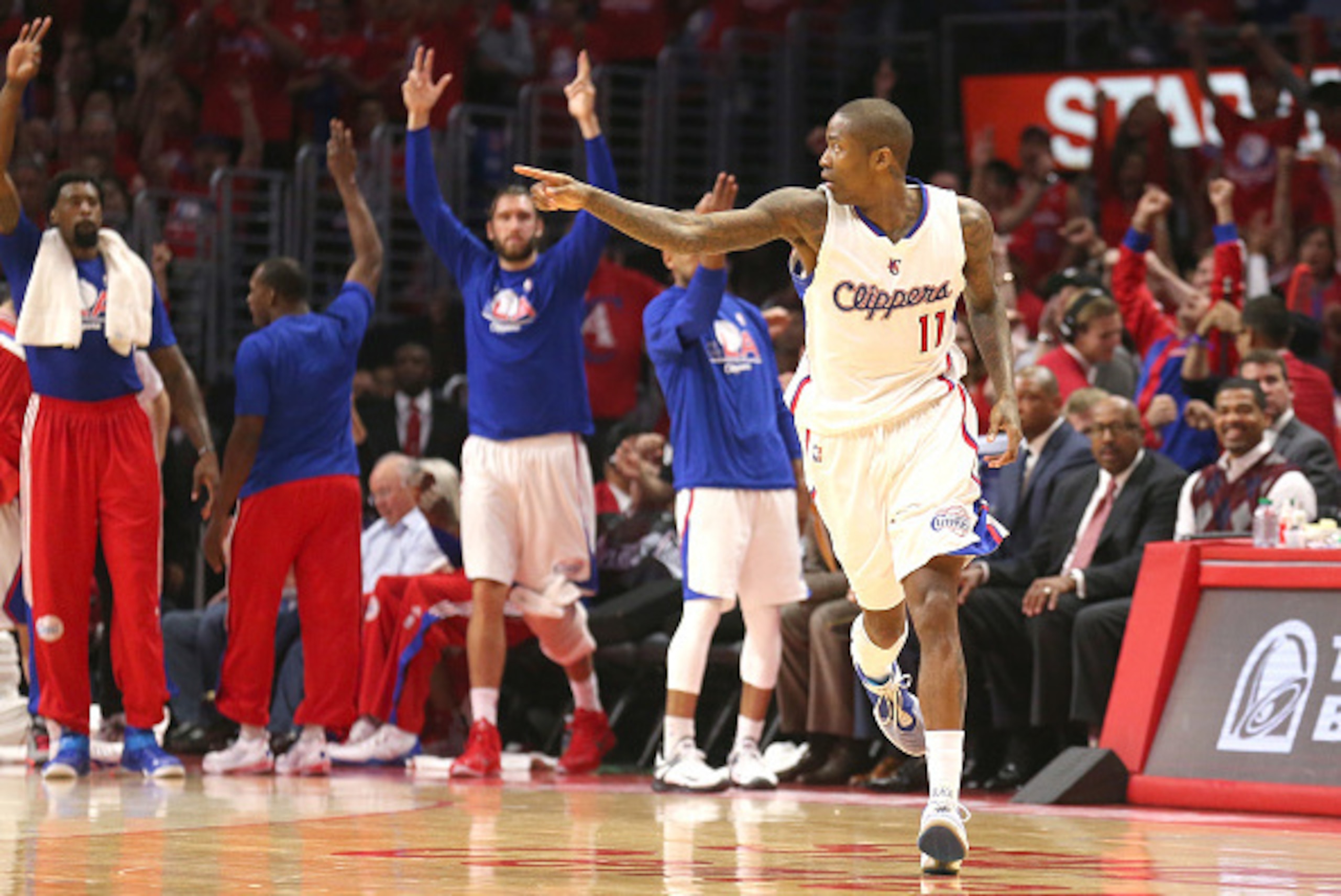
Not because the Clippers beat the defending NBA champions in the Alamo City—L.A. pulled that off during the regular season, too—but rather because of how the Clippers secured that crucial victory. Specifically, not one, but two Clippers reserves scored in double figures: Jamal Crawford with 15 points and Austin Rivers with 16.
Only 19 times during the 2014-15 regular season did more than one of L.A.'s reserves top 10 points in a game. The Clippers went 14-5 in those games, with an average margin of plus-10.3 therein.
TOP NEWS

Pic of LeBron's Helicopter Commute 🚁

Duren Calls Out 'False' Rumors
Trade Idea to Give Warriors Alternative All-Star Upgrade 🏀
Usually, the Clippers' bench-scoring burden is Crawford's alone to bear. According to HoopsStats.com, L.A. ranked 23rd in second-unit point production during the most recent campaign and probably would've finished far worse than that if not for Crawford and his 15.8 points per game.
The fact that the Clippers lack much in the way of reliable contributors among their reserves makes Crawford all the more crucial to the team's attempt to subdue the Spurs in Round 1 and contend for the franchise's first Larry O'Brien Trophy.
None of this is news to Crawford. His two Sixth Man of the Year triumphs are merely the most resounding items on his extensive resume that support his fitness for such a key role in the Clippers rotation.
"I kind of know that’s part of my responsibility," Crawford told Bleacher Report prior to Game 2. "I don’t feel the pressure of it, though, because I’ve been doing it for a while now. I don’t feel the pressure of it. I know that I have to have that group ready as best I can, and hopefully we’ll do a good job."
To be sure, the Clippers don't typically need a lot from their reserves. Their starting lineup of Chris Paul, Blake Griffin, DeAndre Jordan, J.J. Redick and Matt Barnes was among the most dominant five-man units in the league in 2014-15.
According to NBA.com, that fivesome outscored its opponents by 17.7 points per 100 possessions—the third-best mark of any quintet that logged at least 300 minutes together, just behind the current starting fives in Golden State and Cleveland.
But that script has flipped considerably to start this postseason. Per NBA.com, L.A.'s top-five unit has registered a net rating of minus-10.8 points per 100 possessions through its first four games against San Antonio.
That's all the more reason, then, for Doc Rivers to turn to his bench. The trouble is, most of that group that Rivers himself assembled has provided the Clippers head coach and president of basketball operations with little (if any) relief.
Spencer Hawes, for whom Rivers moved heaven and earth (not to mention the Clippers' cap sheet) to bring to L.A., performed poorly all season. Hawes has seen only brief stints off the pine in these playoffs.
Austin Rivers, while effective in fits and spurts, is in the midst of his maiden voyage through the NBA postseason.
Glen Davis brings girth and energy off the bench but scored in double figures just four times all season. The Clippers are basically playing with house money whenever Hedo Turkoglu knocks down shots.
Those guys comprise the core of a second unit that saw more than its fair share of players shuffled out (Jordan Farmar, Reggie Bullock, Chris Douglas-Roberts, Jared Cunningham) and in (Rivers, Jordan Hamilton, Dahntay Jones, Nate Robinson, Lester Hudson) over the course of the campaign.
The one constant? Crawford and the shaking, baking and shot-making that his presence entails.
But even Crawford's contributions were in question coming into the playoffs. He missed 17 games between March and April while nursing a calf injury that left him unable to walk, much less play basketball.
Fortunately for the Clippers, the 35-year-old was able to knock off whatever rust remained in time for the team's franchise-record fourth straight foray into the postseason. In Game 1, Crawford torched the Spurs for 17 points on 7-of-10 shooting in a resounding 107-92 win for the Clippers.
"It’s better," Crawford said of his calf. "Even in the games I wasn’t shooting it well, it’s better. It’s just getting everything else caught up with it."
"Jamal’s Jamal," said Doc Rivers. "He’s a scorer. Jamal’s going to figure it out at some point. And the good thing with Jamal, even when it’s not going, I don’t think I’ve ever seen him lose confidence. That’s Jamal Crawford."
The self-assured Seattleite is more than just an important placeholder for the Clippers; he's a lethal weapon unto himself. Few players in the NBA can handle the ball like Crawford can. Even fewer can knock down the sorts of tough, contested looks at the end of the shot clock—looks that are more prevalent and more important in the playoffs, when finely tuned defenses routinely grind opposing offenses to a halt—to the extent that Crawford can and so often does.
"He’s tough to game-plan for unless you just go ahead and double-team him and never let him shoot the ball or dribble it more than once," Spurs head coach Gregg Popovich explained earlier in the series. "He’s an uncanny scorer. He’s a great, great asset off the bench because he can do so much to bring offense to your team, and he enjoys the challenge. Makes it difficult for everybody to try to keep him under wraps, so he’s very important for their team."
Crawford's role in the playoffs, though, isn't quite the same as it was or would be during the regular season. The Clippers don't require his freelancing as often in the postseason, in large part because he spends more time on the court with other creators.
During the regular season, Crawford played 66 percent (1,125 of 1,703) of his minutes next to two or more starters. Since the start of the postseason, that share has jumped to 82 percent (79 of 96 minutes).
With Rivers shortening and tightening his rotations, Crawford is left with less time having to carry and create shots for units that skew so heavily toward the bench. Instead, the onus is on Crawford to blend his talents with the Clippers stars in a more complementary fashion.
"You just find different ways to be effective," Crawford said. "Obviously, when I’m with the second unit, I’m kind of the point of emphasis. When you’re with those guys, you’re trying to feel your way through it. They still want you to be aggressive, but it comes in a different way."
Crawford has proved himself capable of contributing every which way the Clippers need him to.
Whether drawing contact on his own shots, creating looks for his teammates, spotting up off the ball, scrapping for the ball or matching up with bigger and stronger foes defensively, Crawford isn't one to shy away from a challenge. He can do more than simply spell the Clippers' thin crop of guards and wings but is concerned with putting his team in position to succeed ahead any personal antics.
"Some games are going to be games where I need to score 20-plus points," Crawford added. "Some games, I need to score 10 or below, but if we win, then I’m OK."
And if Crawford can stay healthy and come up big like he did once again in Game 4, the Clippers might be through the remainder of their daunting first-round series against the Spurs and on to the conference semis.
Josh Martin covers the NBA for Bleacher Report. All quotes were obtained firsthand unless otherwise noted. Any unsourced data was compiled manually via Basketball Reference and PopcornMachine.net. Follow him on Twitter.



.jpg?w=2560 "NFL investigating 2 referees for separate viral exchanges")
.jpg?w=2560 "OBJ Calls Out Giants 😳")


.jpg?w=2560 "Ward Nearly Walks Out of Presser 😳")
.jpg?w=2560 "Tyreek makes another cryptic post amid Chiefs rumors")