

No Matter What, Boston Celtics Building Exciting Future After Surprise 2014-15
The Boston Celtics may be down 0-2 to the Cleveland Cavaliers, but that shouldn’t belittle the tremendous success of the 2014-15 season.
Considered by most fans and writers to be a surefire lottery team, the Celtics managed to improve both on and off the court by jettisoning their two best players via trade: Rajon Rondo and Jeff Green. They picked up Isaiah Thomas for an inconsequential first-round pick and rode the stellar coaching of Brad Stevens to the Eastern Conference’s No. 7 seed.
Yes, they did finish below .500, but Boston managed to go 24-12 through the final 36 games and established themselves as a franchise with a smart front office, a clear direction and a novel style of play that will work even better with an offseason to build around it.
TOP NEWS

Brown with an all-time summary of relationship with Tatum

Jokic says booing fans not welcome in Denver
Worst NBA Predictions 🫣
Even if the Cavaliers break out the brooms, the C’s should end the year with their heads held high, and fans should be ecstatic about what the team’s future holds.
Growing Young Core

The most exciting thing about the Celtics going forward is easily their nucleus of talent. While lacking a clear superstar, the pieces have jelled remarkably and make up a deep, well-rounded unit.
Boston’s top players like Marcus Smart, Jared Sullinger, Kelly Olynyk, Jae Crowder and Tyler Zeller are all 25 years old or younger. Evan Turner and Isaiah Thomas qualify as elder statesmen at age 26, and Brandon Bass is a geezer at 29. Per RealGM, Boston’s average player age of 25 is notably lower than the league average of 26.8.
The C’s have had huge success acquiring marginal rotation players like Crowder and Zeller, then turning them into key pieces, and they should continue to grow and blossom in those roles. Pretty much all of the young players have yet to reach their ceilings, and many of them still have very clear areas they could improve in.
Sully, Olynyk and Crowder will all grow as shooters. Smart will become a more disciplined defender. Turner will learn not to force passes in high-risk scenarios.
The playoff experience, however brief it is, will be huge for these young players as they will come back focused and have a leg up over improving teams like the Orlando Magic or Detroit Pistons who have talent but no playoff experience.
It is unlikely any of these players are going to grow into superstars, but once the roster finally had some continuity, it took off, which is a strong testament to the role of consistency in team building.
Sure, Boston will explore some trade options, but the flurry of moves that led to 40 different players suiting up in green, per ESPNBoston’s Chris Forsberg, probably won't happen again.
Boston doesn’t have everything figured out. They desperately need more shooting and rim protection, as we’ll address later, but they finally have some pieces in place that look like cornerstones to build around.
Major Cap Flexibility
One of the most important results of Boston’s trade activity this season is that they now have as clean a cap sheet as any team in the league.
As the Spotrac graphic below shows, the C’s don’t have huge money tied up in anyone but Gerald Wallace and Avery Bradley, and even those contracts won’t look that bad with the cap rising.
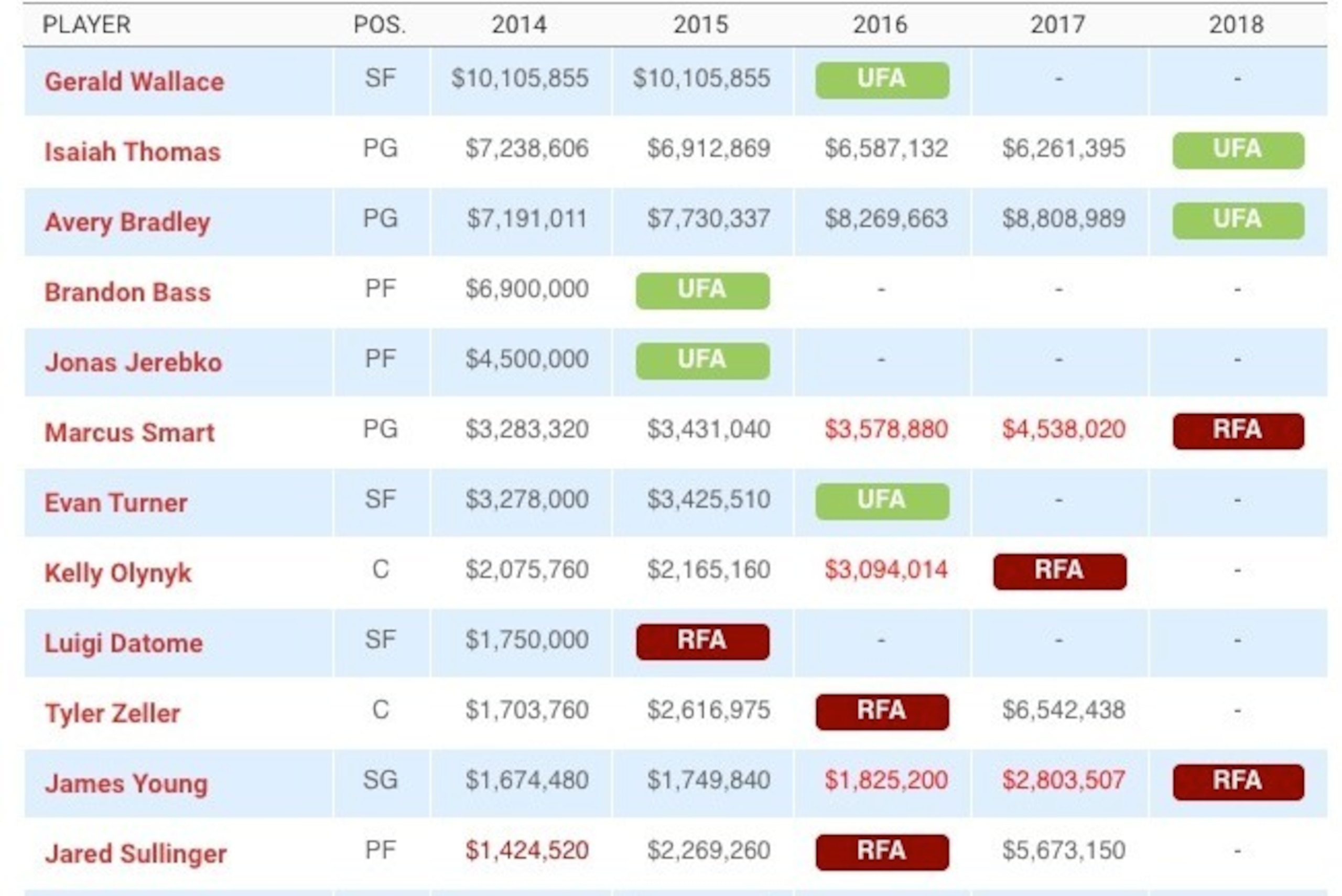
Boston has some tough decisions to make regarding Brandon Bass and Jonas Jerebko (unrestricted) and Jae Crowder (restricted), but they should be able to re-sign them while maintaining enough space to chase a big name.
Admittedly the odds of landing a Kawhi Leonard or Jimmy Butler are slim, but the C’s could pursue unrestricted free agents like DeAndre Jordan or Omer Asik or a young, restricted free agent whose team could be outbid like Khris Middleton or Draymond Green.
The Celtics don’t have the most sterling free-agent track record, but the team now has some success to point to, a clear style of play and infrastructure that should be attractive.
Obviously, maintaining future flexibility will be important since so many Boston players are on rookie deals, and the C’s shouldn’t just sign a player for the sake of spending money, but the team has an enviable number of options.
With their cap space, Boston could also play the role of facilitator in other teams’ trades, which is how they landed Zeller and Marcus Thornton from Cleveland last season.
Even if the Celtics don’t turn their cap room into a marquee player, their financial flexibility makes them all the more intriguing for the future.
Chance to Build to the System
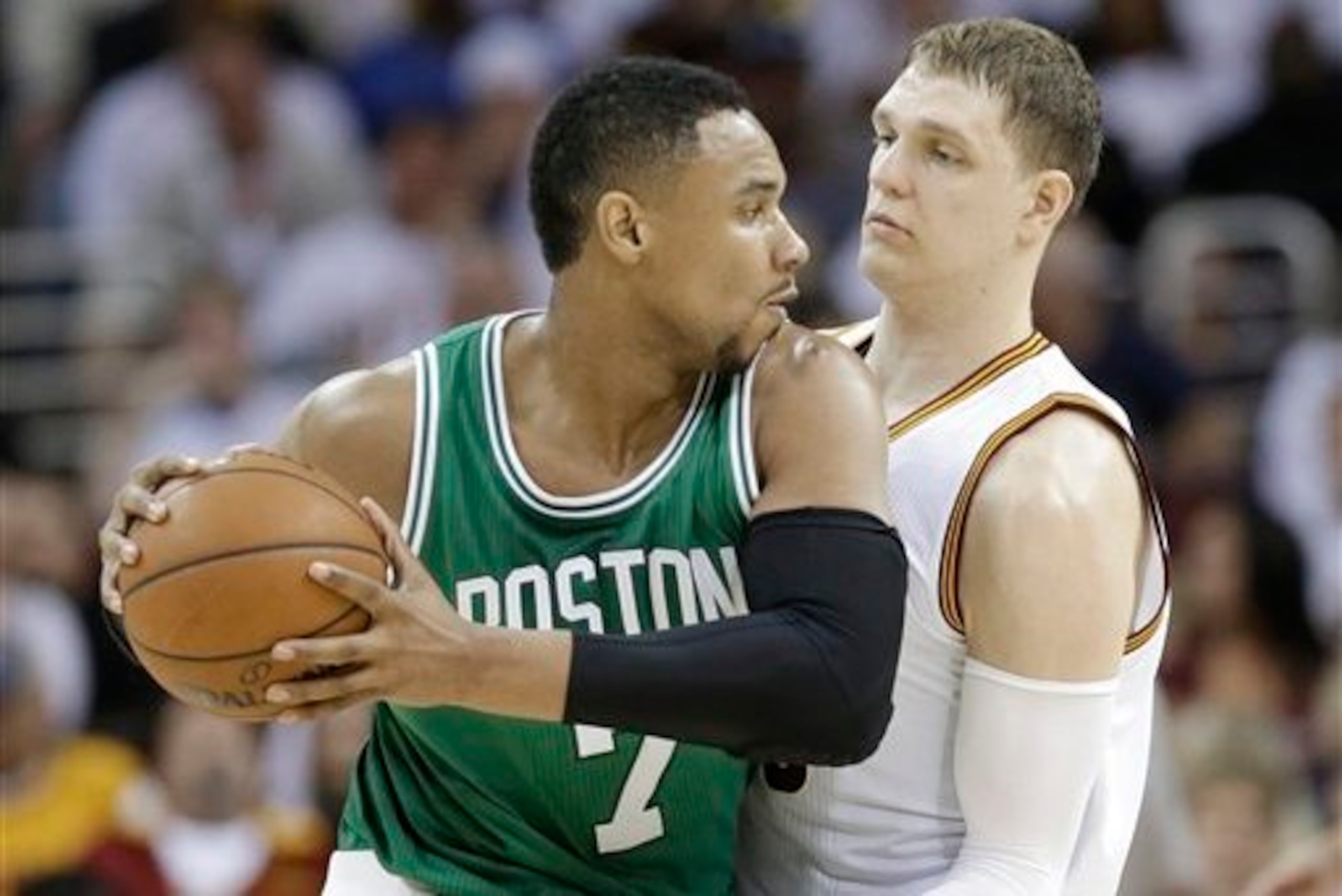
Stevens had his moments during the ghastly 2013-14 season, but this year has been when his true intentions as a coach became clear.
The pace-and-space system he employs has proven successful, but it necessitates some additions and changes to the roster. For example, the C’s finished 13th league-wide in three-point attempts at 24.6, but just 27th in percentage at 32.7.
The team lacks consistent volume shooters, but now has the opportunity to add outside shooting on the wing that could help to open up the floor.
Bradley, Turner and Crowder are all capable of stroking the occasional catch-and-shoot triple, but they can’t be relied on to hit three or four threes in a game with any consistency. Thomas can nail threes, but he’s at his best driving to the hole and finishing in traffic, something that becomes a lot easier when he has open lanes.
The C’s can also look to add more versatile forwards that can switch seamlessly between the 3 and 4 spots. Crowder found a ton of success in that role, but he’s best deployed as a reserve, and Boston can peruse the free-agent market for a starting-caliber player or someone suited to split the minutes with Crowder.
Boston can also address their glaring need for rim protection, a flaw that has been exposed by LeBron James, Kyrie Irving and the Cavs.
The Celtics, as noted by CelticsBlog’s Kevin O’Connor, play a conservative pick-and-roll style, requiring the big man to drop back and coral the ball-handler near the foul line. This defensive system works when the big man is capable of protecting the rim, but Boston lacks a true shot-blocker, and once opposing guards get free off screens they generally have an easy shot at the hoop.
Finding a franchise center is not an easy task, but Boston could add a shot-blocking specialist who could soak up some of the minutes at the 5 absorbed by Olynyk and Sullinger.
With adjustments like these being made, the team will be better-suited to play Stevens’ style on both ends and only build on the 2014-15 momentum. For as impressive as this campaign was, it is important to remember this year was basically Stevens making the most of an island of misfit toys.
Proven Front Office Plan
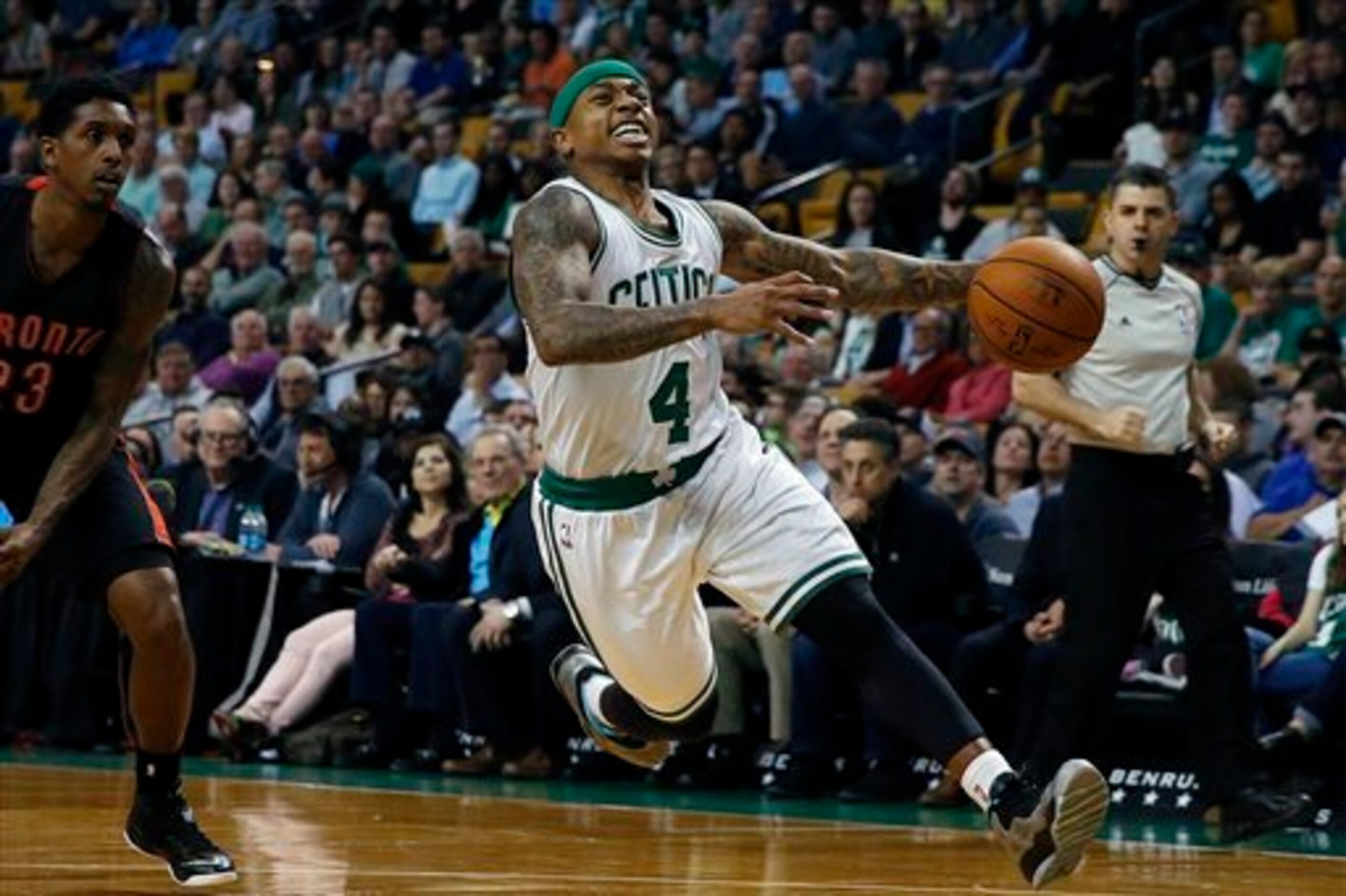
While it initially seemed like the front office had no idea what it was doing with its hodgepodge of veterans and unproven young talent, the team now has a cohesive identity they can build around. They are no longer just a franchise hoarding first-round picks without a clear strategy.
The trades of Rondo and Green prove clearly that Boston has an interest in getting younger, and now that the team has a nucleus in place, they can start trying to add more established talent around.
The Celtics have a treasure trove of assets they can dangle at teams looking to trade stars as they did, albeit unsuccessfully, with Kevin Love and the Minnesota Timberwolves. Boston has also proven savvy at buying low on players, with Thomas and Zeller being prime examples.
If they can continue leveraging these late first-rounders into on-court assets, the team could improve in a hurry, and there is just no way it makes sense to actually use all their picks to draft unproven young guys.
The C’s finally have a blueprint in place for how they want to build, and Danny Ainge has proven capable of building a quality team in the past.
It took one brutal season of tanking and one revolving door season to finally find a direction, but Boston now understands how it wants to build as a franchise: by leveraging its first-rounders to buy low on talent and building a versatile pace-and-space squad.
The Celtics’ future looks bright again, and it may be coming much sooner than anyone expected.

.jpg?w=2560 "Mahomes Told Teammate to Leave Meeting")
.jpg?w=2560 "5 Teams Eyeing Jonathan Taylor")

.jpg?w=2560 "NFL investigating Eagles")
.jpg?w=2560 "Jonathan Taylor Landing Spots 📍")

