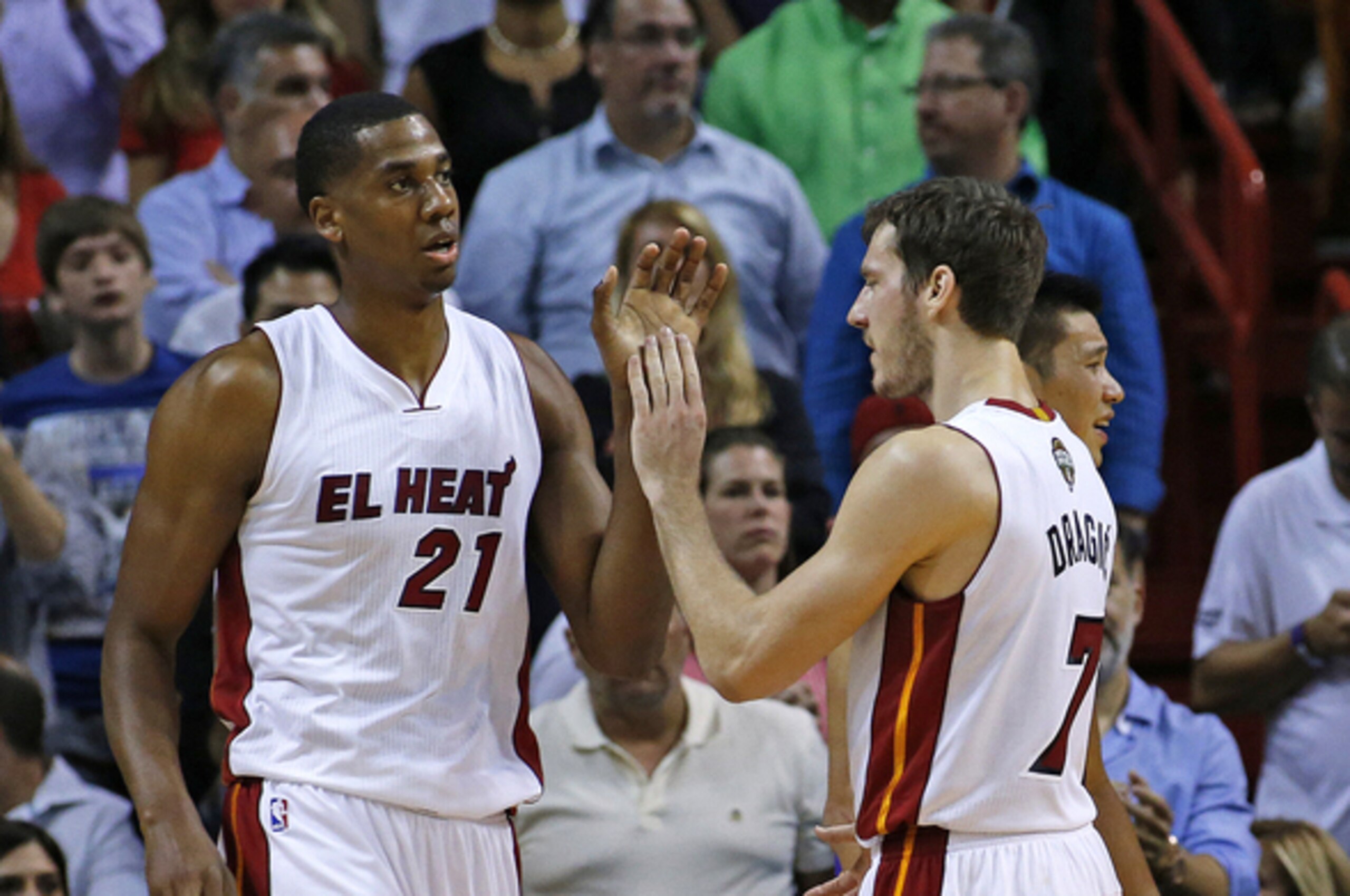

Final Regular-Season Grades for Every Miami Heat Player
The Miami Heat are finally on the other side of what was a disappointing 2014-15 campaign.
Miami's season began with a lot of promise, but it was ultimately undone by injuries. Both Josh McRoberts and Chris Bosh suffered season-ending injuries. Dwyane Wade was out for 20 games, and almost no one on the roster was completely healthy throughout the year.
Still, as disappointing as the end result was, it's not as though this season was a total loss for the Heat. They discovered a diamond in the rough in Hassan Whiteside, traded for a legitimate star in Goran Dragic and had the chance to develop some of their younger players. That's as much as you can ask for in of a losing year.
Let's hand out some grades for each player's performance this season. Grades are based on both preseason expectations and actual production.
End-of-Bench Reserves
1 of 8
Henry Walker
Walker went on a nice hot streak to end the season. But even so, you can't ignore the fact that he was a three-point specialist who hit threes at a mediocre clip.
Nearly 79 percent of Walker's shots came from behind the arc, and he only connected on 34 percent of them. He played hard, and his willingness to play multiple positions was nice. But the Heat needed better shooting from him.
Grade: D+
James Ennis
It's easy to be impressed with Ennis. He gave Miami some big minutes down the stretch and showed encouraging signs for a young wing. Almost all of his shots came at the rim or behind the arc, and he got to the line at a good clip as well.
He'll need to improve upon his 33 percent three-point shooting, and his defense could definitely use some work. But he has the outline of a useful NBA player. Expect him to bust into Miami's rotation next season.
Grade: B+
Josh McRoberts
Injuries ruined McRoberts' season, so we'll hold off on grading him for now. The Heat played great basketball with him on the court. Hopefully, he comes back better than ever next year.
Grade: N/A
Michael Beasley
Experimenting with Beasley was a good idea, but unfortunately, it backfired. Beasley scored 8.8 points per game, but he did so on only 47.4 percent true shooting, easily the worst mark on the roster.
He's still in love with deep jumpers, and though he provided some fun moments at the 5, he was a net minus overall.
Grade: D
Shabazz Napier
Napier is not quite ready to be a rotation player, but he had his moments this season. He shot the ball decently from three (36.4 percent) and had some success driving to the hoop and kicking it out to open shooters.
The problem with Napier is that he's a poor defender and turnover-prone. He coughed the ball up on 24 percent of his possessions, a huge number. He'll have to cut that down to be a dependable player moving forward.
Grade: C+
Tyler Johnson
Johnson was phenomenal to start the year, but his production tanked in the last month of the season. Even so, he did enough to at least warrant a look in 2015-16.
He shot 37.5 percent from deep (including 42 percent from the corners) and showed some genuine ability to get to the rim and finish. He's not a particularly good distributor, but he has potential as an off-the-bench scoring guard.
Grade: B-
Udonis Haslem
Haslem gave the Heat some good minutes when Chris Bosh went down to injury, but it's clear he doesn't have much left in the tank anymore.
While he's still a solid rebounder, his defense has really slipped. He also shot just 57 percent at the rim—a poor mark for any big.
Grade: D
Zoran Dragic
Dragic played just 62 minutes for the Heat, so it's hard to grade him with any measure of accuracy. He appears to be a spot-up shooter (41 percent of his attempts were threes), but he hit just 33 percent from outside.
Grade: C-
Key Reserve: Chris Andersen
2 of 8
Chris Andersen's numbers don't jump off the page (he's averaging 5.3 points and five rebounds per game), but he remains one of the most effective backup bigs in the league.
Andersen shines as a pick-and-roll finisher. He averaged 1.27 points per possession as a roll man this season, placing in the league's 93rd percentile. He doesn't have quite the athleticism he once did, but he's offset that with a greater understanding of when to set hard screens and when to slip picks and roll to the basket.
He's also a timely cutter. He has a knack for noticing when Miami's ball-handlers may run into trouble and makes hard runs to the rim to bail them out.
One thing is worth monitoring moving forward: Andersen's defensive numbers weren't as good as in years past. ESPN's real plus-minus system rates him as a plus—but not a big one—and he allowed 50.4 percent shooting at the rim. The Heat don't have many good perimeter defenders, and that certainly plays a part in his weak numbers at the basket.
But it could be that age (he's 36) is finally taking its toll on Andersen, at least defensively. His block rate fell to 4.6 percent, easily the lowest mark of his career. He's still an effective player, but it's worth questioning how many good years he has left.
Grade: B
Sixth Man: Mario Chalmers
3 of 8
This was a weird year for Mario Chalmers.
On the one hand, he set a career high in scoring average at 10.2 points per game. He was a good slash-and-kick threat and got to the line at by far the highest rate of his career. Unfortunately, he was also a disaster from behind the three-point line, shooting just 29.4 percent.
That hurt Miami badly. The Heat needed Chalmers' shooting to help space the floor—especially on Whiteside's rolls to the rim—and for whatever reason, he didn't have it this season. It's not as though he was only getting tough looks. He shot just 35.6 percent on “wide open” three-point jumpers.
Chalmers was visibly frustrated for much of the year and told the Miami Herald's Joseph Goodman in early April: "I don’t even really know what my role is on this team anymore. I don’t know what I’m supposed to be doing."
In all fairness to Chalmers, his role on the team did change a lot this season, and that may have played a part in his poor numbers. There's almost definitely not going to be so much change next season, and that will hopefully help him bounce back from this year.
Defensively, he was actually quite good. Opponents shot nearly 3 percent worse than their season average when he guarded them and 5 percent worse on shots from beyond 15 feet. Chalmers is only listed at 6'1”, but he's strong. Miami can play him at the 1 or 2 and pair him with any other guard on the roster defensively.
Grade: C+


Point Guard: Goran Dragic
4 of 8
Dragic was only with the Heat for 26 games, but it's easy to be impressed with what he was able to do in that time.
He averaged 17.2 points and 5.5 assists per game on 59 percent true shooting, helping to resurrect what was a defunct Miami transition attack. Before the Heat acquired Dragic, they averaged just 8.5 fast-break points per game, the second-worst mark in the league. With him, they averaged 12.2 per game—a league-average mark.
A big chunk of his possessions came in transition, and he was good at capitalizing on those opportunities. He scored 1.37 points per possession when on the break, placing in the league's 91st percentile on those play types.
Dragic is phenomenal around the rim, sporting one of the league's best arsenal of fakes and acrobatic finishes. He shot 69 percent from within three feet this season, a mark typically reserved for bigs. That's especially impressive considering how little shooting Miami had on the roster. It's scary to think what he could have done with a little more room to operate.
The only problem with Dragic's play wasn't even really his fault. He just didn't get the ball enough. He used 22.2 percent of the Heat's possessions—barely over the 21.5 percent he posted with the Phoenix Suns. Conversely, Wade used 34.7 percent of Miami's possessions.
It's not always easy to make wholesale changes in the middle of the season, but it would have been nice to see Dragic handle a bigger chunk of the offense.
Grade: A-
Shooting Guard: Dwyane Wade
5 of 8
This was one of Wade's least impressive years statistically. He averaged 21.5 points and 4.8 assists per game on 54 percent true shooting. He hasn't been so inefficient a scorer since his rookie season.
However, his counting numbers belie just how good he was in 2014-15.
Wade was asked to do just about everything offensively. As was mentioned earlier, he posted a usage percentage of 34.7. That's his highest mark since 2009-10 and was good for second in the league (behind Russell Westbrook).
That's not something that 34-year-old guards should be asked to do, especially when you consider Wade's injury history. Given all that, his season ends up looking good statistically. He also absolutely cooked defenses in March, the one stretch this year that he was fully healthy.
In March, he averaged nearly 25 points on 56 percent true shooting—one of his best months in years—and threw up some vintage Wade games. He dropped a game-winner on the Portland Trail Blazers and torched the Detroit Pistons with 40 points less than two weeks later.
It's clear that Wade still has something left in the tank, but even so, it would be wise for the Heat to cut down on his workload next season. Again, there's simply no reason that a player of his age should be asked to do so much. Miami should have enough offensive options to make his life a little easier next year.
Grade: B
Small Forward: Luol Deng
6 of 8
Luol Deng was the Heat's workhorse.
He logged 2,421 minutes—the most of any Heat player—and had to put in heavy time at the 4 after Bosh went down with injury. He was one of the few constants in the Heat lineup this season, and that means a lot.
He also had one of his better offensive years with Miami. He averaged just 14 points per game but did so on 56 percent true shooting. He was one of the Heat's few reliable wing shooters, connecting on 35.5 percent of his three-point attempts. That's obviously not an elite number, but it was the best among the Miami forwards.
It's a shame Deng didn't get to play alongside a fully healthy Heat squad, because he's a much better player when he can play off others.
Due to all the injuries, he had to do a lot of creating on his own, and that's just not his game. He doesn't have the best of handles, and his attempts at off-the-bounce creation often led to tough pull-up jumpers.
Should he choose to return next season (he has a 2015 player option, per Hoops Hype), he should have an easier time of things. He's a terrific finisher in the paint and is a great drive-and-kick outlet—he can cash in on catch-and-shoot jumpers or attack a defense that's already on its heels.
Deng is still a strong defender, though not quite the lockdown wing he once was. Opponents shot 1.4 percent worse than their season averages when he defended them. His defensive versatility (he can safely guard most 3s or 4s) also gave the Heat some switching flexibility.
Grade: B+
Power Forward: Chris Bosh
7 of 8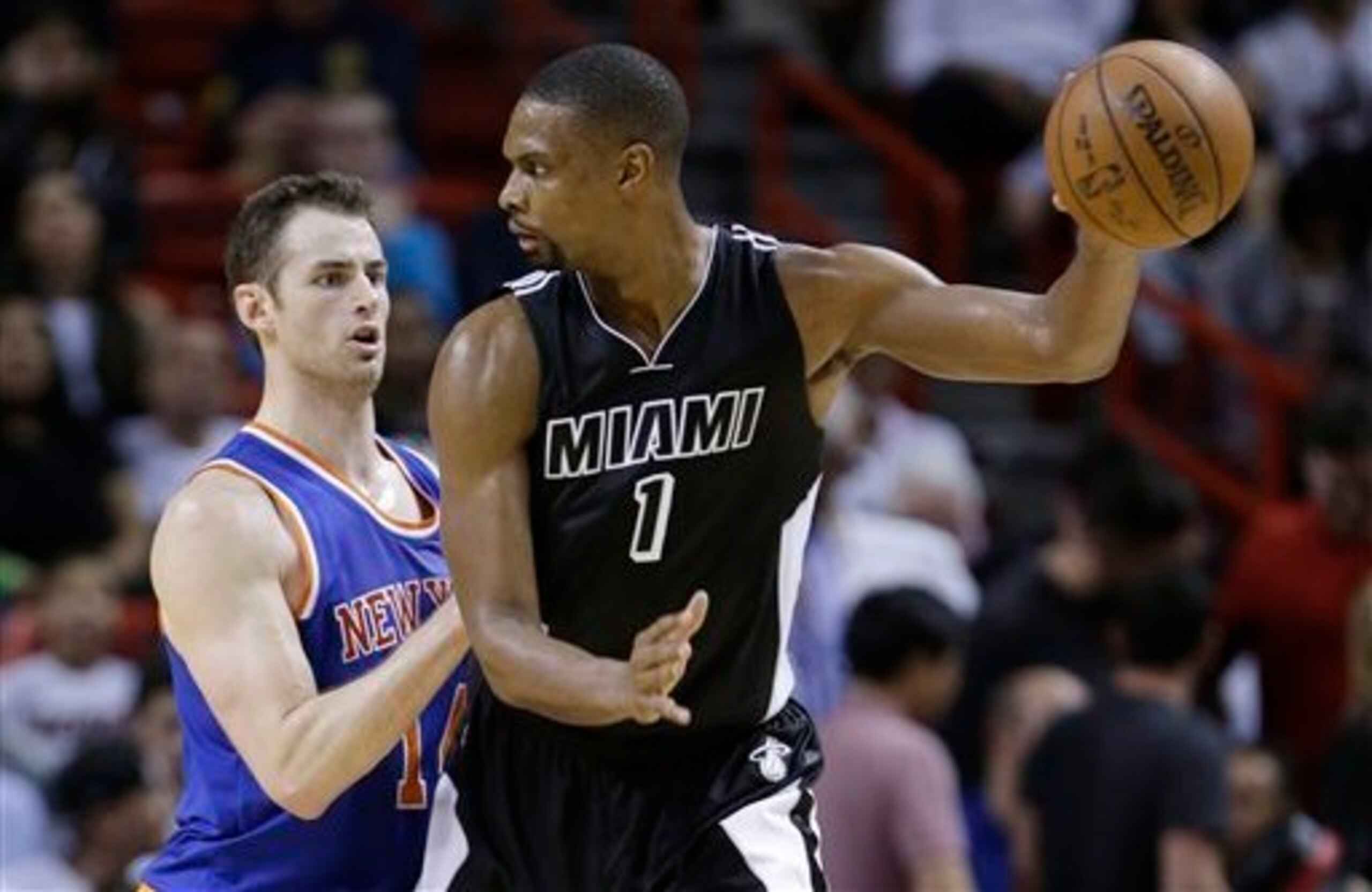
Scary health issues ended Bosh's season early, but the 44 games he did appear in said a lot—namely, that he doesn't plan on changing his game.
It was widely thought that with LeBron James gone, Bosh would return to the post-up bullying he showed with the Toronto Raptors. He did not. If anything, he became more perimeter-oriented. He averaged 3.8 three-point attempts per game this season, second-most on the team. He told Grantland's Zach Lowe in December:
"I get why everybody would say, “Toronto this, Toronto that.” But that’s not the case. I want to take the experiences I’ve gained and use them to help lead this team. My game has changed. I’ve added the 3-point shot. I’m trying to get to the line in different ways. I’m not as quick or explosive as I was.
"
You can perhaps argue that Bosh should go to the low post a bit more than he did this season, but his commitment to his perimeter game is perfect for this iteration of the Heat.
His ability to space the floor (he hit 37.5 percent from deep) is essential given Miami's relative lack of shooting and makes him the perfect frontcourt partner for Whiteside.
His shooting would also make him a great complement to Dragic (assuming he's re-signed). Dragic excelled next to Channing Frye when the two were together on the Suns. Bosh isn't quite the shooter Frye was, but he's a more versatile player who's capable of blowing by recovering bigs off the dribble.
Bosh didn't have his best year defensively, but it's hard to blame him too much for the Heat's struggles on that end.
Miami just didn't have the raw athletes to play its patented blitzing style all the time, and Bosh isn't the type of defender you want dropping back on most pick-and-rolls. His playing the 4 more next season should open up a lot on that end.
Grade: B
Center: Hassan Whiteside
8 of 8
Whiteside is perhaps the NBA's biggest breakout player this season.
He averaged 11.8 points, 10 rebounds and 2.6 blocks per game, doing so on a tidy 62 percent true shooting. That's not bad for a guy who was signed right out of the D-League in November.
Offensively, Whiteside already looks terrific. He's a Tyson Chandler-esque garbage man, gobbling up offensive rebounds and destroying teams in the pick-and-roll.
He scored 1.41 points per possessions when rolling to the basket this season, placing in the league's 97th percentile. He's a springy athlete who can dunk just about everything and has surprisingly soft touch around the rim. He shot 76 percent from within three feet, a great mark even for a true center.
Whiteside even has an intriguing post game. He shot an even 51 percent from the low block and showcased some surprisingly good footwork. He's really long and has a weird knack for hitting shots from tough positions.
With that being said, he's going to have to improve as a passer to turn his post game into a real weapon.
Whiteside recorded six (!!) total assists this season. He assisted on just 1 percent of the team's baskets when he was on the floor, an absurdly low number. He doesn't need to sling the ball around like Marc Gasol, but right now, even the most basic of passes are beyond him. That needs to change.
He has room to improve defensively as well (his positioning is often poor), though he's already impactful on that end.
ESPN's real plus-minus system rates him as an overall plus, and he's a fairly good rim-protector. He surrendered 46.5 percent shooting at the basket. That's not an elite mark, but it's fairly impressive considering how rarely he played with a true big at the 4.
Grade: A
All statistics accurate as of 4/17/15 and courtesy of Basketball-Reference.com or NBA.com/Stats unless stated otherwise.


.jpg?w=2560 "NFL investigating 2 referees for separate viral exchanges")

.jpg?w=2560 "OBJ Calls Out Giants 😳")


.jpg?w=2560 "Ward Nearly Walks Out of Presser 😳")
.jpg?w=2560 "Tyreek makes another cryptic post amid Chiefs rumors")