

What Recent History Suggests About Houston Texans' 2015 NFL Draft Plan
The Houston Texans and the rest of the NFL are at the start of their quietest month of the year. It does close out with a bang on April 30, first day of the draft. In between, the highlight of this humdrum month is that teams may officially begin their offseason workout programs.
The hiatus offers an ideal time for a retrospective look into the Texans’ draft tendencies, another way of inviting league observers and the fans to take a few whacks at the pinata that is general manager Rick Smith. It comes with the job, and every GM is subjected to the slings and arrows of outrageous expectations.
TOP NEWS
.jpg?w=2560 "Chiefs Giants Football")
Mahomes Asked OT to Leave Meeting
.jpg?w=2560 "Colts Football")
Jonathan Taylor Landing Spots 📍
.jpg?w=2560 "Titans Colts Football")
5 Teams Eyeing Jonathan Taylor
Smith has come up short time and again in two notable areas: Those would be drafting a gifted quarterback and the numerous busts coming out of the third round.
Smith is highly regarded in some quarters despite those failures. NFL.com's Adam Schein recently ranked Bill O’Brien and the executive vice president of football operations as his No. 9 coach-general manager duo. Schein credited the job Smith had done “stockpiling talent through the years.”
Tony Villiotti of the National Football Post undertook a slightly more objective analysis, with ratings “based on a comparison of actual starts and projected starts for all players drafted between 2005 and 2014.” This one-dimensional approach placed Smith in the fifth position with a surplus of 16 starts per season. It happens to ignore the fact that Smith took over the job in 2006.
Colleagues with Super Bowl wins such as Kevin Colbert of the Pittsburgh Steelers, Mickey Loomis of the New Orleans Saints and Ted Thompson of the Green Bay Packers trailed behind Smith. Villotti’s questionable conclusion may be founded on a pair of statistics, though it does illustrate the durability of Texans players over the last decade.
The history review will confine itself to the last five draft classes. Each of the first three rounds will be discussed individually, while Rounds 4-7 will be treated collectively.
The information and format was provided by Pro-Football-Reference.com and their Play Index Draft Finder. Career AV refers to career approximate value, a PFR methodology which goes beyond Tony Villotti’s games/games started comparison. It is explained in great depth Sports-Reference.com's AV blog by PFR founder Doug Drinen.
Round 1
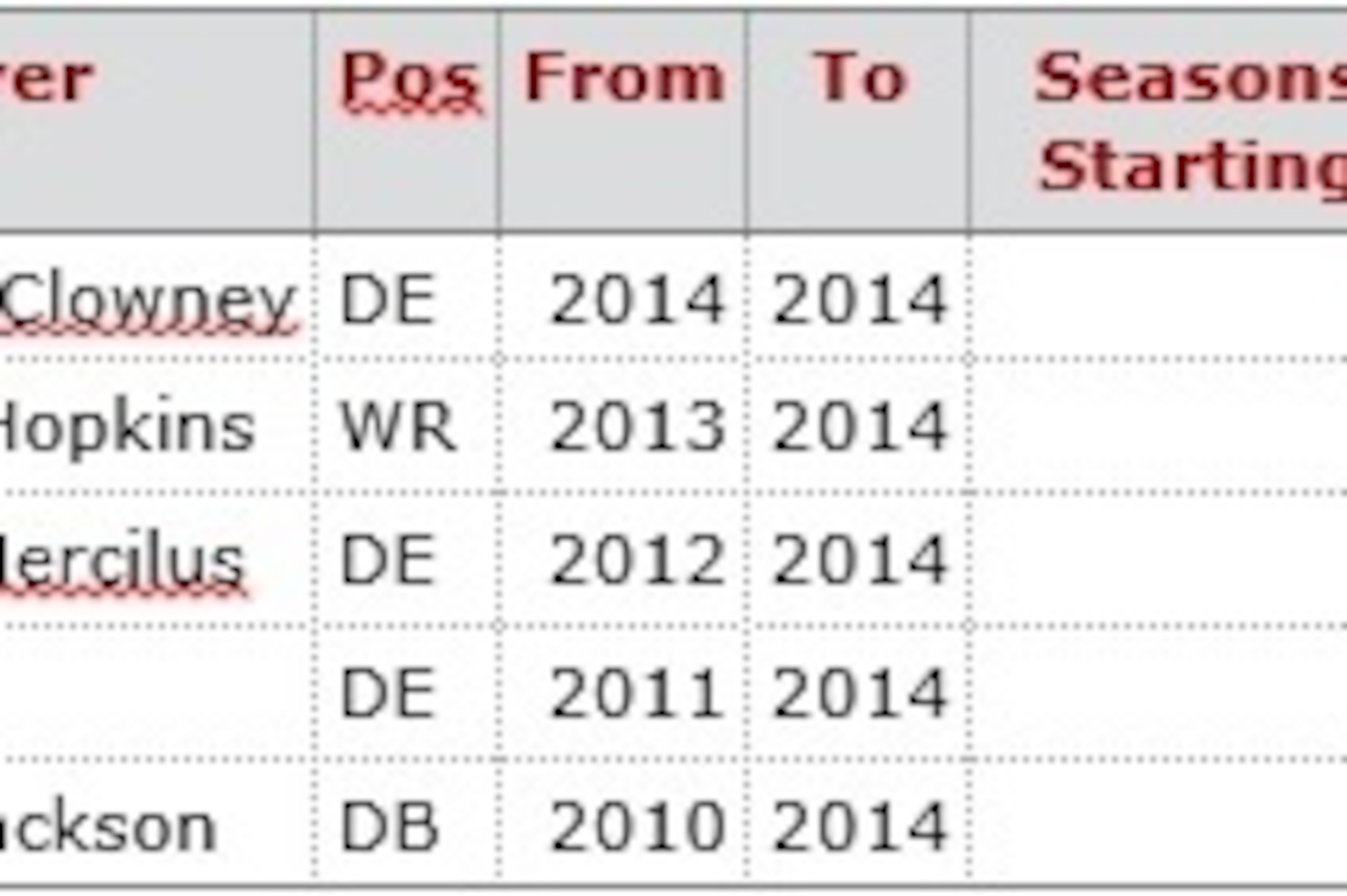
The 2010 draft occurred after the franchise had its first winning season at 9-7, which just so happens to be last year’s record. Kareem Jackson was chosen because cornerback Dunta Robinson was lost to free agency. The Texans face a similar dilemma after this season, when the contract Johnathan Joseph signed in 2011 will run out.
Three of the five selections have been for the front seven of the defense, the purpose being to beef up the pass rush. The Texans’ sack total for 2010 was 30, which tied for 24th place. Watt was the second defensive end taken in the 11th spot, with Aldon Smith going to the San Francisco 49ers at No. 7. Smith shifted to outside linebacker and has been superb, but J.J. Watt has been otherworldly.
Alan Page is the only defensive lineman with an AV of 19 or more in three seasons. Reggie White has two seasons with 19 but never exceeded that number at any time. Watt has two (19 in 2012 and 22 in 2014), and has plenty of time to outdo Page.
Whitney Mercilus was a pre-emptive strike to possibly replace Connor Barwin if he could not be re-signed after the 2012 season. DeAndre Hopkins was an immediate replacement for Kevin Walter, a six-year starter at wide receiver who was released prior to the 2013 draft.
Clowney is the only first-rounder who was strictly a “best player available” selection. The 2013 Texans and their 32 sacks were tied for 30th, and Mercilus had not shown any evidence of converting his speed to power as a pass-rusher.
Every mock draft put Clowney in the top slot. Every draft analyst was convinced his remarkable physical talent would enable Clowney to do what Mercilus could not.
The crying need for an Andrew Luck-quality quarterback would have been a more desirable option but was not possible with the 2014 prospects. In the end of the first round, as it turns out, there was someone who was worth a shot. That is a story for the next round.
Round 2
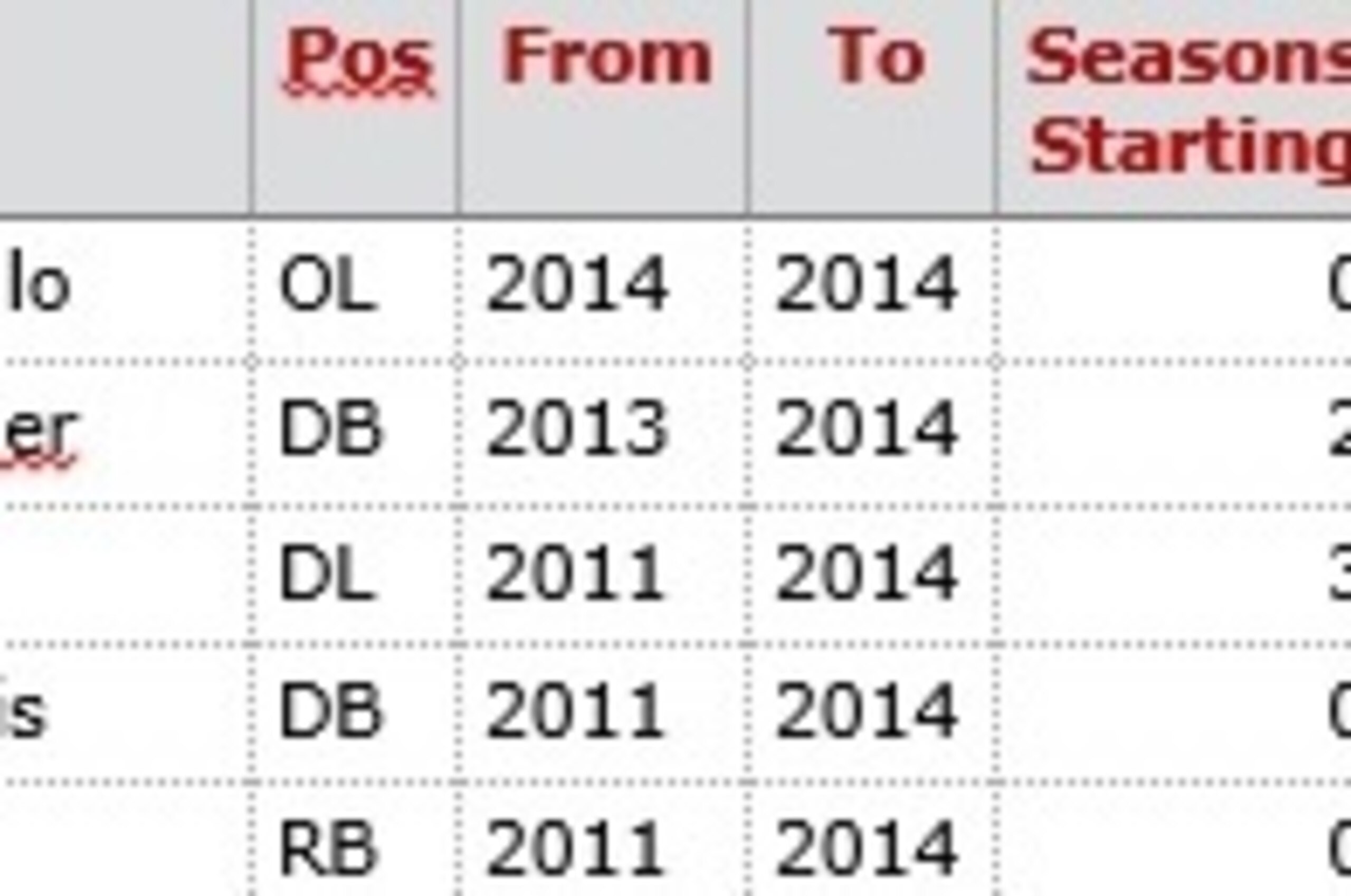
This round will be looked at in reverse chronological order to conclude our first-round story.
True, there was not a prototypical quarterback waiting at the end of the first round, one who would satisfy Bill O’Brien’s specs for a Tom Brady-sized passer in the 6’3”, 215-pound range. Only bandy-legged, narrow-hipped, noodle-armed Teddy Bridgewater was available.
Why harp on the lost opportunity to move up one spot and grab the passer named to every All-Rookie team from the Pro Football Writers of America to Gil Brandt to Bleacher Report?
Let us instead harp on the reality that the second round in the last five years has looked almost as bad as the third.
Xavier Su’a-Filo was drafted to take over for the departed Wade Smith at left guard. He arrived late to the scene due to the quarter system at UCLA. Then he was moved from right guard to left tackle to left guard in training camp.
Pro Football Focus had him down for playing just one complete game the entire season versus the Indianapolis Colts in Week 6. This was in relief of an injured Brandon Brooks at right guard.
D.J. Swearinger is playing like a two-down strong safety, and not a very good one at that. Bill O’Brien has so much faith in him that he interviewed Landon Collins of Alabama at the NFL combine, according to P.D. Starr of State of the Texans. The team also added former Denver Broncos free safety Rahim Moore.
When Wade Phillips became defensive coordinator in 2011, Mario Williams looked more like a super-sized Will linebacker than a 3-technique defensive end. The experiment ended after Williams was placed on injured reserve after Week 5.
Brooks Reed was thrust into the starting lineup and responded with 10 sacks, including four in the playoffs. He was drafted as insurance should the Texans be unable to retain Williams, an upcoming free agent.
The next two seasons found Reed playing to the level of the rest of the defense. The fast start in 2012 deteriorated as the schedule wore on, then completely imploded in 2013. The defense rebounded in 2014, but Reed never rekindled the fire of his rookie year.
Brandon Harris was a bit undersized at 5’9” to be an NFL cornerback, and he performed like it. His playing time in his rookie year was limited to 28 snaps. If Brice McCain had not been injured in 2012, Harris might not have seen the field any more than in his first season.
It was apparent by 2013 that Harris was never going to develop into capable sub-package participant, and he was released in the offseason. If fellow second-round choice Bennie Joppru had not missed each of his first three seasons due to injury, Harris would go down as the worst-ever pick coming out of this round.
Although Arian Foster had gained over 250 yards in his final two games of 2009, Ben Tate was drafted to bring some competition into training camp. He proceeded to break his leg in the preseason opener, and his rookie campaign was a total loss. Foster ended up leading the league in rushing and being named All-Pro.
When Foster was banged up in 2011 and missed three games, Tate had 20-plus carries in only the first two games Foster was hurt. He parlayed some playing time here and there into 175 carries and 942 yards.
That basically sums up his career in Houston. Tate would get plenty of work and yards if Foster was dinged. It looked as if he could take that talent and flourish in any offense.
His Cleveland Browns experience disproved that notion, as did his three games for the Minnesota Vikings and his five carries for the Pittsburgh Steelers in the playoffs. Now Tate seems destined to join the “What Might Have Been” ranks of NFL veterans, with few options remaining.
Round 3

The less said about the Texans’ decisions in the third round, the better.
There is still time for C.J. Fiedorowicz to show he is the road-clearing run-blocker and jumbo target as advertised by the draft analysts. The PFF ratings indicate tight ends who possess both skills are as rare as the head coach who has time to binge-watch all five seasons of Breaking Bad.
Travis Kelce of the Kansas City Chiefs is the only tight end in the top 10 whose pass- (7.0) and run-block (6.8) ratings demonstrate equal ability. Coach O’Brien would probably settle for a run-block rating in Kelce’s ballpark.
The idea behind drafting Louis Nix was for Houston to have a Vince Wilfork of its own. It turns out the Texans had to bring in the original to recoup anything from their investment.
Vince Wilfork announced on Twitter at 2:25 p.m. on March 16 that he would be joining the Houston Texans. By 2:43 p.m., Chris Trapasso of Bleacher Report was pitching the veteran’s facility for tutoring Louis Nix. No mention was made of what impact Wilfork might have on the Texans’ defense.
"Good teacher for Louis Nix, too. RT @Rotoworld_FB: Texans sign Vince Wilfork to man the nose http://t.co/OuHqZlTxB7
— Chris Trapasso (@ChrisTrapasso) March 16, 2015"
Trapasso was joined in the chorus by Fantasy Sports, Scott Wright of Draft Countdown, Dan Wetzel and NFL Draft Bites.
When Bill O’Brien was asked what he would like to see out of Nix, his reply was, “I’d say the ability to make it through a practice,” according to John McClain of the Houston Chronicle.
Brennan Williams and Sam Montgomery never played a down for the team that drafted them. DeVier Posey caught 100 percent of his targets in 2014; then again, it was one pass, which was good for 30 yards!
Mike Brisiel was a cap casualty in the 2012 offseason, resulting in the selection of Brandon Brooks. Brooks came into OTAs at 340 pounds, and Lance Zierlein of Sports Talk 790 in Houston tweeted, “Gary Kubiak said he was not happy with Brandon Brooks after his weigh-in and that Brooks needed to lose weight.” The rookie was down to 325 by the start of the season.
Brooks could be the J.J. Watt of offensive guards and he would not begin to make up for the dearth of worth from this round. Still, he just keeps improving every season. One of these days, Duane Brown might have some company from the O-line in Oahu for the next Pro Bowl.
Amobi Okoye was not pulling his weight at defensive tackle when Mitchell was added to the defensive line rotation in 2010. Okoye had not lived up to his billing as the 10th overall pick in 2007. It turns out the youngest player ever selected in the first round was not ready for the pros yet.
Okoye was due for a $4.6 million cap hit in 2011, and Houston was switching to a 3-4 defense under new defensive coordinator Wade Phillips. Mitchell was not the ideal nose tackle for the system at 6’1” and 289 pounds. The rotation of Shaun Cody and Mitchell at the position worked out, as the Texans defense improved from 30th in defense to fourth in the league that season.
Rounds 4-7

Rounds 4-7 have had their share of successes, and only those are displayed here.
Garrett Graham and Derek Newton have cashed in with eight-figure contracts. Wade Phillips may have misjudged Chris Jones, who moved to defensive end with the New England Patriots and will soon be sporting a Super Bowl ring.
Ben Jones and Jared Crick have been steady contributors playing out of position. Jones, a college center, has solely played guard in his NFL career. Crick went from defensive tackle at Nebraska to defensive end with Houston. Playing in a 3-4 formation does narrow the difference in assignments of the two positions.
Randy Bullock increased his range in 2014, hitting four of five field goals from over 50 yards. He needs to work on his consistency from shorter distances. Ryan Griffin caught 15 passes over his final four games of 2013, only to disappear with the rest of the tight ends in 2014.
Alfred Blue gained 528 yards rushing in 2014, but his average was just 3.1 yards per carry. Jeoffrey Pagan could push Crick in training camp once he learns to maintain his base when engaging offensive linemen.
If you have an interest in viewing some of the lesser lights from these rounds, the full list of picks is available at Pro-Football-Reference.
The Trend
The Texans organization deserves praise for reversing their fortunes in 2014. Adam Schein's compliment to Rick Smith for "stockpiling talent" is a luxury only truly accomplished teams can afford.
Smith has always drafted for need. Whether it was to shore up a gap created by the loss of an unrestricted free agent or address a deficit at a certain position, the general manager has selected players for a specific purpose.
The first four rounds will be an all-out search for wide receiver, outside linebacker, cornerback and safety. This squad has never had enough depth to go for the best available player outside of Rounds 5-7.
The three compensatory picks awarded the Texans (one in the fifth round and two in the sixth) should be reserved for a running back, center or return specialist. The existing picks in those rounds could target inside linebacker and guard.
HoustonTexans.com's Drew Dougherty surveyed 23 drafts in his Mock 4.0 version. Dougherty included the usual suspects: ESPN.com, NFL.com, CBS Sports and Fox Sports, to name a few. Matt Miller and Tyler Conway of Bleacher Report were also included in his tabulation.
Wide receiver led the field with six mocks for 26 percent. There was a tie for second place with cornerback and defensive line at four mocks each for 17 percent. The additions of Cecil Shorts and now Nate Washington are not likely to knock receiver out of the top spot.
Regardless of which position is addressed, the ultimate decision on the No. 16 selection will be made out of necessity. There may come a day when the GM of this team will choose a player because his ability exceeds that of any other prospect left on the board. In the meantime, Rick Smith will be patching holes and sealing leaks.
.jpg?w=2560)
.jpg?w=2560 "Cardinals Giants Football")






