

Is Adrian Peterson the Last Franchise RB in the NFL's Passing Era?
Despite his legacy-tarnishing suspension for child abuse, Adrian Peterson will go down as one of the greatest running backs in NFL history. Peterson's defining on-field trait will be that he always made anything seem possible.
Come back from a torn ACL and MCL to rush for 2,000 yards? No biggie. Trying to contain him on the edge? This run is still going to the house. A 200-yard game? Peterson has five, as well as the all-time record for rushing yards in a single game (296).
But with all that individual success, Peterson has never played in a Super Bowl. Your creator of choice couldn't sculpt a running back with better traits than the 5-star, all-everything runner. Outside of perhaps his early-career fumbling problems, Peterson is the definition of what a scout looks for in a ball-carrier.

.jpg?w=2560 "Cardinals Giants Football")
.jpg?w=2560 "Jets Dolphins Football")
Peterson was simply born 20 years too late.

The devaluation of the superstar running back is a story that begins to take root in the late 1990s. You can point to a lot of different beginnings, but for me the last great gasp of the idea came at the 1999 NFL draft. Then-Saints head coach Mike Ditka surrendered his entire draft (and some of the subsequent year's draft too) to select Texas' Heisman Trophy-winning back, Ricky Williams.
| RB Ricky Williams | 91 (30 for NO) | 1999 1st, Flipped for CB Champ Bailey | |
| 1999 3rd, Flipped for CB Champ Bailey | |||
| 1999 4th, Flipped for CB Champ Bailey | |||
| 1999 5th, Flipped for CB Champ Bailey | 154 (54 for WAS) | ||
| 1999 6th, Flipped for DE Derek Smith | |||
| 1999 7th, Flipped for DE Derek Smith | 0 | ||
| 2000 1st, Selected LB LaVar Arrington | 51 (49 for WAS) | ||
| 2000 3rd, Selected DB Lloyd Harrison | 1 |
As bad as that trade looks, imagine if an architect like Jimmy Johnson or Bill Polian had used the picks instead of the wildly inept Charley Casserly, who was Washington's GM in 1999. Only suboptimal selections kept the trade from looking like a complete disaster.
There was no way that Williams could live up to the expectations. Even if he'd been as good as Peterson, the Saints depleted themselves so much to get Williams that he couldn't succeed. Williams went on to have a good career, even leading the league in rushing for Miami one season (2002). But it was inarguable that pinning that much hope to him was a prophecy that was destined to fail.
Per Football Outsiders, Williams managed just minus-62 DYAR in three seasons in New Orleans.
General managers learned that they couldn't give up much in draft value for running backs (well, except for Ryan Grigson) but continued to pay out the nose for production that they attributed to star backs. Because these runners didn't hit their free-agency years or the trade market until they were already past their prime, this ended in a lot of ugly contracts.
Even the back who was made for this new passing NFL, the shifty-quick receiving threat that was Hall of Famer Marshall Faulk, only made it three seasons on a seven-year, $43.95 million contract extension signed in 2002 before becoming a sunk cost.
He was hardly the only one:
| LaDainian Tomlinson | 527 (3 seasons) | 8 years, $60 million (2004) | 1,188 (6 seasons) | Chargers circumvented the system by re-signing Tomlinson early. Tomlinson a worthy HOF back. |
| Steven Jackson | 426 (4 seasons) | 6 years, $44.8 million (2008) | 374 (5 seasons) | To be fair, he was stuck on an awful offense. |
| Clinton Portis | 746 (2 seasons) | 8 years, $50.5 million (2004) | 614 (7 seasons) | Hey kids, it's only the second-worst trade involving Champ Bailey in this column! |
| Shaun Alexander | 1,184 (6 seasons) | 8 years, $62 million (2006) | -124 (2 seasons) | The patron saint of bad second contracts. Note that Alexander received a franchise tage before his MVP season in 2005, and I counted that as pre-second contract. |
| Chris Johnson | 500 (3 seasons) | 4 years, $53.9 million (2011) | -97 (2 seasons) | He's still going to run for 2,000 yards again, though. Wait for it. |
| Maurice Jones-Drew | 378 (3 seasons) | 5 years, $30.9 million (2009) | 545 (5 seasons) | Lack of tread on his tires in first three seasons likely helped him sustain longer than most backs. |
| DeAngelo Williams | 643 (5 seasons) | 5 years, $43 million (2011) | 279 (4 seasons) | Split time with Jonathan Stewart. |
| Larry Johnson | 966 (4 seasons) | 5 years, $45 million (2007) | -186 (3 seasons) | Charter member of The Curse of 370 after carrying 416 times in 2006. |
| Deuce McAllister | 307 (4 seasons) | 8 years, $50 million (2005) | 286 (4 seasons) | Weird contract, in that McAllister was never actually that good. |
| Eddie George | 492 (4 seasons) | 7 years, $41.2 million (2000) | -231 (3 seasons) | This got blamed on the Curse of the Madden Cover, but it wasn't hard to see coming. |
But, as mentioned above, Peterson made anything seem possible. So the Vikings, who drafted and cultivated his talent, treated him as if they'd had their heads in the sand for the entirety of the last 15 years.
No running back has as many carries as Peterson has since 2007. And keep in mind, those who are close to him—Frank Gore, Marshawn Lynch, Chris Johnson and so on—did not just lose a season to off-field issues. Peterson also missed games in three of the four seasons before his long suspension.
Or, in other words, look at the "attempts per game" column in this next table rather than the total number of attempts:
| Adrian Peterson | 2,054 | 10,190 | 86 | 19.8 |
| Marshawn Lynch | 2,033 | 8,695 | 71 | 16.9 |
| Steven Jackson | 2,009 | 8.141 | 43 | 17.8 |
| Frank Gore | 2,003 | 8.770 | 53 | 17.0 |
| Chris Johnson | 1,897 | 8.628 | 51 | 17.1 |
| Matt Forte | 1,817 | 7,704 | 41 | 17.0 |
| Maurice Jones-Drew | 1,681 | 7,226 | 55 | 14.7 |
| Michael Turner | 1,482 | 6,397 | 61 | 16.3 |
| LeSean McCoy | 1,461 | 6,792 | 44 | 16.2 |
| Ray Rice | 1,430 | 6,180 | 37 | 15.5 |
Peterson wasn't merely a franchise back from his rookie season to last year—he was the franchise back. Nobody was counted on to carry the load more than he was.
And yet, when you look at the efficiency numbers, Peterson's performance was excellent at times but not consistent on the level it needed to be to overcome Minnesota's quarterback drought. Linked up with an aging Brett Favre, who was making one last run with his beaten, 40-year-old body, Peterson made it to the NFC Championship Game in 2009. But the Saints claimed victory after ditching the franchise back model in favor of a three-person committee between Pierre Thomas, Reggie Bush and Mike Bell.
The Saints finished 2009 with the No. 1 DVOA rushing offense in the NFL, per Football Outsiders. The Vikings, with Peterson, finished...23rd.
This was hardly an uncommon occurrence over the course of Peterson's career. Minnesota's line had issues at times, sure, but you'd expect a franchise back to be able to overcome them. Instead, Peterson's career from an efficiency standpoint was wildly unpredictable. Sometimes the Vikings played up to the level you'd expect a team with Peterson to.
Sometimes, they didn't.
| 2007 | 229 (4) | 16.8% (6) | 5.6 | 14.4% (3) |
| 2008 | 83 (17) | -2.9% (22) | 4.8 | -5.9% (21) |
| 2009 | 150 (10) | 1.8% (23) | 4.4 | -6.3% (23) |
| 2010 | 217 (6) | 10.7% (7) | 4.6 | 4.6% (8) |
| 2011 | 153 (9) | 10.4% (11) | 4.7 | 11.7% (5) |
| 2012 | 458 (1) | 24.9% (2) | 6.0 | 7.8% (6) |
| 2013 | 60 (25) | -3.1% (26) | 4.5 | 5.8% (8) |
And while Peterson is simply the last chapter of the novel, this is why NFL teams no longer value running backs the same way they did in the 1990s. When a team can't consistently rely on a player as inconceivable as Peterson to dominate a game, what happens when the college running back you draft doesn't play up to his potential?
Fifteen years ago, the running back class of the 2015 draft would likely have spawned multiple top-10 picks. Wisconsin's Melvin Gordon and Georgia's Todd Gurley are two of the most touted backs we've seen in recent years, and the overall depth of the class lends credence to the idea that a back like Nebraska's Ameer Abdullah would sneak into the bottom of the round.
Instead, the story isn't how many teams will pick running backs in the first round, but if there will be one at all. As I've said, there are many root causes for this: long-term effectiveness, durability, how much the back matters compared to the offensive line.
But there is perhaps no better argument for not drafting a back high than Peterson's effectiveness. When even an outlier who can do just about anything can't overcome the current trend in the NFL, it speaks to just how hard it is to be valuable in that role.
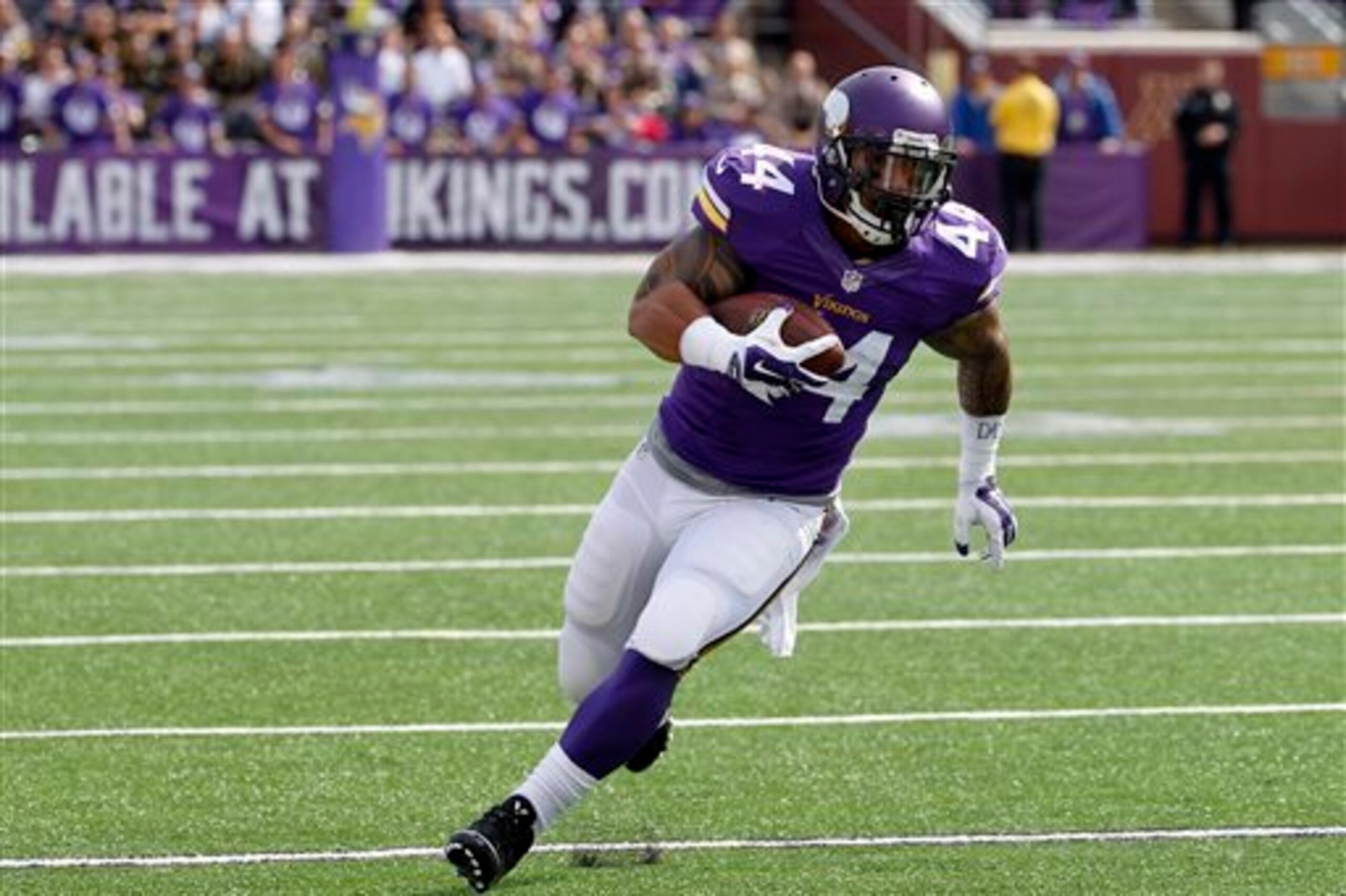
Time in the NFL flows like a circular river. There is no reason to believe that we are at the apex of professional football and that the running game will never come back in vogue. Eagles head coach Chip Kelly, for one, seems destined to try to buck the trend after spending heavily on Curse of 370-certified back DeMarco Murray. Auburn's Gus Malzahn is just the most famous of a cadre of college coaches who uses the spread offense to push a run-first agenda.
But look at the generally accepted ideas melding together here: how running backs decline quickly, how the NFL has shifted the burden of the carries away from one back for years, how a running game focused on pure volume has essentially become a close-out tactic.
These may lead to the running game becoming a more viable attack, but they also lead down the road where the idea of one back taking the entire workload is a relic as antiquated as starting pitchers throwing 150 pitches a game. Backfields are taking on more specialization—passing-down backs, goal-line backs, etc.—and college coaches are increasingly building their teams around a system of runners, not one guy.
And, if that's true, Peterson may have again performed the impossible by bucking the trends and being that lone back.
He also may be the last running back to do so.
All DYAR and DVOA numbers cited are courtesy of Football Outsiders. Learn more about DVOA here.
Rivers McCown is an NFL Analyst for Bleacher Report and the co-host of the Three-Cone Drill podcast. His work has also appeared on Football Outsiders and ESPN.com. Follow him on Twitter at @riversmccown.
.jpg?w=2560 "Titans Ravens Football")


.jpg?w=2560 "NFL investigating 2 referees for separate viral exchanges")