

Is It Time for the Memphis Grizzlies to Bring Jeff Green off the Bench?
The Memphis Grizzlies are feeling a drag with Jeff Green failing to meet expectations that he'd be the complementary scorer who completes them as a contender. His shortcomings on both ends of the floor raise the question of his usefulness in the starting lineup.
The 6'9", 235-pound small forward frequently scores in double figures, but doesn't shoot well. He also has a negative effect on the Grizzlies' defense.
Grizzlies head coach Dave Joerger denied that Green is hurting the team, as Fox Sports South's Rob Fischer tweeted.
TOP NEWS

Jokic says booing fans not welcome in Denver
Worst NBA Predictions 🫣

Brown with an all-time summary of relationship with Tatum
Still, Memphis should consider the effect of trading Green's underwhelming production and defense for Tony Allen's strong defense and absent scoring in the lineup.
Green's inefficient offense

Green adds some scoring, but his inaccuracy detracts from it.
He scores 12.3 points per game, but hits 39.5 percent from the field and 33.3 percent from beyond the arc for the Grizzlies. He's registered double figures in 23 of 29 games, but has made less than 40 percent in 15 contests.
Green's inefficiency hearkens back to former Grizzly Rudy Gay. ESPN Radio Memphis' Chris Vernon was one of many to harp on this via Twitter.
As Gay raised his shot-taking with poor results in his final run on Beale Street in 2012-13, Green similarly seizes on opportunities while failing frequently.
Also, Green's presence in the starting lineup doesn't help it outscore opponents. The five-man combination of Green, Marc Gasol, Zach Randolph, Mike Conley and Courtney Lee produces a net minus-3.4 points per 100 possessions with a net minus-1.8 percent field-goal percentage.
Meanwhile, the set of Allen, Gasol, Randolph, Conley and Lee score 7.3 per 100 more than opponents while shooting 3.5 percent better from the field.
On this end, Allen couldn't match what Green gives, but the 33-year-old shooting guard's defensive impact more than compensates for it.
The need for Allen's defense
The three-time All-Defensive Team honoree is as important to the Grizzlies' attack as Gasol. His intensity, ability to apply pressure, close passing lanes and get steals set the tone for the "grit 'n' grind" defense.
Green defends aggressively, but isn't as effective, as seen with his minus-0.6 box plus-minus, compared with Allen's 3.5.
The Commercial Appeal's Peter Edmiston tweeted of Allen's defensive impact in the first half of the Grizzlies' 96-83 win against the Milwaukee Bucks on Saturday.
Because of the defensive chasm between Allen and Green, SI.com's Rob Mahoney said, "The question of which players ought to start for Memphis ... isn't some superficiality."
After discussing how the Grizzlies have progressively been outscored by more in each month since acquiring Green from the Boston Celtics, Mahoney pointed out that Memphis' defense is among the worst when Allen isn't on the floor, Allen's ability to lock down on opponents' leading perimeter scorers and the difference in defensive chemistry without him.
Mahoney explained:
"The most significant recurring issues occur in the defensive exchange. Allen has the benefit of having worked through thousands of screens and recoveries with Gasol and Randolph. Green does not have that familiarity or the resulting shorthand. That might not seem like a significant issue, but it botches the choreography of everyday defensive possessions.
"
Such natural exchanges like the one below during a Jan. 24 game against the Philadelphia 76ers don't develop in the second half of a season.
Moreover, the Grizzlies' defense is characterized by its synchronization. Five players shift together as a unit. Because of this tightness, the strongest stoppers, Allen and Gasol, offset the weaker ones, Randolph and Lee.
Team chemistry concerns

A team that relies heavily on chemistry comes unraveled when it disrupts a delicate link in the system, as is the case with the Grizzlies' volatile shooting guard.
Joerger tempted fate when he inserted Green in the lineup, sending Allen to the bench upon his return from a wrist injury. Allen went sour last spring during a stretch on the bench, and the team suffered defensively.
On March 4, Allen received a one-game suspension for fighting Nick Calathes in practice.
While mentioning Allen's unhappiness off the bench last year, the Memphis Flyer's Kevin Lipe said:
"There had been some question about how he'd handle being demoted to the bench again, and it seems things were fine, but even if his suspension was just ('just') related to some physical altercation in practice—which anyone who has played a sport knows is a thing that happens sometimes—it bears watching to see what's going on with him attitude- and chemistry-wise.
"
Also, one must wonder if Allen's issues had bubbled beneath the surface for some time.
This is more than a need to assuage the desires of a defensive standout. Memphis' need to smooth out problems with him is great due to its need for togetherness defensively and the offensive give-and-take.
Reading into a remark in which Joerger said the team "came out and walked around" and was "casual," The Commercial Appeal's Geoff Calkins inferred this was due to Allen's absence from the lineup. Calkins pointed to Allen's intensity, a central element to the Grizzlies' grind.
Working around Allen's lack of scoring
Allen's lack of offensive production makes him easy to underestimate as a starter. He's posting career lows of 11.8 points and 10 shots per 36 minutes.
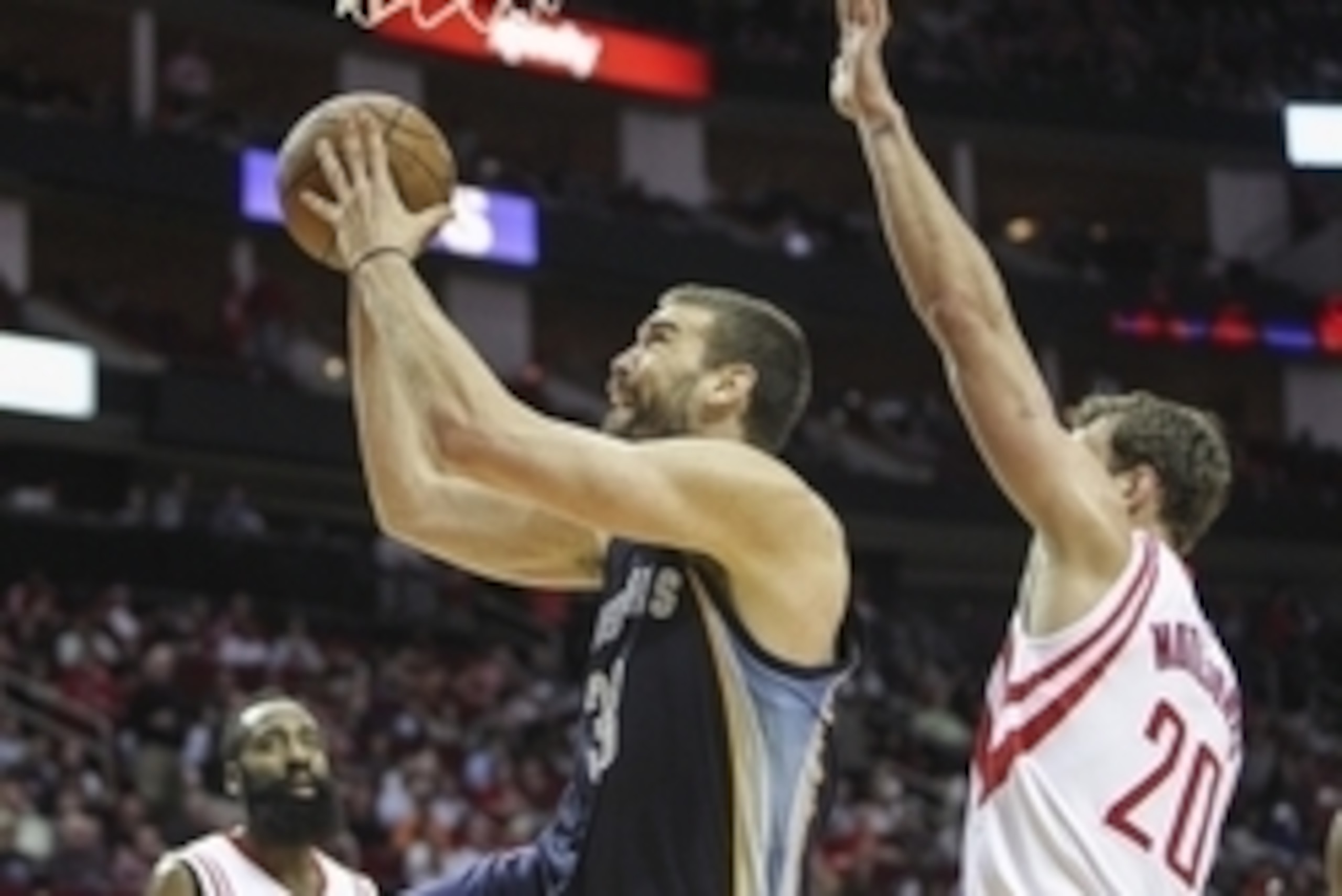
His 52.8 percent true shooting clip is seventh on the team and 0.5 percent below the league average.
At least he's above water, with 103 points produced per 100 possessions, which is four more than what he allows. Meanwhile, Green's 104 per 100 are two less than his defensive rating.
The Grizzlies have lived with Allen's confounding offensive tendencies, but they must learn to win a title while giving him a necessarily prominent role.
To get over the hump with such an offensive non-factor as a starter, Memphis needs more from Gasol. While the Spaniard's segment of offense was already receding, it became more significant after Green arrived, as the table below shows.
| Time period | Points per game | Field-goal attempts per game | Field-goal percentage |
| Through Dec. 26 | 20.2 | 14.7 | 50.4% |
| Dec. 27-Jan. 11 | 17 | 13.1 | 48.6% |
| Jan. 14-March 15 | 15.8 | 12 | 49.3% |
Gasol has become more deferential, and Green is glad to take shooting opportunities on which the big man passes.
Calkins tweeted of how this causes an imbalance late in the Grizzlies' 95-92 loss to the Celtics on Wednesday.
Accordingly, Joerger would be wise to place a sizable chunk of Green's minutes in time when Gasol is off the floor. According to NBA.com, Gasol shoots 6.1 percent better with Green out.
Remember that the Grizzlies' offense was more efficient when Gasol was scoring more. Through Dec. 26, the Grizzlies scored 109.8 points per 100 possessions. Since then, they've posted 104.2. SB Nation's Mike Prada stated early in the season that Memphis scored better with the 30-year-old taking ownership of the offense.
Conclusion
Returning Allen to the starting lineup would do more than substitute an inefficient shooter for a defensive boost. Memphis would not only attack perimeter scorers better, but the entire unit would rediscover chemistry that had been missing with Green starting.
Green could still provide scoring help in a bench role.
Also, the switch would offer an opportunity to restore offensive order while nudging Gasol toward a more aggressive approach.
Acquiring Green might have been the best the Grizzlies could do to add a scorer, but fit matters. In their quest for a championship this year, starting the NBA's best perimeter defender improves their chances.
Statistics are current through March 15 games. Unless otherwise noted, advanced metrics come from basketball-reference.com.
Tom Firme is a Memphis Grizzlies featured columnist for Bleacher Report. Follow him on Twitter @TFirme.

.jpg?w=2560 "Mahomes Told Teammate to Leave Meeting")
.jpg?w=2560 "🚨 Week 8 AP Top 25 Poll")

.jpg?w=2560 "Baker Gets Glove From Rays 🧤")
.jpg?w=2560 "5 Teams Eyeing Jonathan Taylor")
.jpg?w=2560 "Steelers Roll Saints in Paris")
.jpg?w=2560 "NFL investigating Eagles")
