

Serge Ibaka Could Be X-Factor in Oklahoma City Thunder's Playoff Push
The Oklahoma City Thunder's playoff push is real, and as Thursday night's 104-89 victory over the Dallas Mavericks exemplified, it has the potential to be spectacular.
Not only did Russell Westbrook go for 34 points, 10 assists and five rebounds, but stretch 4 Serge Ibaka also totaled 21 points and a career-high 22 rebounds, seven of which came on the offensive glass.
According to ESPN.com's Royce Young, it was the first 20-20 game of Ibaka's career:
TOP NEWS

LeBron's Special Helicopter Deal

MJ Makes Record-Setting Donation 🙌
Shams: KAT, Hart Could Be Trade Names
ESPN Stats & Info added that the 25-year-old's unique statistical outburst was the franchise's first of its kind in nearly eight years:
Outside of momentarily propelling Oklahoma City into the Western Conference's No. 8 seed ahead of the Phoenix Suns, Ibaka's showing provided a glimpse of just how potent the Thunder can be when their third wheel is turning in concert with the rest of head coach Scott Brooks' big guns.
However, that's been a rare sight for most of the season, and it's a main reason why Oklahoma City ranks right around the league average in offensive efficiency, per NBA.com.
Compared to last season, Ibaka's averages are down across the board. He's scoring less frequently, rebounding at the second-lowest rate of his career and blocking shots the way he did as a sophomore during the 2010-11 season.
| 2013-14 | 15.1 | 8.8 | 2.7 | 53.6 | 38.3 | 108.1 |
| 2014-15 | 13.9 | 7.7 | 2.2 | 46.3 | 38.9 | 102.5 |
So why can't Ibaka find a scoring rhythm?
"I don’t know the answer to that,” Brooks said at the end of January, according to The Oklahoman's Anthony Slater. "Hopefully that trends the other way."
The three-point shooting numbers are up, which is great, but as the lower scoring numbers indicate, Ibaka's move away from the basket has harmed his general effectiveness.
By constantly stationing Ibaka in the corners and above the break, Oklahoma City has marginalized one of his most redeemable skills—scoring from close range.
Last season, Ibaka attempted 32.7 percent of his shots within three feet. This year, that percentage has dipped below 20 percent, which is a career-low by more than 12 percentage points, according to Basketball-Reference.com.
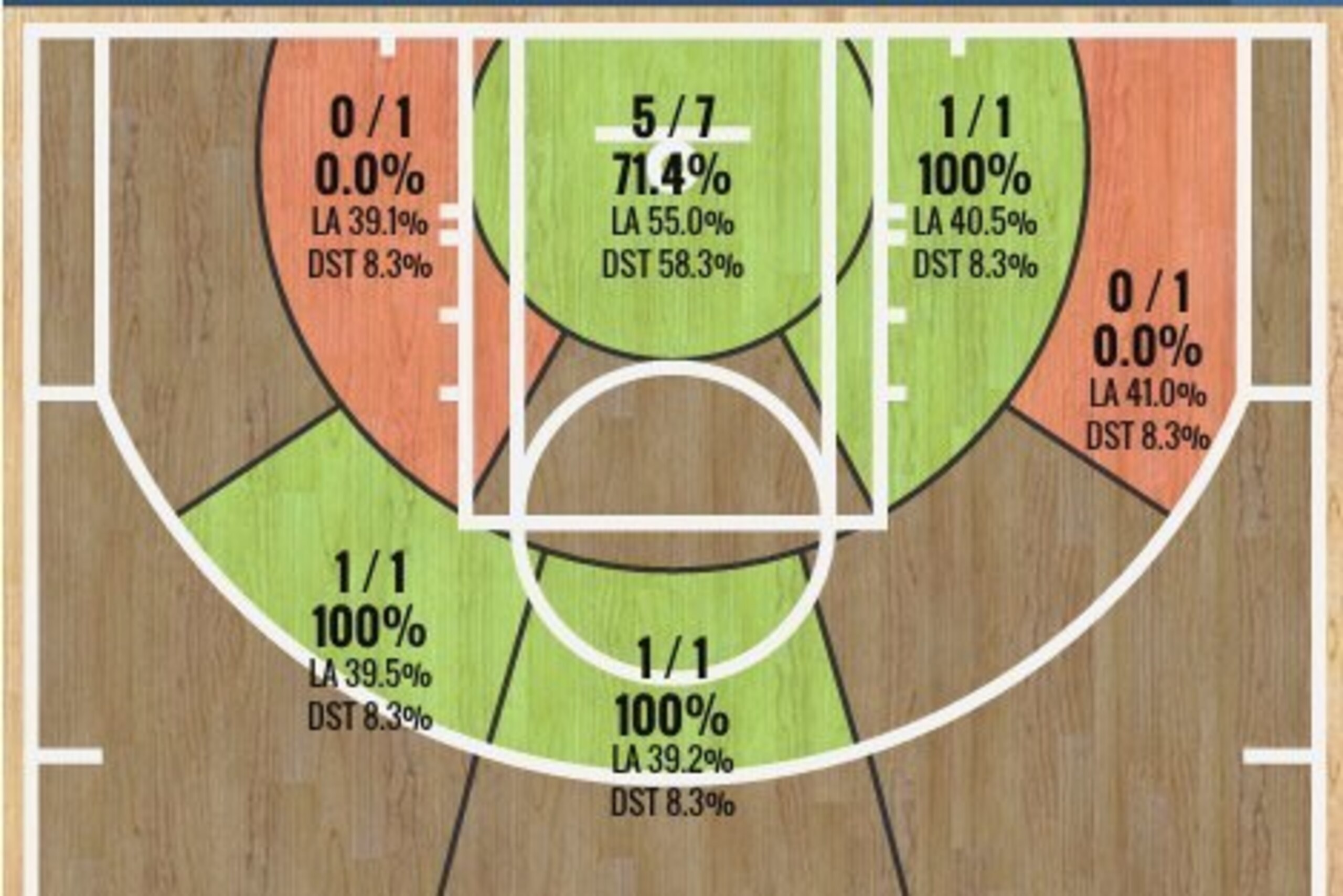
But on Thursday night, Ibaka reverted back to last year's strategy, attempting seven of his 12 shots within the restricted area. A smattering of mid-range looks complemented those high-percentage maneuvers, as his shot chart from NBA.com indicates:
If those low-post touches can become a regular staple of Ibaka's arsenal moving forward, it's mind-blowing to think about the havoc Oklahoma City will be capable of wreaking.
According to Synergy Sports data provided to NBA.com, Ibaka ranks in the 83rd percentile among post-up scorers, shooting 55.3 percent on such plays. However, those touches have accounted for less than seven percent of Ibaka's production this season, which is equal to the number Paul Pierce has posted with the Washington Wizards.
Now, part of that has to do with clearing out space for Westbrook and Kevin Durant to drive or work out of the high post, but the offense clearly benefits from a slightly higher number of touches for Ibaka closer to the hoop.
It would also help if Ibaka could start knocking down mid-range jumpers with a bit more regularity.
For the first time in his career, Ibaka's hitting fewer than 40 percent of those looks, which have historically helped stabilize his scoring numbers. Last season, he attempted a career-high 30.9 percent of his shots from mid-range and hit them at a 45.7 percent clip.
Alas, the sudden struggles have provided opponents with an opportunity to leave Ibaka while honing in on stopping a surging Westbrook or a sniping Durant.
"It’s allowed defenses to trap and contain Westbrook and Durant more on those not-as-deadly pick-and-pops, feeling far less fear that Ibaka will burn them on the back end," Slater wrote.
And get this: A plurality of Ibaka's shots have come with the closest defender more than six feet away, according to SportVU player-tracking data. Ibaka's hitting just over 45 percent of those shots, which are classified as "wide open."
Last season, 50.9 percent of those shots dropped.
So not only could a slight redistribution of touches get Ibaka into a more comfortable rhythm, but if he can find ways to knock down the open ones that have been there all season, Oklahoma City will be in serious business.

Despite some very real bumps in the road, having Durant, Ibaka and Westbrook on the court together benefits the offense tremendously.
According to NBA.com, when Durant, Ibaka and Westbrook share the floor, Oklahoma City churns out an offensive rating of 108.2. Spanning the length of the season, that would rank as the NBA's fifth-best efficiency rating ahead of the Eastern Conference-leading Atlanta Hawks. It's also a colossal 5.7 points better than the Thunder's season-long total.
To this point in an injury-riddled campaign, we've only seen brief glimpses of the balanced offense that carried Oklahoma City to the 2014 Western Conference Finals. Even so, it's not a state secret that Oklahoma City has the prime-time players necessary to shake up the Western Conference playoff picture in a hurry.
And when Ibaka is able to shine with a multitude of moves and maximize his Swiss Army knife skill set, it's hard not to conjure up images of offensive grandeur as the chase for postseason positioning heats up.
All statistics current as of Feb. 20 and courtesy of NBA.com and Basketball-Reference.com unless noted otherwise.

.jpg?w=2560 "Grading WWE Raw 🔠")

.jpg?w=2560 "Bijan's INSANE 1st Half 🤩")
.jpg?w=2560 "Viral Rams Coach Vid 🖕")
.jpg?w=2560 "Injury-stricken Seahawks signing veteran RB")

.jpg?w=2560 "2 NFL Officials Suspended")