

LA Clippers Show Signs of Improvement Despite Lackluster Season
Fans of the Los Angeles Clippers have generally basked in negativity this season.
If you only talked to viewers and read about the team without actually watching or checking the standings, you might never know the Clips are 35-19, sitting sixth in the stacked Western Conference. But it's true.
To reach such a record, a team has to have a little more than two star players. It needs the pieces to fit to some degree, even if that degree includes little basketball help beyond its healthy top six guys.
TOP NEWS

LeBron's Special Helicopter Deal

MJ Makes Record-Setting Donation 🙌
Shams: KAT, Hart Could Be Trade Names
It's unclear if the Clippers are championship contenders at the moment. They're clearly not as competitive at this time as they were a season ago, even if their record is almost identical 54 games in (last year's Clips started 36-18), but there have been categorical improvements within the team and roster.
Improved Shooting
The 2013-14 Clippers had one of the more interesting offenses in recent NBA history.
The team finished No. 1 in points per possession, obviously a fantastic accomplishment, but it couldn't really shoot. The Clippers hit just over 35 percent of their three-pointers, ranking 22nd in long-range accuracy, hardly the marker of an elite, modern-era offense. But the Clips just kept churning out points.
The positive sign for last year's offense was that it took a bunch of attempts from beyond the arc, eighth-most in the NBA. At least it was creating space, even if it wasn't sinking those shots. This year, though, the Clippers have been doing both.
The Clips are hitting a little more than 37 percent of their threes, jumping to the fifth-best percentage in the league (which complements the fifth-most attempts).
J.J. Redick is sinking a career-high 44 percent of his attempts. Chris Paul is up to 28 percent. Matt Barnes can't seem to miss, draining 37 percent of his long balls.
Having Redick around for the whole year obviously makes a major difference. The Duke alum, who missed 47 games last season with back problems, doesn't just help the team's production with his own made shots, either. The Clips run a separate offense when he's in the lineup, calling for more off-ball picks (pin-downs, flare screens, etc.) and executing on play calls they wouldn't even try without him on the floor.
Still, it's not like the overall schemes are all that different from a season ago. The Clippers are mostly running the same stuff for the same looks, even if there does appear to be a general malaise marinading within the squad. But who cares? The team, once again, ranks first in points per possession.
The Clips are still taking a bunch of threes. They're just making more of them.
Passing
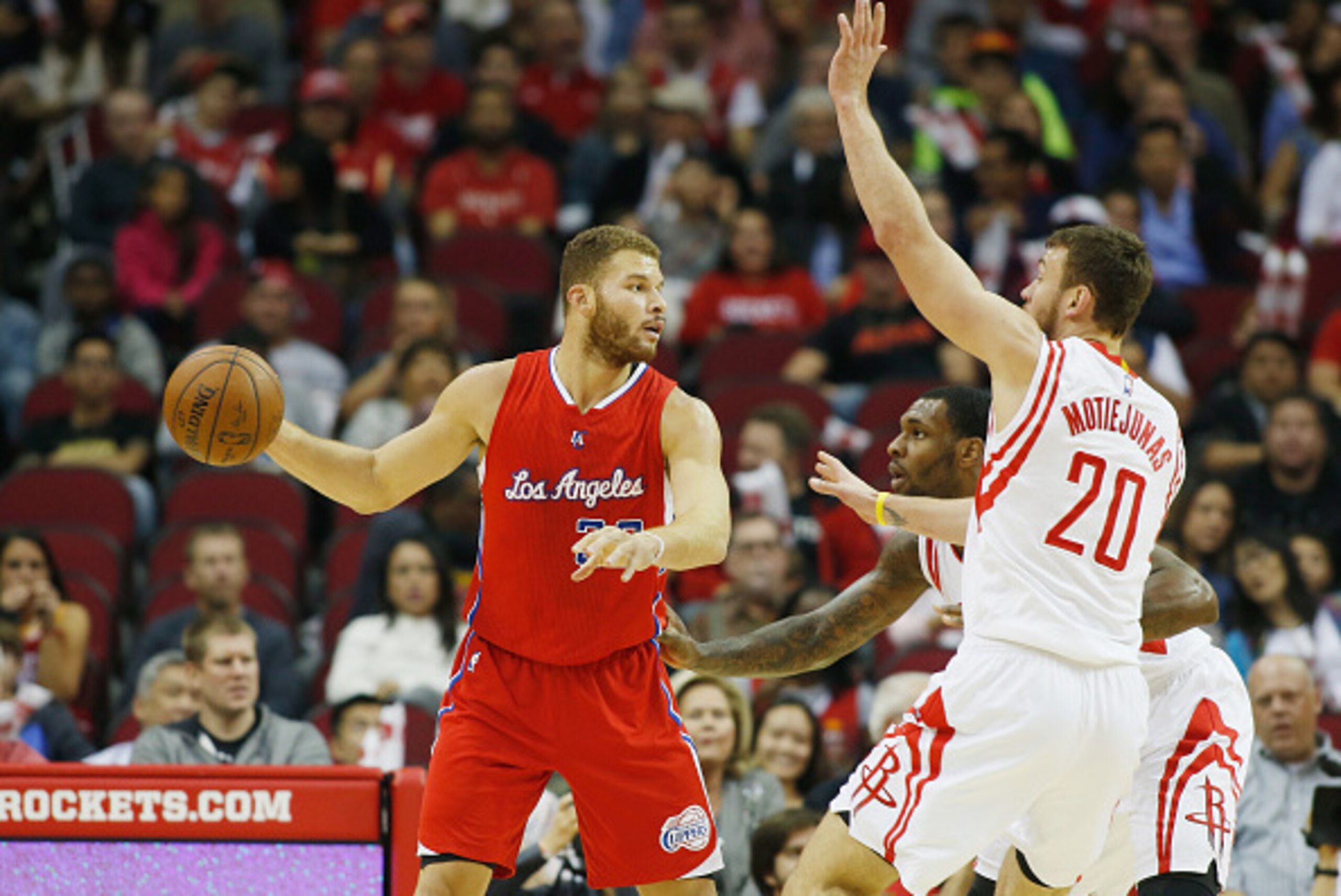
One of the reasons the Clippers were able to maintain such a high efficiency without consistent three-point shooting last season was because of their passing.
Everyone knows what Chris Paul can do, but the group talent goes beyond that. Blake Griffin has become one of the best passers—not just big-man passers, overall passers—in the NBA.
Let's pretend like Griffin is still healthy for the sake of this argument, because a world where Blake Griffin is injured is one that's worse.
Griffin has learned how to distribute out of virtually every situation. He will find guys in transition. He facilitates out of the pick-and-roll, both as a ball-handler and a screen-setter who receives the ball while diving to the rim. He passes out of the high post, the low post and whenever a light bulb goes off in his head, the lamppost.
When you have a power forward who can move and distribute in the ways Griffin can, it creates unguardable mismatches. That's why you see stats like this one from ESPN's Tom Haberstroh: "34: That's the highest number of alley-oop assists thrown by a single player this season. Who's that leading lobber? No, it's not Chris Paul, and it ain't James Harden. It's Blake Griffin."
Oh, right. This happens:

Joakim Noah and Marc Gasol may be brilliant passers, but they don't have the athleticism to execute such dishes as quickly or as swiftly as Griffin. It's the passing versatility which makes Blake so effective.
Since Griffin went down, the Clips have been running more pick-and-rolls with DeAndre Jordan. It's their way of forcing defenders to collapse into the lane, something they don't do for Hawes, without Griffin there. The Clips need that pick-and-roll for their offense to work.
It's not the same without Griffin, though. It can't be—not just because the Clippers miss his scoring ability, but also because they need his abilities to create for the offense to hit elite levels.
Throw two of the NBA's best passers in the same lineup and add in guys to space the floor, and you're going to have an efficient offense. It's why, as long as Paul and Griffin remain on the floor, the Clips offense is always going to be a juggernaut.
The post-surgery news on Griffin so far has been encouraging, according to the L.A. Times' Melissa Rohlin. Here's to hoping it stays that way.
DeAndre Jordan's Emergence

Paul went down with a shoulder injury last winter, keeping him out for 18 games. But the Clippers didn't falter. That was mainly because of Griffin, who injected himself into the MVP conversation with his play, eventually finishing third in voting at the end of the year.
Griffin averaged 27.5 points, 8.2 rebounds and 4.4 assists in the games Paul missed. He ran the team. He proved that an elite offense could funnel its attack through Griffin, specifically. He showed he could become the best player on a championship contender.
He inspired all those cliches, and by the time Paul returned, the Clips were doing just fine, posting a 12-6 record in his absence.
When it was announced on Feb. 8 that Griffin would have elbow surgery, there were flashbacks to the CP3 injury from last season. Who would step up?
We all assumed the guy would be Paul, the man who has been generally considered as the third-best player in the NBA over the past half-decade. But we made a mistake. 2014-15 Paul wasn't 2013-14 Griffin. Little did we know it was Jordan who would be the one to make a leap.
This is the second season in a row that Jordan has made a dramatic, in-season improvement heading into the second half of the year. Maybe some of it has to do with stepping up without Griffin in the lineup, even if this streak did begin before Blake's actual injury. Mostly, though, it's just Jordan becoming a better player. Once again.
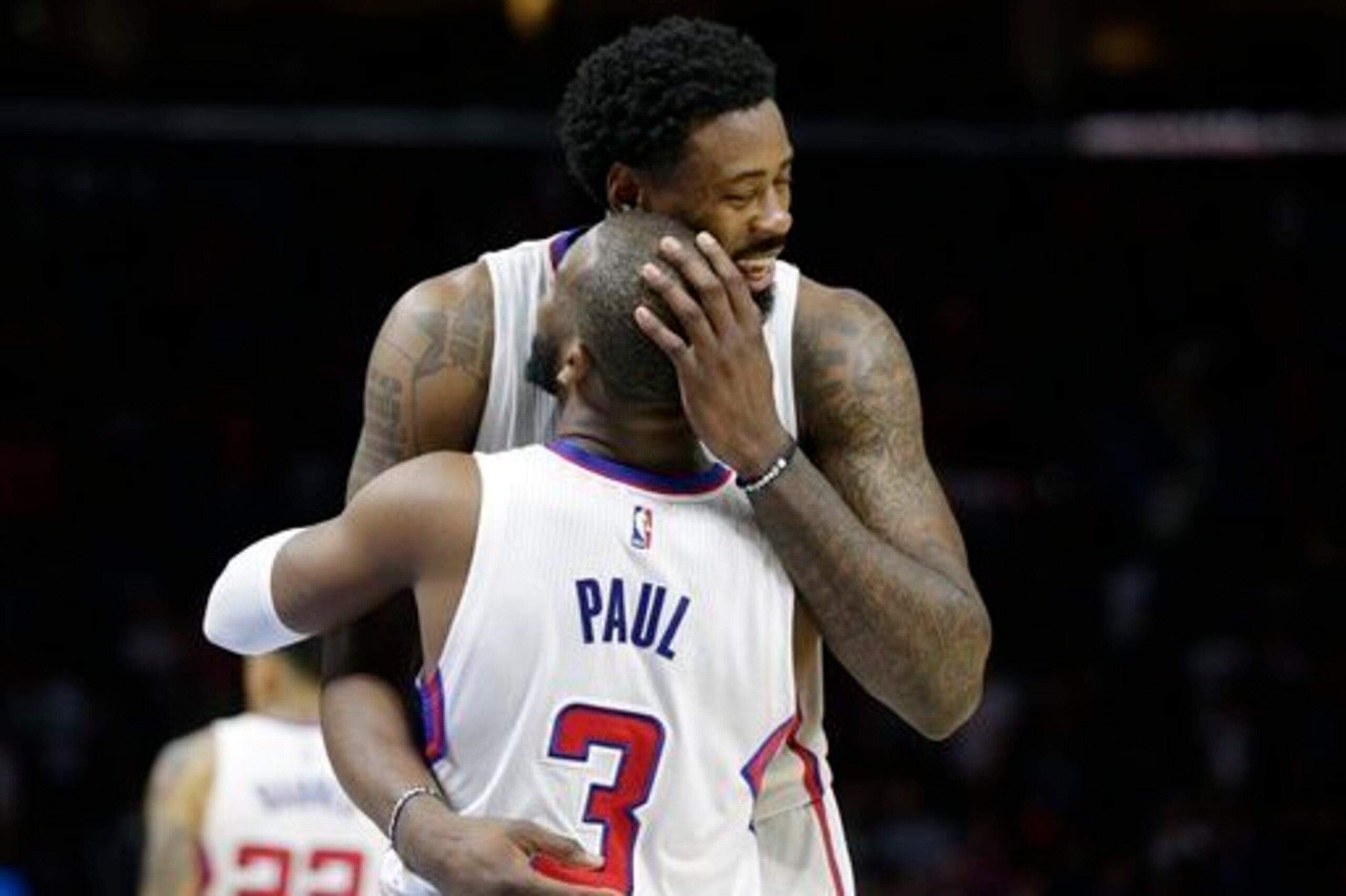
Jordan has three 20-20 games over his past six performances. Three! Before February began, he had a grand total of zero career 20-20 games. Talk about a change.
Jordan is averaging 14.1 points and 16.5 rebounds per game over his last eight. He's a creating, forceful, gravitational pull whenever he rolls to the hoop. Isiah Thomas even called him the best screen-setter in the league during an episode of NBA Gametime last week on NBATV. And he's right.
Laying picks is one of the most underrated skills in basketball, probably because there aren't any statistics to explain the value of it. Jordan, though, has become elite at setting timely, aware screens and getting defenders hung up on him. It's that skill along with his gravity, finishing ability and offensive rebounding that allow us to call him a two-way center even if he doesn't have a post game.
It would've been difficult to put Jordan on the All-Star Team in the Western Conference regardless of his production, but he's building momentum to becoming the Tyson Chandler of his generation.
Fred Katz averaged almost one point per game in fifth grade but maintains that his per-36-minute numbers were astonishing. Find more of his work on ESPN's TrueHoop Network at ClipperBlog.com. Follow him on Twitter at @FredKatz.
Unless otherwise noted, all statistics are current as of Feb. 18 and are courtesy of Basketball-Reference.com and NBA.com.

.jpg?w=2560 "Grading WWE Raw 🔠")

.jpg?w=2560 "Viral Rams Coach Vid 🖕")

.jpg?w=2560 "Injury-stricken Seahawks signing veteran RB")