

Amar'e Stoudemire Provides Reinforcements at Right Time for Dallas Mavericks
The New York Knicks granted Amar'e Stoudemire a buyout at the perfect time.
For the Dallas Mavericks.
Speculation turned into fact Sunday night, after the New York Daily News' Frank Isola brought word the Knicks would be severing ties with Stoudemire. Team president Phil Jackson confirmed the news on Monday in a press release.
TOP NEWS

LeBron's Special Helicopter Deal

MJ Makes Record-Setting Donation 🙌
Shams: KAT, Hart Could Be Trade Names
Shortly thereafter, Shams Charania of RealGM dropped a somewhat expected bomb:
Tim MacMahon of ESPN Dallas corroborated Charania's report and added that Stoudemire's deal with the Mavericks will be made official once he clears waivers. So, barring a maniacal filibuster staged by Sam Hinkie and the Philadelphia 76ers, the Mavericks are left reaping the benefits of Stoudemire's twilight.
And not a moment too soon.
Gone are the days in which Stoudemire can define and direct a team on his own. That version of the six-time NBA All-Star is a distant memory, lost behind the smog of age, ebbing athleticism and injuries.
But the Mavericks are not bringing Stoudemire in to be a savior. For the first time since 2010, he is neither a retreating lifeline nor nuclear burden. He is an accessory, albeit a principal one, to the Mavericks' established championship contraption.
Indeed, it would be difficult to find a better fit for Stoudemire. Other than the Los Angeles Clippers, no team would have been equally equipped to capitalize on all the 32-year-old big man can still do.

Stoudemire essentially replaces Brandan Wright, whom the Mavericks shipped out as part of the Rajon Rondo trade. Wright's function on the offensive end was that of a pick-and-roll slasher, whose points came off cuts to the basket.
Tyson Chandler is that lone roller now, with Dwight Powell soaking up some of the playing time left available by Wright's departure. Not surprisingly, more than 22.6 percent of Chandler's offensive touches have come as the roll man this season. Less surprising still, nearly no other team initiates pick-and-rolls more than the Mavericks.
Combine the frequency with which the Mavericks feature roll men and ball-handlers, and pick-and-rolls account for 28.9 percent of the team's total offensive plays. Only the Orlando Magic (29.5 percent) conduct such sets at a higher rate.
"He would fit in great because we play a lot of pick-and-roll," Chandler previously said, per MacMahon. "Coach [Rick Carlisle] does an excellent job understanding scorers and how to get them the ball and putting them in a position to succeed."
Even now, years removed from his career-making days with the Phoenix Suns, Stoudemire remains a devastating pick-and-roll finisher; the Knicks just haven't been a team that catered to his strengths for some time. They rank 29th in pick-and-roll frequency this season (blame the triangle), and Mike Woodson forced Stoudemire to work from the pinch-post for all of 2013-14.
Still, Stoudemire has proved effective when given the opportunity to operate off incisive cuts to the basket.
Though only 10.3 percent of his offensive touches have come as the roll man this season, he's averaging 1.05 points per possession in those situations. Both Al Horford (1.02) and Marc Gasol (1.03) are pumping in less.
Volume disparities in mind, that's absurdly good.
Having that second effective option to milk is huge for Dallas. Powell is scoring 0.81 points per possession as the roll man, and the Mavericks' offensive efficiency has dropped since acquiring the now-injured Rondo. The team is scoring 105.4 points per 100 possessions since the trade, down from 113.6.
Signing Stoudemire doesn't guarantee an offensive revival of sorts. Again, the days of him inciting drastic change are over. But he fits seamlessly into this offense, replacing all Wright could do and then some.
The "and then some" is important here.
As Chris Herring of The Wall Street Journal noted, Stoudemire has morphed into more than a point guard-dependent scorer:
That post-up game will be similarly big for the Mavericks. For one, they're devoid of a true low-post option. They rank dead last in offensive post-up volume, with Dirk Nowitzki as their only true threat.
More than 46 percent of Stoudemire's possessions have come within post-ups, and he's shooting better than 50 percent off them. While the Mavericks' passing-packed, pick-and-roll-heavy style isn't conducive to loitering back-to-the-basket sets, it's good to add another player who can create his own shots and isn't overly reliant on surrounding artistry.
Chandler and Stoudemire will have to share the floor again, after all. Although said combination will debilitate Dallas' spacing, it will be necessary at times given Stoudemire's unsavory defensive history. The Mavericks will need to make up for those rhythmic rumples with self-created opportunities to a certain degree.
Then again, the luxury of playing Stoudemire with the second unit is that it gives him a fighting chance on the defensive side of things. He's not one for, shall we say, serial sleeping, but he fails to grasp important nuances—guarding off screens, help defense, up-fakes, etc.
Spending time as a reserve marginalizes that damage. Second units are seldom flush with the floor-spacing towers that give Stoudemire the most trouble, so he was actually a defensive plus with the Knicks this season.
Opponents are also shooting 3.4 percentage points below their overall season average when being defended by him, and 11.5 percentage points worse when attacking him within six feet of the cup.
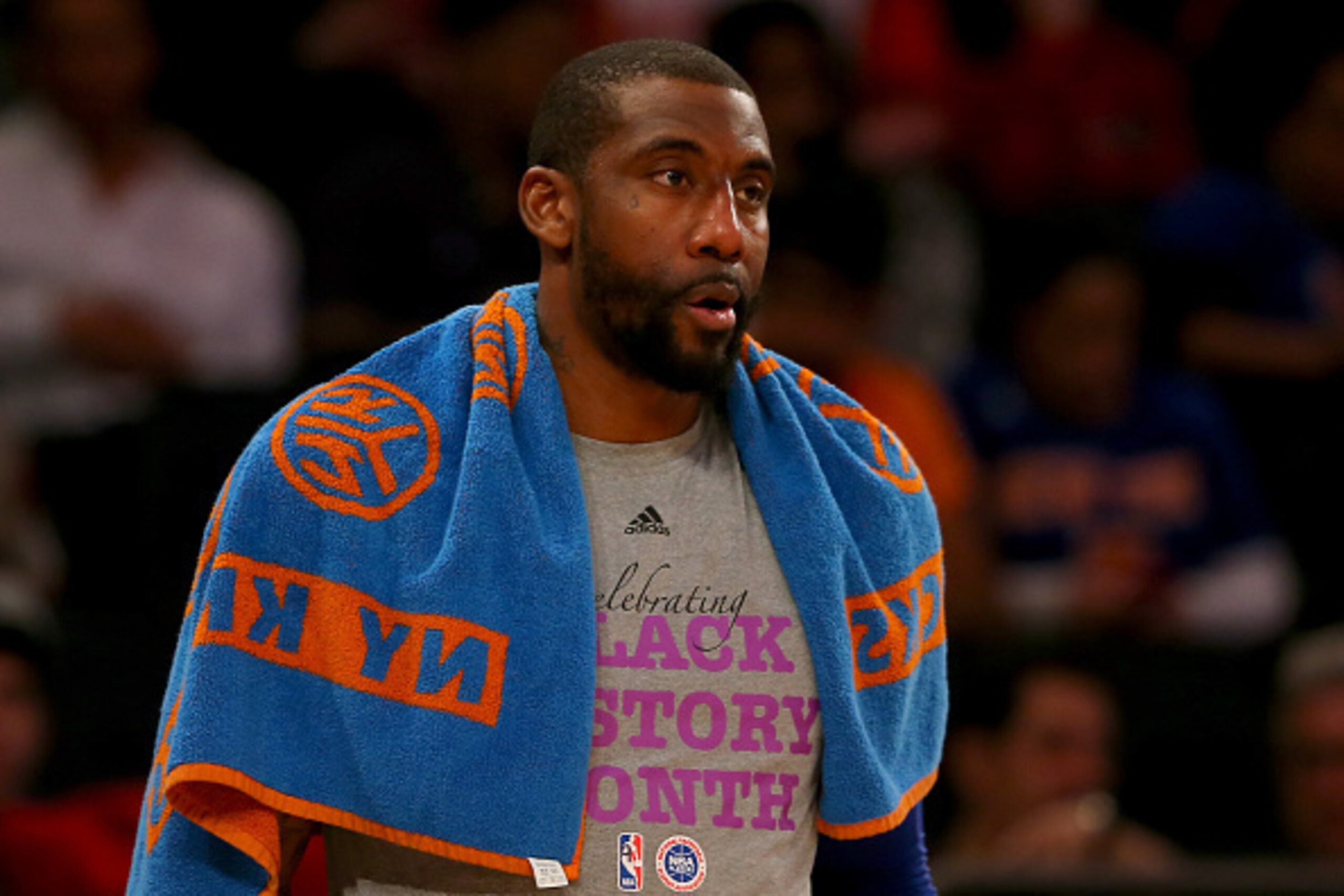
Free from New York's traditional lineups (blame the triangle once more), Stoudemire should see more time at center, where he's thrived in the past. He's now also playing under one of the league's most resourceful coaching staffs.
Carlisle has the Mavericks surviving while incorporating steady doses of Charlie Villanueva, Al-Farouq Aminu and Powell. Integrating Stoudemire won't pose any insurmountable issues.
At the very least, Stoudemire can exist within the Mavericks' second unit without hamstringing its defensive potential. The reserves rank eighth in defensive efficiency, per HoopsStats.com, which has been a crucial part of Dallas surviving the Western Conference gauntlet in the aftermath of its offensive downshift.
Which is the other, less scientific aspect of all this: The Mavericks are adding a potent performer on top of what they already employ.
Stoudemire joins what is already a playoff contender, and he does so as the only player averaging at least 12 points and five rebounds in under 25 minutes of action over the last three seasons.
Dallas is 36-19 and within one game of a top-three playoff spot. Nineteen of its final 27 tilts come against opponents with records above .500. The Mavericks are 13-15 when facing such teams this season.
Fifteen of those games see them match up with Western Conference playoff squads or the Oklahoma City Thunder. They're 4-12 against those opponents thus far.

Adding Stoudemire addresses the Mavericks' greatest need ahead of that stretch run: Frontcourt depth.
They rank in the bottom half of shot attempts within the restricted area, and in the bottom six of opportunities inside the paint. They need Stoudemire and all he can do—his ability to fit in, his potential beside the piercing Rondo and Monta Ellis, his capacity to lighten the frontcourt burden Chandler Parsons and Nowitzki carry, the low-post dynamic he brings.
Balancing his minutes and role with a deteriorating body will be part and parcel of this entire transition. But at its core, Stoudemire's arrival is simple.
It's exactly what the Mavericks need, exactly when they need it.
*Stats courtesy of Basketball-Reference and NBA.com unless otherwise cited.

.jpg?w=2560 "Grading WWE Raw 🔠")

.jpg?w=2560 "Viral Rams Coach Vid 🖕")

.jpg?w=2560 "Injury-stricken Seahawks signing veteran RB")