Marshawn Lynch Needs to Power His Offense Past the New England Patriots
Trying to tackle Seattle Seahawks running back Marshawn Lynch looks like it would be about as much fun as standing in the path of a probably illegal racing lawn mower. He’ll run you over, and then keep churning once you’re on the ground.
He runs like a garbage truck with no brakes, showing little regard for the limbs of those who attempt to slow his forward march. Do not be alarmed if you feel physical pain while watching him. That’s surely a common sensation and one the New England Patriots will experience in a very real way this Sunday.
.jpg?w=2560 "Seahawks Chiefs Football")

.jpg?w=2560)
Every opposing defense feels the physical power of Lynch at some point. But on this particular championship Sunday he needs to be a difference-making force, just as he was during the NFC Championship Game.
As noted by Pro Football Focus (via Jason Churchill of CBS Sports Radio), a significant percentage of Lynch’s rushing yards during a win over the Green Bay Packers came after contact.
"Incredible: Via @PFF, Marshawn Lynch had 110 of 157 yards AFTER contact.
— Jason A. Churchill (@ProspectInsider) January 19, 2015"
To be exact, 70 percent of Lynch’s rushing yards against the Packers came after he faced and blasted through contact of some kind. He broke an absurd 14 tackles in that game, per PFF. It’s all right if you need to pause for a moment and really process that number.
You know about Lynch’s power, but it’s still staggering to see it quantified. Lynch led all running backs in yards after contact during the regular season while averaging 2.96, again per PFF. But here’s the best and most unfair measure of Lynch’s power: He broke 88 tackles as a runner (101 in total), and no other running back finished with even 70.
| Marshawn Lynch | 88 |
| DeMarco Murray | 67 |
| Le'Veon Bell | 55 |
| Chris Ivory | 52 |
| Arian Foster | 51 |
| Eddie Lacy | 49 |
When the playoffs are included, Lynch’s missed-tackle count now sits at 109, an average of 6.1 per game.
The Patriots defense has power of its own and tackling efficiency. The run defense ranked ninth overall during the regular season while giving up only 104.3 yards on the ground per game, and their six rushing touchdowns allowed were tied for the second fewest.
But dig a little deeper and you see a potential power outage for the Patriots. Or better yet, compare the table above to this one. Please note the duplicated names.
| Week 4 (@Chiefs) | 207 | Knile Davis, 107 yards (6.7 per carry | 48 yards |
| Week 7 (vs. Jets) | 218 | Chris Ivory, 107 yards (5.1 per carry) | 16 yards |
| Week 13 (@Packers) | 130 | Eddie Lacy, 98 yards (4.7 per carry) | 24 yards |
| Week 16 (@Jets) | 116 | Chris Ivory, 53 yards (4.8 per carry) | 16 yards |
The Patriots allowed 100-plus rushing yards in a game only six times this season, and four of those drubbings came against backs who share a body type and running style with Lynch.
Jets running back Chris Ivory finished third in missed tackles forced, and he averaged five yards per carry over his two games against New England. Overall during the 2014 season, Ivory plodded along at a pedestrian 4.1 yards per carry. Then there’s Packers running back Eddie Lacy, who like Lynch finished among the top five in yards after contact (2.82) and was sixth in missed-tackles created.
Lacy is the closest we get to a Lynch clone while trying to pluck one from New England’s 2014 opponents. Lynch predictably leads the NFL in yards after contact over the past two seasons with 1,281, according to ESPN Stats & Information, and Lacy is right behind him with 1,111.
The physicality gap between the likes of Lynch and Lacy at the top and the feeble running backs at the bottom is, well, cavernous.
"Marshawn Lynch averaged 2.95 yards per carry AFTER contact this year. Trent Richardson averaged 3.1 yards per carry period.
— Pro Football Focus (@PFF) December 29, 2014"
Lynch’s strength is central to Seattle’s offensive success. It’s easy to look at game film and diagnose how the read-option plays executed by Lynch and quarterback Russell Wilson should be defended effectively. Simply put, for a defense the right approach always starts with discipline and not over committing in one direction while leaving a running lane wide open.
That’s a standard assessment for any defensive coordinator with a clicker in the film room. But executing is an entirely different matter when Lynch has been bullying his way through the middle all game. Cheating a step or two makes life easier, and then suddenly Wilson is sprinting to the outside.
When Lynch can do this in the open field...

And then this...
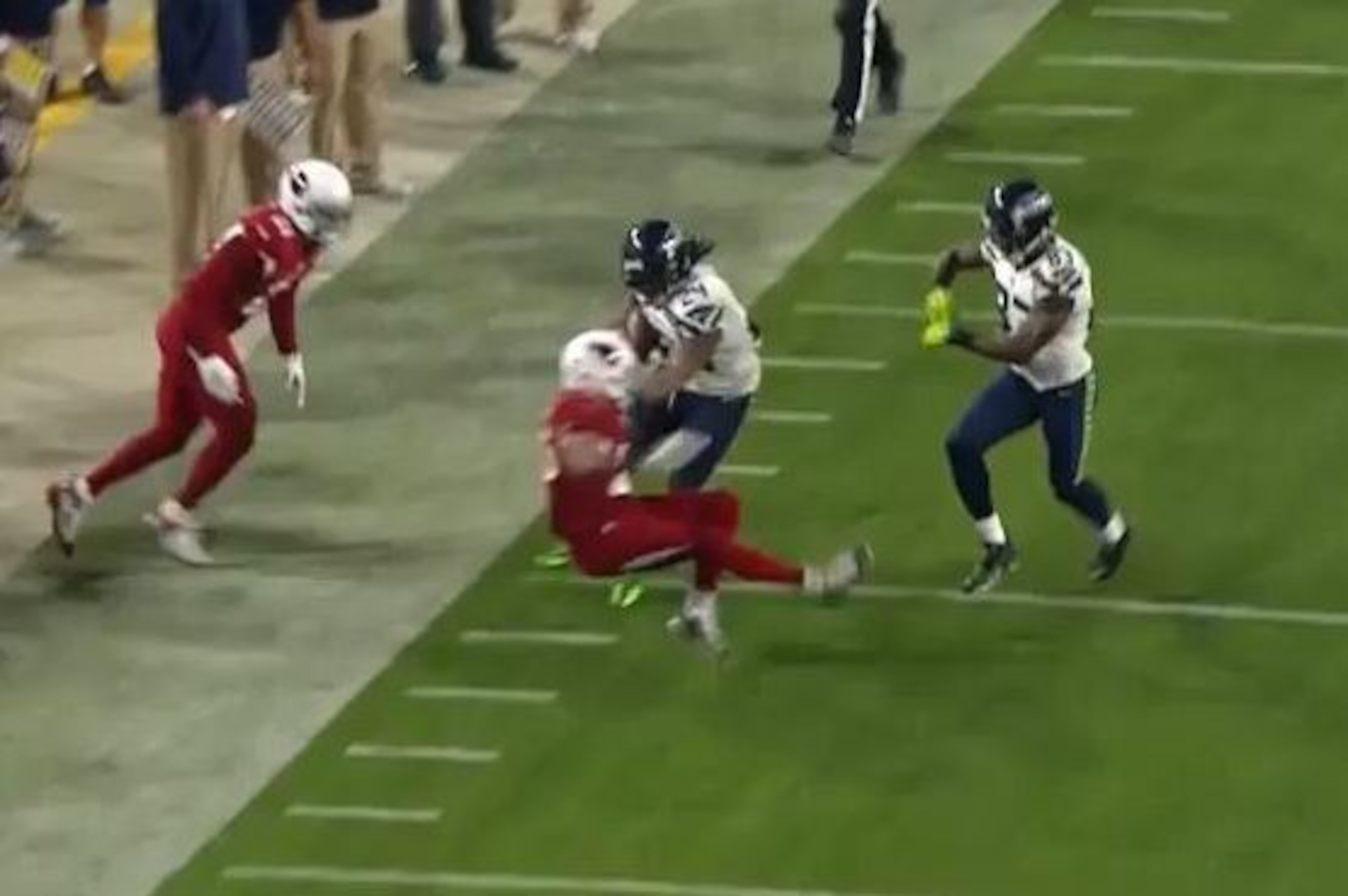
...Preventing him from reaching the second level is of the highest priority.
Lynch is always the one constant for the Seahawks offensively. At times the wide receivers struggle to create separation, and that passing-game problem will only get worse with Patriots cornerback Darrelle Revis roaming the field. There also has to be at least some concern about which Russell Wilson will show up after a poor outing until the final minutes against Green Bay.
But Lynch is always barrelling forward, often with defenders crumbling around him. If he does that for one more game, the Seahawks can exploit a potential weakness and secure another championship.
.jpg?w=2560 "Super Bowl Halftime Jay-Z")
.jpg?w=2560 "Cowboys Eagles Football")
.jpg?w=2560 "WWE Raw Live Grades 🔠")