Breaking Down How the Washington Redskins Pressured Mark Sanchez, Eagles Offense
It's been strange to watch a blitz-happy play-caller like Jim Haslett fight his natural urges in recent weeks. The Washington Redskins defensive coordinator has reined in his penchant for bringing pressure, something that's not always helped his struggling unit.
It's been a safety-first response to the many injuries the Washington defense has sustained. That's why Haslett deserves some praise for abandoning caution with the game on the line in Week 16.
That's when the Redskins threw three straight Cover 0 blitzes at Mark Sanchez and the Philadelphia Eagles offense. Up to that point, Haslett had been content to challenge the Eagles with just three- and four-man rushes.
.jpg?w=2560 "Commanders 49ers Football")
.jpg?w=2560 "Colts Football")
.jpg?w=2560 "DOLPHINS-AIKMAN")
His restrained strategy was as tough to watch as it was costly for the Redskins D. Had it not been for Cody Parkey missing a pair of field goals, the Eagles would have done more to punish this overly cautious approach.
But with the game tied at 24-24 in the fourth quarter and Sanchez driving the Eagles for the winning score, Haslett finally pushed the blitz button. Sanchez had already thrown for over 300 yards and a pair of touchdowns.
Many of his passes had connected with tight end Zach Ertz, who finished with 15 catches for 115 yards. But Haslett's blitzing approach succeeded in shutting both Ertz and Sanchez down.
In the first example, the Redskins sent six rushers after Sanchez and matched five-on-five in coverage:

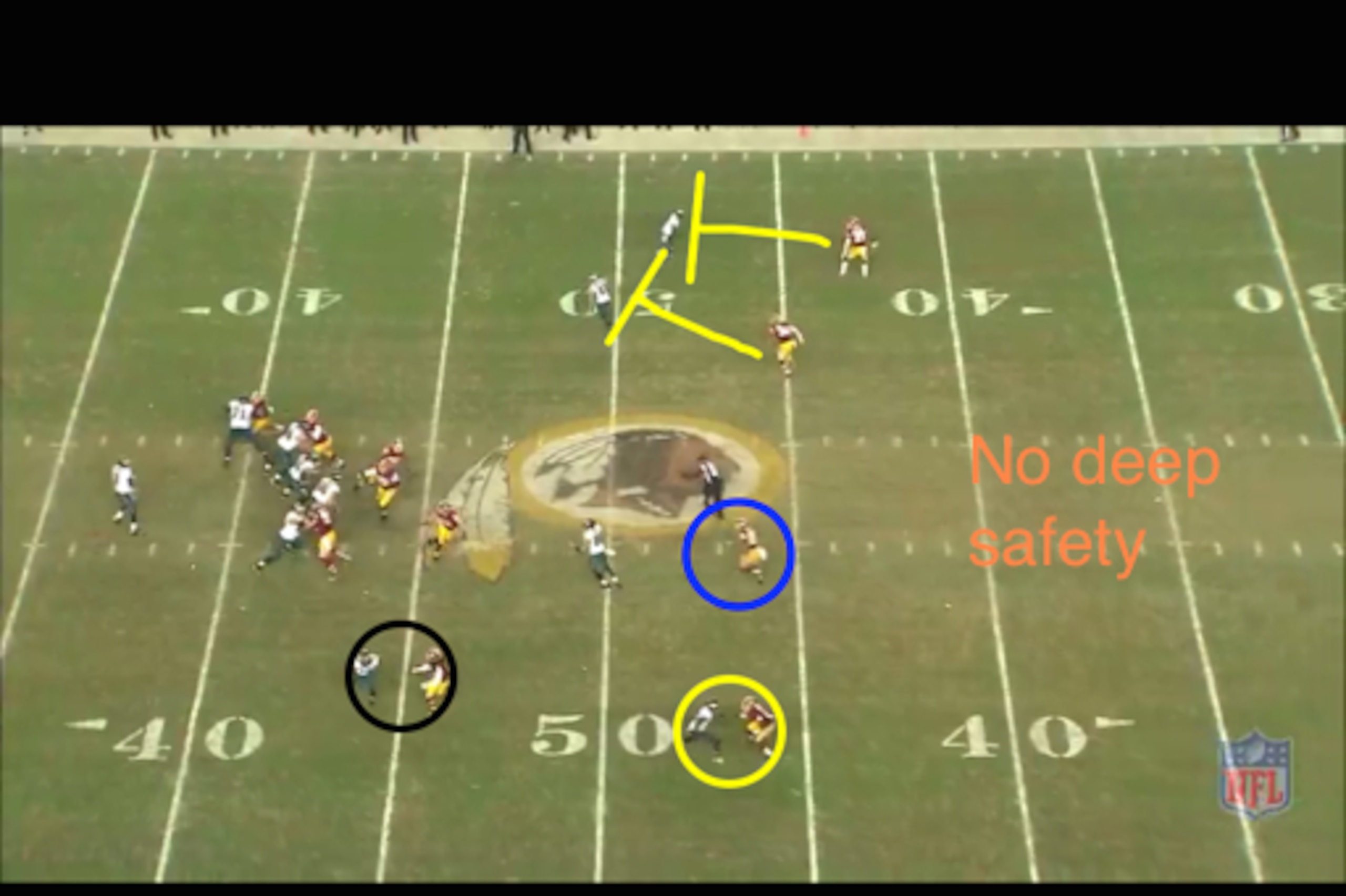
Free safety Ryan Clark rotated from a Cover 1 look to lock up Ertz in man coverage (blue circles). This added an element of disguise to this pressure.
So did safety Phillip Thomas showing blitz before picking up running back Darren Sproles in coverage (black circles).
Once the coverage took shape, Washington had matched up every potential Philly receiver in man coverage, with no deep safety behind it:
That left Sanchez at the mercy of the blitz. Haslett sent inside linebackers Will Compton and Steve Beauharnais through the middle:
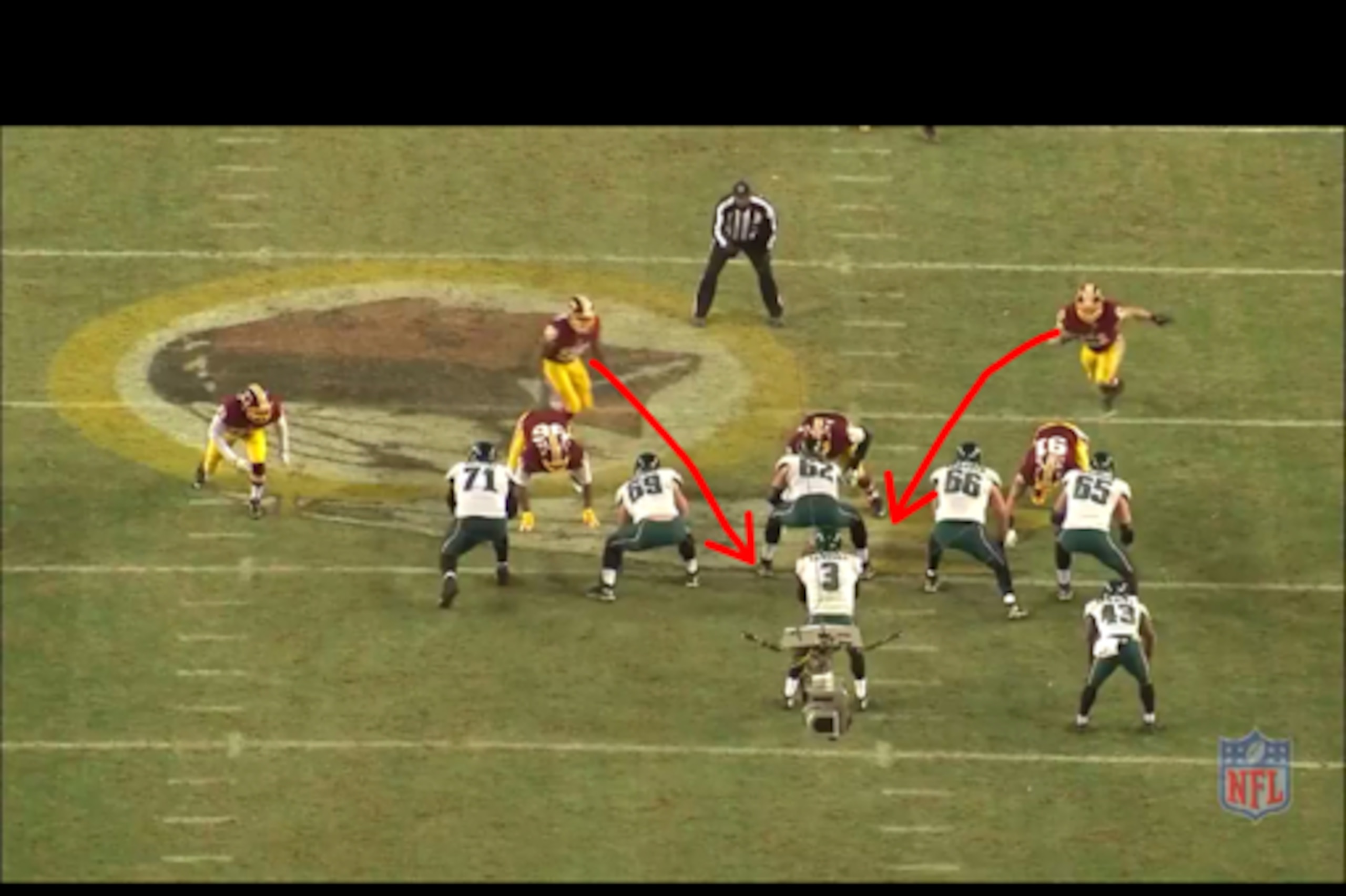
The pressure up the middle was designed to make Sanchez target Ertz. The tight end would be his hot read behind the blitz.
That's just where Haslett wanted Sanchez to throw because he had Clark hovering over the tight end's route. The veteran safety quickly closed on Ertz before knocking the throw away:
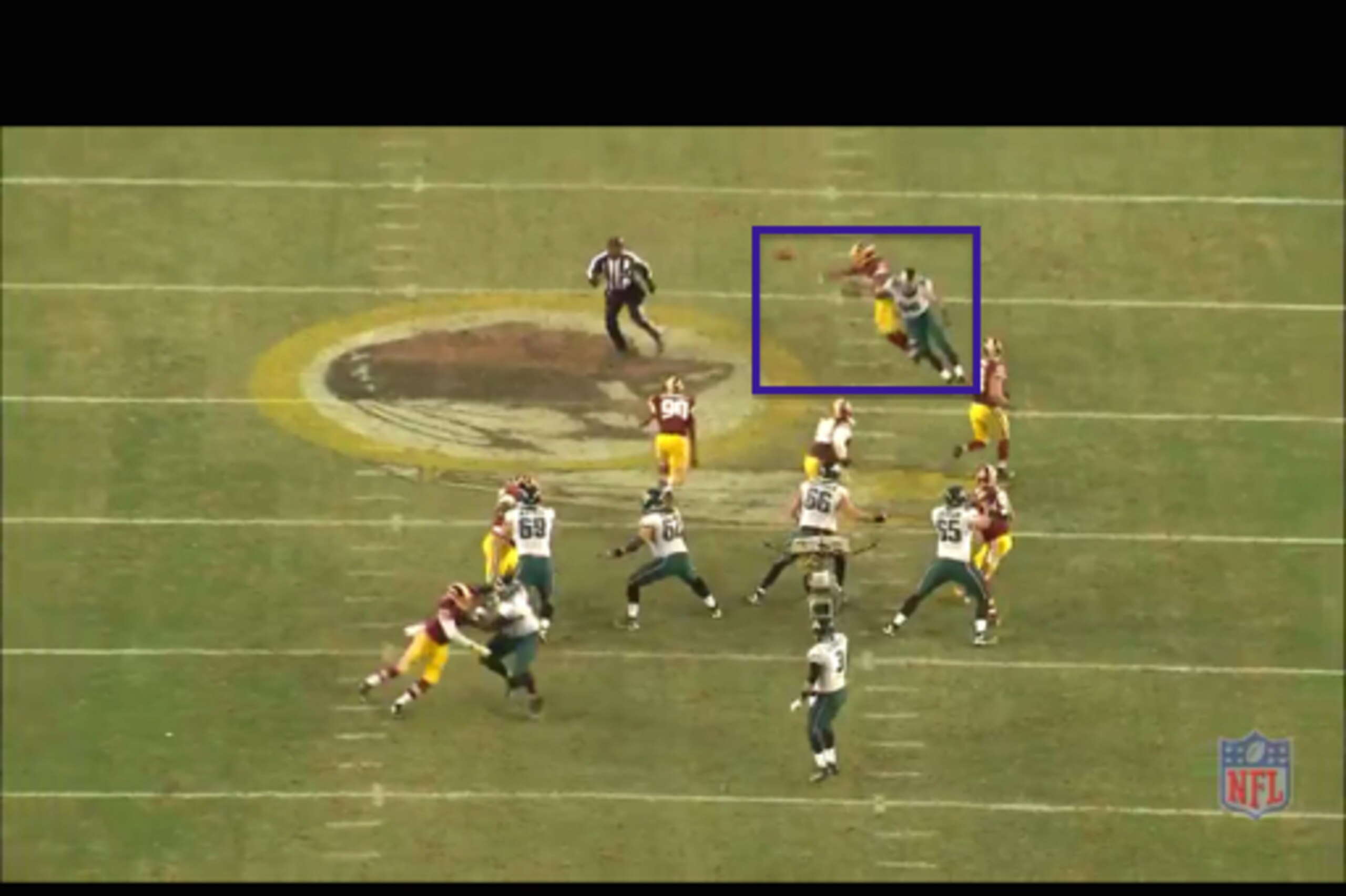
The Redskins had successfully baited Sanchez into making a throw they wanted him to make. Haslett had forced him to target Ertz once again but had Clark ready to take the pass away.
Haslett followed this clever Cover 0 concept with variations of the same pressure.
The first riff on the theme involved using Thomas on a "green dog" concept:
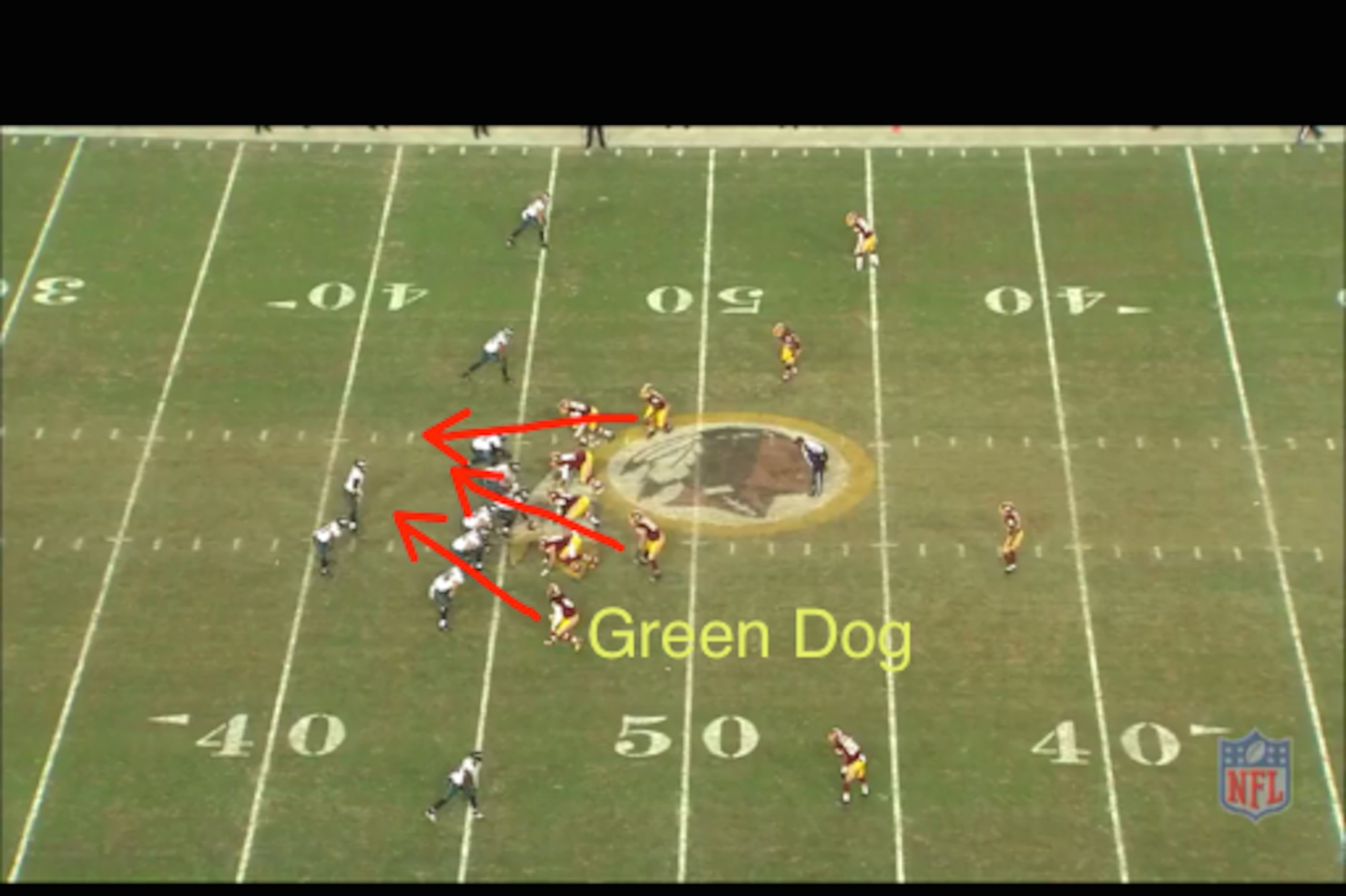
Simply put, green dog is the term used to describe the license given to a defender charged with occupying a running back in man coverage. If that runner stays in and doesn't release on a pass pattern, the defender is free to blitz.
In this case, that meant Sproles staying in to block Beauharnais:
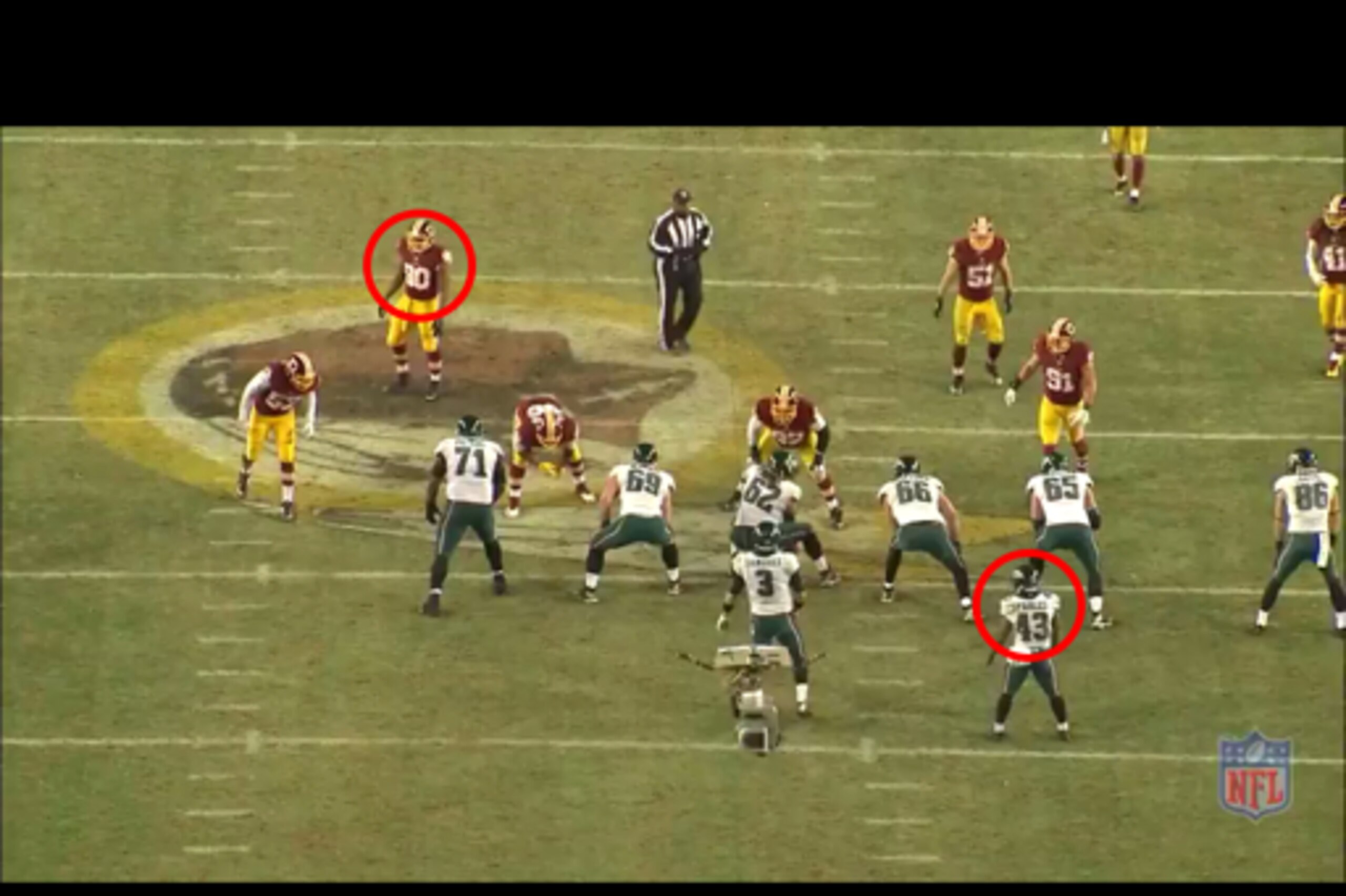
So Thomas was free to join Beauharnais and Compton on the blitz. Behind the pressure, the coverage again shifted to the same Cover 0 shell:

With Sproles shifting to the other side to block Beauharnais, Thomas was unblocked off the edge. His pressure obscured the passing lane for Sanchez:
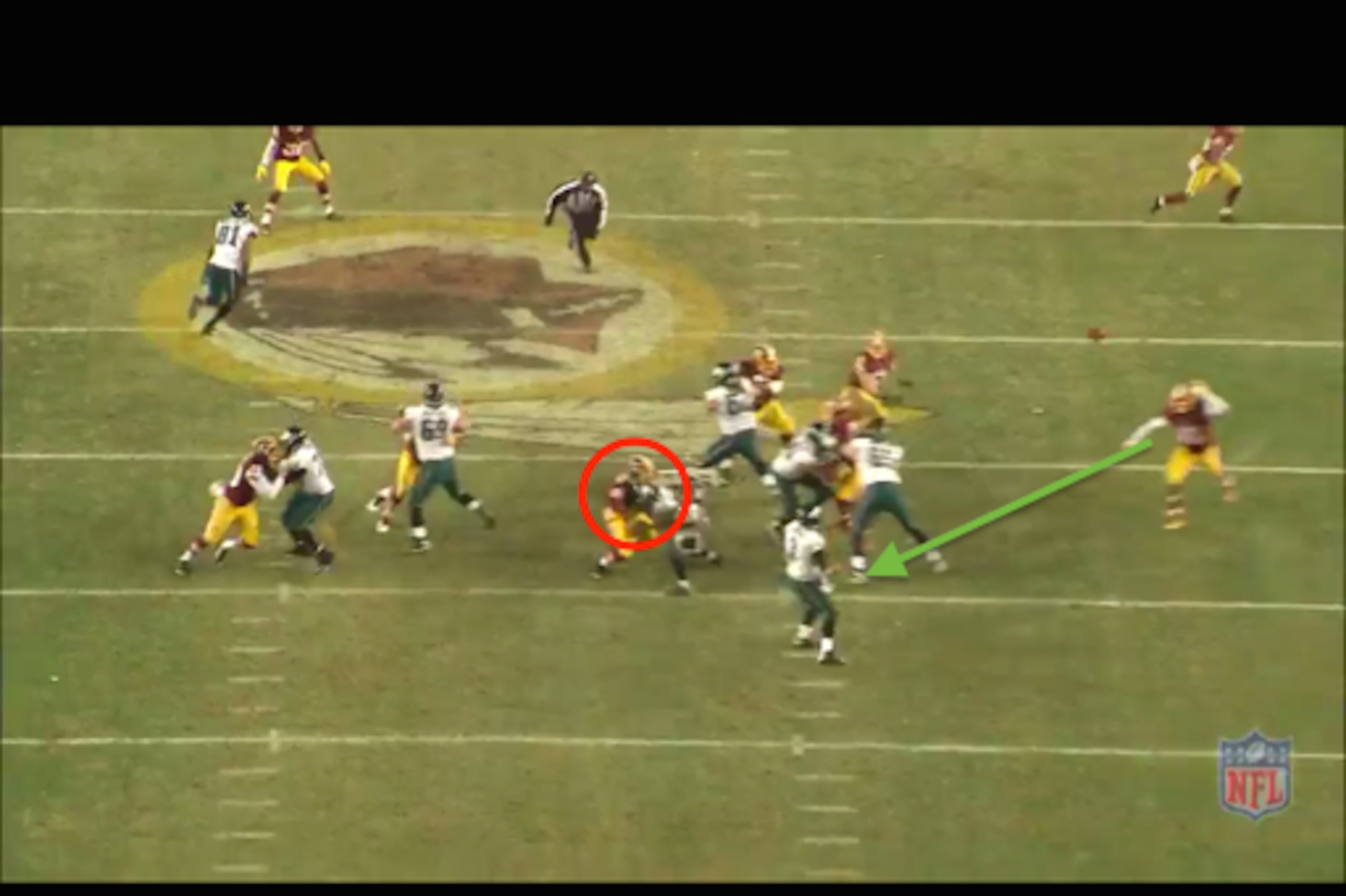
The quarterback was again targeting Ertz. But again he found Clark waiting to immediately tackle the tight end and limit the Eagles to just a six-yard gain:
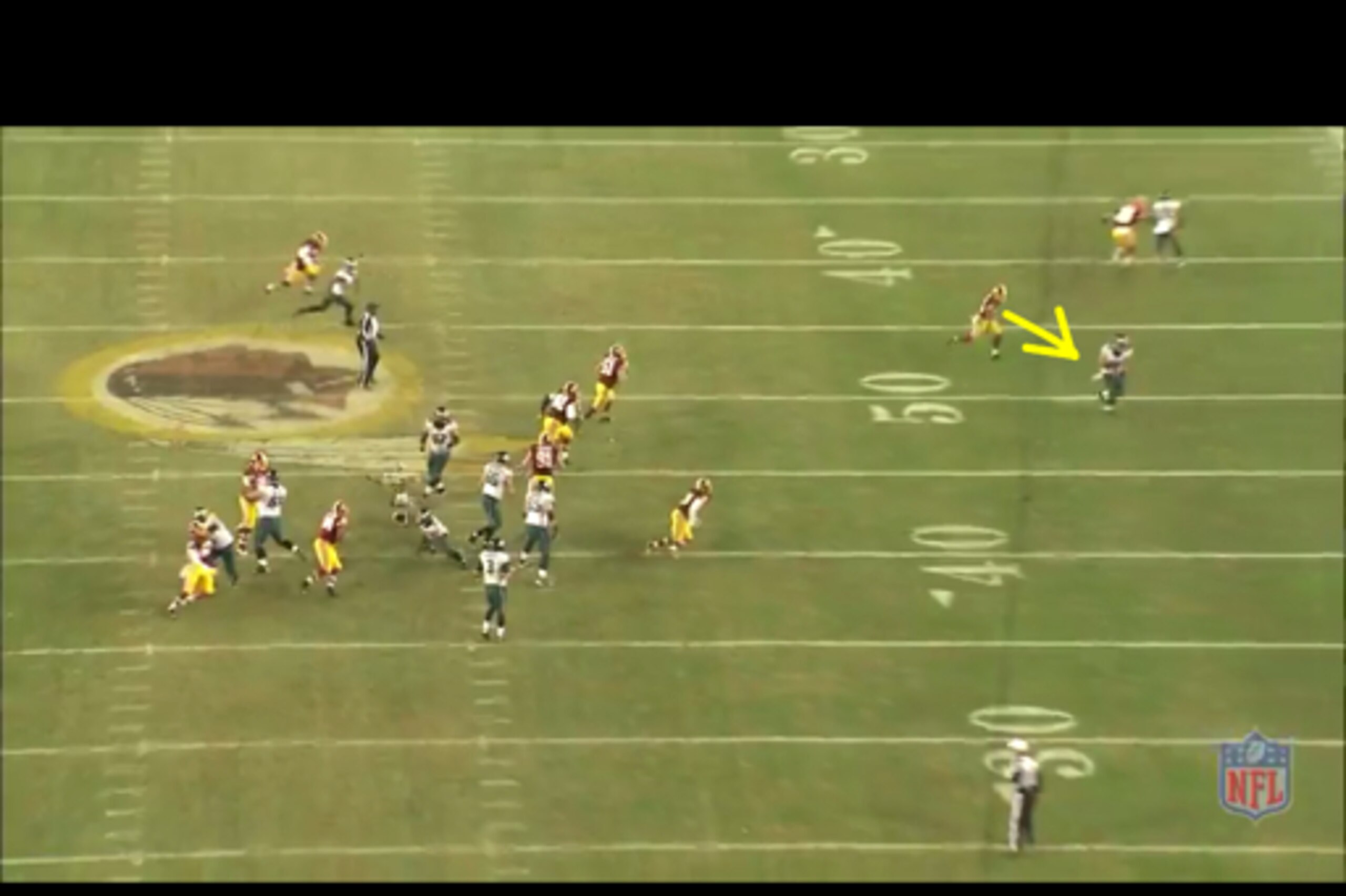
After surprising the Eagles' blocking scheme with one more blitzer than it could account for, Haslett tweaked his front to get a free rusher in Sanchez's face.
Haslett dialed up the same blitz he had on the previous two plays. That meant Compton and Beauharnais rushing the middle with covering defenders matching up with every potential receiver:
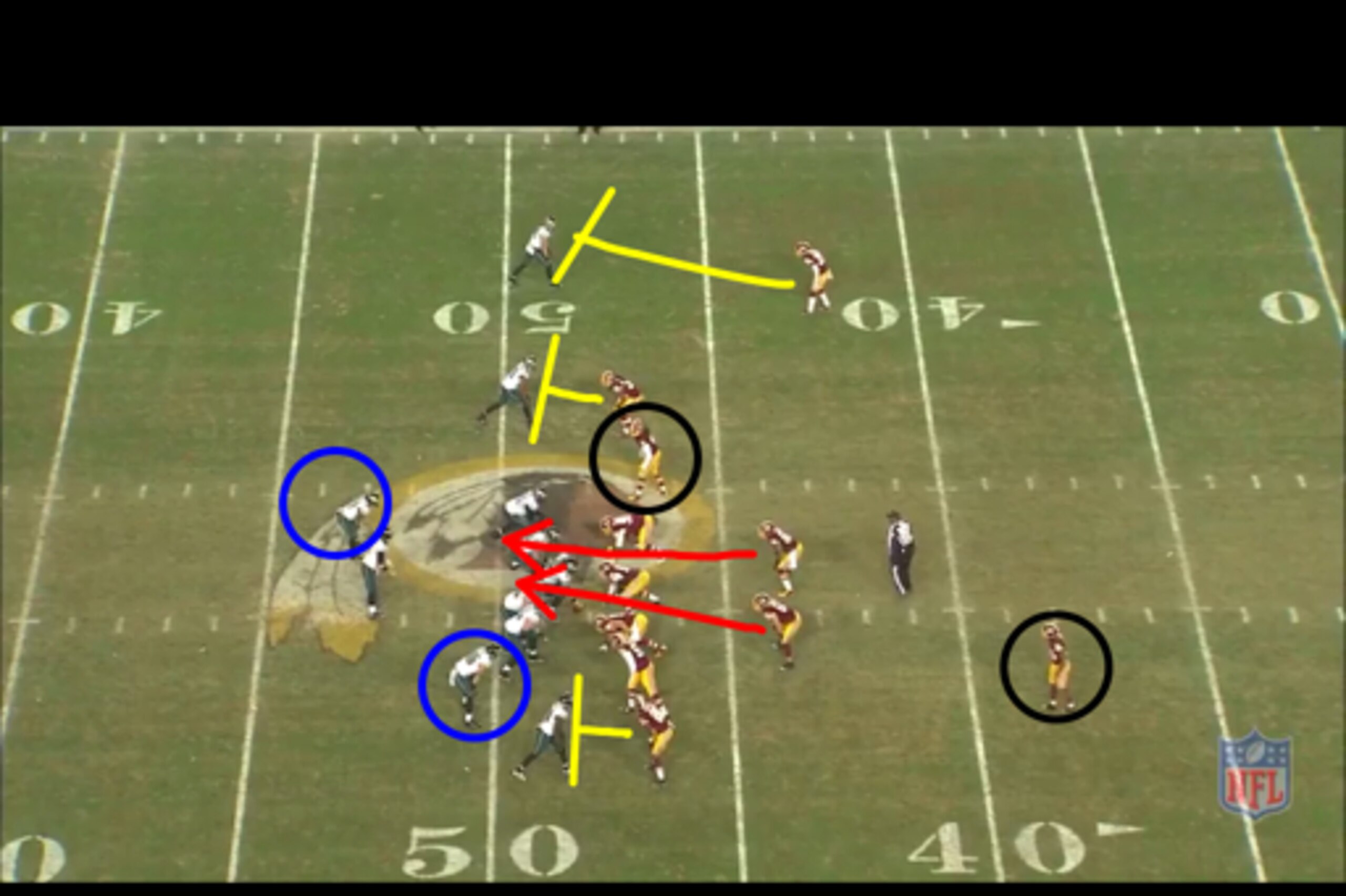
Once the coverage was set, the Redskins adopted the same Cover 0 shell. Again, it meant Clark locking up Ertz, while Thomas covered Sproles (black lines):

But what was happening up front was more interesting. Haslett had adjusted his four-man alignment.
He shifted rush end Ryan Kerrigan (91) inside to tackle and aligned outside pass-rusher Jackson Jeffcoat next to him on the same side of the formation:
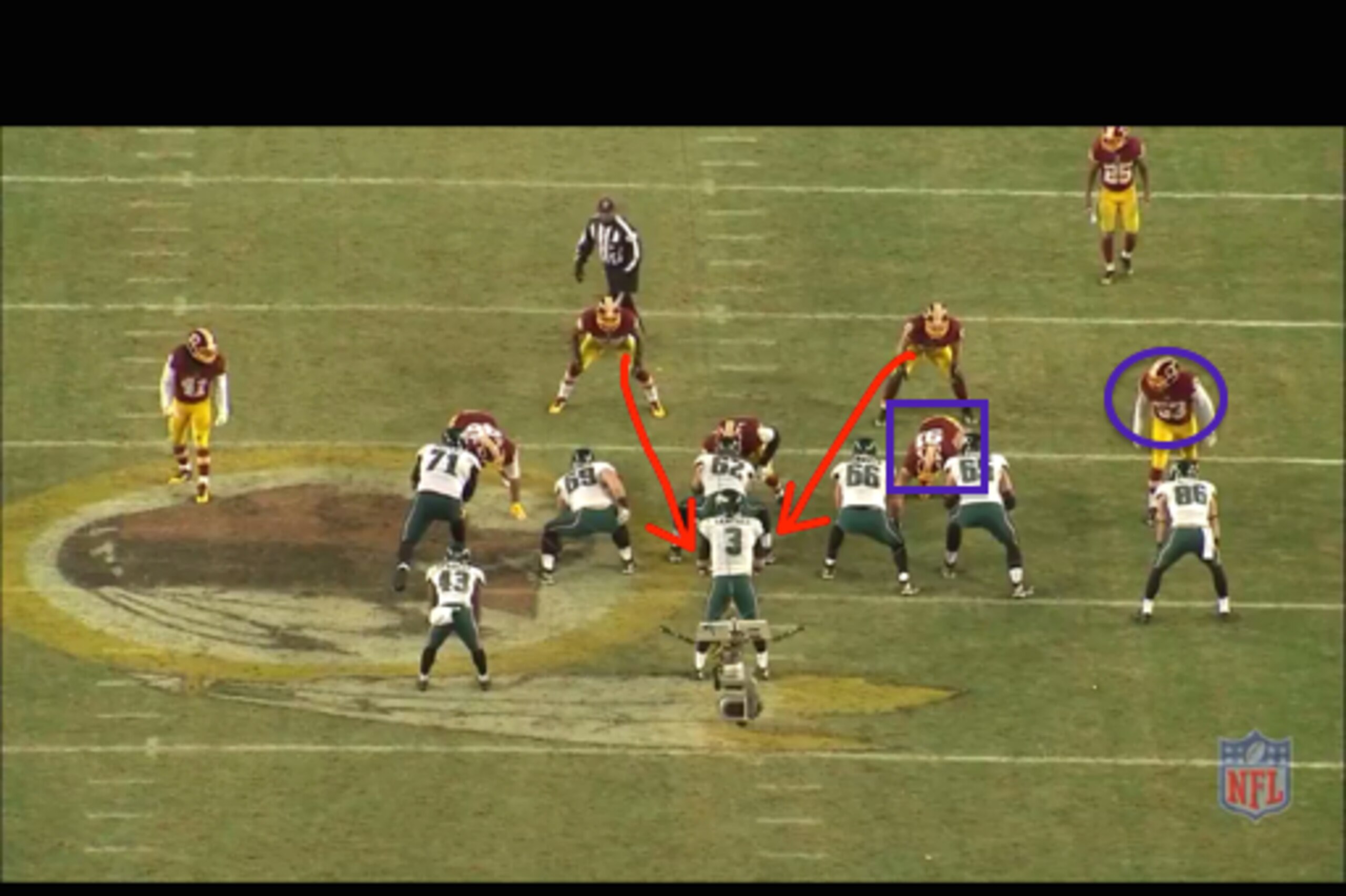
Once they rushed, along with Compton and Beauharnais, there were too many rushers for Philadelphia's offensive linemen to account for. It was Kerrigan, Washington's most prolific pass-rusher, who broke free:

Kerrigan's free rush lane was created because right guard Andrew Gardner had to pick up Compton's blitz. Meanwhile, right tackle Lane Johnson reacted to Jeffcoat's wide-angled rush.
Kerrigan rushed into Sanchez's face and filled the passing window:

Kerrigan's pressure and presence rushed Sanchez into a wayward throw that rookie cornerback Bashaud Breeland pounced on. His interception was the defining moment of the game, a moment created by Haslett's Cover 0 blitz concepts.
The Redskins soon converted that turnover into the winning field goal.
Haslett had crafted a pressure that left his best pass-rusher unblocked and forced the destination of Sanchez's pass. The Eagles passer couldn't go to Ertz because Clark had again taken away the tight end's route.
Haslett used Cover 0 blitz concepts to beat the Eagles. He can include the same ploy to frustrate the Dallas Cowboys in the season finale.
That's just what he did during the first meeting back in Week 8. The Washington defense swarmed in for five sacks and repeatedly hit and harassed quarterback Tony Romo as part of Haslett's blitz-heavy plan.
Cover 0 pressure was a big part of that plan. The best example came in the first quarter when inside 'backer Perry Riley Jr. dropped Romo for an 11-yard loss.
Washington showed the Cowboys man coverage with no safety help behind it:

Haslett sent seven after Romo, with the pressure overloaded on one side. Clark came off the edge, while inside linebackers Riley and Keenan Robinson rushed the middle:
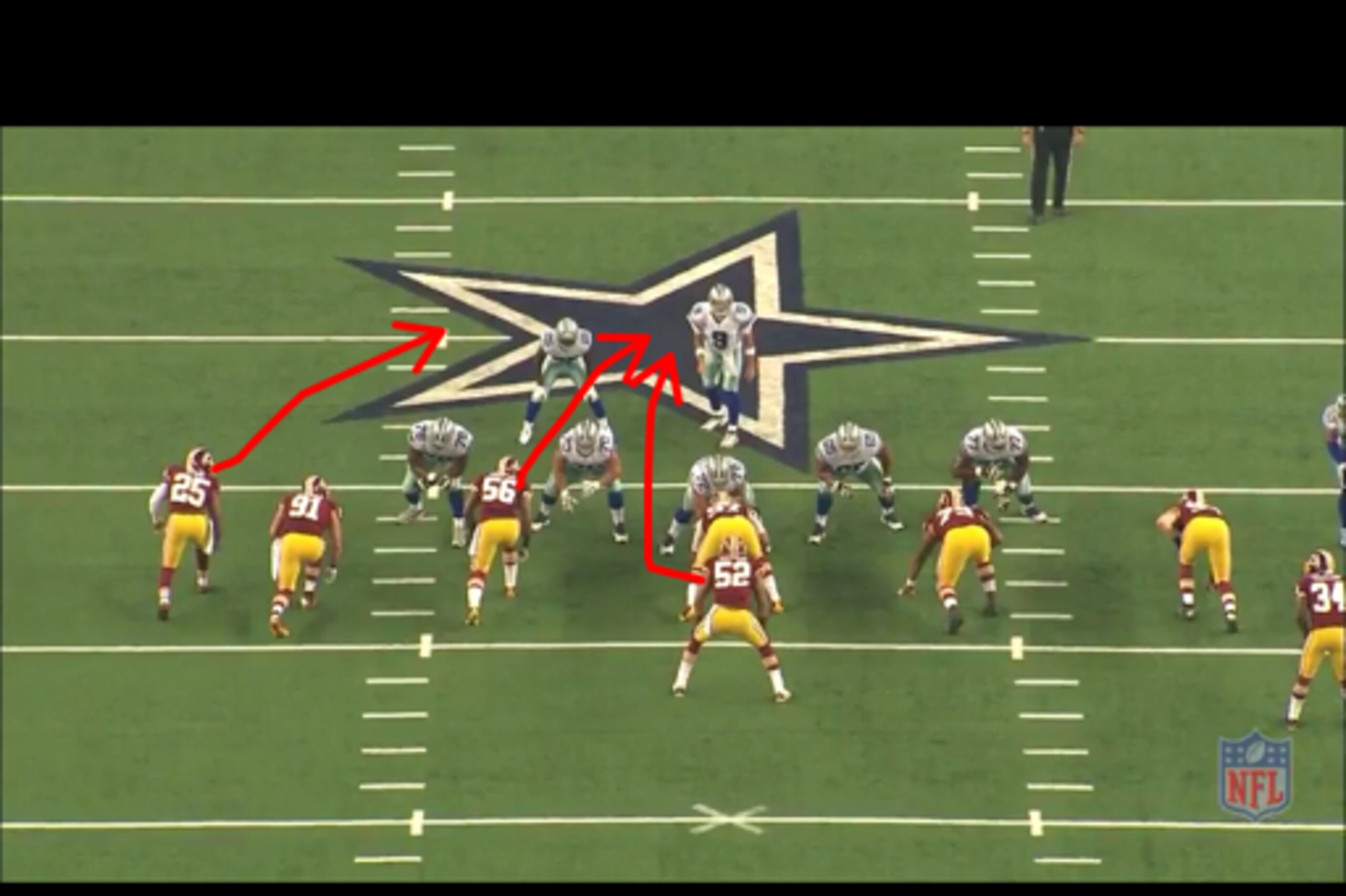
Romo was throwing into the same blanket man coverage look Sanchez would later face:
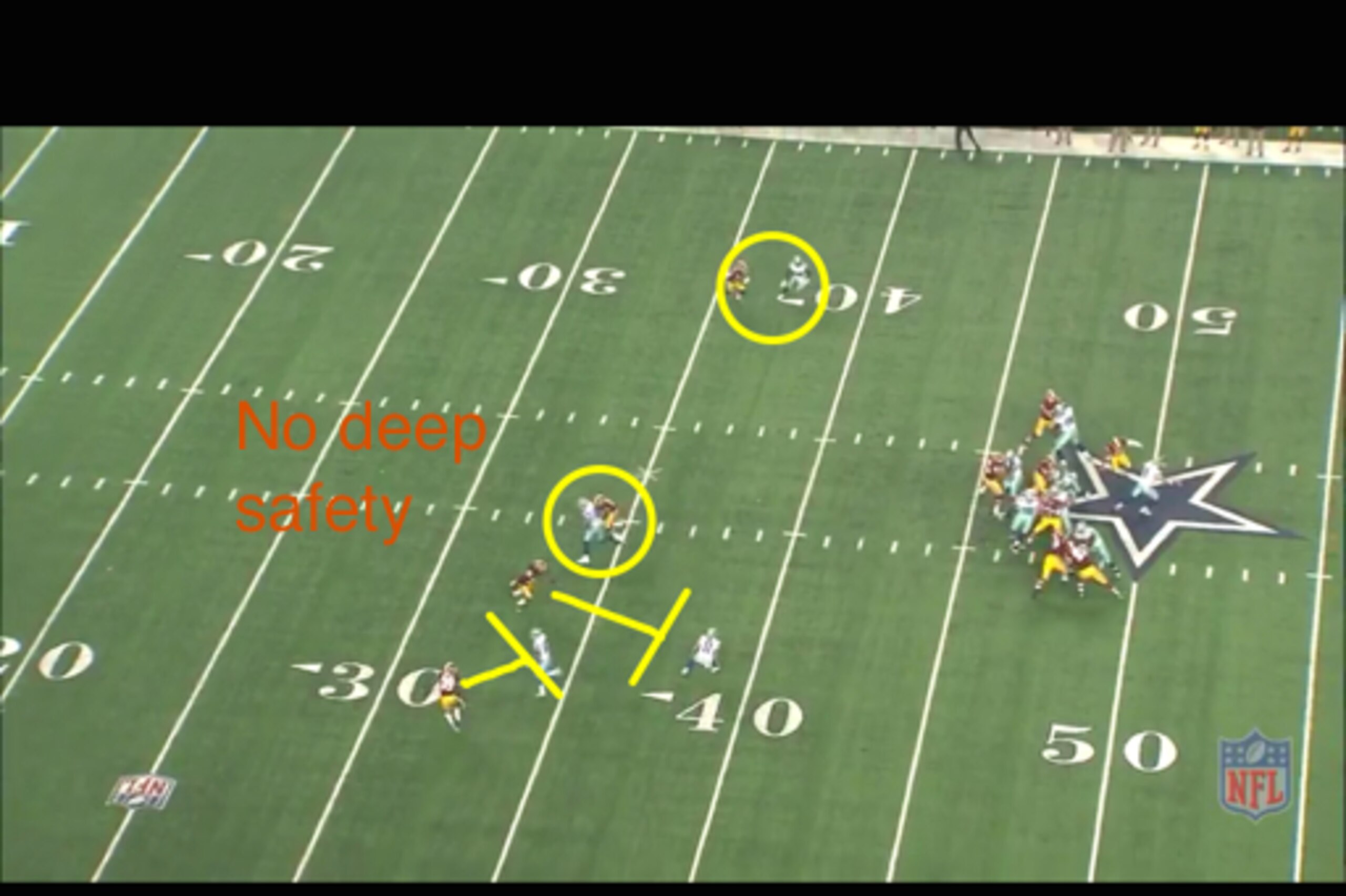
The pressure meant Romo had no time to stand in the pocket and wait for his receivers to escape such tight coverage. But the plastering technique by the covering defenders meant Romo's receivers needed extra time to break free and get open. That's the Catch-22 posed by all man-coverage blitz schemes.
The pressure soon closed in around Romo. Clark was the first to move him, coming free off the edge:
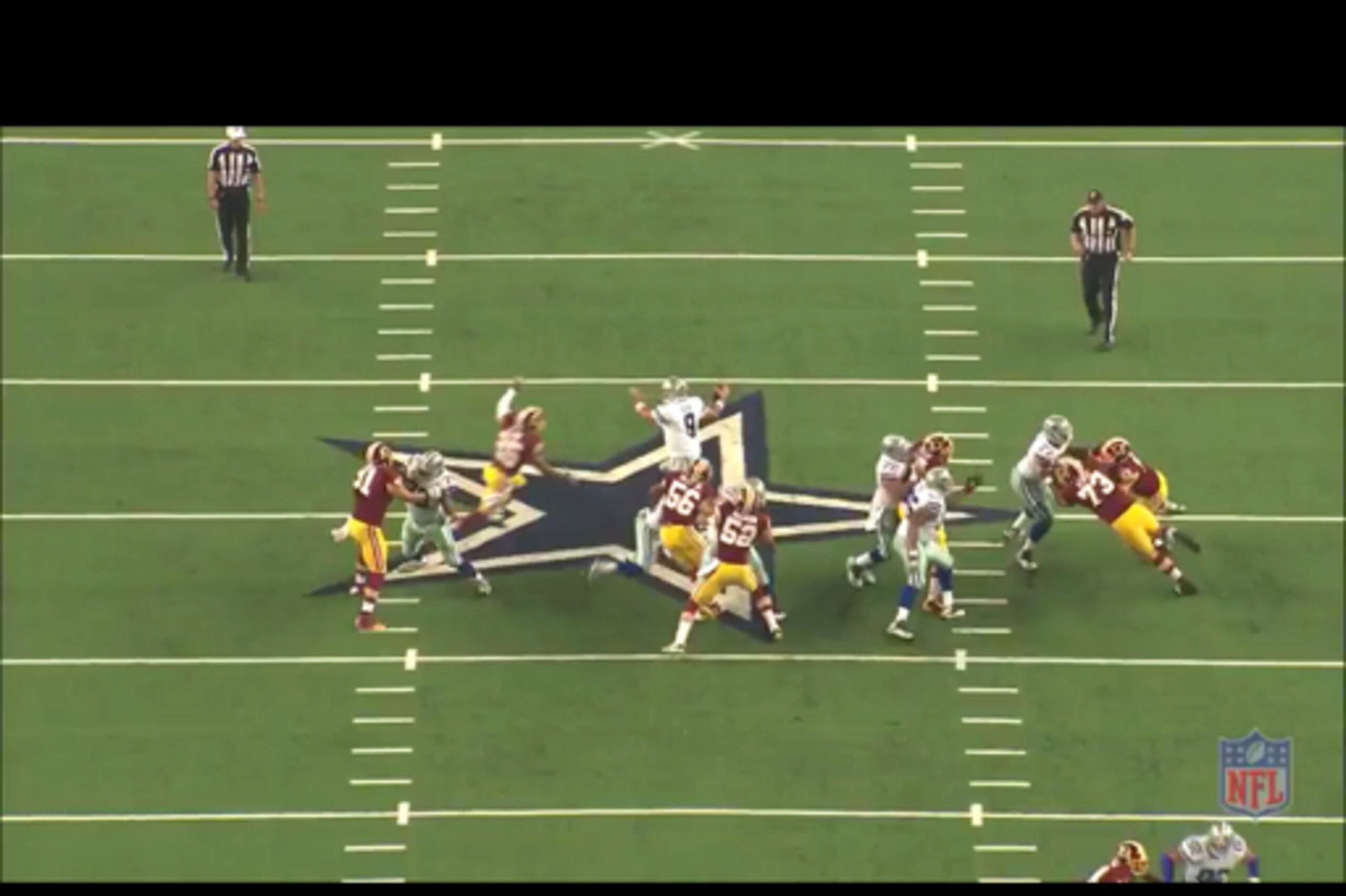
But as soon as he'd escaped Clark's clutches, Romo was met by Riley:
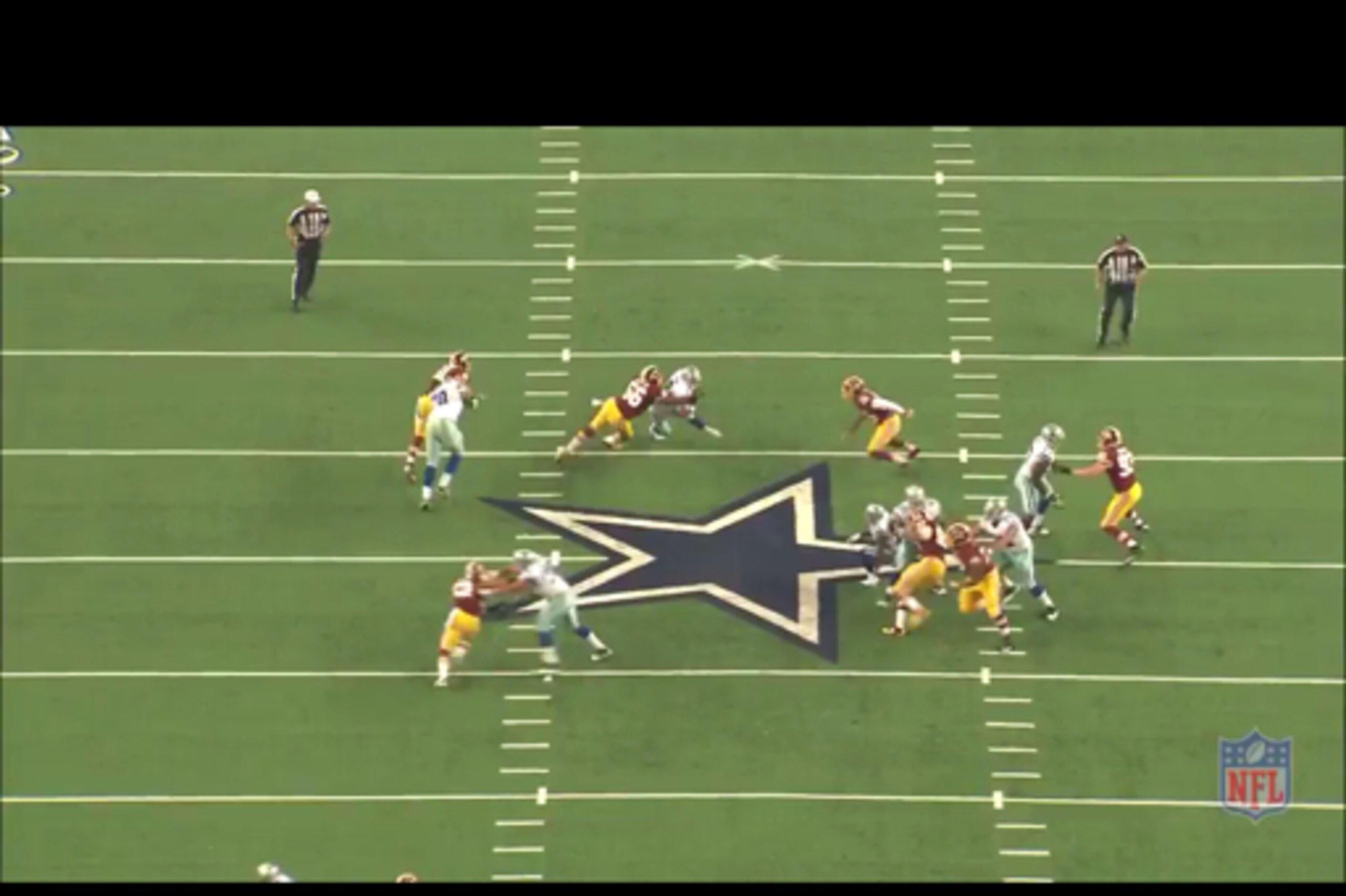
Haseltt's Cover 0 strategy baffled the Cowboys in Week 8. The relentless pressure left Romo shell-shocked, per ESPN Cowboys reporter Todd Archer:
"They are banking on one guy making a tackle every single time. The ball has to come out of your hand when they are sending them. That was the most Cover 0 blitzes we have seen in a game. You don't necessarily think a team is going to run 10 snaps of it in a game. I'm not sure how many they did, but it was a lot.
"
Obviously, there are plenty of risks inherent in successfully executing Cover 0 blitz concepts. If the pressure is blocked, receivers have more time to escape single coverage. With no safety help over the top, that's a recipe for surrendering some huge plays through the air.
But the reality is the concepts have worked whenever the Redskins have run them this season. Cover 0 blitzing is one of the few things Haslett's defense does well.
It worked wonders against the Eagles and can do the same to upset the Cowboys and help finish a disappointing season in style.
All screen shots courtesy of CBS Sports, ESPN, NFL Network and NFL.com Game Pass.
.jpg?w=2560)
.jpg?w=2560 "NFL Paris Football")


.jpg?w=2560 "Malik Beasley Negotiating Plea Deal (AP)")