

Inside the Los Angeles Lakers' Historically Bad Defense
The Los Angeles Lakers are having a rough season by every metric.
Offensively, their lack of quality ball-movers bogs down the offense and cycles in a constant flow of isolation basketball. Kobe Bryant, great passer that he is, is ultimately still a ball-stopper. Nick Young is the same, minus the passing. Jeremy Lin is more a creator for himself out of the pick-and-roll than for teammates.
But it's on the defensive end that the Lakers are struggling even more, and it's arguably a greater reason why they've sputtered to an 8-17 record.
TOP NEWS

Duren Calls Out 'False' Rumors

Pic of LeBron's Helicopter Commute 🚁

NBA Power Rankings Entering Preseason 🔢
Their 110.5 defensive rating is dead last in the NBA, according to NBA.com, whereas their 103.5 offensive rating sits at a mediocre, but not awful, 16th.
Pick-and-roll coverage has been the root cause of their problems. Synergy Sports (subscription required) has them giving up the fourth-most points per possession to pick-and-roll ball-handlers, the most to big men rolling down the lane, and the most to shooters on the perimeter on pick-and-roll kickouts.
The nature of the pick-and-roll is that it puts the defense at a momentary disadvantage. No matter the coverage, one defensive player is covering two players for at least a split second. Some teams simply switch all screens to avoid this lapse, but that creates unfavorable mismatches.
Some teams constantly guide the ball toward the sideline and do not let the ball-handler get to the middle of the floor. Some teams trap the ball-handler with two players, or at least provide extra pressure for a second or two to muddle up passing lanes.
The Lakers fight through the screens and rely on weak-side defenders loading toward the ball to force difficult, cross-court passes. This is the strategy adopted by many of the league's top defensive teams—the Chicago Bulls and Indiana Pacers, for example—because it pushes ball-handlers into the mid-range while protecting both the rim and three-point line.
As with any defensive blueprint, it requires multiple moving parts to work in tandem. For the Lakers, their biggest failings have come in two areas: the way their bigs contain the ball once the driver comes off the screen, and the weak-side defenders' ability to deal with rollers.
Here's a prime example of the former, with Carlos Boozer not taking a proper angle once the San Antonio Spurs' pick-and-roll with Cory Joseph and Boris Diaw occurs.
At the moment of the screen, Boozer is already in trouble. Instead of sliding over toward the middle of the free-throw line in anticipation of Joseph using the pick, he's still in line with Diaw.
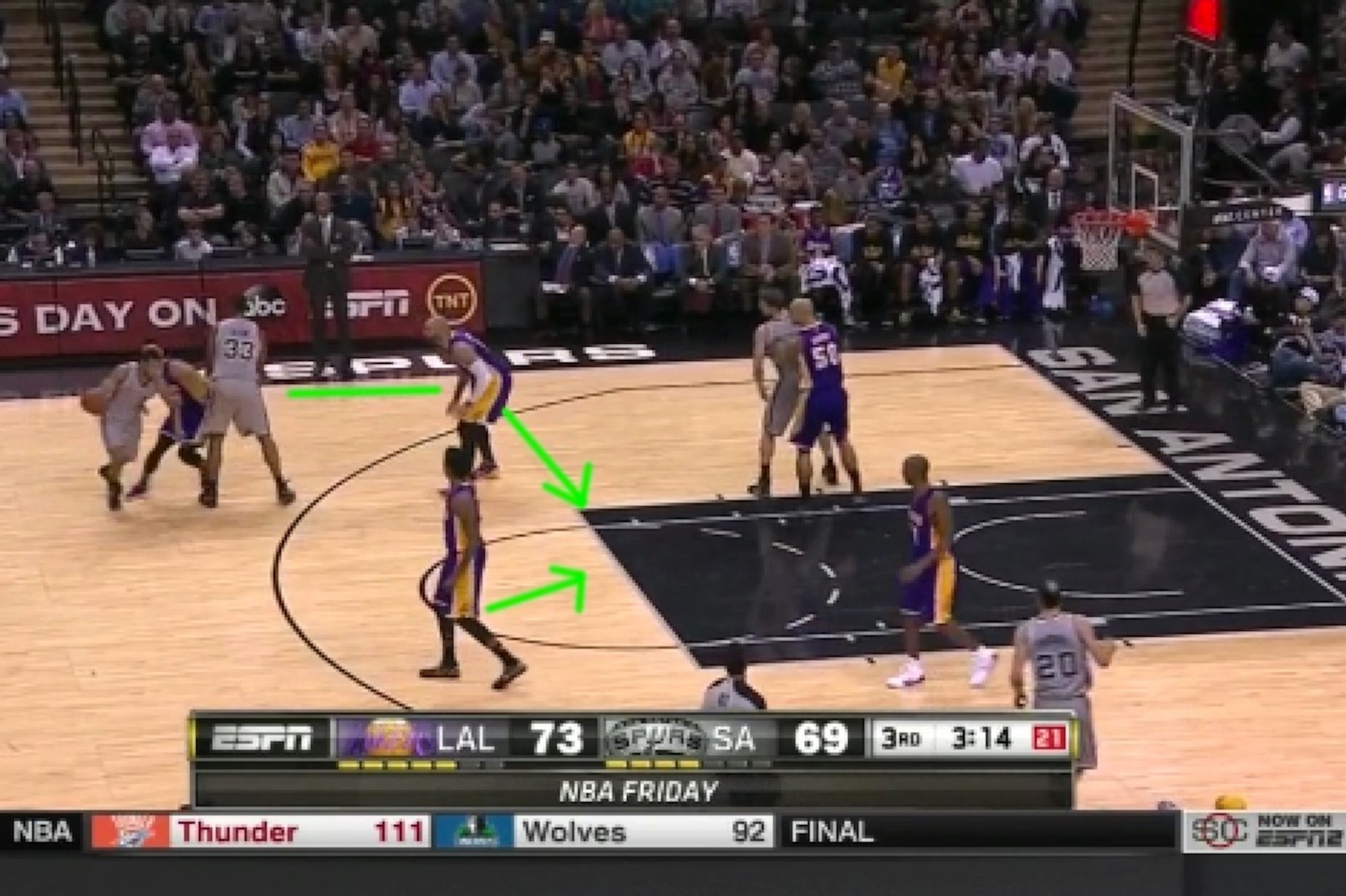
It's the responsibility of all bigs in the pick-and-roll to be early. Because they're usually slower than the guard dribbling the basketball, they must anticipate direction and adjust accordingly.
Boozer, however, is giving up a straight-line path to the rim and now must frantically slide his feet to catch up with Joseph.
Boozer, however, isn't the only problem. Young, who's guarding a player well above the opposite wing, should already be on the nail—the center of the free throw-line—to deter penetration. Even if he's not there, he should at least stunt toward the nail as the drive occurs.
Even if he can't leave a shooter wide open by fully rotating, a quick stunt could hold up Joseph just enough to allow Boozer to recover.
Lin, who's guarding Joseph, should not escape blame either. He gets lit up by a pretty weak screen and does not fight hard enough to get back into a guarding position on Joseph.
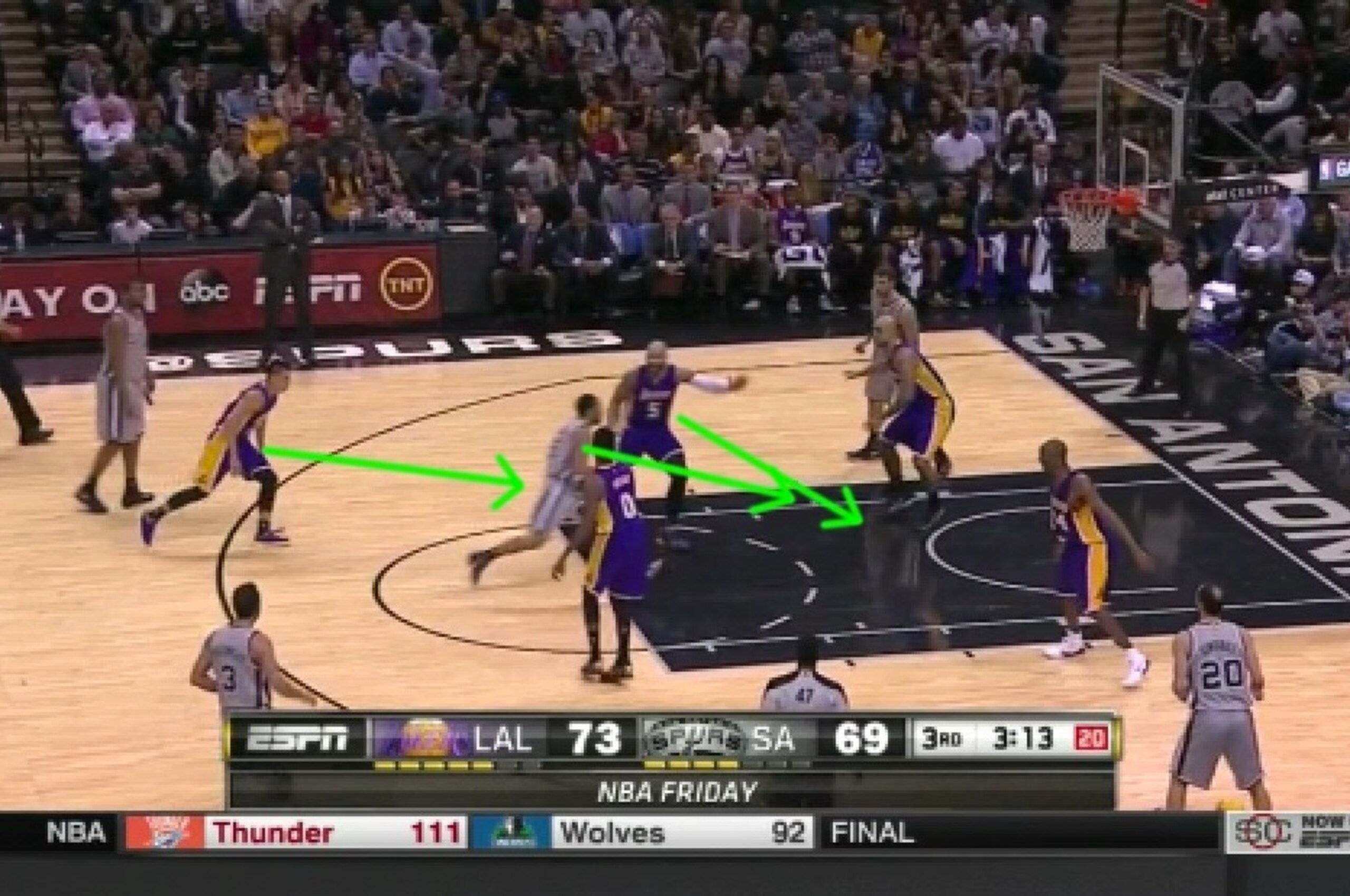
Ultimately, this is still primarily Boozer's fault. Maybe he's concerned with Diaw popping (and that's why he sticks to Diaw for a second too long), but containing the basketball is always the first responsibility. If ball-handlers want to throw out to shooters, the defense must scramble accordingly.
Here's the play in full:
Here's another example from the same game. Bryant tries to force Manu Ginobili to reject the screen, but he manages to squirt around it anyway. Boozer, once again, is late in his positioning.
To account for Ginobili's foot speed, Boozer has to retreat toward the paint before actually confronting the ball. If he scrambles high instead of low, it will be too late.
But even so, Ginobil's momentum toward the rim and Boozer's late reaction means he can barely contest without risking a foul. The result is a relatively unbothered floater.
The back side of pick-and-roll defense is more about effort than anything else. Boozer's errors, while frustrating, are more mental. With film review and work on the floor, these types of mistakes can be cleaned up relatively quickly.
In the Lakers' pick-and-roll defense, it is the job of the corner defender to "tag" the roller, which is to say he must briefly bump the big man diving to the rim before scampering back out toward a shooter.
With the on-ball defender and the big guarding the pick-and-roll both concerned with the ball-handler, this "tagger" is tasked with momentarily halting the momentum of the big so he cannot run free to the rim.
This also buys the defenders involved in the pick-and-roll a bit of time to get realigned. The on-ball defender can use that extra half-second to get back in front of the ball, and the defensive big can then shift back to guarding the roller.
The tag, in short, is crucial.
As a rule of thumb, if the ball is going away from you and you are not directly involved in the pick-and-roll, you are the tagger.
On this play against the Boston Celtics, Young is the tagger.
As Rajon Rondo comes off the Tyler Zeller screen, Lin goes under the screen (a common tactic used against poor shooters) and does a nice job along with Jordan Hill in clogging the paint.

Rondo, in theory, should have nothing to do with the ball other than to throw up a difficult layup or floater. Instead, he drops it off to Zeller for an easy finish.
So what went wrong? Take a look at Young on the tag.
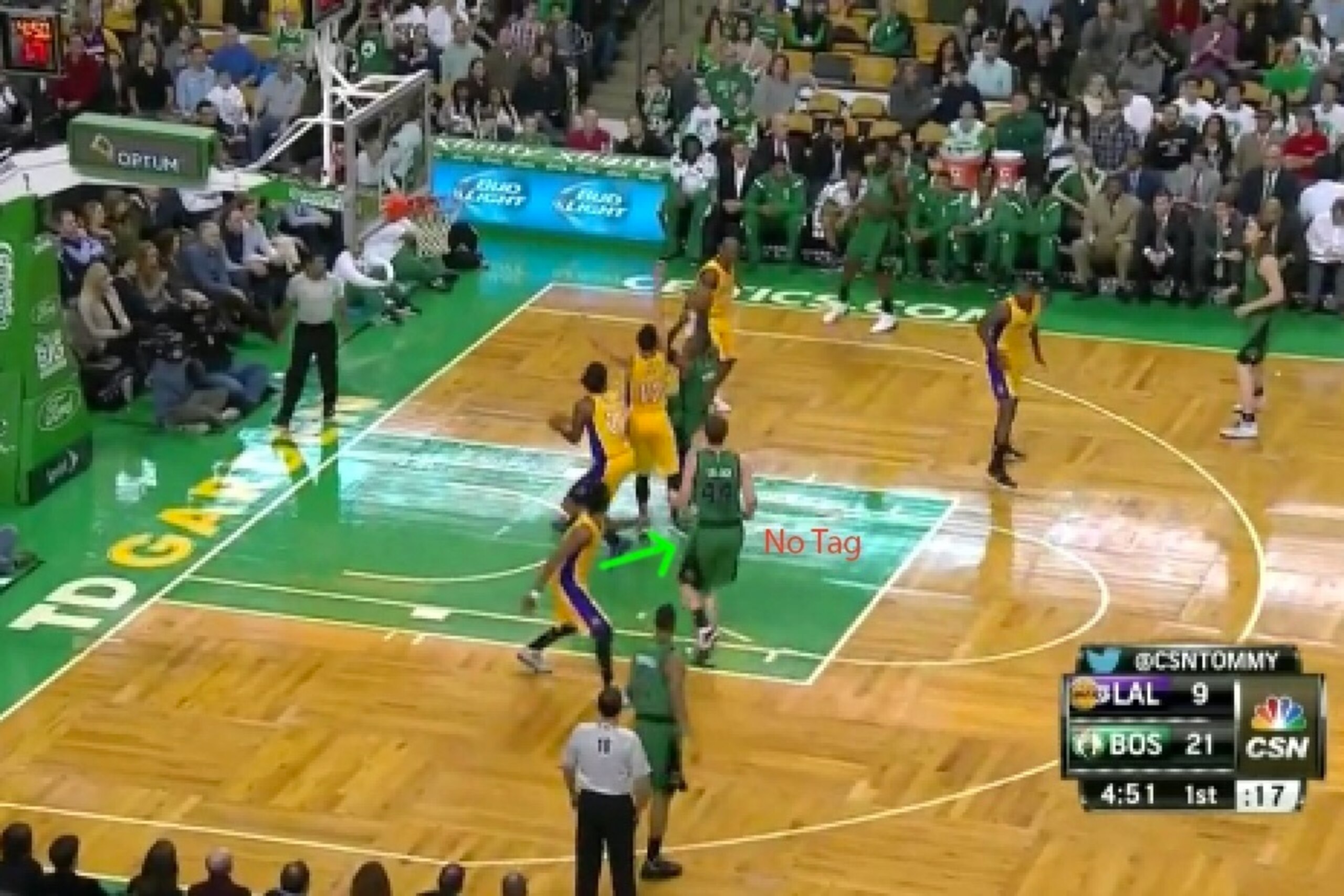
To start with, he only feebly sticks his hand out at Zeller. Even though his man, Evan Turner, is lifting out of the corner to make himself available for a possible kick-out pass, that's hardly a viable option. Even if Young does get sucked in too far to deal with Zeller, there should be enough of a window on flight time of the pass for him to recover.
Young also needs to bump him higher up the floor. A tag five feet away from the rim is virtually useless—Zeller can still catch and finish over Young with his size advantage. A tag at the elbow, however, means he's late on the roll and given the ball farther from the rim.
Defenses can live with Zeller making a play at 10 feet.
It's nearly impossible to be perfect on the pick-and-roll every time on defense. NBA players are so talented that even the minuscule advantage provided by a screen is enough to create havoc.
The best teams understand this dilemma and shade their defense to give up certain shots while eliminating others. Some teams are fine with the ball-handler pulling up uncontested from 18 feet. Others are fine with rollers catching it in the eight-foot range and having to finish in tough situations.
The Lakers don't seem to be dictating anything in their pick-and-roll defense; they're reactionary. This is certainly not what head coach Byron Scott is teaching.
If there's anything positive to be taken from Los Angeles' horrific defensive start, it's that their issues don't stem from an inability to play defense. Lin and Bryant are more than capable in pick-and-roll. Boozer comes from a scheme in Chicago that is similar to what he's executing in Los Angeles.
But for whatever reason, the Lakers aren't clicking on defense. And until they do, they'll continue to struggle in the win column.
.jpg?w=2560 "OBJ Calls Out Giants After Release")
.jpg?w=2560 "NFL investigating referee after viral exchange with player")




.jpg?w=2560 "LaFleur's Fumbling Warning ⚠️")