Jordan Hill Forcing His Way into Los Angeles Lakers' Long-Term Plans
For the second consecutive season, Los Angeles Lakers big man Jordan Hill is enjoying a breakout year.
But this one has more substance. More production, too. He isn't simply turning heads; he's turning corners.
And by the time this campaign has come to an end, he will have played his way into a long-term future with the purple and gold.
TOP NEWS

Pic of LeBron's Helicopter Commute 🚁

Duren Calls Out 'False' Rumors

NBA Power Rankings Entering Preseason 🔢
To say that no one saw this coming would be false, but the number of those who had a hunch could probably be counted on one hand.
Fortunately, new Lakers head coach Byron Scott was among the few still standing in the former lottery pick's corner. Hill's career per-game averages entering this season were only 6.7 points and 5.3 rebounds. During training camp, Scott said he expected Hill to push both categories to double digits, per Lakers Nation's Serena Winters:
Maybe Scott felt confident in Hill's previous per-36-minute production. The 6'10" bruiser had averaged at least 12 points and 10 boards per 36 minutes in four of his first five seasons.
But the sustainability of those stats was hard to gauge because the sample size had always been small. Last season was the first in which Hill topped the 16-minute mark, and even then, he only logged 20.8 a night in former coach Mike D'Antoni's ill-fitting, perimeter-based system.
Scott's confidence could have been legit, or it may have been forced out of him. After all, L.A.'s front office handed Hill a two-year, $18 million contract over the summer (team option for 2015-16). At $9 million per season, Scott needed Hill to be a double-double machine.
As Silver Screen and Roll's James Lamar explained, Hill didn't have to dominate, but he needed to at least be consistent:
"Hill doesn't have to become the All-Star his fellow 2009 lottery mates have blossomed into. Players don't draft themselves, and sometimes player-team marriages just aren't meant to be. It's the risk-reward of team building. What matters now, though, is Hill being trusted for who he is, poised for a breakout year for a Lakers team hoping to develop their frontcourt of the future.
"

With Scott's trust and an offense better catered to his strengths, Hill has been one of the Lakers' most steady producers. His 13.1 points per game trail only Kobe Bryant (25.4) and Nick Young (15.1). Hill's 8.8 rebounds easily rank as the team's best.
Most importantly for the Lakers, there is no secret to Hill's success. He still plays with the same passion that made him such a valuable supplier of instant energy before, only it's more polished, more effective and far more noticeable on the box score.
Hill isn't the player those per-36 minute figures said he would be. He's better.
"The 27-year-old big man is adding to his game by displaying a more deft shooting touch from mid-range, facilitating for teammates more effectively and still ripping down plenty of boards," wrote Bleacher Report's David Murphy.
The majority of Hill's stat sheet sets a new standard for himself. Part of that is to be expected. He is up to 30.3 minutes a night, so it's logical that his scoring would climb to a career high.
According to him, he could have been making this type of impact all along had he just been given the right opportunity and the right amount of freedom, he told Sporting News' Sean Deveney:
"I knew I had the skills to do it, I just needed the minutes. With D’Antoni, it was hard for me to find the minutes. He wanted me to do the things he wanted me to do to get the minutes. I couldn’t really do what I wanted to do, to play the way I know I could play.
So, things happened and now it’s a whole new year. Now, I am one of the main focal points of the team, so I can go out there and do what I am capable of doing.
"
Obviously, he is proving himself capable of doing more than so many imagined he could. He has taken a number of steps this season that can't be easily dismissed as the byproduct of an expanded role.
Seeing more action doesn't explain how Hill's turnover percentage has fallen to a personal-best 8.5 percent. Or why his 26.3 defensive rebounding percentage is higher than it's ever been.
Extra minutes didn't make him an obviously more comfortable shooter away from the rim. He has already converted more shoots between 20 and 24 feet from the rim (nine) than he did all of last season (five). He's also bumped his success rate at that distance from 33.3 to 42.9 percent.
If the 27-year-old can push himself out beyond the three-point arc—something he told Deveney he hopes to accomplish next summer—his value would skyrocket. It's already high enough that Deveney reports the Lakers "are considered likely" to pick up Hill's $9 million option for next season, an idea that seemed far-fetched when the center first put pen on paper.
At the very least, this season has given the franchise a long look at what appears to be Hill's basement. He is still an energy guy at his core, the type who wears floor burns like battle scars and relentlessly attacks the glass.
He is averaging 4.5 contested rebounds—rebounds where an opponent is within 3.5 feet—per game, a number that puts him ahead of noted Windex men Kevin Love (4.1), Andrew Bogut (3.8), Marc Gasol (3.4) and LaMarcus Aldridge (3.3).
"I'm just relentless on the glass," he said recently, per Mike Bresnahan of the Los Angeles Times. "I feel like nobody can get me off it."
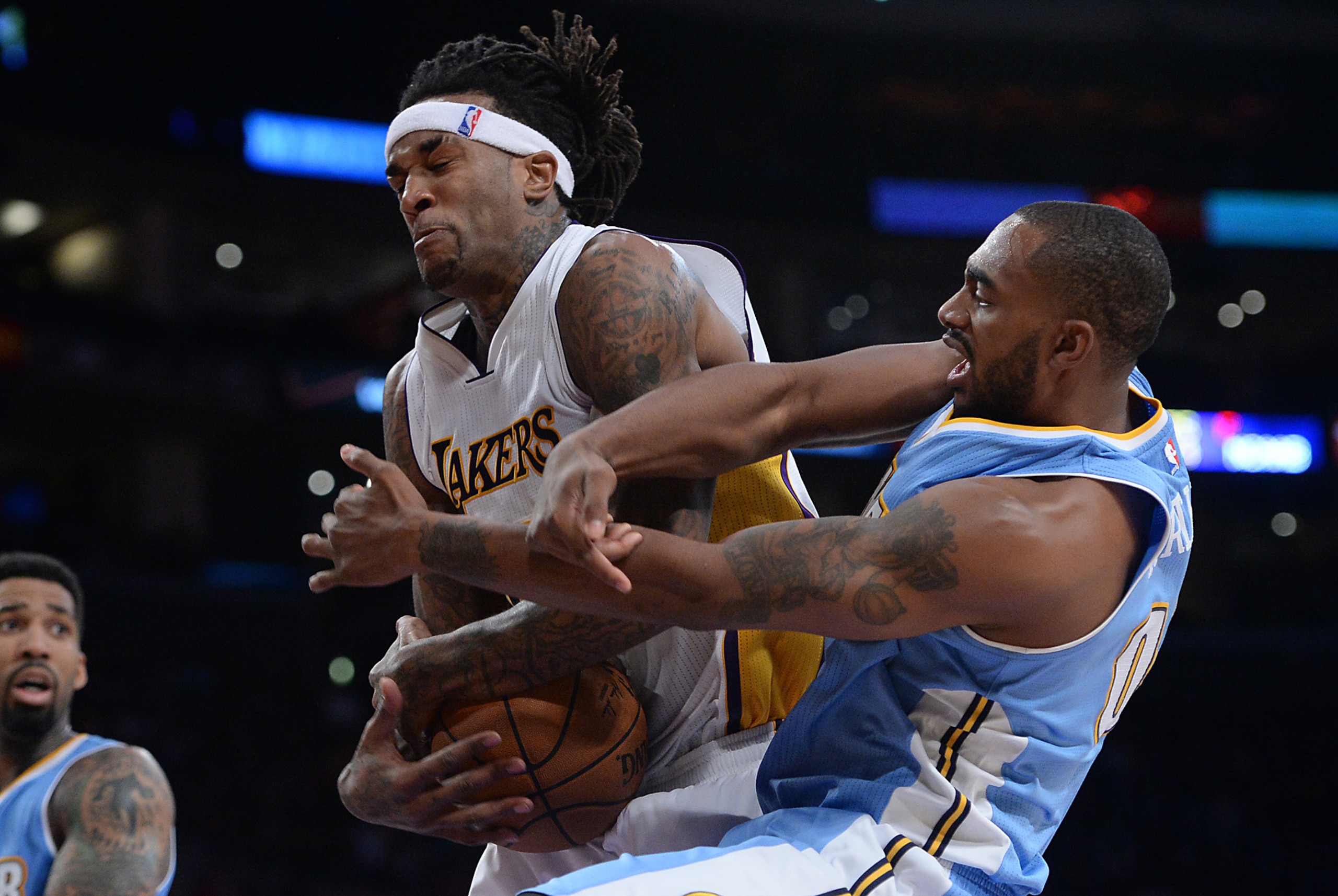
Wrap intensity and competitive drive around a 6'10", 235-pound frame, and you already have something of value.
If this is Hill at his best, he's still a player worth keeping for the Lakers. There are only six other players averaging at least 13 points and eight rebounds while shooting 49-plus percent from the field. With a 19.2 usage percentage, Hill is the least offensively involved of them all, which speaks both to his motor and ability to maximize the chances he gets.
Hill isn't a perfect player by any stretch. He isn't a threat off the dribble, a deterrent against penetration or a rim protector. But if he was those things, plus a relentless hustler and a developing shooter, he wouldn't be working for a $9 million salary.
Keeping him around limits L.A.'s spending power next summer, but as Bleacher Report's Dan Favale explained, there have never been any assurances that the Lakers can find a better option elsewhere:
"Retaining him will cost flexibility, significantly handicapping their capacity to sign another superstar. But renouncing the rights to Hill and going star-gazing would be a risk in itself.
There is no guarantee the Lakers land a Goran Dragic or Marc Gasol. There is no guarantee whomever they sign—be it a star or mid-level talent—lives up to his deal. They know what they have in Hill, and that's an asset worth considering as they push forward with the hope of beginning an era defined by something other than transition and volume losing.
"
The Lakers haven't really started the blueprints for their post-Kobe plans, but they might have already unearthed an intriguing interior nucleus to build around.
The more Hill can expand his shooting range, the better he'll fit alongside Ed Davis and Julius Randle. Provided Davis sticks around (he has a $1.1 million player option for 2015-16, per HoopsHype), he could give a similar effort on the defensive end that Hill provides on the offensive side. If the 20-year-old Randle taps deep enough into his potential, the Lakers might have a needed cornerstone, plus two pieces that complement him well.
Hill looks like a keeper. The Lakers may have felt that way about him last season, but they can say it with more conviction this time around.
And if he wasn't a part of their long-term picture, he's in there now. He has already shown enough potential and production for the Lakers to feel like they cannot let him get away.
Unless otherwise noted, statistics used courtesy of Basketball-Reference.com and NBA.com.
.jpg?w=2560 "OBJ Calls Out Giants After Release")



.jpg?w=2560 "NFL investigating referee after viral exchange with player")