Mike Zimmer, Teddy Bridgewater Make Minnesota Vikings' Future Bright
Rebuilding in the NFL isn't easy.
Even though the league is constructed in different ways to promote parity, the difficulty of turning around the culture of a losing franchise is significant. Of the 477 head coaches through NFL history, an incredible 230 didn't or are yet to make it past their second season.
Mike Zimmer decided to take on this challenge during the offseason when he became the head coach of the Minnesota Vikings.
TOP NEWS
.jpg?w=2560 "Titans Giants Football")
OBJ Calls Out Giants After Release
Lamar Jackson Day-to-Day

Live Live: Updates from every NFL game
Despite managing one of the most impressive defenses in the NFL as the Cincinnati Bengals' defensive coordinator for years, Zimmer had consistently been overlooked for head coaching positions. Zimmer's most significant move during his first season was to bring in another person the NFL overlooked.
Teddy Bridgewater wasn't the Vikings' first pick in the 2014 NFL draft, but he was a first-round pick. The Vikings traded up to select him at the end of the first round after initially taking Anthony Barr with their top-10 pick in the draft. Barr may have gone first, but Bridgewater was the potential franchise quarterback.
As anyone in Minnesota who watched Christian Ponder play will already understand, the potential franchise quarterback is always more important than any other draft pick.
Bridgewater and Zimmer would be taking over two of the four most important roles within the Vikings franchise. Save for the owner and the general manager, the head coach and starting quarterback are the two most important pieces of any NFL franchise. Those four people play the greatest roles in determining if a team can sustain success on the field.
Although Bridgewater wouldn't enter the season as the team's starter, an injury to Matt Cassel would quickly push him into the spotlight.
Through just 13 weeks of this season, Zimmer has led the Vikings to more wins than they tallied through all of the 2013 regular season. The team's 6-7 record won't help it make the playoffs, and win-loss records alone aren't always reflective of an improving team. But there's no doubt that it's telling in this instance.
Last year's Vikings team was led by Leslie Frazier and a combination of Matt Cassel with Christian Ponder at quarterback.
Frazier, like Zimmer, built his reputation on the defensive side of the ball. However, the defense that he had built over four seasons as the head coach and even longer as the defensive coordinator finished the regular season 27th in DVOA, per Football Outsiders.
To this point in 2014, Zimmer's retooled but not completely rebuilt version of that defense ranks 20th in DVOA.
Zimmer built his reputation in Cincinnati by getting the most out of the talent available to him. His final two defenses in Cincinnati ranked 10th and fifth in DVOA. Much like he did with Geno Atkins, Reggie Nelson, Leon Hall, Jonathan Joseph, Michael Johnson and Vontaze Burfict, Zimmer is using players such as Everson Griffen, Harrison Smith, Sharrif Floyd, Xavier Rhodes and Anthony Barr to their strengths in Minnesota.
His ability to both develop and use talent is something that has been proved over multiple seasons. The Bengals defense without him this season has dramatically dropped off. Given time, Zimmer and general manager Rick Spielman should be able to create one of the better defenses in the NFL for the Vikings.
With Zimmer sorting the defensive side, the focus then falls onto Bridgewater and offensive coordinator Norv Turner.
Bridgewater's rookie season hasn't been spectacular. He has struggled with his consistency like most rookies do, and there have been times when the pace of the game has flustered him. In terms of skill set though, Bridgewater has been very impressive in an exceptionally difficult situation.
No other rookie this season has been dropped into as tough a situation as the former Louisville quarterback has. The futility around Bridgewater has come at a surprise also because this offense looked set to be one of the better units in the NFL under Turner.
Adrian Peterson's absence has obviously been huge, while Cordarrelle Patterson's absence has been more subtle but almost as impactful. Patterson was recently benched because he became a liability when asked to run routes down the field. As Patterson faltered, fellow receiver Greg Jennings has struggled to be consistent, while tight end Kyle Rudolph missed a prolonged period through injury.
Lacking talent at the skill positions isn't a fatal flaw for a quarterback unless his offensive line becomes a major problem also. Bridgewater's offensive line has been that.
As a unit, the Vikings offensive line has executed like one of the worst in the NFL. Individually, each player is underperforming against expectations, while Matt Kalil has been by far the worst starting left tackle in the NFL.
Offensive linemen and skill-position players are more easily replaced than the quarterback moving forward, so none of these problems should be considered major for the long term. Over the short term, they have limited Bridgewater's production but not drowned the signs of his potential.
The base of Bridgewater's skill set starts with his ability within the pocket.
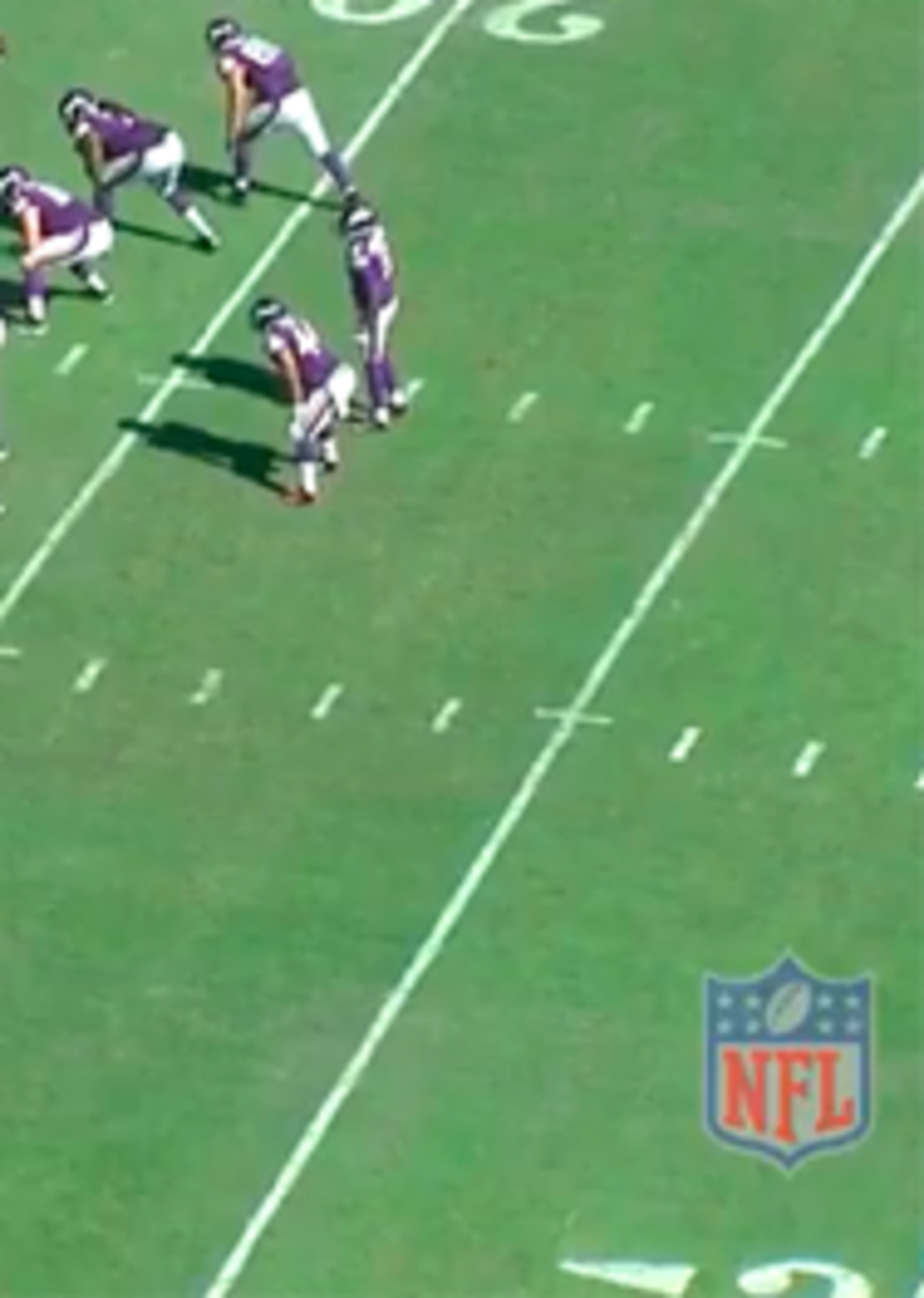
Despite playing behind one of the worst offensive lines in the league, he has consistently shown off impressive pocket presence and a willingness to make throws against pressure. On this play against the Tampa Bay Buccaneers, Bridgewater delivers a perfect pass against a big hit.
Before the snap, the defense is threatening a double A-gap blitz with press coverage underneath and a single-high safety.

The defense doesn't blitz, but its four-man rush gets quick pressure as Gerald McCoy is left alone in a one-on-one situation with the right guard. McCoy arrives in the backfield and hits Bridgewater as soon as the quarterback lets the ball go.
Despite the pressure, Bridgewater drops a pass over Jennings' shoulder in the end zone.
One of the keys to this play was Bridgewater's recognition of the defense before the snap. Even though the defense was playing with a single-high safety, that safety wasn't adjusting his position to where the offense was aligned.
Being on the right hash meant that Bridgewater could get the ball to Jennings' route quicker than the safety could work across the field.
This play was a sign of Bridgewater's intelligence, something that has repeatedly shown up during the season. Most rookies struggle to read NFL coverages, but Bridgewater has done so with impressive consistency this year even if he has been too cautious on the whole.
If Bridgewater's ability from the pocket is his primary strength, his second most important trait is his intelligence.
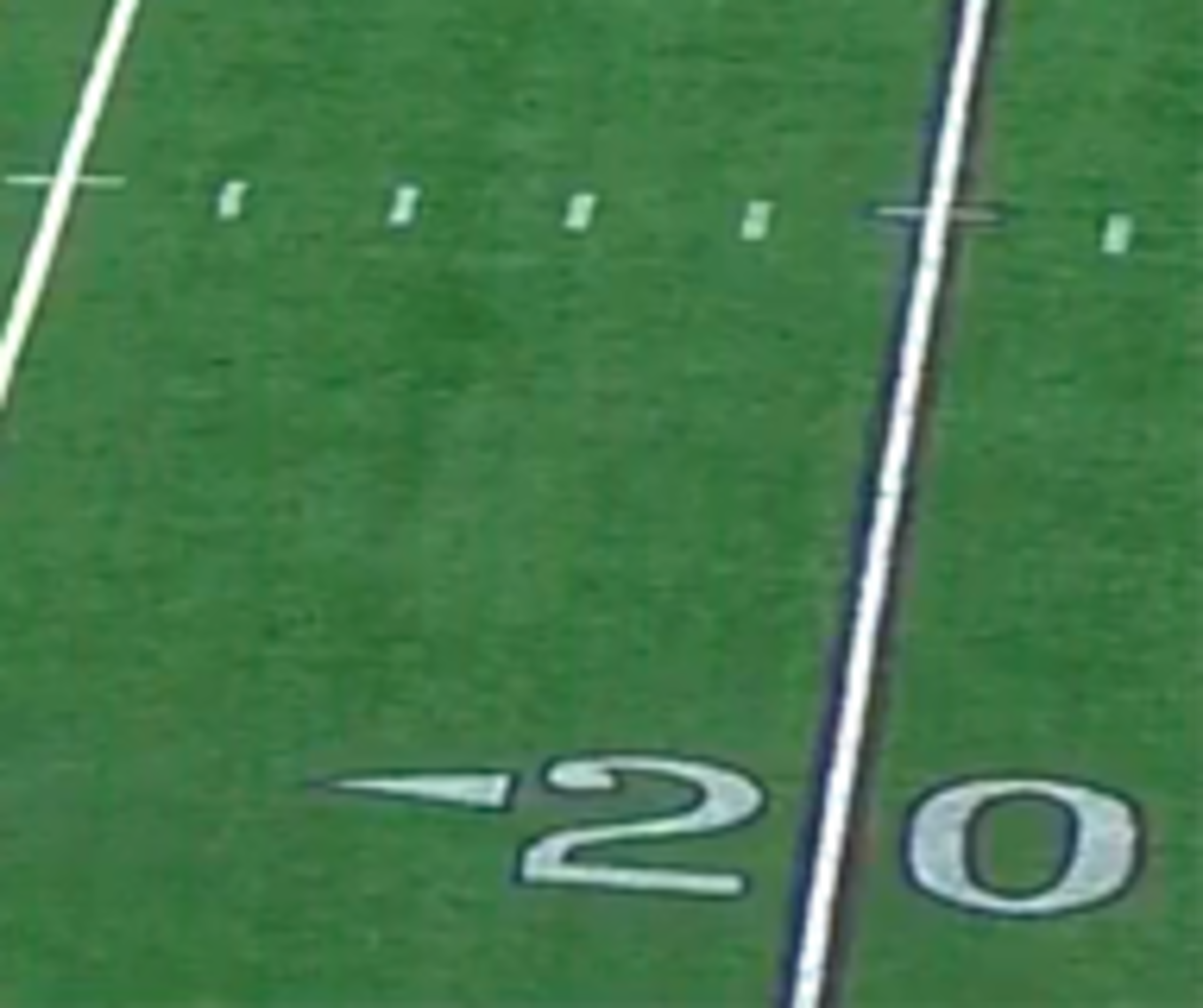
On this play, Bridgewater is able to diagnose the incoming blitz at the snap. He can do this by recognizing the alignment and body positions of the five numbered defenders over the middle of the field. He understands that he has a slant route that should be open for a first down to the other side of the field.

At the snap, the defense blitzes from the right side. The Vikings pass protection has been sent to the left of the offense, so there is no pressure on Bridgewater at the top of his drop. He is able to comfortably hit his wide receiver in stride against single coverage.
Pocket presence and intelligence are a combination that the best quarterbacks in the NFL share. While Bridgewater hasn't been exceptionally accurate to go with those traits, he has been accurate enough to be encouraged about his ability in a better situation.
The only major issue that Bridgewater has shown off this year is his deep accuracy, and that has looked better over recent weeks.
Heading in the right direction doesn't guarantee that the Vikings will ever arrive at a point where they can sustain success for seasons. However, at this stage, the franchise is definitely heading in the right direction.
Rebuilding a roster isn't ever easy, but you don't need to wallow in the mud for years to eventually become a good team. Of the 60 top 10 picks taken from 2008 to 2013, only nine have been first-team All Pros, and only 23 have made a Pro Bowl.
The New England Patriots, New York Giants, Pittsburgh Steelers and Baltimore Ravens are prime examples of teams that figured out the four most important pieces of their franchise to sustain success over the past decade or so.
Pairing the defensive-minded head coach with the rookie quarterback is a blueprint that should allow the franchise to build a balanced team. If Bridgewater and Zimmer prove to be the quality additions that they promise to be, then filling in the rest of the pieces to create a successful team should be relatively simple.
Statistics courtesy of Pro-Football-Reference.com and Football Outsiders.



.jpg?w=2560 "Saquon Out for Game")