Check out Doc Rivers' Bag of Play-Calling Tricks for Los Angeles Clippers
The Los Angeles Clippers offense is on a roll.
The Clippers may have gotten off to a slow start, experiencing stalls within the attack during their 5-4 beginning to the season. But since then, the team has won 10 of 11, with the ultimate fireball coming on Blake Griffin's game-winning, buzzer-beating three Monday night against the Phoenix Suns in a 121-120 overtime win. The victory brought the Clippers' overall record to 15-5.
L.A. now owns the best field-goal and three-point percentages in the NBA, ranking third in points per possession. Since that 5-4 start, it is averaging 116.2 points per 100 possessions, a figure which blows out the rest of the league.
TOP NEWS

Duren Calls Out 'False' Rumors

Pic of LeBron's Helicopter Commute 🚁

NBA Power Rankings Entering Preseason 🔢
Early in the season, the Clips seemed to have lost what they had last year: the No. 1-ranked offense. Now, for whatever reason, much of it is back. But even when L.A.'s ball movement was lagging, when Griffin was settling for jumpers and when shooters were missing from outside, Doc Rivers' squad was still running similar plays to the ones that carried it to the top of the league a season ago.
Amazingly, the Clippers' best play isn't a Jamal Crawford 32-foot pull-up three (even if that is by far the most fun one). Here's an in-depth look at three in particular that deserve mentioning.
High-Low, Here We Go

One of the reasons Griffin is such a dominant screener in the pick-and-roll is because he's not just a scorer. People think of pick-setters as versatile if they can both roll and pop. Well, Griffin can take it one step further: He can facilitate after setting ball screens.
That's why one of the Clippers' most dangerous plays becomes the tic-tac-toe pick-and-roll, a Chris Paul-Griffin screen-and-roll, which ends in a DeAndre Jordan alley-oop. Here is an example from the Clippers' blowout victory over the Miami Heat back in mid-November:

One of the reasons this play is so successful is because Jordan isn't Griffin's only option. The best plays allow for decisions on the fly, and having learned how to adjust to defenses in an instant, Griffin has become one of the NBA's best freelance-passing big men.
The pick-and-roll's goal here is to create a mini four-on-three break within the half court for Griffin. When two defenders follow Paul after the pick-and-roll, it forces the opponent to make decisions on how to help in a split second.
On the above play, Chris Andersen immediately steps up to help on Griffin, who is arguably the best finisher in the West when he gets a head of steam going to the rim.
Here is the turning point:
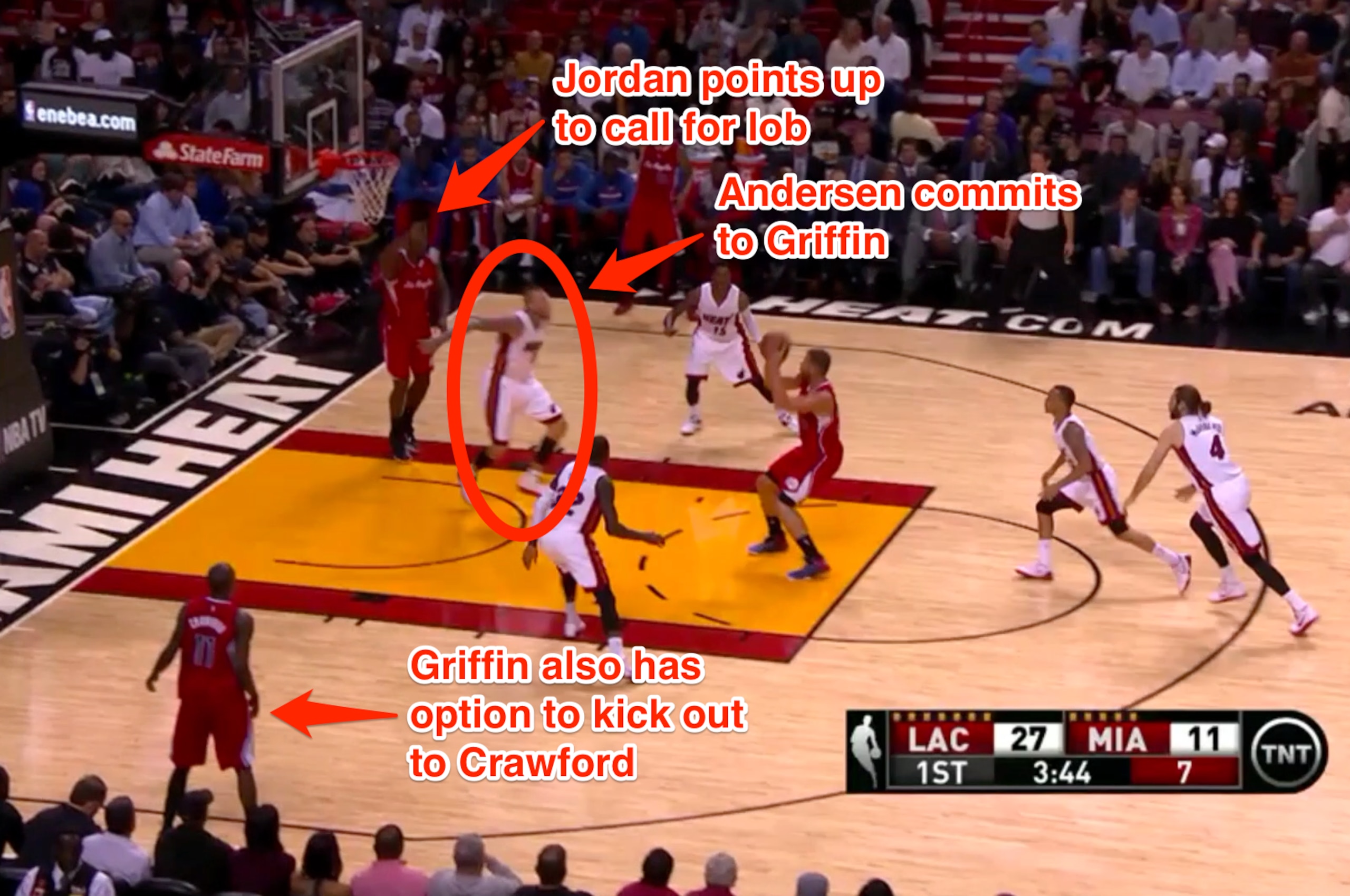
That's when Griffin instantly recognizes he can throw it up to his partner in crime.
Slam dunk.
But again, this play doesn't just work because Griffin can hit Jordan with lobs all the time. There are multiple options.
Below is the same play with a different result, a J.J. Redick corner three:

It's not a predetermined decision. He's merely—as players like to say after games—taking what the defense gives him.
Griffin lobs to Jordan when the help defense comes from the direction of the big man. But in this case, Luol Deng leaves a dead-on shooter, Redick, wide open in the corner to go help on one of the scariest athletes in the league, who had an open lane to the basket. And now with Griffin's improved jump shot, it's become harder to give him unlimited space in the open floor. It's not exactly an enviable position for the defense.
Just like on the Jordan oop, the point of decision comes right here for Griffin:

As soon as Deng leaves Redick, Griffin's going to his shooting guard. There's no hesitation. It's part of what makes this play virtually unstoppable. But still, the Clippers find ways the use little hybrids of the tic-tac-toe pick-and-roll so they can mix it up.
Jordan begins the above play in the paint. Sometimes, though, you'll see the lob come from Blake to Jordan in a slightly different pick-and-roll format, like this one:

The difference between these two sets becomes apparent in this still shot from Nov. 29's 112-96 win over the Utah Jazz:
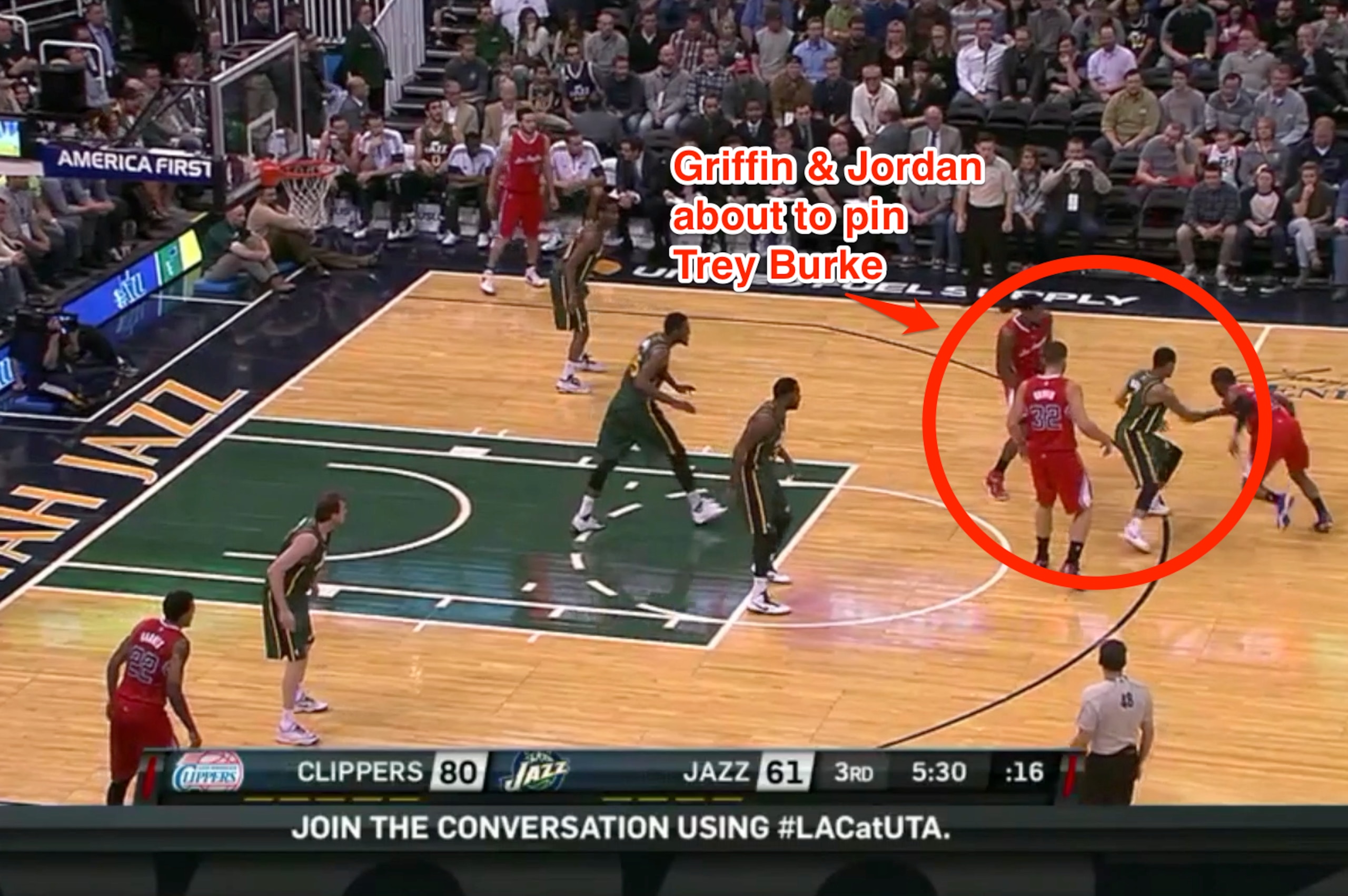
Jordan and Griffin screen either side of Paul's defender. Griffin pops, Jordan rolls, giving Paul high and low options. He finds Griffin open, who has the opportunity to shoot or create from there, and when the Jazz defense miscommunicates after being knocked off its kilter by the Jordan screen, Griffin finds his center for the lob.
At times, it seems like the Griffin-Jordan high-low game is somewhat unguardable, and it's mostly because the plays are particular to the personnel. There isn't a better foursome of teammates to run this exact set than Paul, Redick, Griffin and Jordan.
The Redick Factor

Redick isn't just good for standing in the corner. He's also one of the league's best shooters to send bouncing off screens. The play below from the Clippers' November loss to the Chicago Bulls is an example why:
Here, we see the Clippers implement the dribble-handoff in one of their most effective ways.
The play starts when Redick makes a pass to Jordan at the top of the key, who then takes one or two bounces and hands off to Paul, who is running off a double-screen from Griffin and Redick.

As Paul fields the ball from Jordan and proceeds to make a turn toward the paint, Chicago's Joakim Noah switches onto him as his primary defender, Jimmy Butler—who got hung up on a Redick screen—tries to recover onto him. This sends two Bulls at Paul as Redick flashes toward the wing, running past a Jordan screen.

As I wrote last week, Redick is one of the most essential points of the Clippers offense, mostly because of his movement off the ball. Here, we see another execution of the Redick Slide, which places his defender, Kirk Hinrich, out of position and opens space for Redick to shoot.
This play works well because the Clippers are basically playing musical chairs with their screens. Someone is always setting a pick for someone else.
If you just had the ball, you're setting a screen for another teammate. If you're trying to get it, you're running off a screen or a double-screen. It requires impeccable communication on the defense's part to navigate around so many picks.
This is a consistently effective play for the Clippers, but just like in the high-low game with Griffin and Jordan, there needs to be different iterations. And we've seen the Clippers trick teams with them.
This past weekend, L.A. opened up its game against the New Orleans Pelicans in running this play, except Matt Barnes and Redick switched roles.
"Running an opening play to get a three-point shot for Barnes? That's funky," you might say. And you might be right. But instead of Barnes putting up the long ball like Redick does, there's an extra wrinkle.
Redick darts off a double-screen from the weak side to receive the pass from Barnes and drains the three:
It's the same concept—the same play—just with one more layer, and the additional file the Clippers add at the end (Redick's supplementary route) is consistent with this call's strategy, which says everyone is either handling the ball, setting a screen or coming off one.
This is essentially an after-timeout play (more casually known as an ATO) from Rivers, since it led the game for the Clips. Doc, who's known for his ATOs, will run similar screen plays after stoppages and often prioritizes getting Redick opportunities right out of the gate. This is just another example.
The KFC Screen

The following play is my personal favorite in the Clippers' arsenal, one the they run relatively often—maybe once or twice a game—to get Griffin open right underneath the basket. Opponents know it's coming. Yet, it still always seems to work.
The reason it has so much appeal? Even though he doesn't seem to be particularly essential to the play's execution, it's all about Paul. Here's an example from Dec. 1 against the Minnesota Timberwolves:

We'll get to CP3 in a second. First, let's break down the constant movement.
It's not necessarily that Griffin always makes the basket or gets fouled (though he often does). It's more that the passing lane almost always seems to be open, and if someone as powerful and skilled around the rim as Griffin can receive a pass with both feet in the paint, he's always going to be in a good position to score.
That is, after all, the most important part of running plays, right? A coach can't score for his players, only put them in a position to be successful.
This play is so strong because of all the screen action.
After Paul tosses an entry pass to Jordan at the right elbow, he heads down to the paint as Barnes comes over from the corner to just outside of the restricted area. Redick, meanwhile, takes off from the left side to receive the dribble-handoff from Jordan.
As Redick receives the pass from Jordan, Griffin cuts to the basket, running his man, Minnesota's Thaddeus Young, into a Barnes back screen.
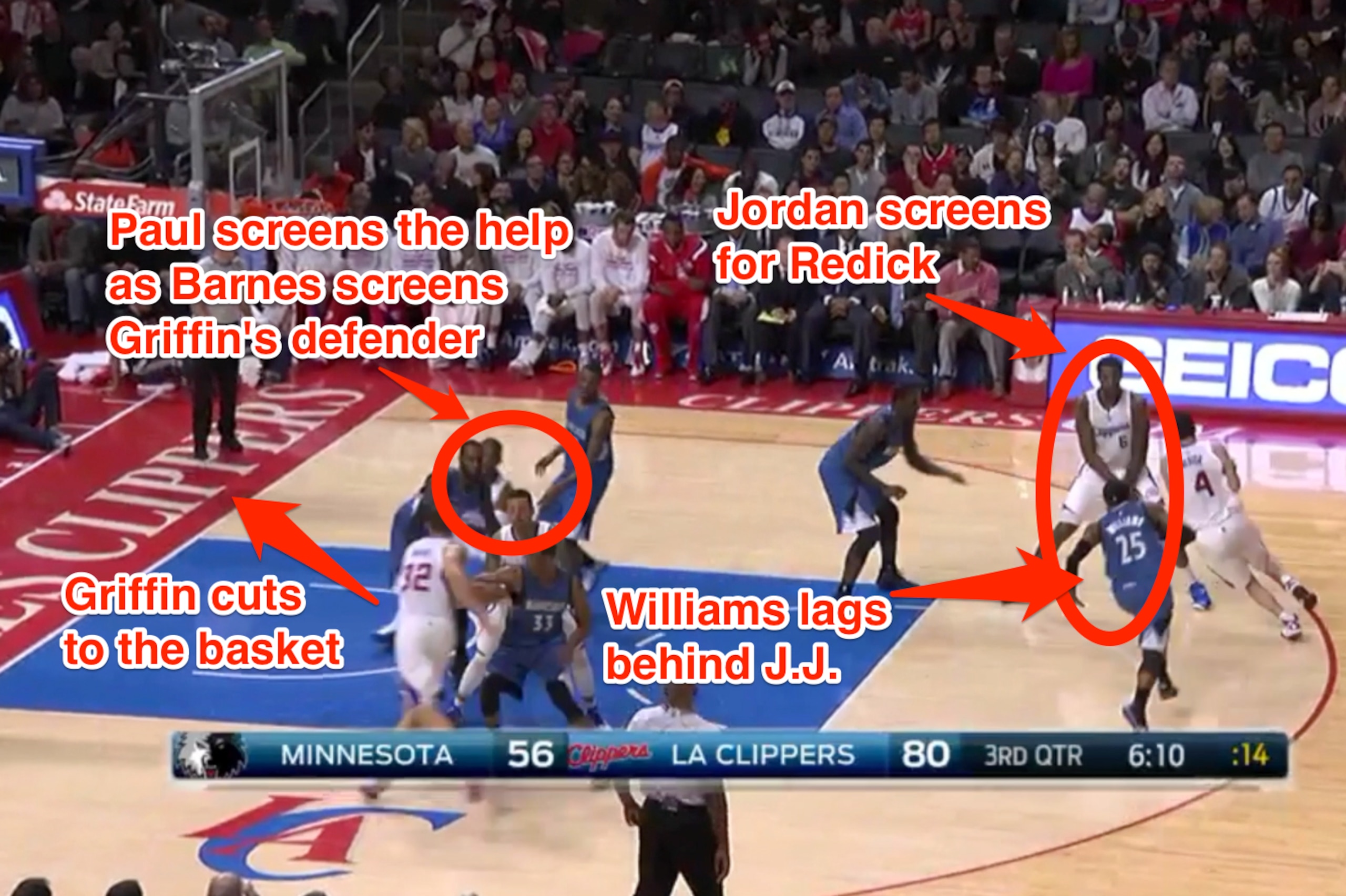
Part of why the dribble-handoff is so effective is that it acts as both a pass and a screen. If the player receiving the pass (Redick in this case) is able to create enough room between himself and his defender before the reception, the screen becomes that much more effective.
See how much space is between Redick and Mo Williams above? That's partly on Redick, one of the craftier off-ball movers in the league. It's also on Williams, who is hardly known for sticking with his assignments.
Once Redick receives the handoff, he'll put the ball on the floor and turn toward the basket, still in movement. At this point, the paint is cluttered with three Clippers. Naturally, the defense tends to think it's in fine shape, sending over the last line of help to defend against Griffin's basket cut. But the Clippers account for this. Paul screens the help, turning Barnes' pick on Young into a double-screen.

And here's where Paul's on-court mafia mentality shows up.
After deterring the help for just long enough, CP3 comes in and body checks Young, fending off the man guarding Griffin for one final split second so the Clippers power forward can have enough time to receive the pass and go up for a lay-in or dunk:
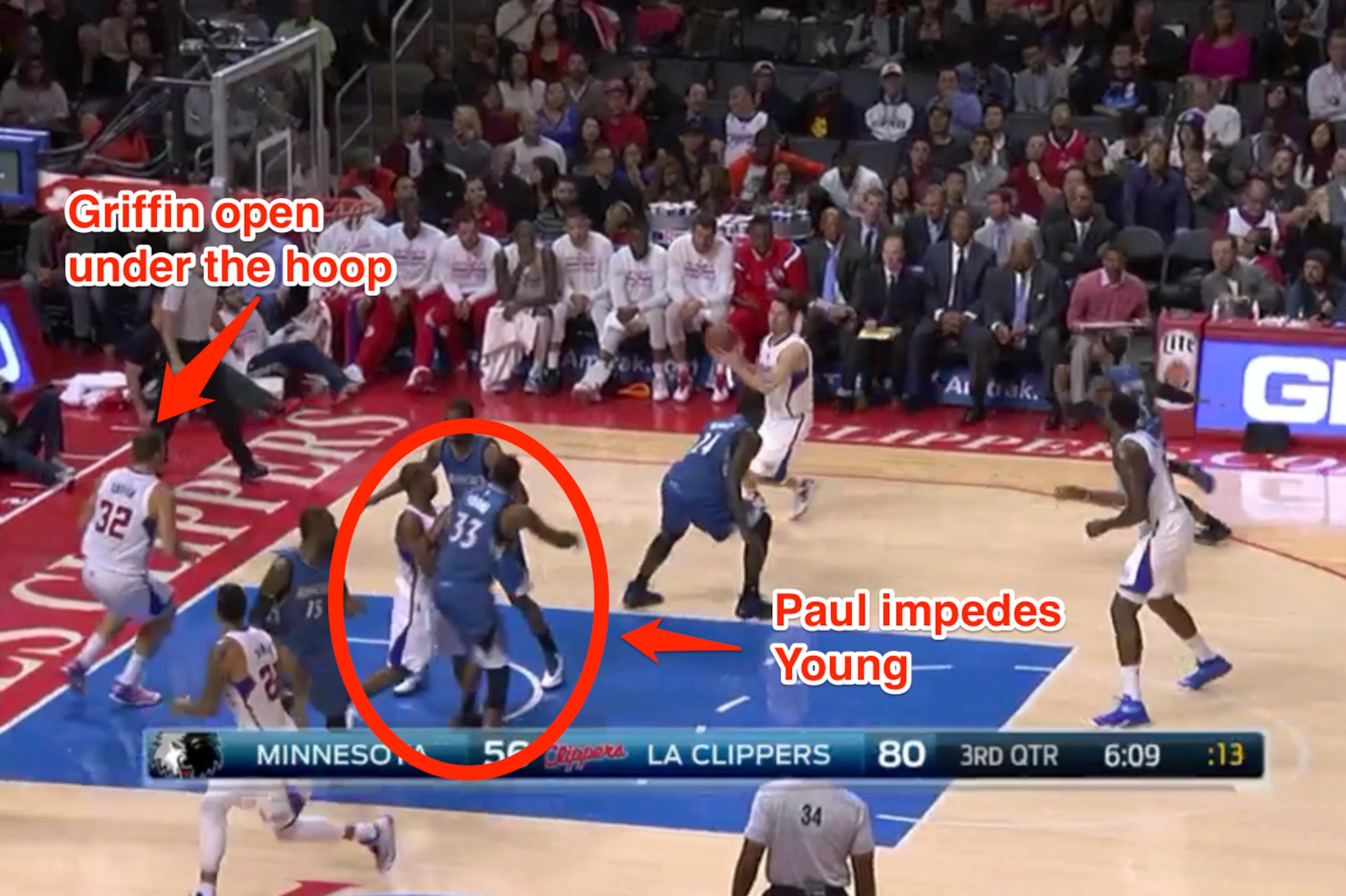
Here's a closer angle of what it looks like when Paul impedes Young's path to Griffin:

It's hardly legal, but it's subtle enough that it never gets called.
Paul is basically setting a double-screen of his own after doing the same with Barnes. It's a double-double-screen—we'll call it the KFC screen, even if this double-double doesn't make you sick for 24 hours—and it changes everything.
Little guys can get away with a whole lot in the paint, and Paul's perfectly aware of this. It's almost like he plays it off as if he's just trying to get off his spot and just happens to run into the defender, accidentally curbing his direction and opening up a passing lane to Griffin.
Without Paul's KFC Screen, the passing lane to Griffin isn't open as consistently.
This isn't necessarily a one-time adjustment by Paul, either. He gets away with these antics all the time in the paint. It's part of what makes him one of the feistiest screen-setters among the NBA's point guard crop, a trait which goes mostly unacknowledged even with all the praise that comes CP3's way.
You can see him pull the same stunt against Anthony Davis, thought to be one of the NBA's best defenders, when the Clippers ran this against the Pelicans over the weekend:

Ultimately, this is a timing play.
It works because Griffin takes off when Redick receives the handoff. It works because of Barnes' initial screen, because CP3 gets into the paint in time to deter one defender and chuck another. It works because Redick is an underrated passer who knows, similar to a quarterback throwing an end-zone fade route to his No. 1 receiver, that Griffin will be waiting under the paint when he looks his way.
In the end, it all comes down to Paul helping his team in the subtlest ways possible. He is, after all, the reason the Clippers offense ticks the way it does.
Fred Katz averaged almost one point per game in fifth grade but maintains that his per-36-minute numbers were astonishing. Find more of his work at WashingtonPost.com or on ESPN's TrueHoop Network at ClipperBlog.com. Follow him on Twitter at @FredKatz.
Unless otherwise noted, all statistics are current as of Dec. 9 and are courtesy of Basketball-Reference and NBA.com.
.jpg?w=2560 "NFL investigating referee after viral exchange with player")
.jpg?w=2560 "OBJ Calls Out Giants After Release")