Buccaneers vs. Redskins: Breaking Down Washington's Game Plan
Lovie Smith's 1-8 Tampa Bay Buccaneers may be the perfect opponent for the Washington Redskins coming off a bye week. The Bucs' vulnerabilities should allow the Redskins to do the things they do best.
Specifically, Jay Gruden's 3-6 team can rely on its core principles such as zone-stretch running and creating big plays through the air off play-action passing. However, Washington's often criticized offensive line will need to be wary of a strong Tampa Bay pass rush keyed by awesome defensive tackle Gerald McCoy.
Double-Team Gerald McCoy
TOP NEWS
Bears' Santos Wanted to Kick 58-Yarder
Picking Each NFL Division Winner 🔮
.jpg?w=2560)
B/R's Expert Week 7 NFL Picks 🔮
It's an obvious place to start, but this Redskins O-line simply can't afford not to double-team McCoy. He is arguably the most dominant interior D-lineman in football, although today's NFL boasts a few candidates for that distinction.
However, few players can match McCoy's blink-of-an-eye takeoff speed combined with his overwhelming upper body strength. That blend makes him a dominant force against both the run and the pass.
The symbol of that dominance was captured brilliantly against the Cleveland Browns in Week 9. Pro Football Focus writer Sam Monson relayed the image:
But it isn't just explosive power that defines McCoy's game. The 6'4", 300-pounder is actually very technically adept, particularly in how he uses his hands.
His sack against Pittsburgh Steelers quarterback Ben Roethlisberger in Week 4 serves as a great example of McCoy's skill. As he often does, he began the play lined up as a 3-technique in the B-gap between the offensive guard and tackle:
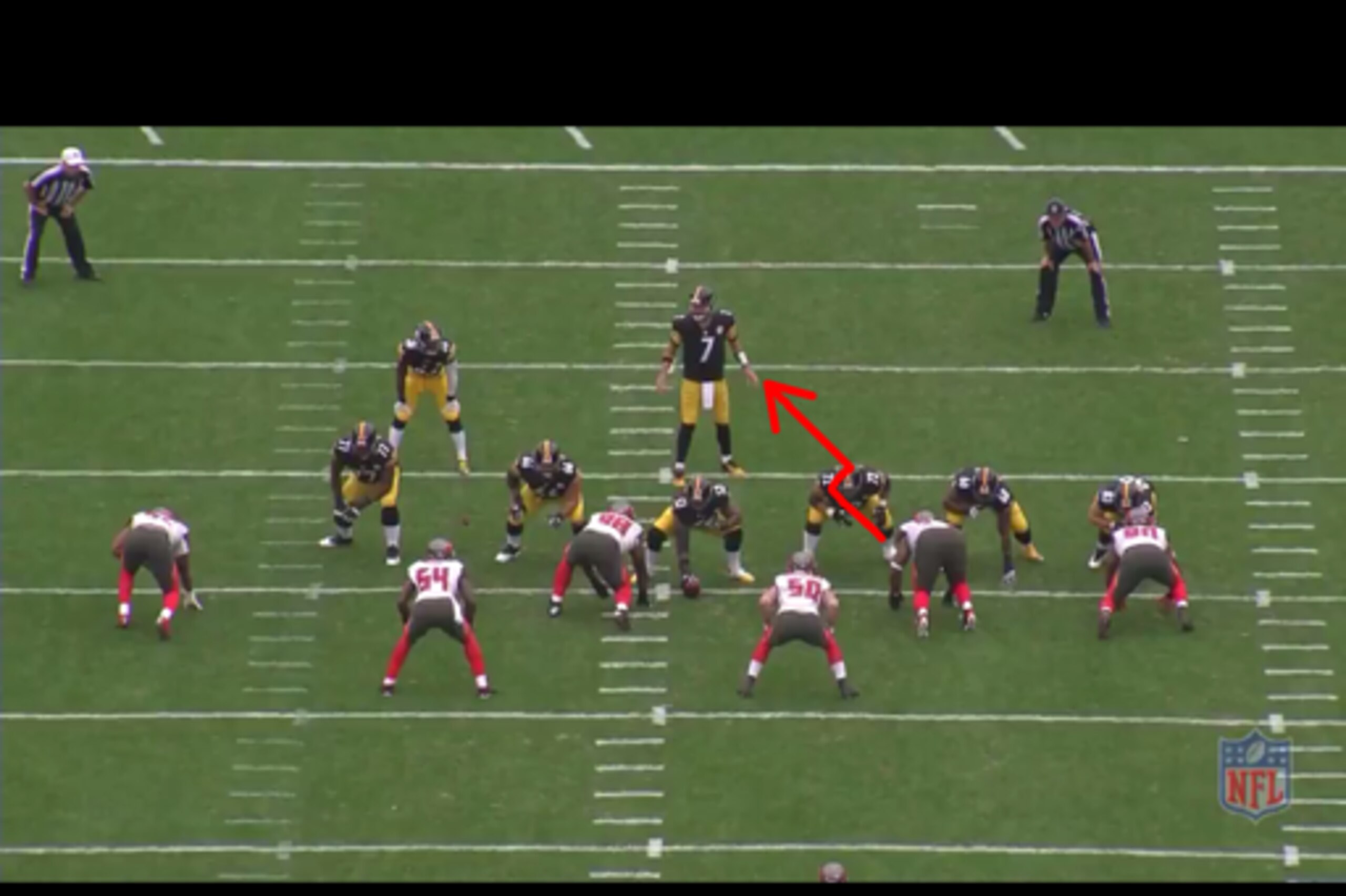
McCoy expertly used a swat and swim move to easily dispatch the left guard. First, he slammed an arm into the inside shoulder of the guard to swat him away:
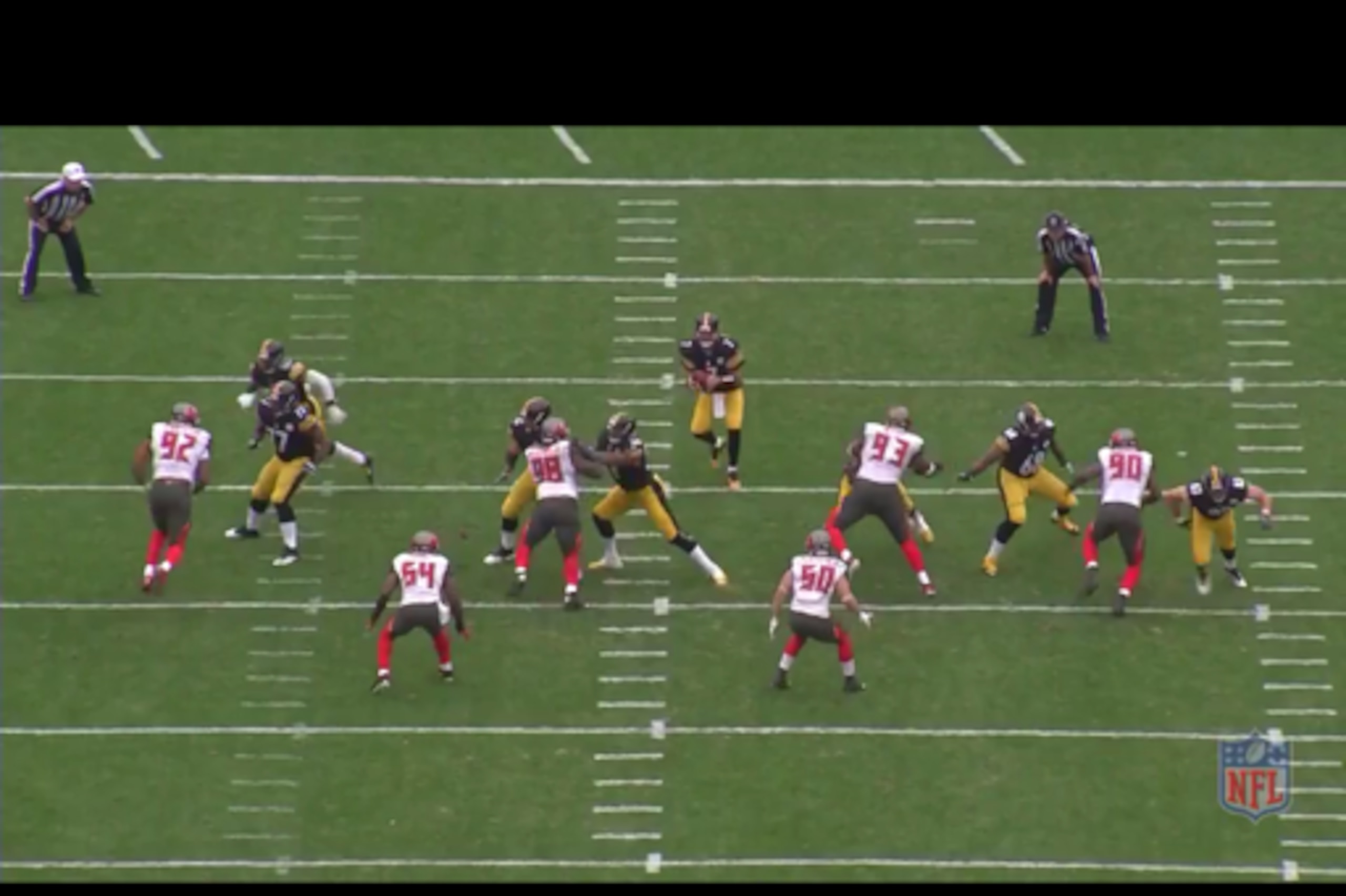
Next, McCoy brought his outside arm over the top, in a swimmer's stroke-like motion, to toss the guard aside:
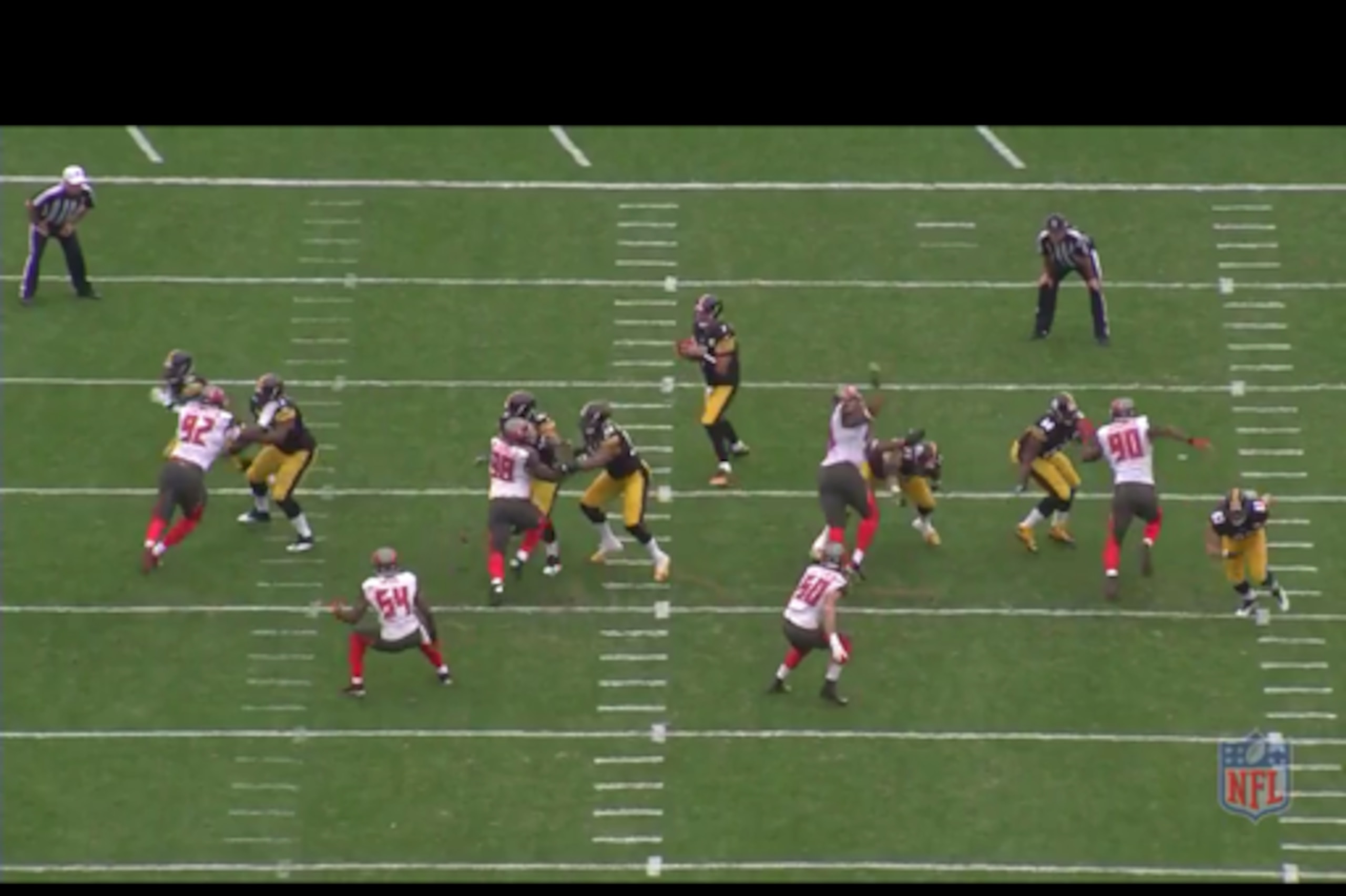
That crisply-executed combination gave McCoy a clean path to engulf Roethlisberger and notch the sack for a six-yard loss:
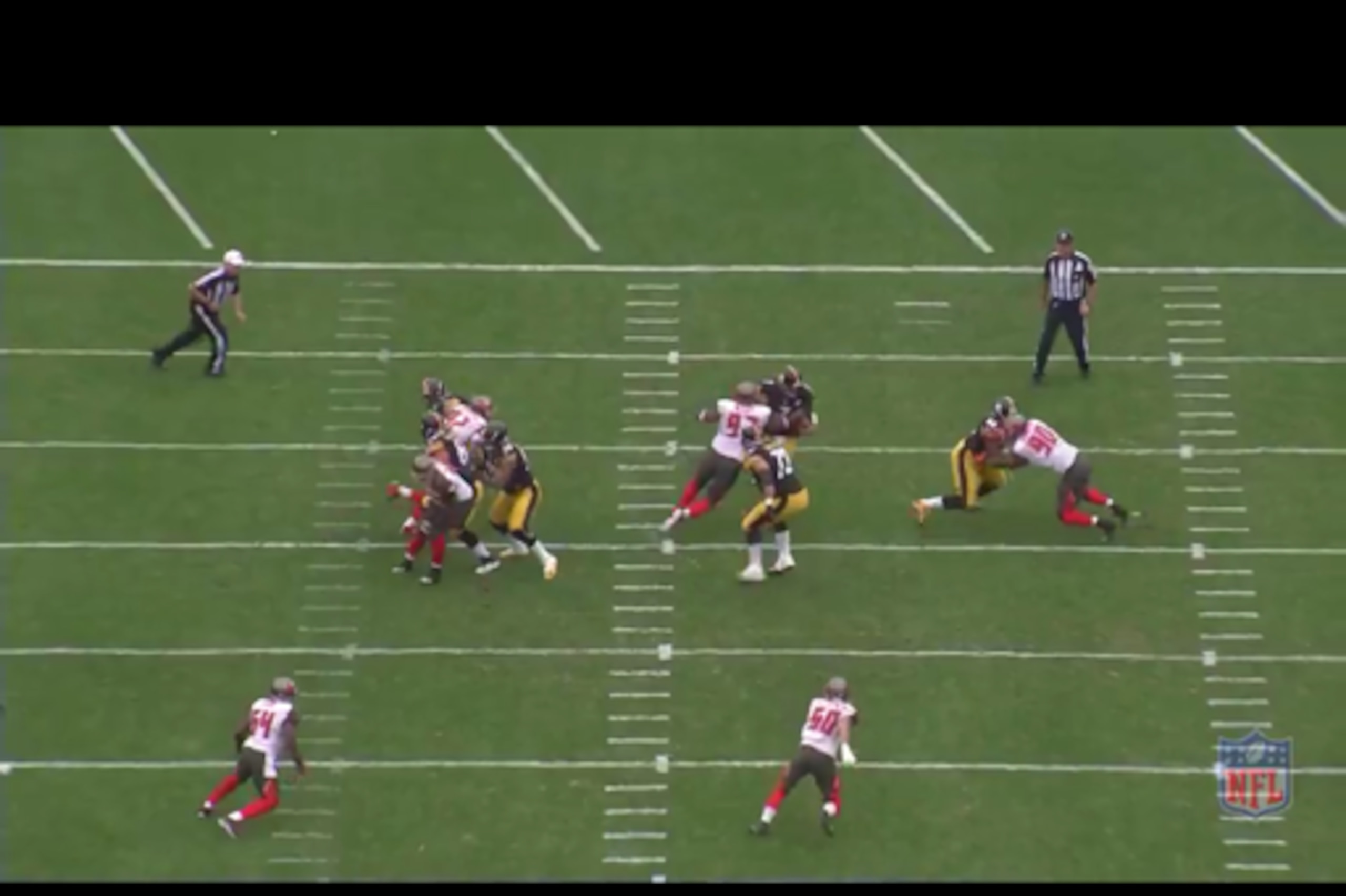
In terms of execution, this really was the sweet science of pass rushing. It also served as a brilliant illustration of why McCoy cannot be left one-on-one.
There isn't a single member of Washington's interior line who can block him by themselves. Center Kory Lichtensteiger and guards Shawn Lauvao and Chris Chester must make sure they are doubling up on McCoy.
It would also be a good idea for Gruden and offensive coordinator Sean McVay to use some wham blocks from tight ends coming across in motion, as well as letting running backs chip inside.
If the Redskins don't commit numbers to McCoy, he's talented enough to wreck every facet of their offense, as Mark Bullock of The Washington Post has pointed out:
"McCoy is used as a penetrating defensive tackle, playing the 3-tech role that former Buccaneers great Warren Sapp used to play. This technique gives McCoy more one-on-one matchups in both the run and pass game.
He’s a difficult defender to block in the run game, particularly with the zone-blocking scheme. There are a few ways zone teams will block a 3-tech, but McCoy has shown he can beat them.
"
Yet, as good as he is, McCoy isn't the only part of Tampa Bay's ability to apply pressure Washington should be concerned about.
Recognizing Pressure and Avoiding Crowded Zones
One important aspect of McCoy's sack on Roethlisberger was the coverage behind the four-man rush. As is Smith's traditional preference, the Bucs adopted a two-deep safety shell with tight coverage underneath:

That's what Roethlisberger was attempting to throw into. It's not easy for any quarterback to accurately target receivers in that void behind the linebackers and in front of the safeties.
This kind of layered and crowded structure is why the Bucs feel comfortable only rushing four. That's usually their habit even when they show blitz.
Take a look at this sack on Roethlisberger by Michael Johnson, one play after McCoy had decked the Pittsburgh passer. The play began with Tampa Bay showing pressure by stacking two linebackers in the A-gaps threatening to blitz:

However, at the snap, both 'backers dropped back in zone coverage underneath:

With the slot corner also rotating underneath, the Bucs had three defenders crowding the middle zones:
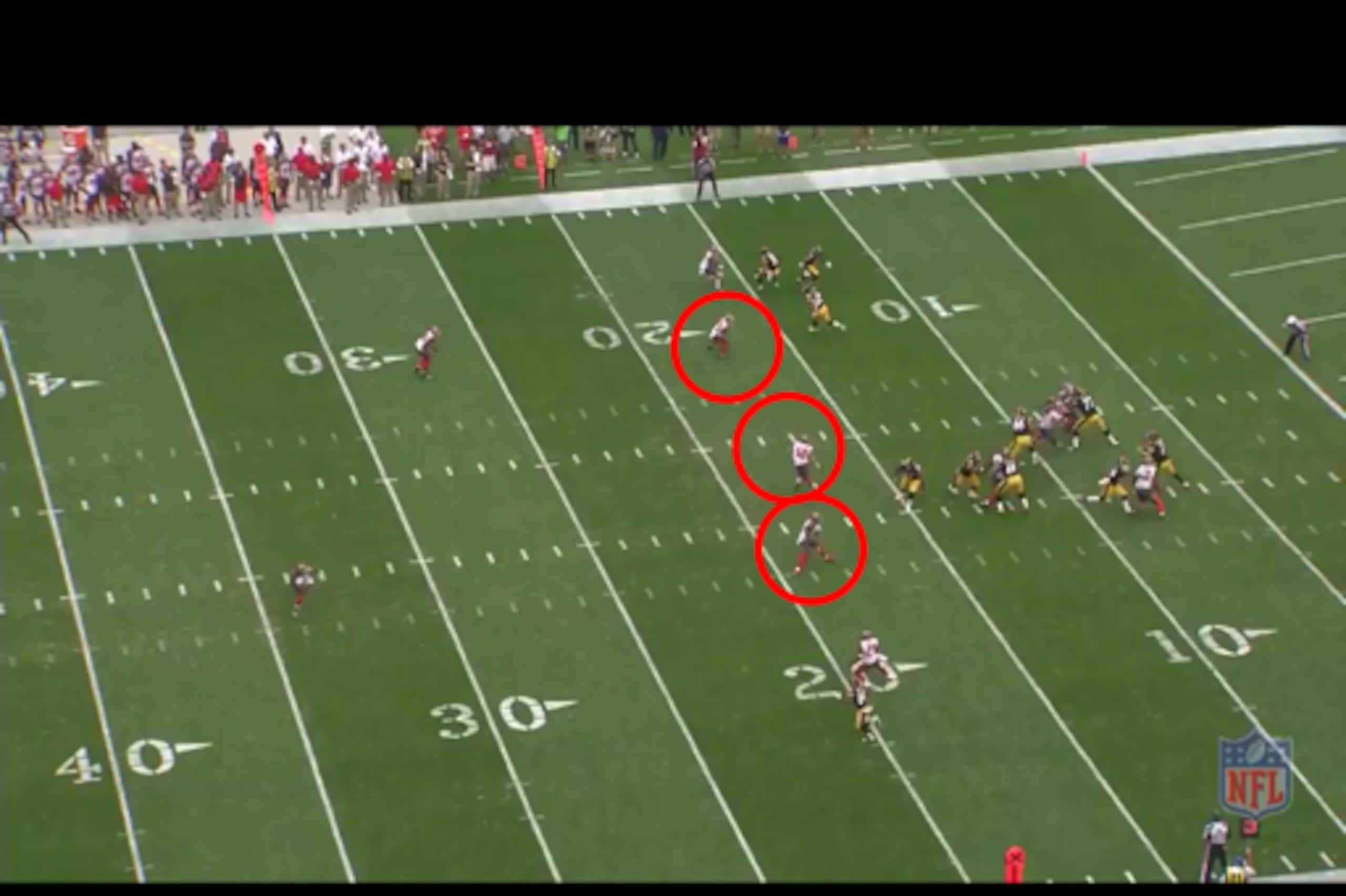
You can see how the defense again split the field, with deep safety help behind the congestion underneath. This forced Roethlisberger to pause in the pocket.
But his hesitation only allowed Johnson to get the sack and knock the ball loose for a key turnover the Bucs recovered deep in Steelers territory:

It's easy to see the problems the Buccaneers are able to create for opposing passers. Quarterbacks are forced to make tough throws into narrow voids against covering defenders that are reading their eyes, at the same time pressure from up front is closing in.
That dynamic is sure to challenge Robert Griffin III's struggles making quick and accurate reads. He also won't be able to hold onto the ball as long as he did against the Minnesota Vikings in Week 9.
That would put too much stress on an offensive line that must also be wary of when the Bucs show pressure from sub-package looks. In particular, the double A-gap blitz look is something the Redskins have struggled with in recent weeks.
The Vikings used it to create havoc, with linebacker Chad Greenway getting a sack thanks to the scheme. The Bucs usually bluff the blitz, but that could still put Washington's blockers in a bind.
Lichtensteiger and his teammates may overplay the appearance of A-gap pressure given their recent struggles with it. That would create single matchups for a deep and talented defensive line rotation.

Getting the recognition and adjustments right versus pressure looks will be a tough balancing act for both Lichtensteiger and Griffin. But it's one the pair must master.
Of course, avoiding obvious pressure situations, such as 3rd-and-long, will certainly help. That's where Washington needs its zone-based ground game.
Create Big Plays on the Ground
Fortunately, the Bucs are susceptible to giving away big plays in the running game. Better still, they have struggled against zone-blocking schemes like the one the Redskins operate.
The best example came in Week 6 when the Baltimore Ravens flattened the Buccaneers 48-17 in Tampa Bay. Baltimore offensive coordinator Gary Kubiak is a longtime disciple of ex-Washington head coach Mike Shanahan, and runs the same zone-stretch rushing scheme his mentor installed in D.C.
The Ravens' best run of the day was this 52-yarder by Justin Forsett. It came off a stretch run to the right:

The Ravens were ready to execute the familiar stretch blocking. Notice how Tampa Bay had shifted the strength of its defense toward tight end Owen Daniels (81), who had come across in motion.
By doing so, the Bucs became clustered on one side, an alignment just begging to be exploited by a single, quick cut from the running back.
That's just what Forsett did once his blocking was set. In typical zone fashion, double-teams neutralized half of the D-line, before blockers released to the next level to engulf the linebackers:
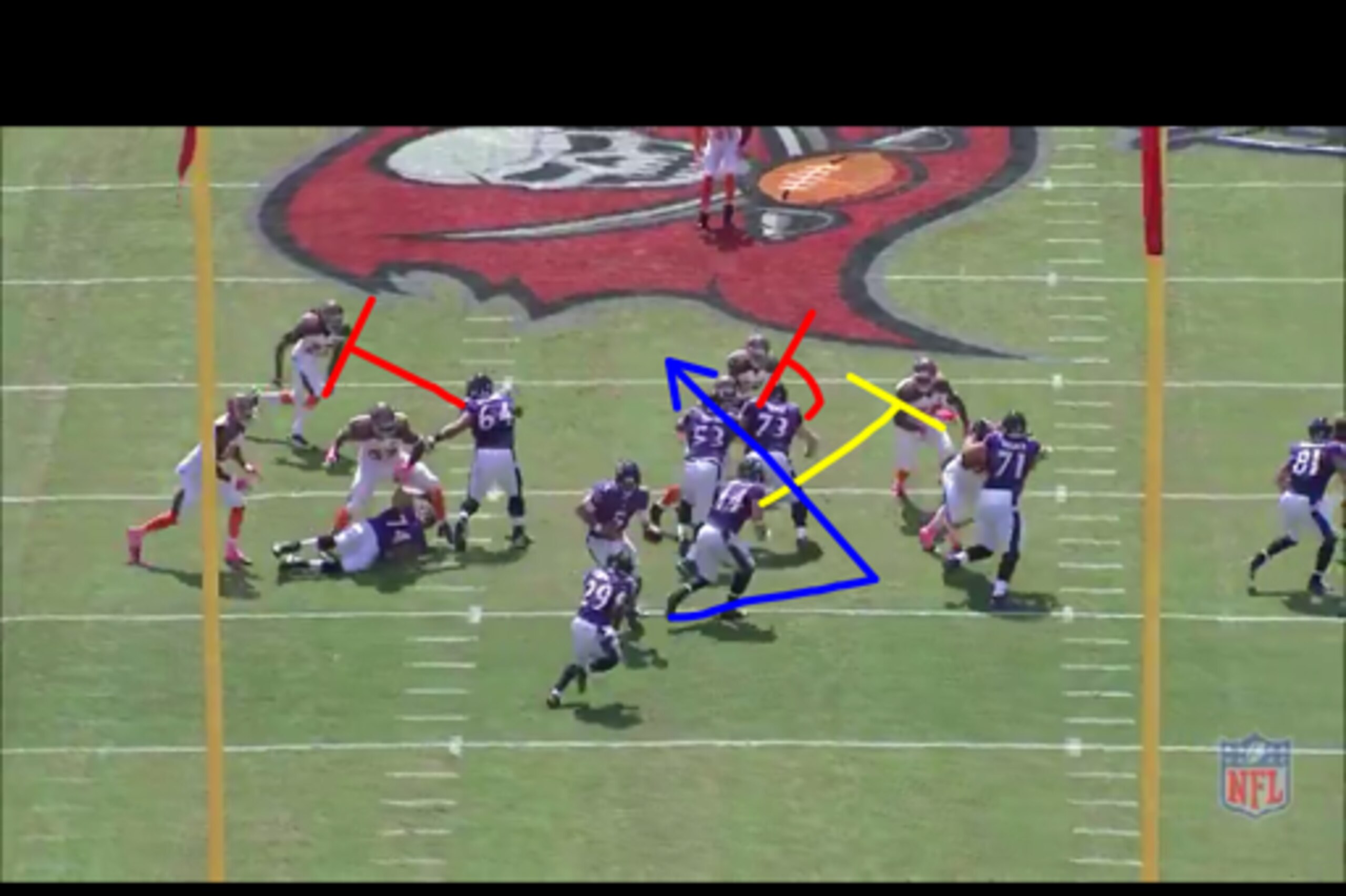
No member of the Tampa Bay front seven beat his block, and each linebacker was too easily engaged at the second level. That meant Forsett had a very inviting cutback lane to attack the void in the middle.
He made his cut and quickly burst into the space where there was no backside pursuit because of the pre-snap shift toward Daniels. The deep safety shell was too far away to limit Forsett to a minimal gain:
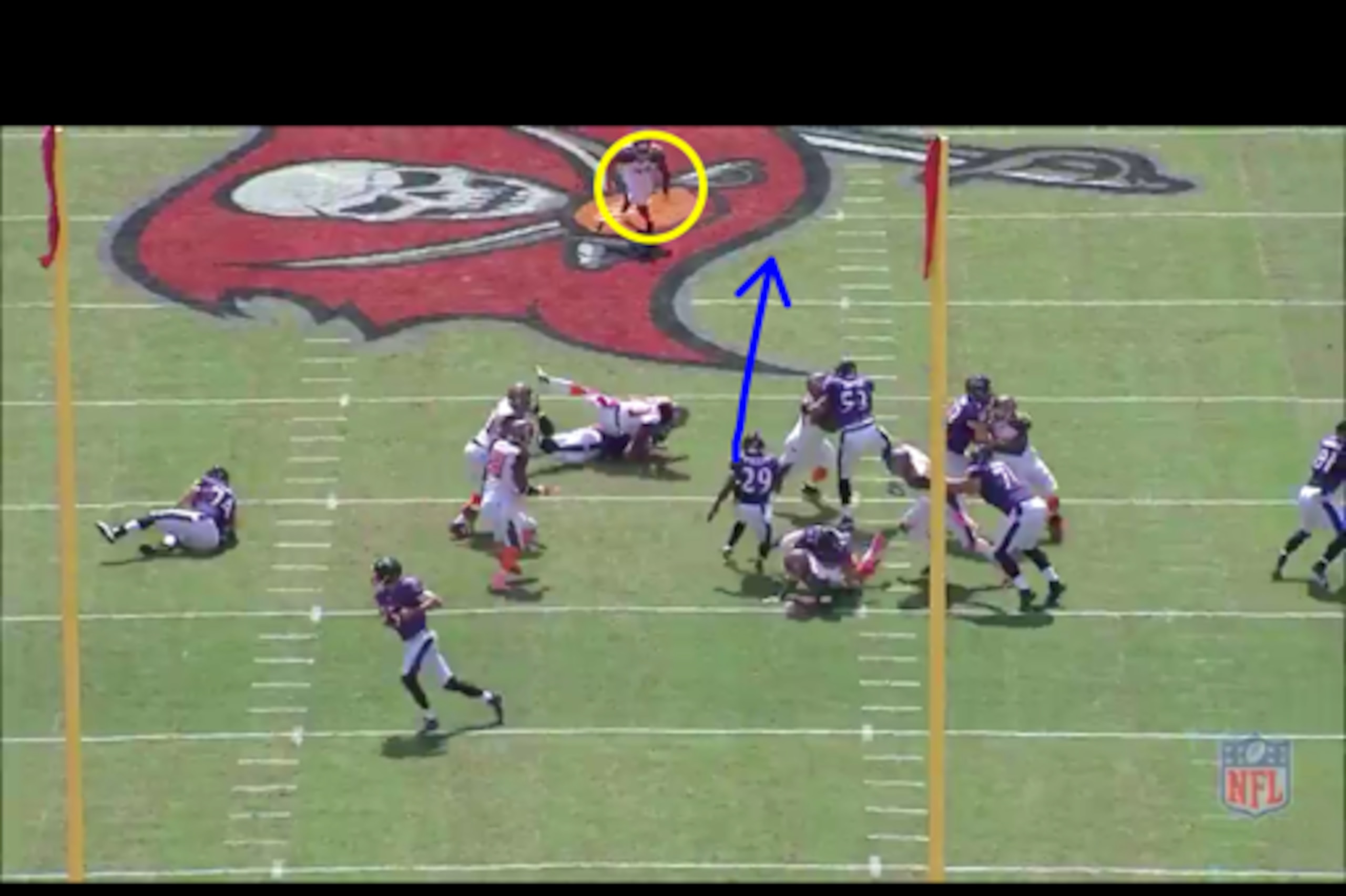
Once he was beyond the linebackers, the ex-Houston Texans runner already had a big play. He sped toward the edge and eventually completed his 52-yard run:
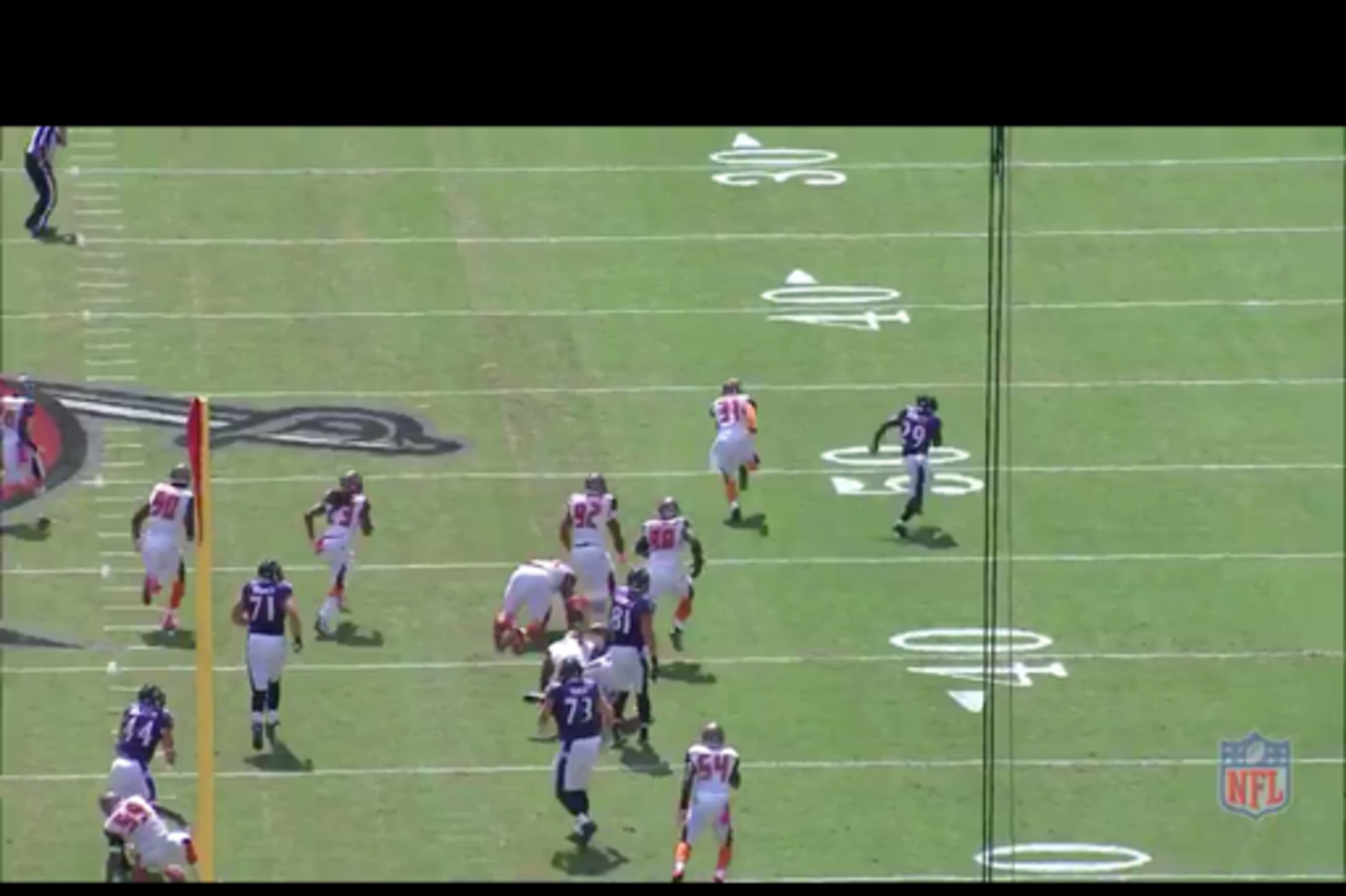
Replicating this kind of big gain on the ground should be no problem at all for the Washington offense. After all, the stretch run is still the staple play of the unit.
Two-time 1,000-yard runner Alfred Morris may have endured a rather tepid season so far, but it's worth noting the ground game has shown signs of life in recent weeks. Morris powered his way to 73 yards against the Dallas Cowboys in Week 8, before amassing 92 against the Vikings.
He topped four yards per carry in both games. More important, Morris managed a long run of 29 yards in Dallas, while scoring on a 14-yarder against the Vikings. That's proof that there's still big-play capability in this running game.
Producing more gains like that will not only tame the Tampa Bay pass rush, it will also set up some huge plays for Griffin and his receivers.
Exploiting the Bucs with Play-Action Passing
Any time a running game is thriving a natural consequence is big plays off play-action passing. So it proved for the Ravens in Tampa Bay.
After Forsett had established himself on the ground, Kubiak called a bootleg pass featuring a deep strike to Steve Smith, set up by a play fake. The play began with Daniels again going across the formation in motion as part of Baltimore's run look:
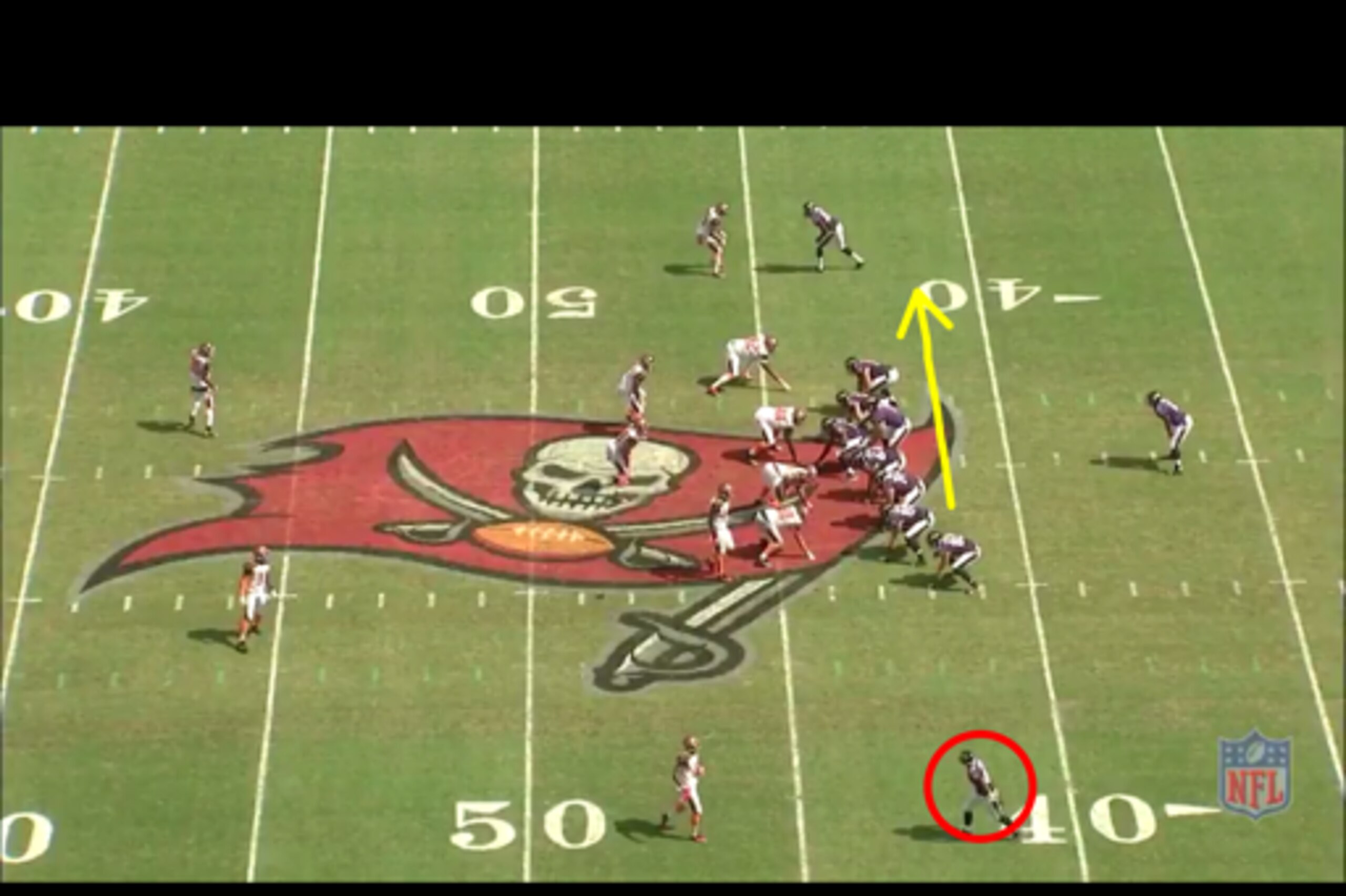
As they had done before, the Bucs shifted their linebackers toward Daniels. They also rotated a safety down into the box (blue circle) to create an eight-man front:

This altered the coverage scheme from two-deep to Cover 1 with just a single-high safety patrolling the deep zone. That gave Smith a one-on-one matchup on the outside.
The Bucs were so concerned about the run that when quarterback Joe Flacco faked to Forsett, the entire front seven overplayed the supposed handoff:
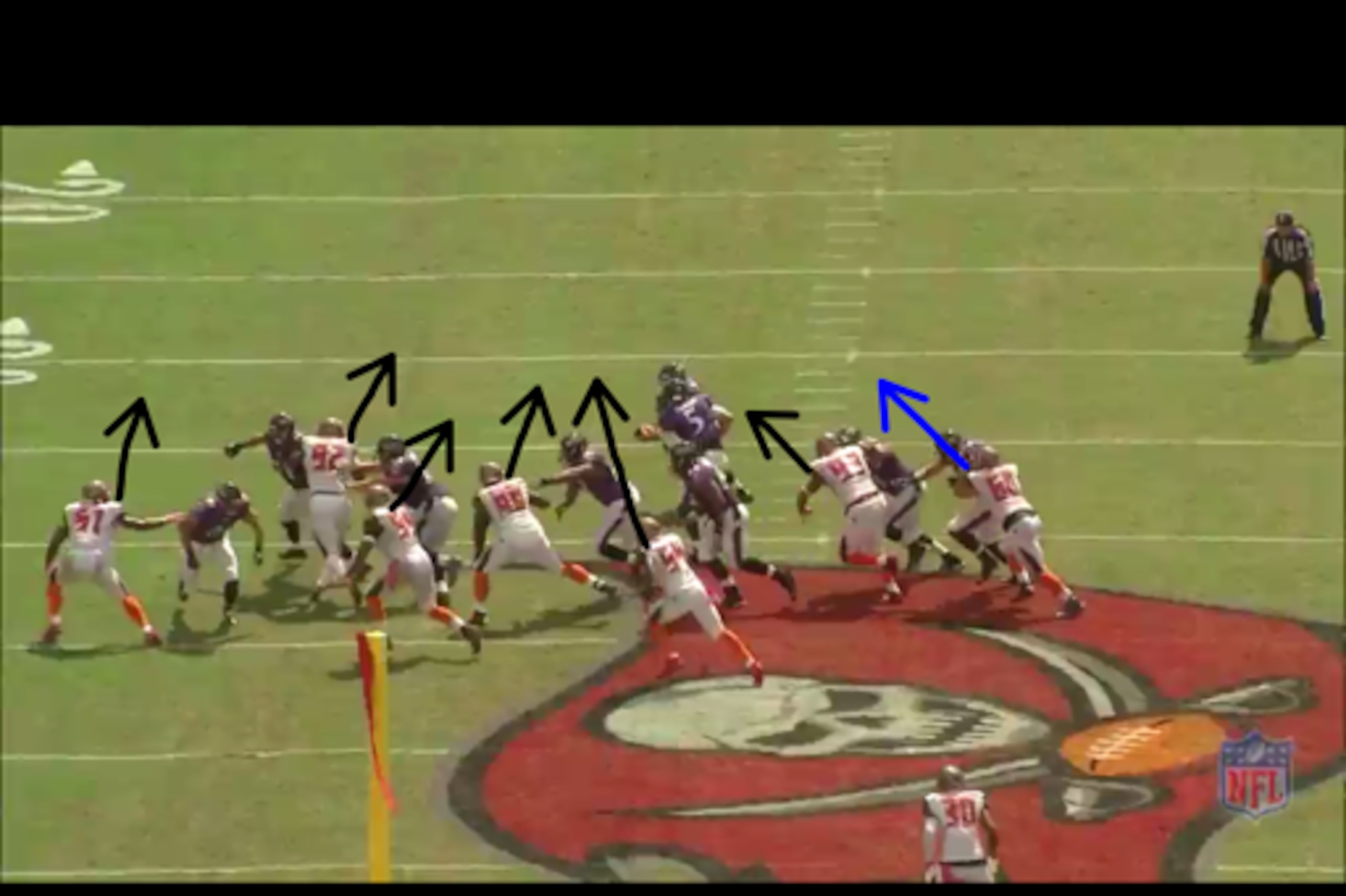
Because the linebackers were stacked on one side and because the backside defensive end crashed inside for the run, nobody had contain when Flacco rolled out of the pocket:

Even the eighth man, safety Major Wright, had a bad angle on Flacco because he was looking inside for Forsett.
Having moved away from any potential pressure, Flacco had more than enough time to set his feet and launch a precise vertical throw in Smith's direction:
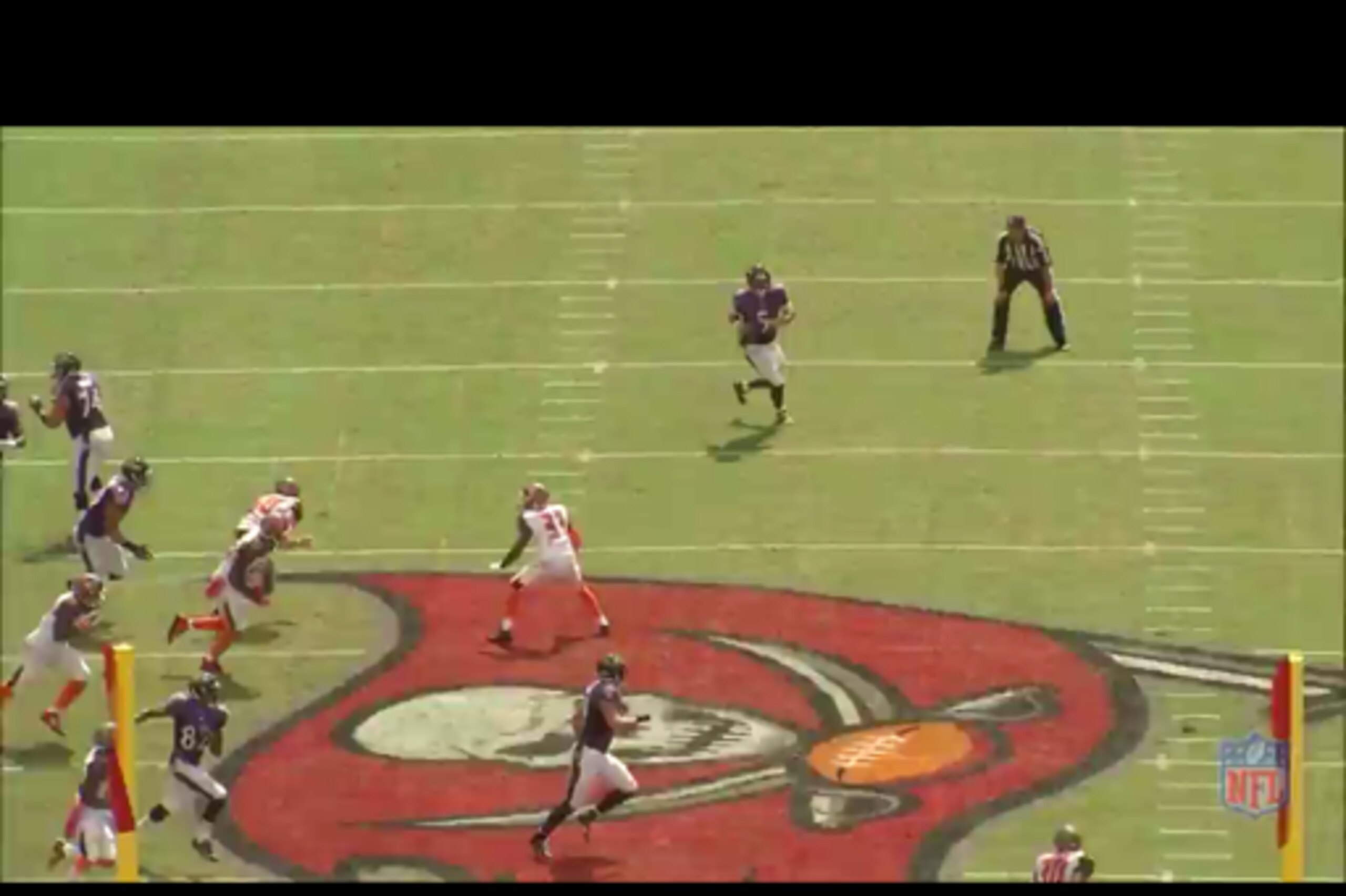
The veteran burner easily outran his coverage to complete a 56-yard score:

If this play looks familiar to Redskins fans, it should. It's the same play-action rollout and deep pass the team has been running since 2010.
The big difference this season is that Washington boasts perhaps the best vertical threat in the NFL to make these concepts even more effective. DeSean Jackson has been sensational, catching 36 passes for 784 yards and a quartet of touchdowns.
He is most effective when attacking deep, particularly off play action. ESPN Redskins reporter John Keim has detailed the numbers:
"Jackson is open, even when he’s not. Jackson, who is 5-10, leads the NFL at 21.8 yards per catch. He has an NFL-best nine catches of 40 yards or more -- nobody else has more than five. Coach Jay Gruden said Jackson 'could have double that, given the opportunities.'
"
And eight of Jackson’s 36 catches have come off play-action; he averages 42.0 yards on those plays. In the past five games, he’s averaging 27.5 yards on 21 receptions.
Gruden should be able to get Jackson behind the Tampa Bay secondary more than once this week.
But Jackson won't be the only big-play wide receiver on the field.
Double-Cover Mike Evans
Washington defensive backs will have their hands full trying to contain towering pass-catching tandem Vincent Jackson, 6'5" and 230 pounds, and rookie Mike Evans, 6'5" and 231 pounds.
Both are dangerous, but it's Evans who could bear the closest watching. The former Texas A&M standout has topped 120 yards in each of his last two games. In his last three, Evans has recorded at least one reception of 30 yards or more.
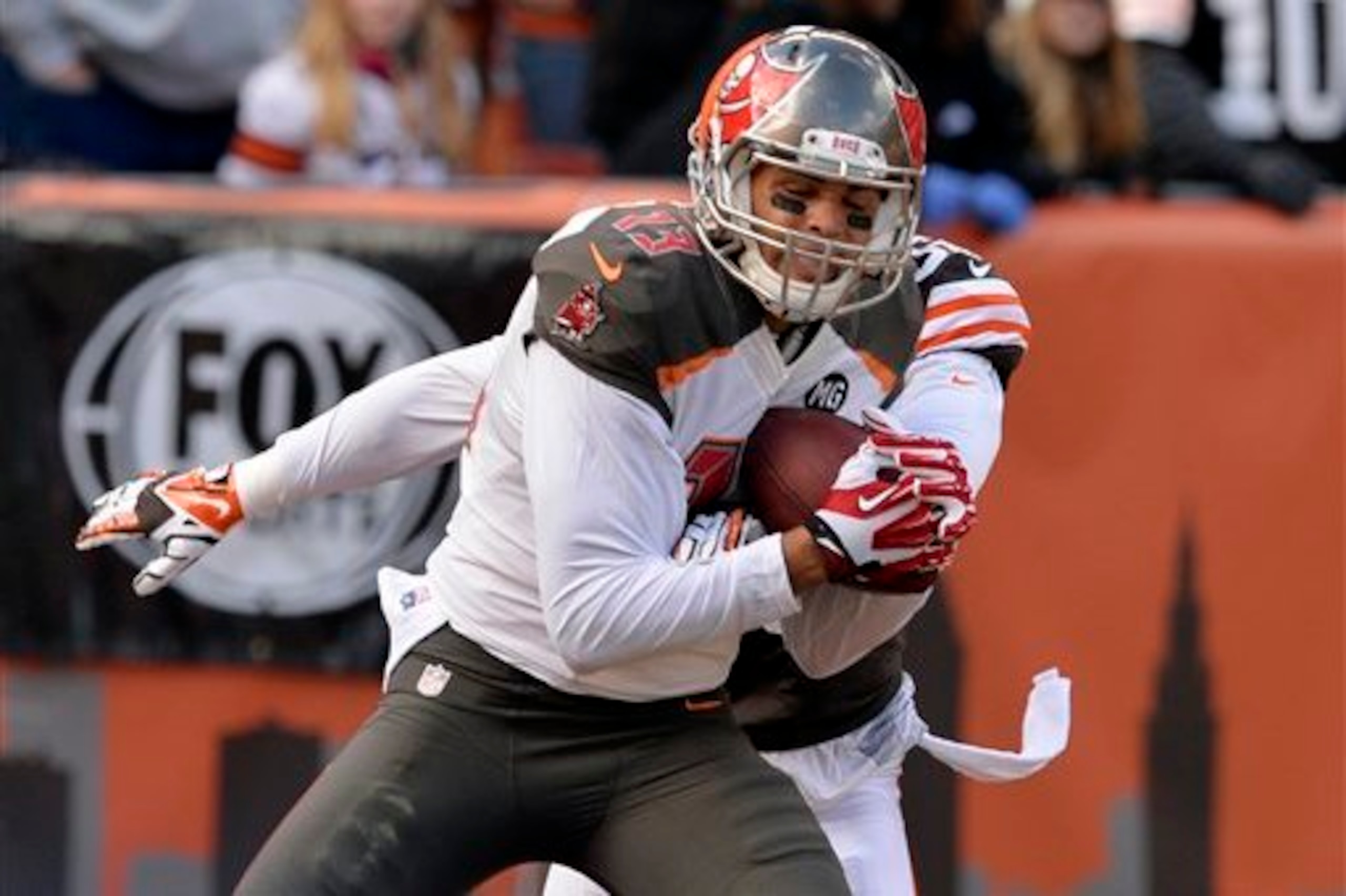
That's a level of big-play potential Washington defensive coordinator Jim Haslett has to shackle. His best ploy will involve bracketing Evans in regular double coverage.
That should mean press coverage underneath with a safety over the top. Either one of young cornerbacks David Amerson or Bashaud Breeland are aggressive enough to play physical at the line against Evans.
Breeland may be the better matchup because he's a little nastier than Amerson. He can scrap with Evans and frustrate him underneath, while Ryan Clark or Brandon Meriweather hover over the top.
Putting Breeland on Evans will let David Amerson, who is a little taller at 6'1", match up with Jackson individually more often, freeing a safety to help out on the other side.
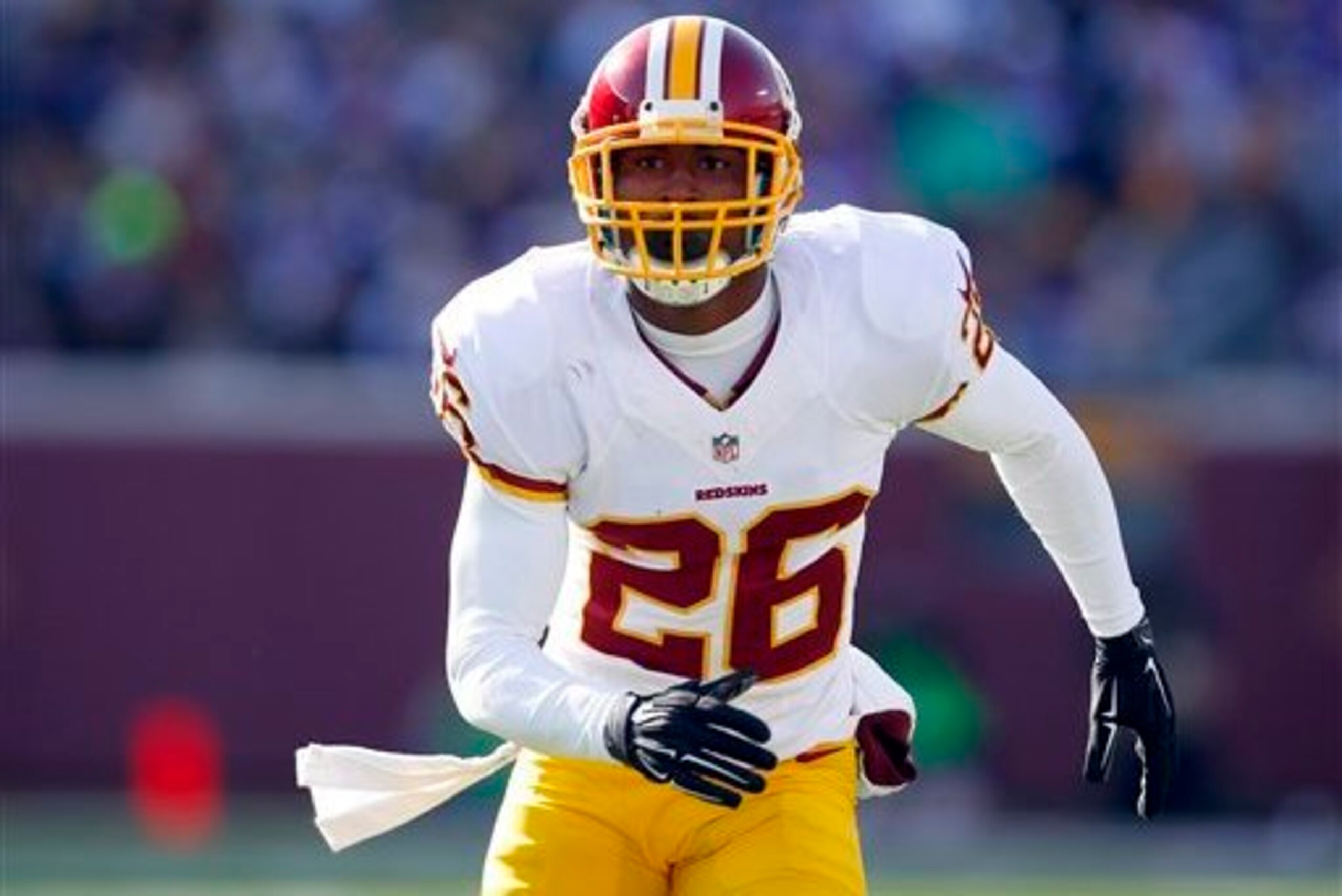
It's important the Redskins routinely show this coverage look over Evans. That will force the Bucs to go elsewhere with the ball.
It will be former Chicago Bears backup Josh McCown throwing the passes for the men from Florida. His presence will help form the same dynamic that gave Washington's defense fits last season.
When McCown was a member of the Chicago Bears, his passes to tall burners Brandon Marshall and Alshon Jeffery helped lead to 41 points in Week 7. The Redskins played a lot of off coverage that day, but will need to be more physical against Jackson and Evans.
It would also be a good idea to test McCown in the pocket. But with at least one safety committed deep, Haslett will have to get the coverage-pressure balance right.
Haslett should try blitzing middle linebackers Perry Riley Jr. and Keenan Robinson early and often. The Bucs have surrendered 25 sacks this season, a weakness Haslett's D must exploit.
The Buccaneers may be exactly the right opponent at the right time as the Redskins attempt to salvage their season. However, Tampa Bay's rush-coverage dynamic on defense will test Griffin's pocket awareness and ability to make reads.
But that could be nothing compared to the threat Evans and Jackson will pose to an inconsistent secondary. Still, if Washington's units stick to what they do best, Gruden's team will have enough weapons for the win.
All statistics via NFL.com.
All screen shots courtesy of CBS Sports, Fox Sports and NFL.com Game Pass.