Cavaliers, Like Heat Before Them, Are Learning What Life in the Bubble Is Like
There is nothing new about the piercing eyes, rabbit ears and wagging fingers that are fixated on Northeast Ohio these days, testing the Cleveland Cavaliers' patience, maturity, restraint and resolve.
Those eyes, ears and fingers have just redirected their attention from south to north.
Or do you forget what the Miami Heat faced in 2010-11?
TOP NEWS
Giannis' Warning to NBA ⚠️

NBA Power Rankings Entering Preseason 🔢
Wizards Guard Admits Tanking 😨
How could anyone who follows the NBA?
From the start, there were so many so-called Gates, so many controversies stripped of context that caused the carnival barkers to speculate, hyperventilate and, of course, castigate, all to feed the 24-hour sports cycle. It started for the 2010-11 Miami Heat with Welcome-Gate, when their newly assembled Big Three got pummeled for prancing, preening and flexing before playing a single NBA game together, during a smoke show that—while over the top—was simply intended as a shared celebration with the team's fans.
Then, well, the floodgates opened.
There was Chill-Gate, when Chris Bosh punctuated a 35-point performance against the Phoenix Suns by revealing that his new coach, Erik Spoelstra "needs to meet us halfway, he wants to work, we want to chill," with most observers omitting the next snippet of his reply: "...but we're going to have to work to get everything down, to get our timing down, and to get our chemistry down." There was Cable-Gate, when Toronto took Bosh to task for quipping that he couldn't get the "good cable" when he lived there. There was Bump-Gate, when LeBron James may or may not have intended to brush Spoelstra's shoulder on the stomp back to the bench during a loss in Dallas that dropped Miami to 9-8, followed by a players-only meeting and a story on ESPN.com that undermined Spoelstra's authority.
There was Cry-Gate, when Spoelstra revealed that "a couple of players" were crying after a tight loss to Chicago, in an effort to show how much they cared, and then endured more criticism after scolding the media for sensationalism.
There was Karma-Gate, when the @KingJames account tweeted, while James was in Los Angeles during the Cavaliers' 55-point loss to the Lakers: "Crazy. Karma is a b****. Gets you every time. It's not good to wish bad on anybody. God sees everything!"—only for James to assert later that he meant no ill intent, and he was merely relaying someone else's opinion. And there was Contraction-Gate, when James felt compelled to clarify comments he'd made about how it "would be great for the league," and more like the 1980s, if there were fewer teams.
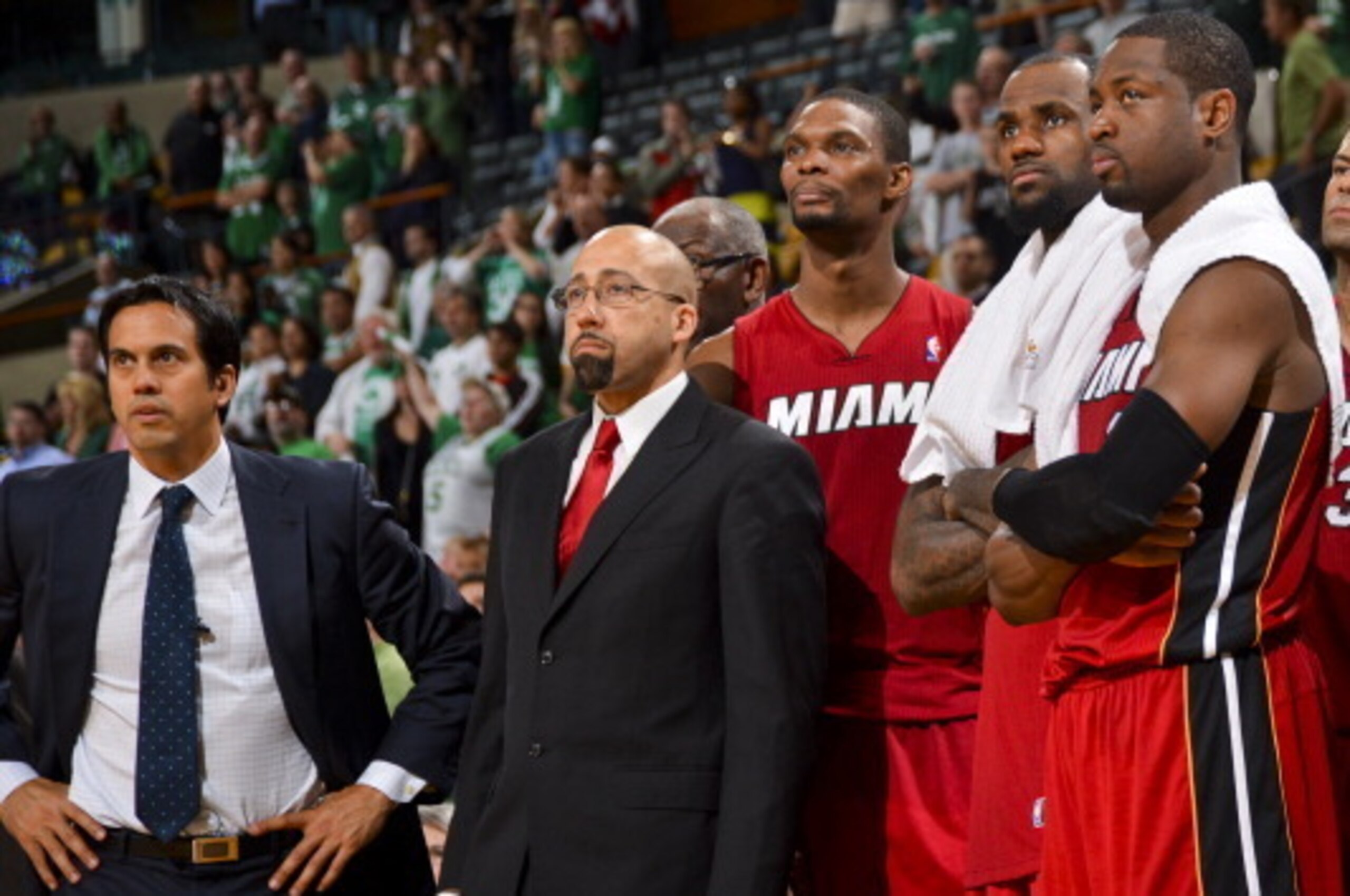
And that's an abridged version of all of the sensationalistic storylines the Heat encountered when they met with reporters or turned on their televisions. Some, like a couple of those mentioned above, could have been avoided with a bit more care. Some, though, were largely, if not entirely, media-manufactured, meant to produce clicks and ratings—shots at their effort, their character, their sacrifice.
"It got to be annoying," Heat forward Udonis Haslem said. "I think, at first, everybody was excited to be together. And after a while, you know, it's just like beating a dead horse. Keep harping on the same thing, keep having to answer the same questions, talk about the same stuff. Eventually, it starts to get aggravating. Know what I mean? You just want to play the game of basketball, and make it about more than just the 'Big Three' and all that."
It required considerable restraint.
"Some of the stuff probably pissed me off more than it pissed 'Bron and those guys off," Haslem said. "And it was comments that were made about them that pissed me off. Those guys did a good job of ignoring it, but it pissed me off, some of the statements that people would make about those guys. I'm not much for holding my tongue."
He's not, but he largely did, and the Heat managed to tune out enough of the noise—"the peripheral opponents," to borrow Pat Riley's parlance—to reach the NBA Finals that first season, as well as the next three, while winning two championships.
Cleveland is just starting with its refreshed roster, 3-3 after two straight victories, but it is already enduring an onslaught similar to what the Heat experienced way back when. That's a product of playing with James, and the media's obsession with absolutely everything he, and his teammates, do or say.
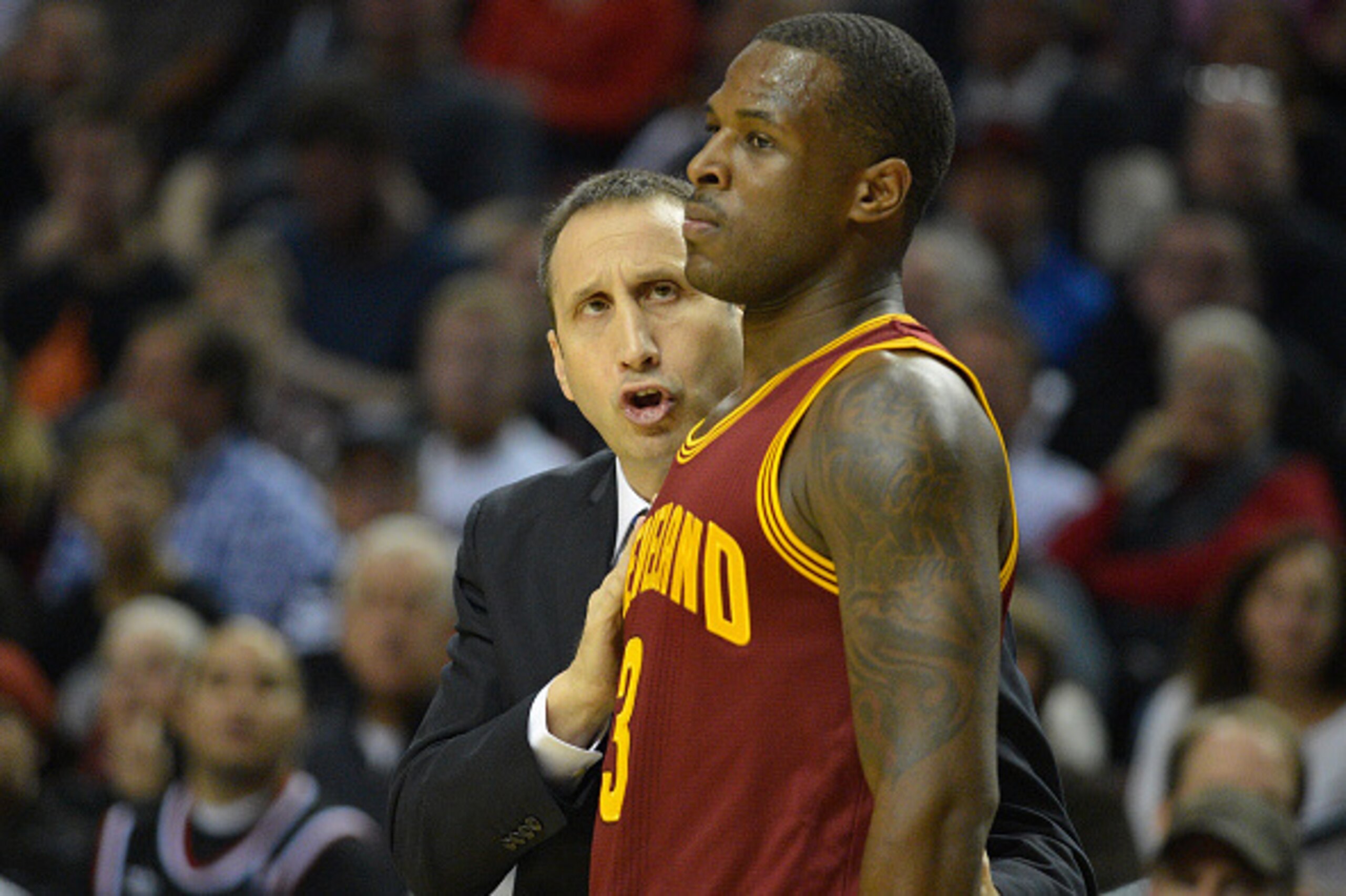
If a New Orleans Pelicans guard reveals that he would prefer not to come off the bench, that it isn't his game to be a catch-and-shoot player even if that's what the coach wants, or that he doesn't see a problem with taking so many shots in the preseason, it's a local story at most. Now, when Dion Waiters even intimates any of those things, it's a national crisis. And when he reportedly tells a media member that he's skipping the national anthem for religious reasons, only to take to Twitter to deny it later, that's an international incident.
If two members of the Sacramento Kings are sorting out their ball-handling roles, no one pays the slightest attention, outside of California's state capital and a few fantasy owners. If James and Kyrie Irving are doing so, they're forced to put out fires, related to whether they've had a heated locker room exchange.
If a Minnesota Timberwolves forward talks in the preseason about getting more inside touches to get himself going, the ripples are felt from Minneapolis to St. Paul. When a former Timberwolves forward, who is now a Cavaliers forward, says it, he gets caught in a coast-to-coast debate about whether his early complaining means he's headed out of town at the first chance he gets.
And if two Denver Nuggets perform a unique celebratory handshake, even one that appears to some to portray the smoking of a joint at the end, it's unlikely that their public relations arm will need to disseminate an explanation that they were merely "sharpening their mustaches." Perhaps Denver is a poor example. But the Utah Jazz probably wouldn't need to, either.
This is the world in which Love, Irving and the rest of the Cavaliers now reside.
Parsing and probing will be par for their course.
The question now is how they'll handle it.
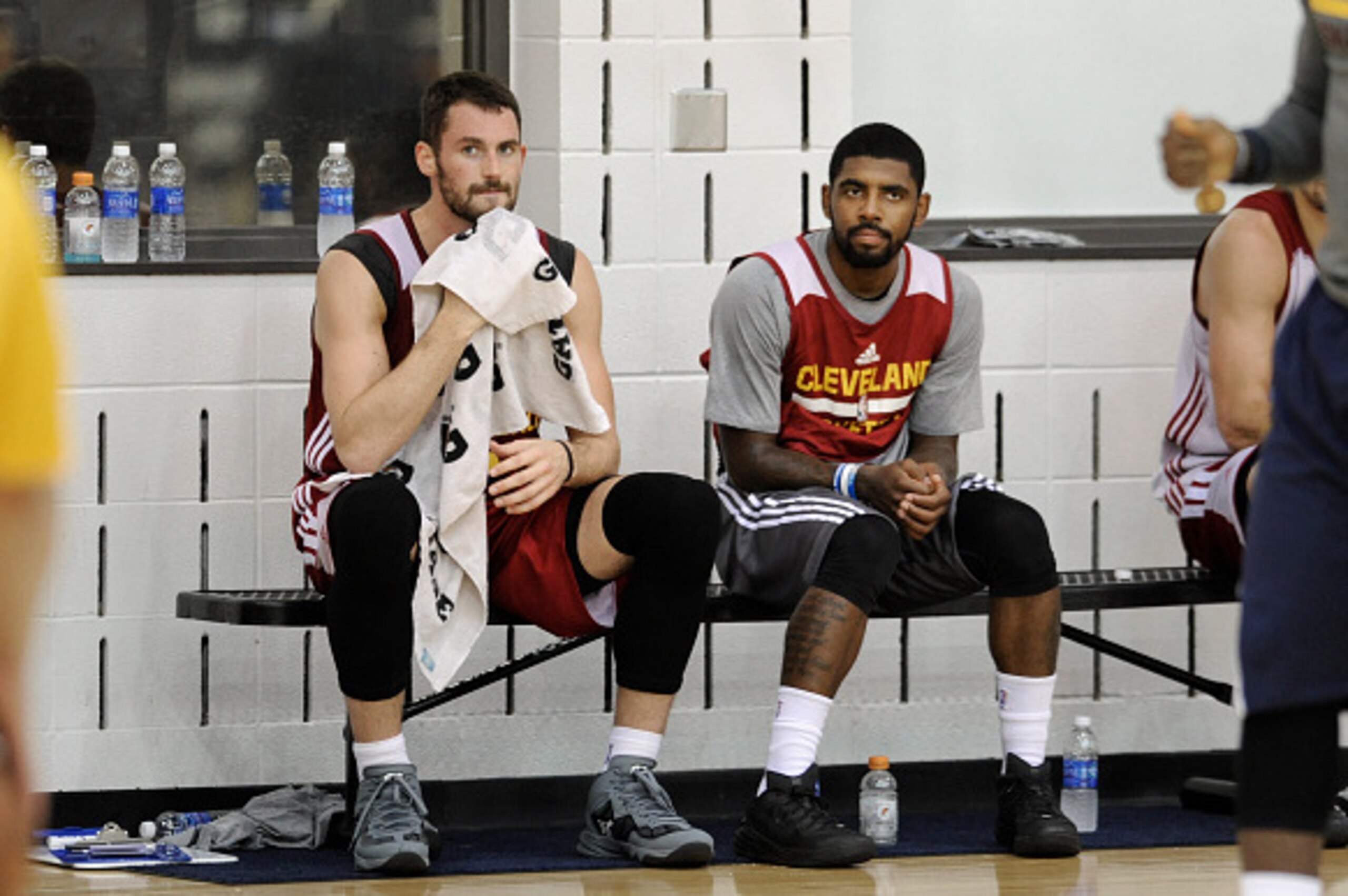
Will it help them come together, as it generally did for the Heat?
Or will it pick and pull them apart?
All of this was highly predictable, after all.
James knows nothing else, not for the past 15 years. He will never be left alone. Nothing will ever go under the radar. It's impossible for him to shield others entirely. He can only try to prepare and fortify them. After the first day of training camp, when asked what he had told his new teammates, he offered, "Just got to build our habits, we got to build character, and we always got to protect each other, no matter what's going on, through the best of times, and through the worst of times. So we'll see what happens."
The message was clear, as enunciated by Love:
"We just can't let anyone into the circle."
That sounded similar to something James Jones said, in terms of lessons learned from Miami. Jones played the fifth-most minutes on that 2010-11 team, and while his playing role is diminished in Cleveland, James wanted the veteran professional on this new squad in part so he could share his experience.
"It forced us to compact our circle [in Miami]," Jones told Bleacher Report in late September. "There was just so much going on, on the outskirts, in the media, in the city, around the country and the whole sports industry in general. There was just so much noise that it forced us to compact our circle, just so we could be clear in our thoughts. It was a learning experience, but I think with that group specifically, with the veterans we had, it just made us focus a lot harder."
Jones called it "continual madness."
"Every story was a breaking news, end-of-the-world story," Jones said. "So about after the first two or three weeks, you kind of just drowned it out, because you knew whatever we were going through was just going to be the story until they found another headline or another story. So it got old pretty quick, but it did force us to stare our high expectations in the face from day one, which made it easier for us to do the work."
He believed, again back in late September, that this time might be different, because the "NBA landscape is different," that the league had been "shook up" by James' move, especially as traditional teams like the Celtics and Lakers were making last stands.
"So it was a transition point," Jones said. "You have that same thing happening now, except the team that we have now is filled with those young and up-and-coming talented guys, guys like Kyrie, guys like Dion, guys like Kevin, Tristan [Thompson]. That Miami team was built around veterans. So it was a different expectation level, and I think the average fan is more understanding. They understand that you can have expectations, but the expectations aren't that high."
There's also the reality that the general public and national media are more pleased with James' decision this time—to return home—than his decision in 2010 to leave it.
So there's a more positive vibe.
But that hasn't stopped the steady drumbeat of controversies.
Cleveland is now a Gate-d community too, with Handshake-Gate just being the latest, but not the last.
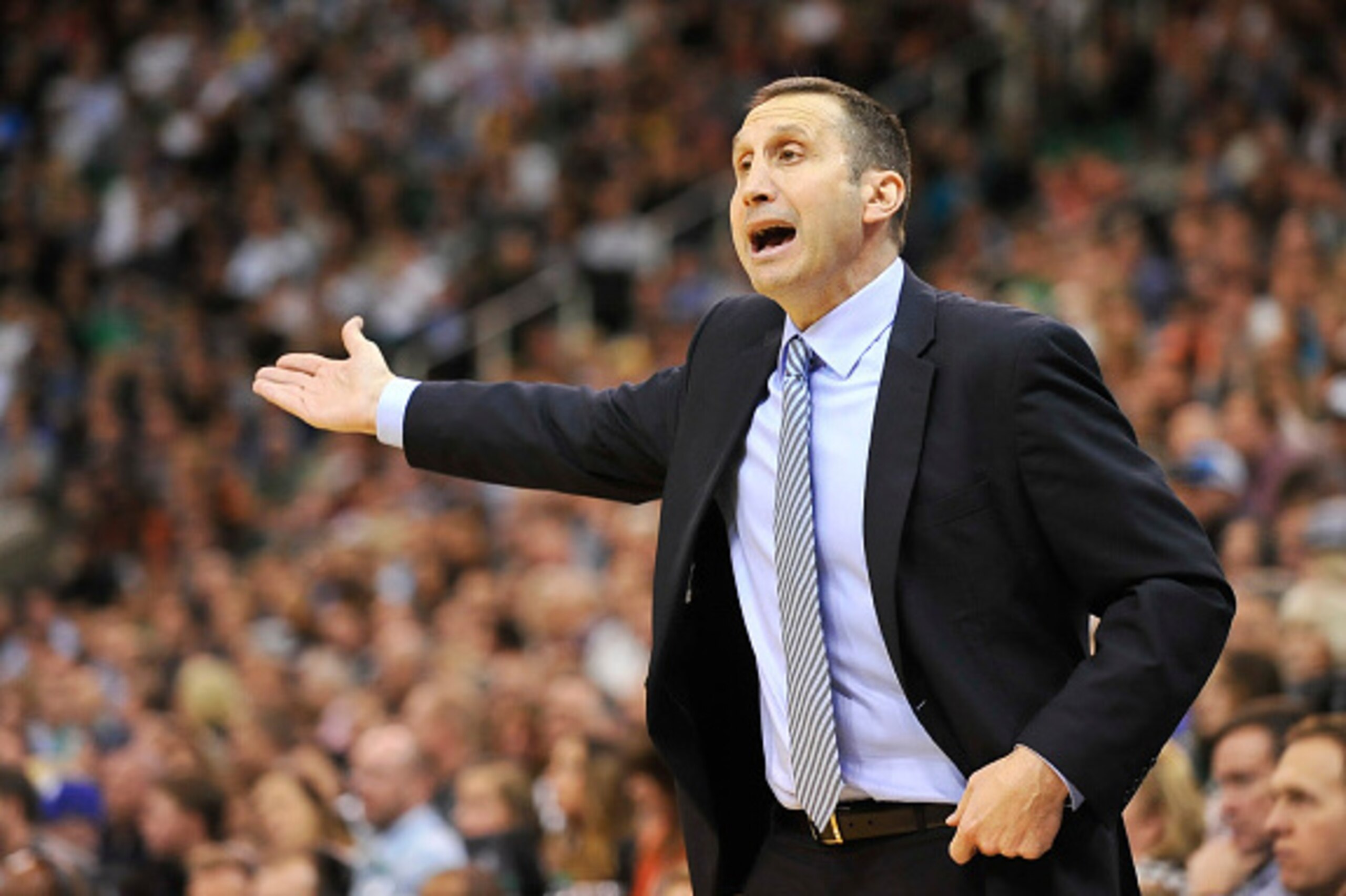
That will put some pressure on their coach, David Blatt, in his first season in the NBA, to keep his team composed amid the chaos. Two of his top three players have never played in a playoff game. Four of the nine rotation regulars are in their second or third years, and two rookies (Joe Harris, Will Cherry) are getting time now due to injuries. Their skins may not be especially thick.
In late September, I asked him how he intended to address the scrutiny with his players, particularly his youngest ones.
"I'm going to have to feel where that's coming from, and gauge the impact that it's having on them," Blatt said. "And I'll talk to them, I'll sit down and talk to them. That's something to consider, yes. What I generally recommend that they do is just don't pay any attention. Get out there and do your job. And that way you don't get in any trouble worrying about what other people are saying. But yeah, every guy handles it in their own way. I'll keep my finger on the pulse of the people here and try to recognize if there are issues. And I'll talk to them."
Still, so far, that hasn't stopped some, especially Waiters, from increasing the intensity of the microscope. On the same day that James told the media that Waiters would be best-served ignoring critics and blocking out distractions, the Cavaliers' third-year guard got into a verbal showdown with Washington's Bradley Beal, declaring the Cavaliers, and not the Wizards, the best backcourt in the game.
That only fed another media frenzy.
Ideally, to remain focused in the never-ending storm, the Cavaliers will need to heed the suggestion that Jones gave in late September.
"Whenever the game starts, 7 o'clock, 7:30, the only thing that matters is starting the game and finishing the game with a W," Jones said. "And anything that distracts you or takes you away from that isn't helping you. Because everyone is here to win. We're here to improve every day to put ourselves in the best position to win every game. And so when guys start to get sidetracked about that, and they realize that they're thinking about things other than winning, then they realize they're not really in tune with this team. This team is filled with guys who have demonstrated that over their careers, and have demonstrated that with their actions. I don't think it will be hard. We just have to remind them to check themselves when they start seeing themselves drift away from what's important. You don't have to have those conversations, unless you see something."
Jones didn't believe at the time that they'd be necessary because of how much work the youngsters had put in, how anxious they were to be part of a winning program after suffering through a rebuilding period.
"When guys are excited about winning, you don't have to do much monitoring," Jones said.
We'll see.
And, down in Miami, they won't mind playing spectator, especially now that so many fewer people are watching them on a minute-to-minute basis.
"It's nice not to have to worry it [any]more, I'll say that," guard Mario Chalmers said of the intense microscope. "There's a lot more freedom around here. I mean, it got easier over the years, just because you got used to it. But it was still tough."
When the crush comes at you, there's little chance to circumnavigate.
Ethan Skolnick covers the NBA for Bleacher Report. Follow him on Twitter, @EthanJSkolnick.
.jpg?w=2560 "Every Trade's Best Trade Asset 🔁")
.jpg?w=2560 "Insiders: Cowboys Overpaid for Porter")
.jpg?w=2560 "MHJ's Potential Trade Value 📉")