Blitz Gives Washington Redskins Defense Its Identity
The Washington Redskins found their identity on defense during Week 8's 20-17 road win over hated rival the Dallas Cowboys. That identity is founded on the blitz, after coordinator Jim Haslett unleashed a batch of complex, heavy pressures to stymie Tony Romo and the Cowboys.
A scheme deeply rooted in the blitz suits a Redskins unit loaded with pressure players up front, along with aggressive cover men on the back end. More than just personnel though, the blitz is this defense's best means of creating big plays instead of surrendering a plethora of huge gains.
Haslett's blitzing strategy led to five sacks in Texas, four of which came on third downs. The pressure helped create a pair of takeaways, something that has been a rarity for this season's D.
TOP NEWS
.jpg?w=2560 "NFL Paris Football")
NFL House in Paris Closes for Protests
.jpg?w=2560 "Seahawks Chiefs Football")
Trevon Diggs Cut by Seahawks
.jpg?w=2560)
B/R's Expert Week 7 NFL Picks 🔮
Haslett called a game that best suited the instincts and style of many of his key players. One such player is safety Brandon Meriweather.
A capable but reckless defensive back, Meriweather is often inconsistent in coverage. But he's always been a dangerous blitz man, dating back to his days with the New England Patriots.
Haslett took full advantage of that skill by routinely sending Meriweather off the edges of loaded pressure fronts. Washington's first sack of the game came via this ploy.
A closer look shows the blitz scheme at work. It began with Haslett showing Romo a six-man pressure front on 3rd-and-5:
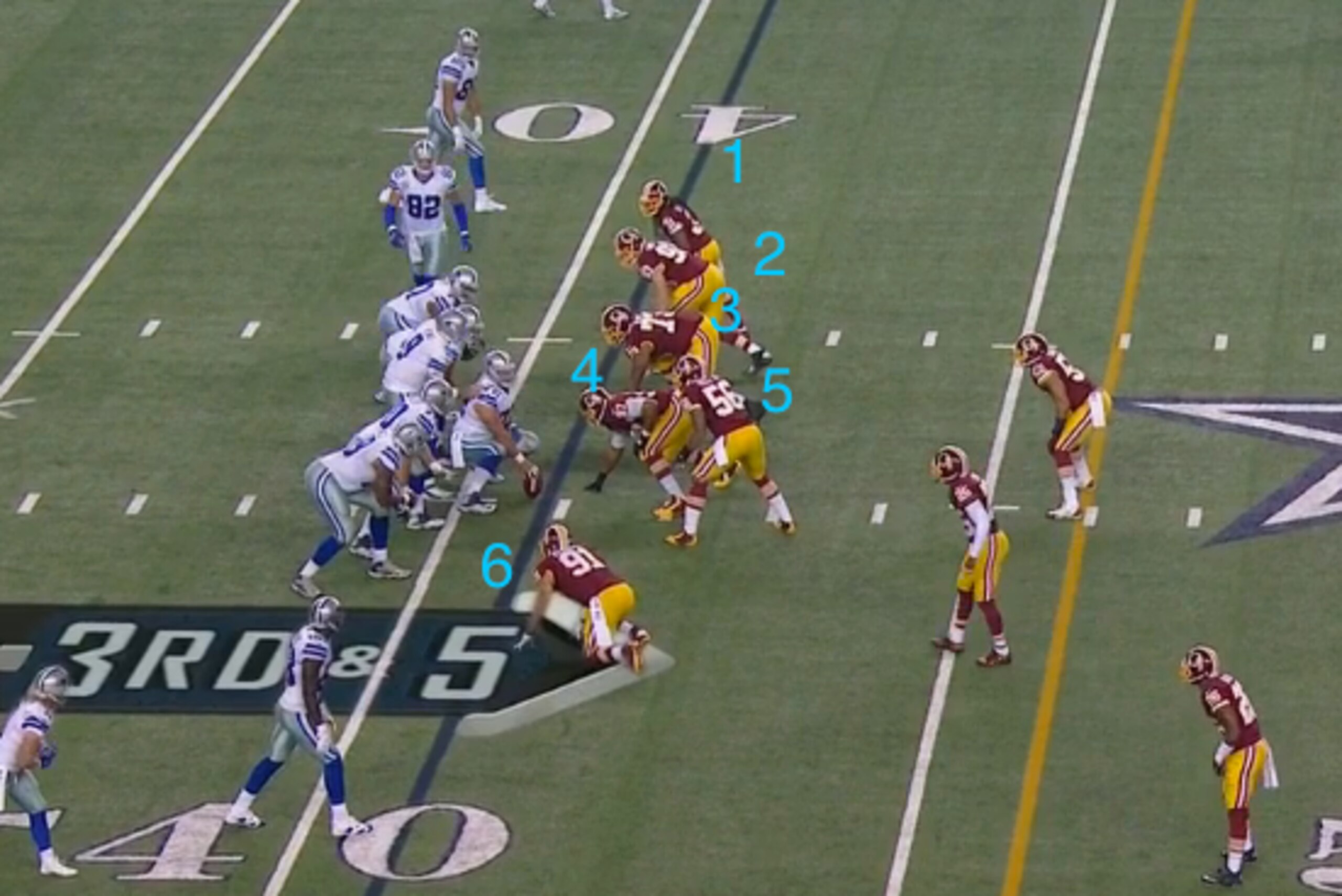
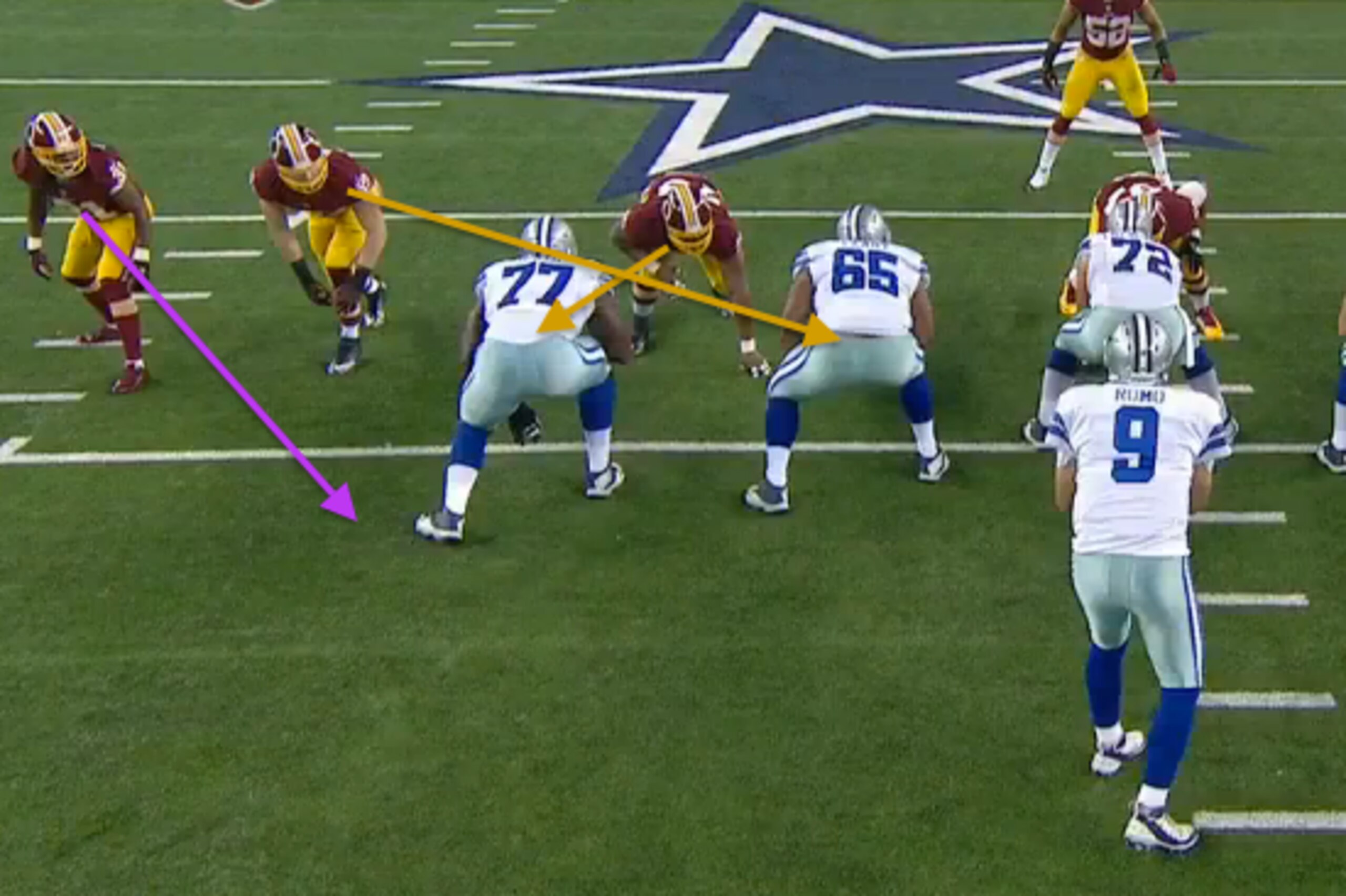
Meriweather would come off the edge against left tackle Tyron Smith. To get him free, defensive tackle Frank Kearse and rookie rush end Trent Murphy ran a twist stunt inside, with Kearse slanting into Smith and Murphy drawing attention inside:
This game, along with a well-timed rush, let Meriweather blitz clean off the edge and swarm on Romo for a 12-yard loss:
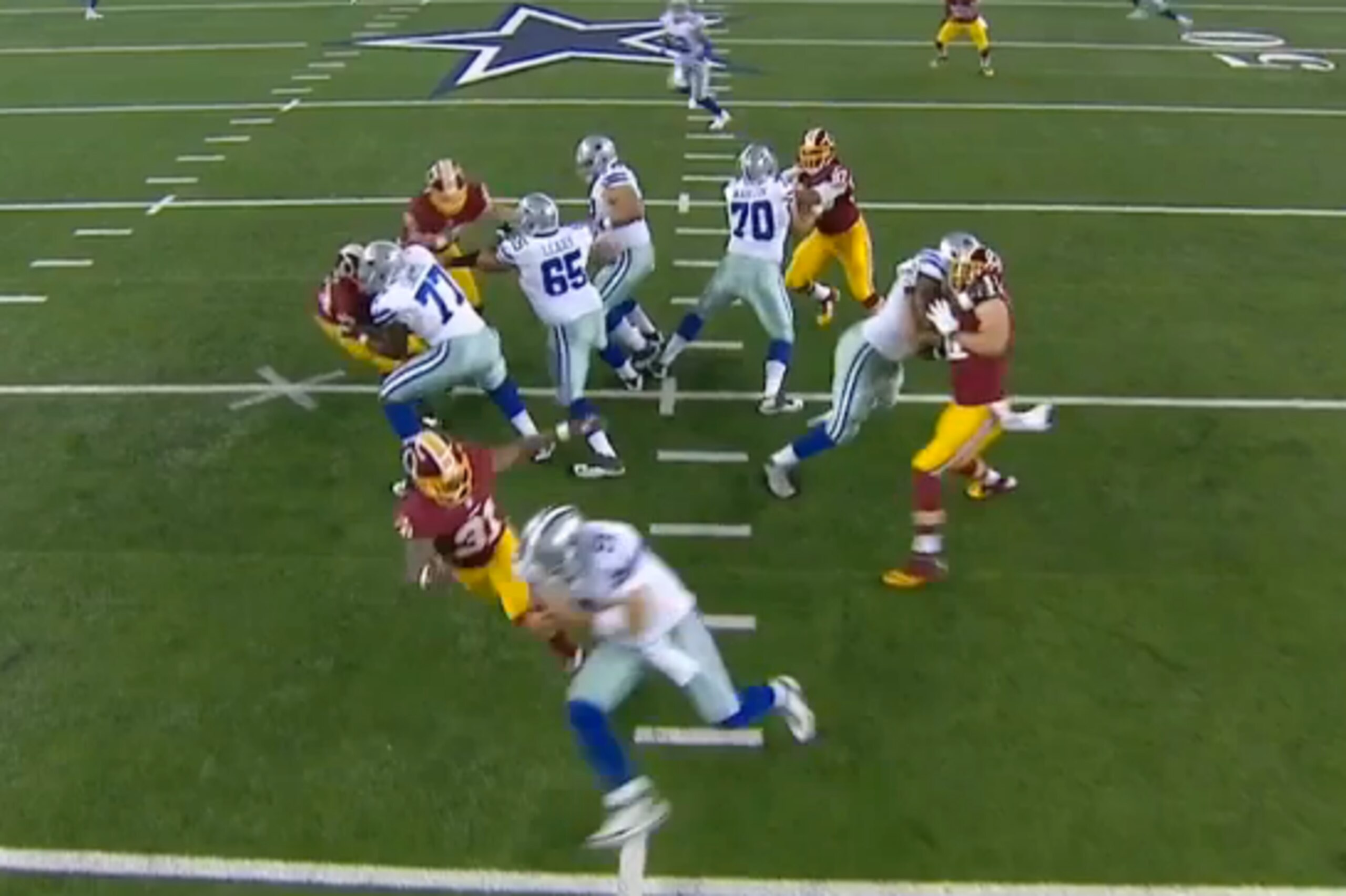
The combination of a stunt allied with an edge pressure was typical of Haslett's multiple approaches to bringing the blitz. He crafted several complex designs to confuse the Dallas protection scheme and create free blitz lanes.
Haslett utilized various looks and moving parts to outnumber protections. Those little ploys and wrinkles are how Haslett turned using the blitz into a coherent system.
ESPN.com Redskins reporter John Keim detailed just how Haslett mixed things up:
"One time, they aligned three rushers outside the left tackle, then ran a stunt. Romo completed a pass on the play, but the look was unique. They showed an all-out blitz on the fourth-down snap, but five rushed and the others dropped into coverage, causing Romo to hesitate and eventually throw incomplete.
They sent the safeties quite often. In fact, a defensive back was sent on each of the five sacks, with Meriweather later in the game causing a fumble on a hit of Romo.
"
Those schemes helped an aggressive box safety like Meriweather enjoy perhaps his best game in burgundy and gold. The 30-year-old registered seven tackles, forced two fumbles and notched a pair of sacks.
But Mewrieather wasn't the only member of the secondary who thrived thanks to the blitz. Rookie cornerback Bashaud Breeland's physical, opportunistic style was perfect for defending throws made under pressure.
Washington's blitz designs and Breeland's roughhouse coverage techniques combined perfectly on a critical 3rd-and-goal in the third quarter. Haslett wisely decided to rush backup Dallas passer Brandon Weeden into a quick throw by sending three rushers through the middle as part of a seven-man pressure design:
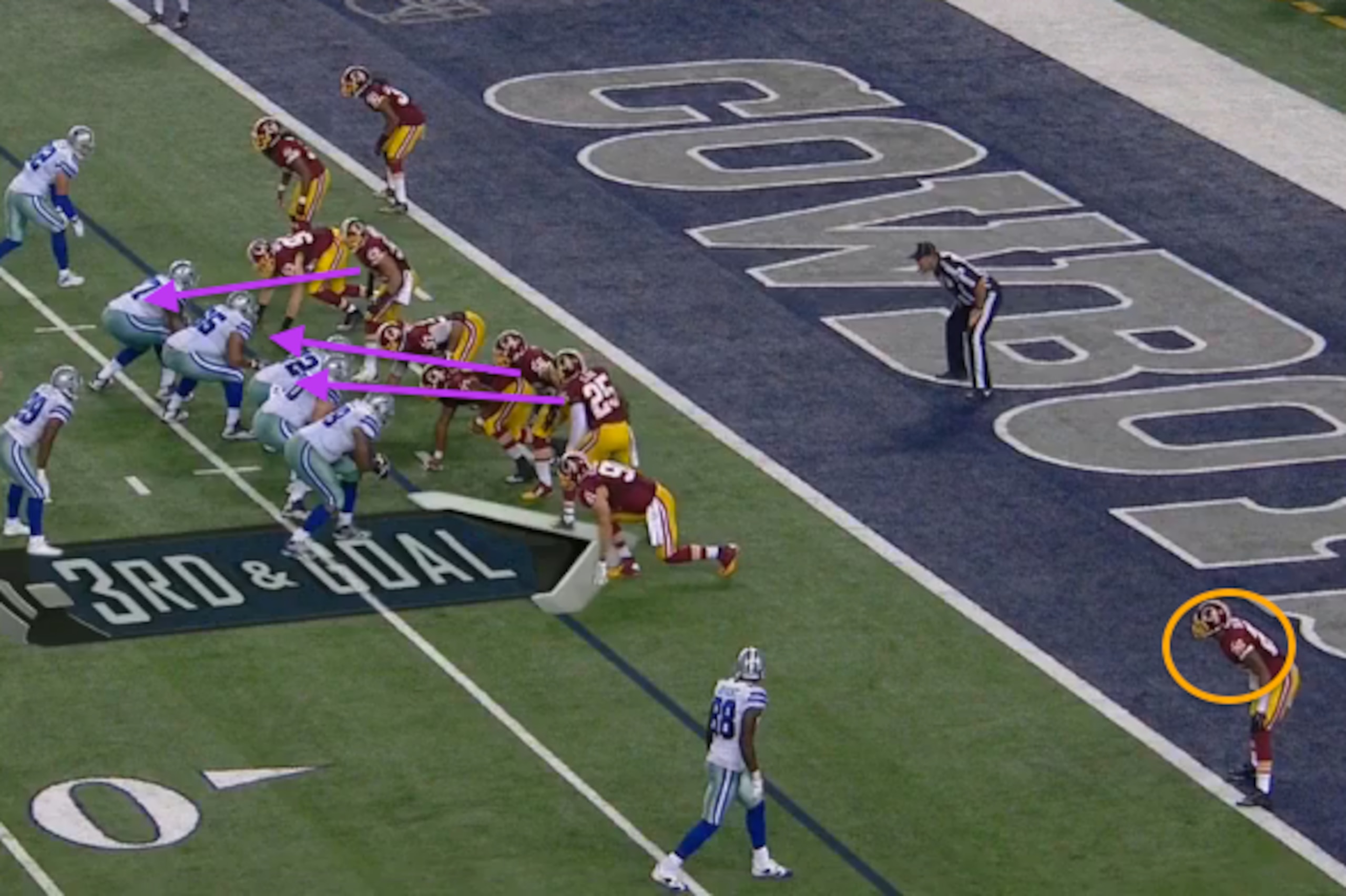
Weeden had a rusher in his face as he flipped the ball toward Dez Bryant:
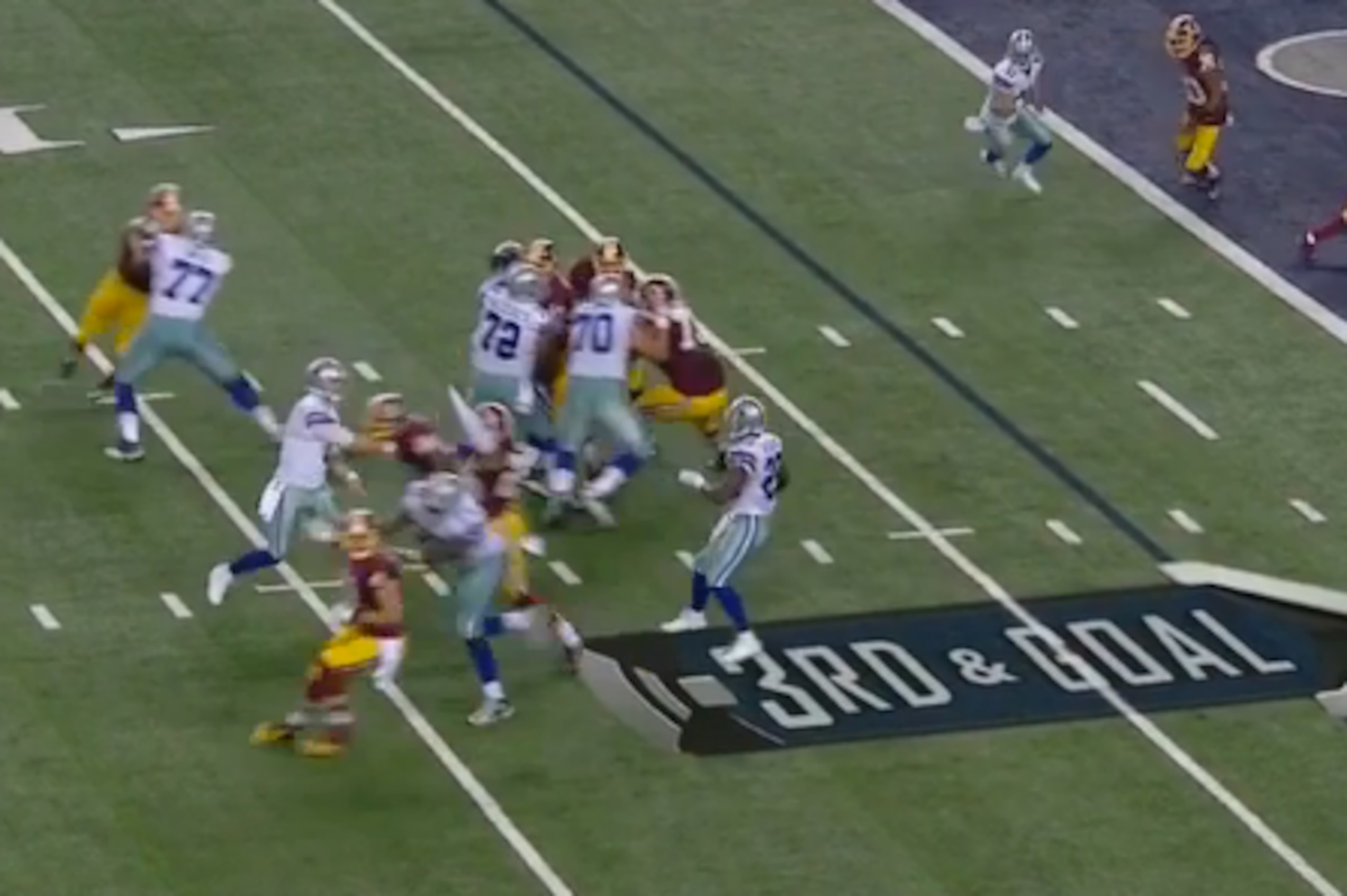
The errant pass gave Breeland the time to pounce and knock the ball away to prevent a touchdown:

This crucial play was the perfect marriage of pressure and aggressive coverage from a blitzing defense. One can't thrive without the other.
Breeland's willingness to crowd his receiver, a quality he shares with fellow young corner David Amerson, forces quarterbacks to throw into small windows, as well as gives the blitz more time to get home.
The pressure is an essential aid for a cornerback out on an island taking chances against a quality receiver. Without the blitz to speed up a quarterback, an offense has the necessary time to get beyond single coverage and produce huge gains.
It's no wonder that a physical, daring and lengthy cover man like Breeland had his best game when the Redskins blitzed more often.

But it's not just individual players who thrived within a specific system. This scheme created several big plays for a defense that has struggled to make them for most of this season.
This speaks to the compromise a defense has to make when it blitzes a lot. Namely, it's the tradeoff between surrendering long gains but still making impact plays that end drives.
That's what Washington did in Dallas. It's how the Redskins limited the Cowboys to just 17 points despite 221 all-purpose yards from star running back DeMarco Murray (141 rushing, 80 receiving).
When it counted, the blitz stifled Dallas. Sacks on third down, pressure leading to turnovers and forcing incomplete throws kept the game in Washington's favor.
A great example came toward the end of regulation with Romo trying to lead the Cowboys to a winning score. On 3rd-and-1 with 22 seconds remaining and just one timeout, Romo had to throw.
Haslett challenged him with a seven-man pressure that had free safety Ryan Clark blitz off the edge while linebackers Riley and Keenan Robinson came through the middle:
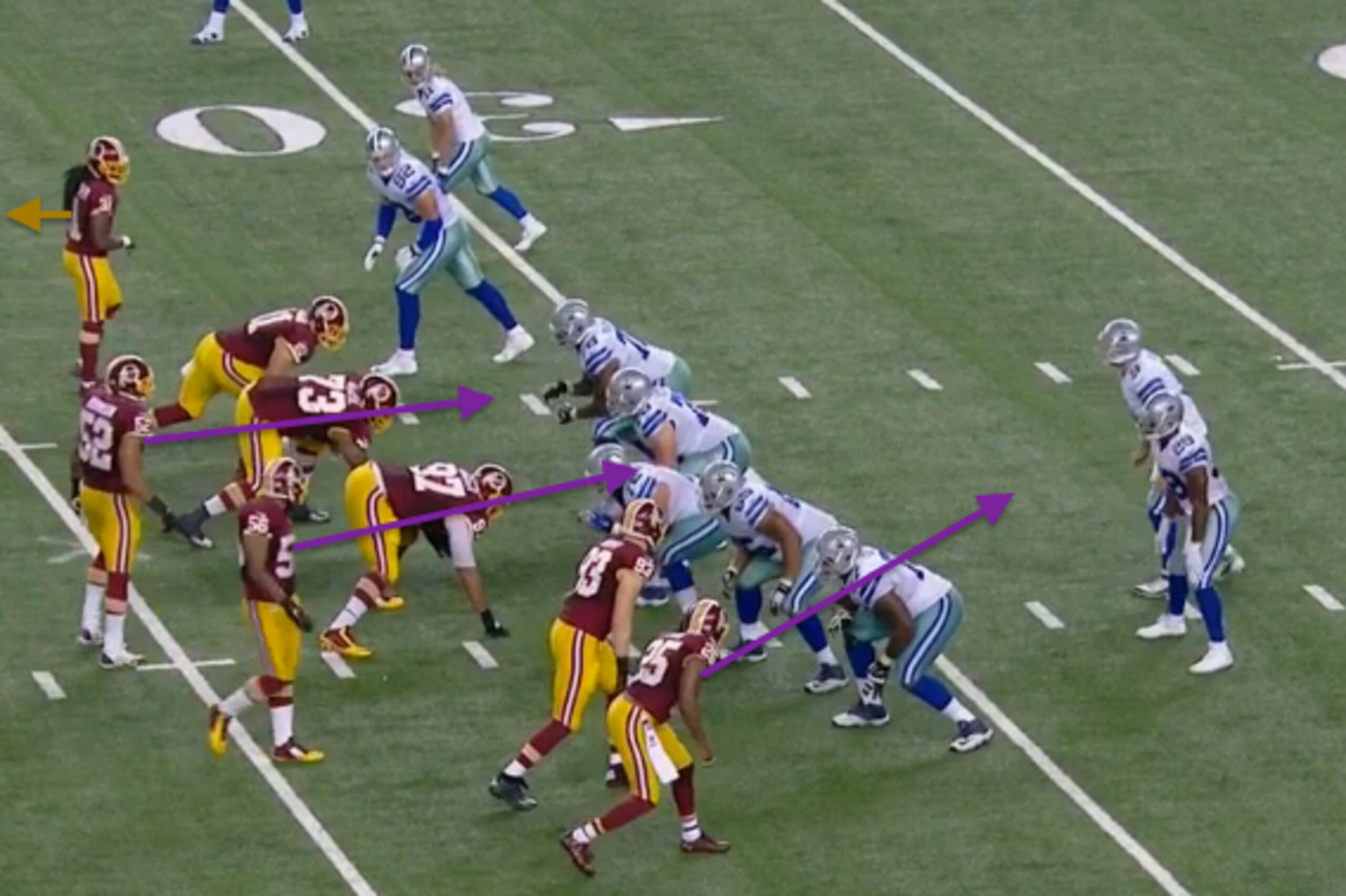
With Clark in his face, Romo was forced to simply throw the ball away and take an intentional grounding penalty:

The pressure forced a punt from deep and ended Dallas' attempt to win the game in regulation. The reward for this bold call came when Washington won the game in overtime.
Keim made note of how Haslett stuck to his blitz-led plan throughout the game, regardless of how precarious the situation was:
That's the sort of continuity the Redskins need in their defensive scheme. The unit is not stout enough to consistently snuff out a running game, or talented enough in the secondary to regularly blanket the league's best passing attacks.
Haslett doesn't possess the shutdown personnel in the secondary to play like the Seattle Seahawks. He doesn't have the powerful and dynamic front-seven athletes to play simple rush and coverage the way the San Francisco 49ers do.
Instead, Haslett has big-play pressure specialists such as Jason Hatcher, Murphy, Ryan Kerrigan and Meriweather. This is a group that has to feast on big plays. The blitz is the best way to create those big plays.
That's why sending additional rushers on a regular basis has to become the backbone of a consistent scheme for this season's defense, the way it is for the Arizona Cardinals.
Watching Haslett's D relentlessly harass Romo was eerily reminiscent of the way the blitz-happy Cards have been causing quarterbacks fits all season.
Arizona's unit, masterfully guided by coordinator Todd Bowles, is missing key figures but remains the fifth-stingiest scoring defense in football. That's despite Bowles' group surrendering the most passing yards in the league.

Those rankings are a true indicator of the feast-or-famine nature of a blitzing system. With top pass-rushers John Abraham, Darnell Dockett and Calais Campbell unavailable, Bowles has to consistently send extra rushers and leave his coverage undermanned.
That's the compromise the Cardinals have made. It's led to numerous big plays that have keyed a 6-1 start. The latest preserved Week 8's 24-20 win over the Philadelphia Eagles. Grantland.com writer Bill Barnwell has described how Arizona have embraced their identity as a blitzing defense:
"In a league where coaches are often risk-averse and roll out conservative coverages in key moments, nobody is more aggressive with the game on the line than the Arizona coaching staff. The Cardinals blitzed heavily in the fourth quarter to hold on to their narrow win over the Chargers in Week 1, and did so all throughout Philadelphia’s last drive.
Arizona doesn’t have many sacks on the year — just seven through seven games — but it has been able to create bad throws and remain a nuisance via steady blitz pressure. The Cardinals have blitzed on 27.7 percent of opposing plays, per ESPN Stats & Information, the third-highest rate in football. The blitz hasn’t produced sacks, but it has increased the percentage of time they bother the passer.
"
Washington's defensive coaches should welcome the same identity. The last thing the Redskins should do is kid themselves into believing they don't need a clear system because they are a flexible, hybrid defense.
The 31st-ranked Atlanta Falcons defense have made that mistake this season, per ESPN.com reporter Vaughn McClure. The problem with trying to be many things is that it usually ends with not being good at any one thing.
The Redskins are a good blitzing defense. But this isn't merely about recklessly sending rushers after an offense every snap on a whim.
Instead, it's about taking a sophisticated approach to packaging blitz concepts within a system designed around pressure and the big plays it creates. That's what the Washington defense should look like for the rest of this season.
It's the right identity for Haslett as a play-caller, as well for the style of his players. It's also right for a schedule that will feature young quarterbacks such as Teddy Bridgewater, Austin Davis and Mike Glennon.
Starting with rookie Bridgewater and the Minnesota Vikings next week, Haslett has to be willing to challenge these inexperienced passers the way he did Romo.
Against the Cowboys, Washington proved how effective its defense can be with the blitz. But that can't just be a one-off reserved for their hated enemy.
Instead, the blitz must become a staple of what this team does defensively.
All statistics via NFL.com unless otherwise stated.
All screen shots courtesy of ESPN.com and NFL.com Game Pass.
.jpg?w=2560 "Colts Football")