Philadelphia Eagles vs. Arizona Cardinals: Full Report Card Grades for Arizona
For the 2014 Arizona Cardinals, games are hard-fought, hard-hitting battles that more often than not they have found ways to win. That was no different on Sunday as the Philadelphia Eagles came calling, looking for a fight.
When all was said and done, the Cardinals (6-1) beat the Eagles (5-2) on a 75-yard touchdown pass from quarterback Carson Palmer to rookie wide receiver John Brown, sealing the final score at 24-20, Cardinals.
But before that play—and even after it—the two teams slugged it out, struggling for every yard, every first down and every point. Andre Ellington carried 23 times for 71 bruising yards (3.1 yards per carry) and a touchdown. LeSean McCoy toted the rock 21 times for 83 yards (4.0 YPC); he had to make people miss just to gain an inch at times.
Palmer completed fewer than half of his passes in a game for the first time since Dec. 4, 2011, when he was quarterbacking the Oakland Raiders. But he threw two massive touchdown passes that together covered 155 yards, and he did not turn the ball over. That was huge.
"Carson Palmer became 18th QB in NFL history with two TD passes of 75+yds in same gm (no one has ever had 3) #PHIvsAZ
— MarkDalton (@CardsMarkD) October 27, 2014"
The turnover battle turned out to be the difference in the game, as the Cardinals forced three and turned it over just once on a fumble by Ellington. Coming into this game, Arizona ranked third in the NFL with a plus-7 turnover margin; Philadelphia ranked 28th with a minus-5.
How did each Cardinals positional unit fare in Sunday’s win over the Eagles? Let’s find out.
Quarterback
1 of 10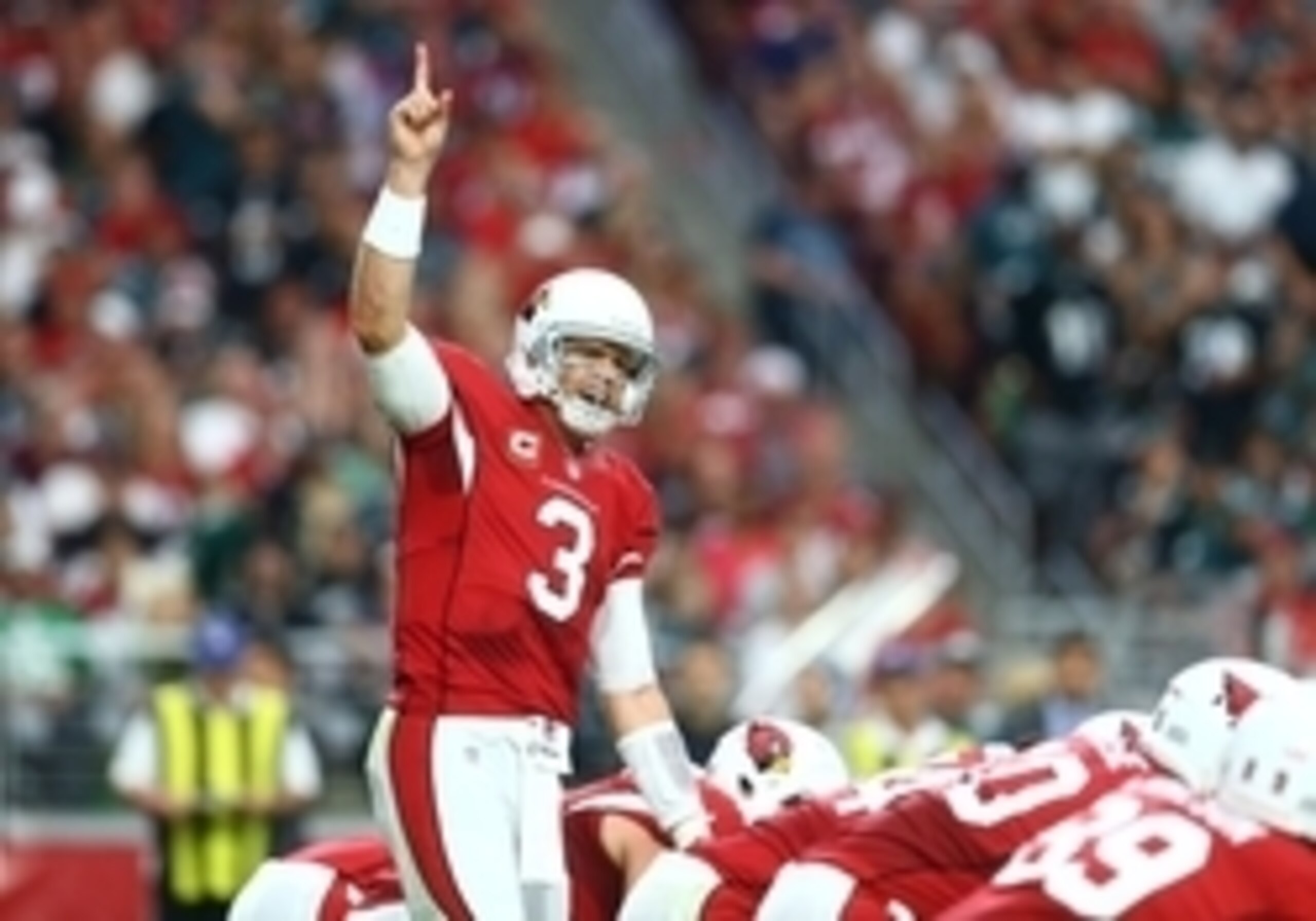
As previously noted, Palmer completed fewer than 50 percent of his passes in this game. He finished 20-of-42 (47.6 percent) for 329 yards, two touchdowns and no picks for a 90.3 passer rating. He amazingly was not sacked despite heavy pressure from the Eagles throughout the game.
Palmer had to leave the pocket repeatedly just to try and make something happen, which resulted in some inaccurate throws. He also should have had a third touchdown pass, to Michael Floyd on Arizona’s first drive, but the star receiver dropped it after letting the ball get into his body rather than reaching for the jump-ball with his hands.
In all, Palmer played well. He had to check down to receivers and backs too much, but even too many of those short passes fell incomplete.
"Was Palmer certain Brown would catch the TD pass? "I knew. I've seen that gear."
— Kyle Odegard (@Kyle_Odegard) October 27, 2014"
Having the fortitude to throw it deep to Brown on 3rd-and-5 late in the game and down by a field goal gives his grade a boost. It’s higher than you’d think, though, given the low completion percentage.
The other major contributing factor was his efforts in escaping the Philly pass rush.
Grade: B+
Running Back
2 of 10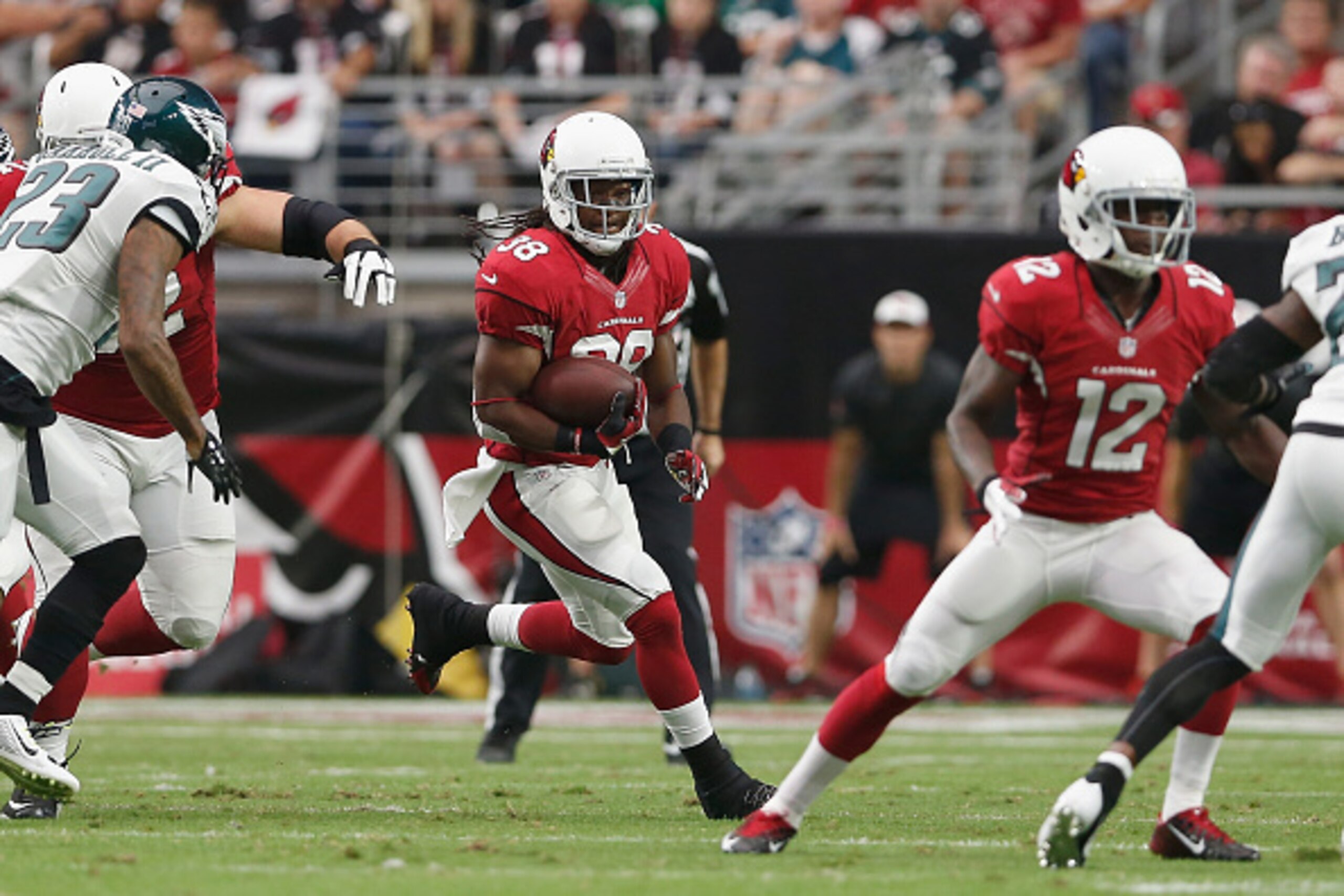
Former Arizona State running back Marion Grice was activated for Sunday’s game against the Eagles, and the Cardinals had four backs active on game day for the first time since Week 3.
But that was as close as Grice got to the field, as it was the Andre Ellington show from start to finish. In addition to rushing for 71 yards, Ellington caught three passes for 14 yards.
Over the past three games, he has averaged 27 touches per game. It appears Arians was not kidding when before the season he told everyone he wanted to get Ellington “25 to 30 touches per game.”
He has not been as effective this season as he was last season, when he led the NFL with a 5.53 yards-per-carry average. But he’s getting into the end zone of late and is helping wear down defenses.
Ellington was not great, but he was consistent and aided in the victory with his one-yard touchdown run in the first quarter.
Grade: C+
Wide Receiver and Tight End
3 of 10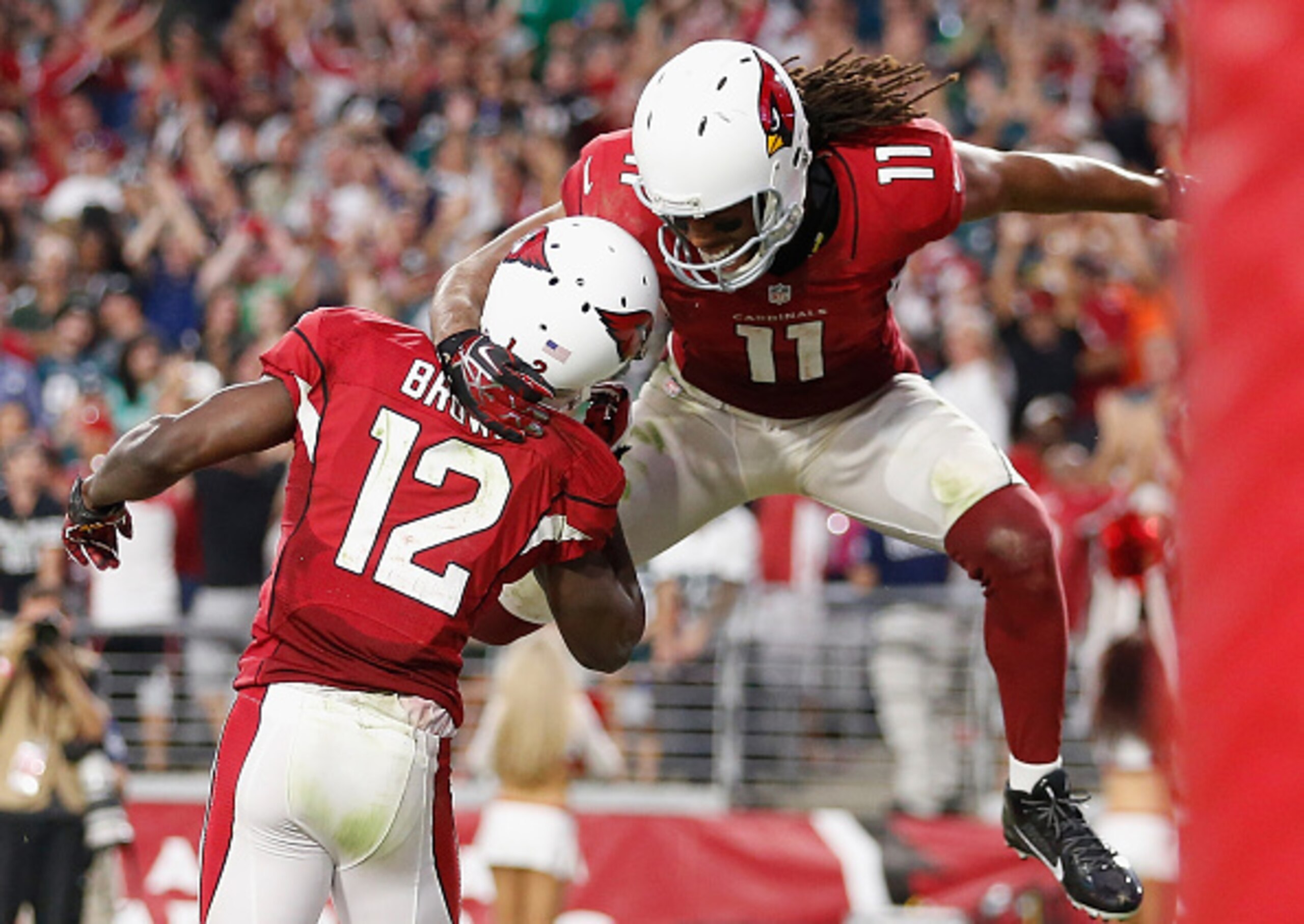
Larry Fitzgerald: 7 receptions, 160 yards, 1 touchdown
John Brown: 5 receptions, 119 yards, 1 touchdown
Everyone else: 8 receptions, 50 yards, 0 touchdowns
Does that put into perspective the kind of day the Cardinals offense had? If not for Fitz and Brown’s two touchdowns that covered 155 yards, this game ends very differently.
Floyd dropped two very catchable passes, including a first-quarter would-be touchdown that would have put the Cardinals ahead early. He was targeted just four times and did not catch a pass.
It looked for a moment as though tight ends would have a hand in the passing game, but that was quickly thwarted as John Carlson had two receptions for only 16 yards. Palmer did target the big tight end at the back of the end zone, and Carlson nearly came down with it. It took a great defensive play by Eagles inside linebacker DeMeco Ryans to knock the ball out of Carlson’s hands as he was coming down with the pass to keep the Cardinals out of the end zone on the drive.
Blocking was an issue at times for the receiver corps, as it always is. The team needs rookie tight end Troy Niklas back in the lineup if it expects to control the line of scrimmage against Week 9's opponent, the Dallas Cowboys.
Fitz and Brown’s big days help the grade, but overall it was a mediocre day for the receiver corps.
Grade: C+
.jpg?w=2560 "NFL Paris Football")
.jpg?w=2560 "Seahawks Chiefs Football")
.jpg?w=2560)
Offensive Line
4 of 10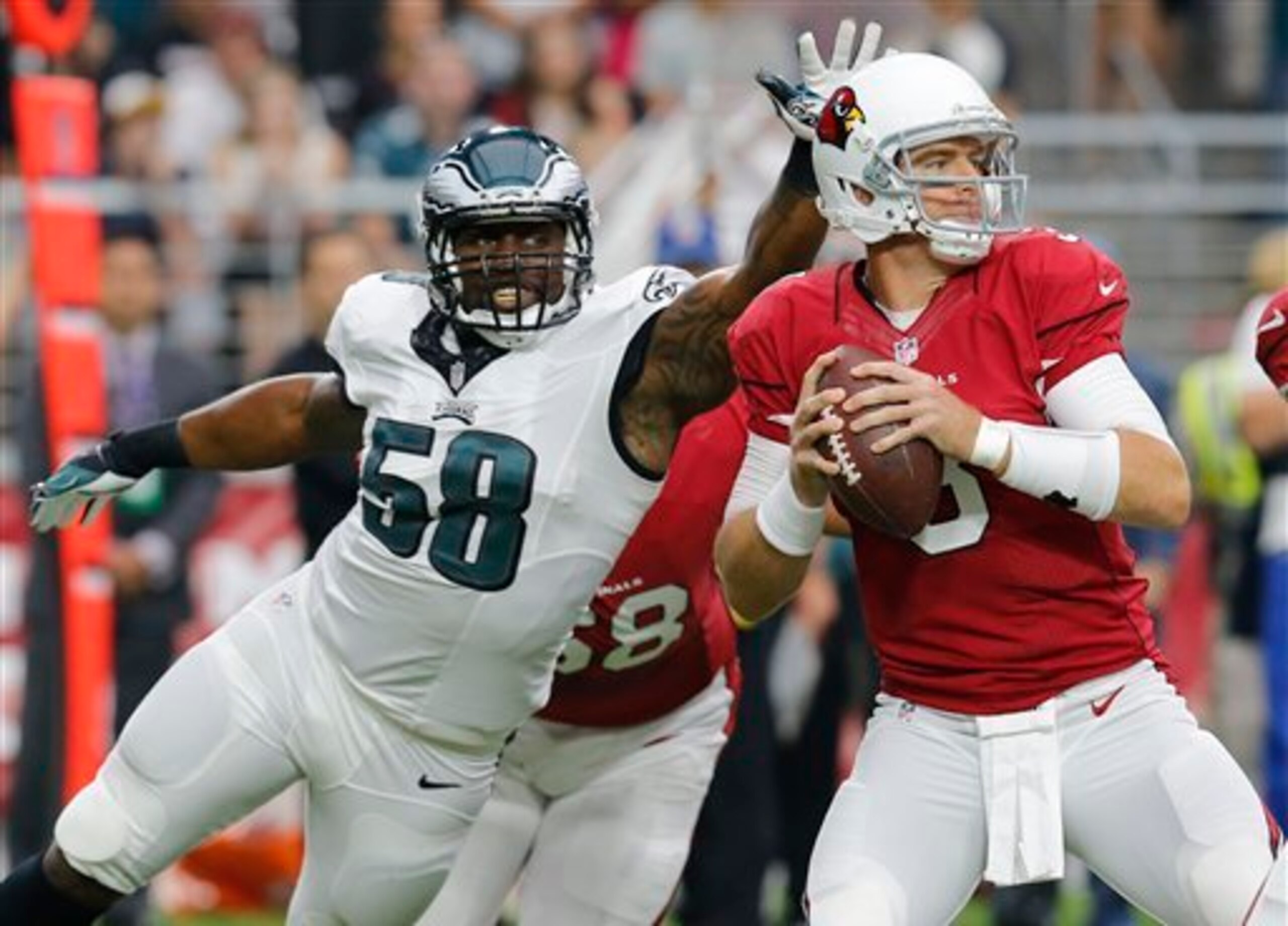
Palmer not being sacked all afternoon is more a testament to Palmer than it is the offensive line. The Eagles had Palmer on the ropes all afternoon; it took some athletic moves and a veteran prowess to repeatedly escape disaster in the backfield.
Arizona left guard Ted Larsen especially struggled, having a difficult time holding off Eagles linebacker Mychal Kendricks and nose tackle Benny Logan. Defensive line stunts gave Larsen fits on Sunday.
I watched right guard Paul Fanaika run right by two defenders in the backfield as he pulled on a power run play to the left. Ellington was hammered for a loss on the play.
At what point does the shoddy guard play become too much for Arians that he gives former No. 7 overall pick Jonathan Cooper a chance to redeem himself for a disappointing offseason? Where is the line in the sand? The two guards, though they are among the worst in the NFL, have not crossed it, apparently.
Grade: D
Defensive Line
5 of 10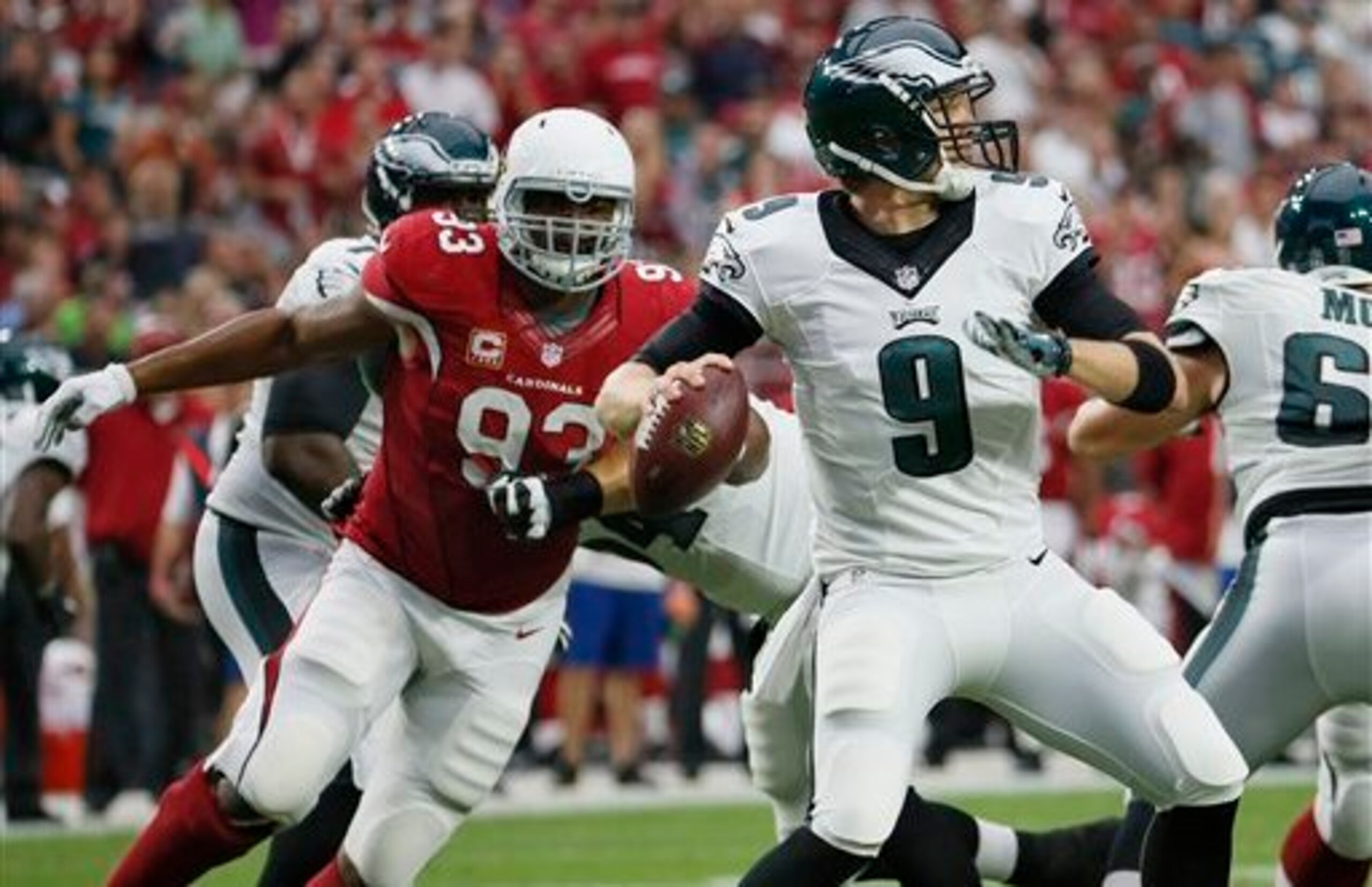
Too much pressure surrendered by the offensive line; not enough pressure created by the defensive line. Is this 2010?
But in all seriousness, Eagles quarterback Nick Foles had all day to throw on nearly every dropback. Even blitzes were unsuccessful.
It will take some in-depth film study to find out what’s wrong with the pass rush, but one thing is certain: the run defense has nothing wrong with it. Sure, McCoy ran for 83 yards and averaged 4.0 yards per carry. But most of that came in the second half when Arizona’s defense was on the field too long and was gassed.
That’s on the offense for not being able to move the ball, which ultimately is (again) on the offensive line for not being able to protect Palmer and open lanes for Ellington.
Calais Campbell returned to action against the Eagles, and he created a bit of pressure. But for the most part, the defensive line was merely average.
Grade: C-
Linebacker
6 of 10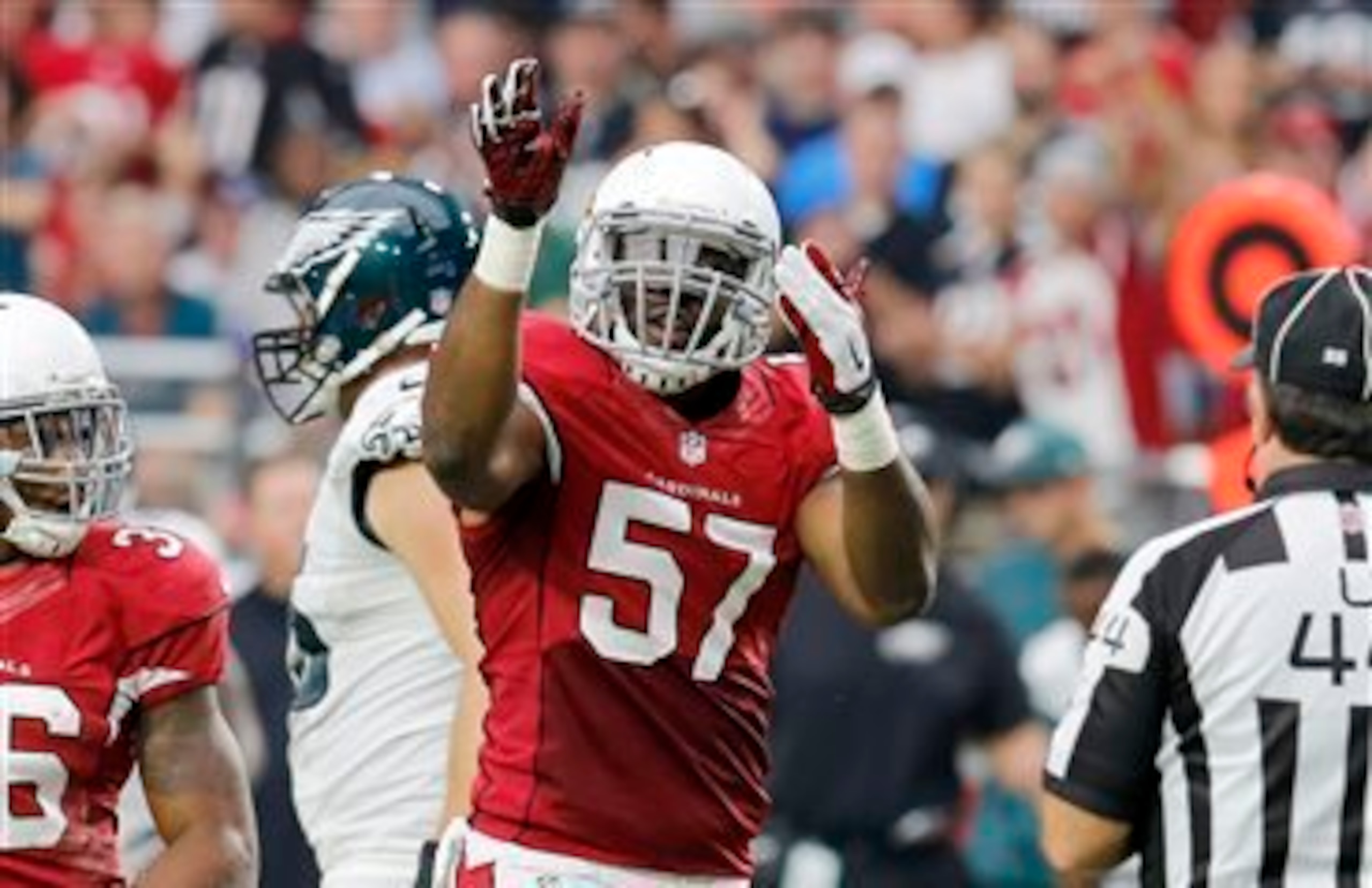
Linebackers were not making plays in this game. The secondary made the plays and, unfortunately, that’s not always a good thing. The top seven tacklers for Arizona in this game are officially listed as members of the secondary, though rookie safety Deone Bucannon mostly plays his defensive snaps at linebacker.
No pressure on Foles, only two plays in the Eagles backfield and poor coverage is a bad combination for a unit. It’s hard to get off the field on third down when the quarterback has no one within five yards of him as he looks for an open receiver downfield.
Foles could have sat in a recliner, thrown his feet up and sucked on a corncob pipe while reading the newspaper the way his offensive line protected him.
"Hearing the #Cardinals are looking for a pass-rusher before the Tuesday trade deadline. They've had talks but nothing serious at this point.
— Mike Jurecki (@mikejurecki) October 27, 2014"
I haven’t seen or heard confirmation from anyone regarding whether the team is looking to make a trade for a pass-rusher, but it makes sense if that’s the case. Arizona is near the bottom of the NFL in sacks on defense, and the edge rush is a big part of why that is.
Grade: D
Secondary
7 of 10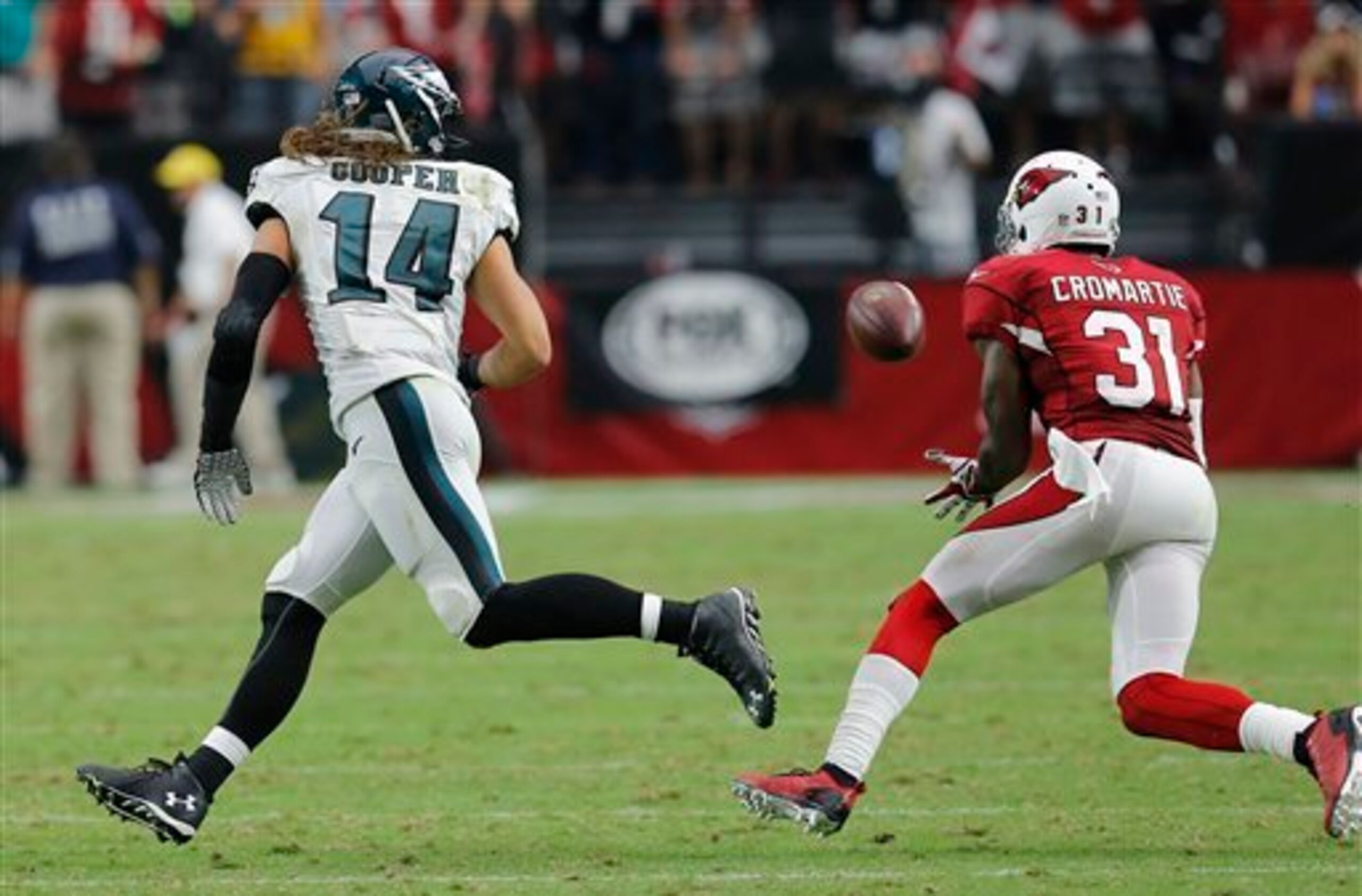
Cornerback Antonio Cromartie made two great plays on Foles passes to record his first interceptions with the Cardinals. It’s his sixth multi-interception game in his career, and he is the 13th player since 1960 to record that feat in a game for at least three teams.
He had done so for the San Diego Chargers and New York Jets in previous years.
Patrick Peterson left with a concussion in the first half and did not return. He was covering Eagles receiver Jeremy Maclin when Bucannon hit the receiver shortly after making a reception, and Maclin’s helmet collided with Peterson’s.
Foles was in control before Peterson left, and nothing changed after he went to the locker room.
On the day, Foles completed 36 of 62 passes (58.1 percent) for 411 yards, two scores and the Cromartie interceptions for a 75.4 rating. Lack of pressure led to the secondary needing to cover receivers longer, and the DBs did a nice job for the most part.
I’m interested in finding out just how many passes Foles threw away, because there were many of them. The third-year quarterback would move around in the pocket and escape when pressure finally arrived, only to throw it into the stands because no one was open.
That’s the main reason Foles’ completion percentage was so low. The secondary played a solid game given the fact the pass rush was nonexistent. That’s why the grade is not as poor as you would expect after allowing 400-plus yards passing.
Grade: B-
Special Teams
8 of 10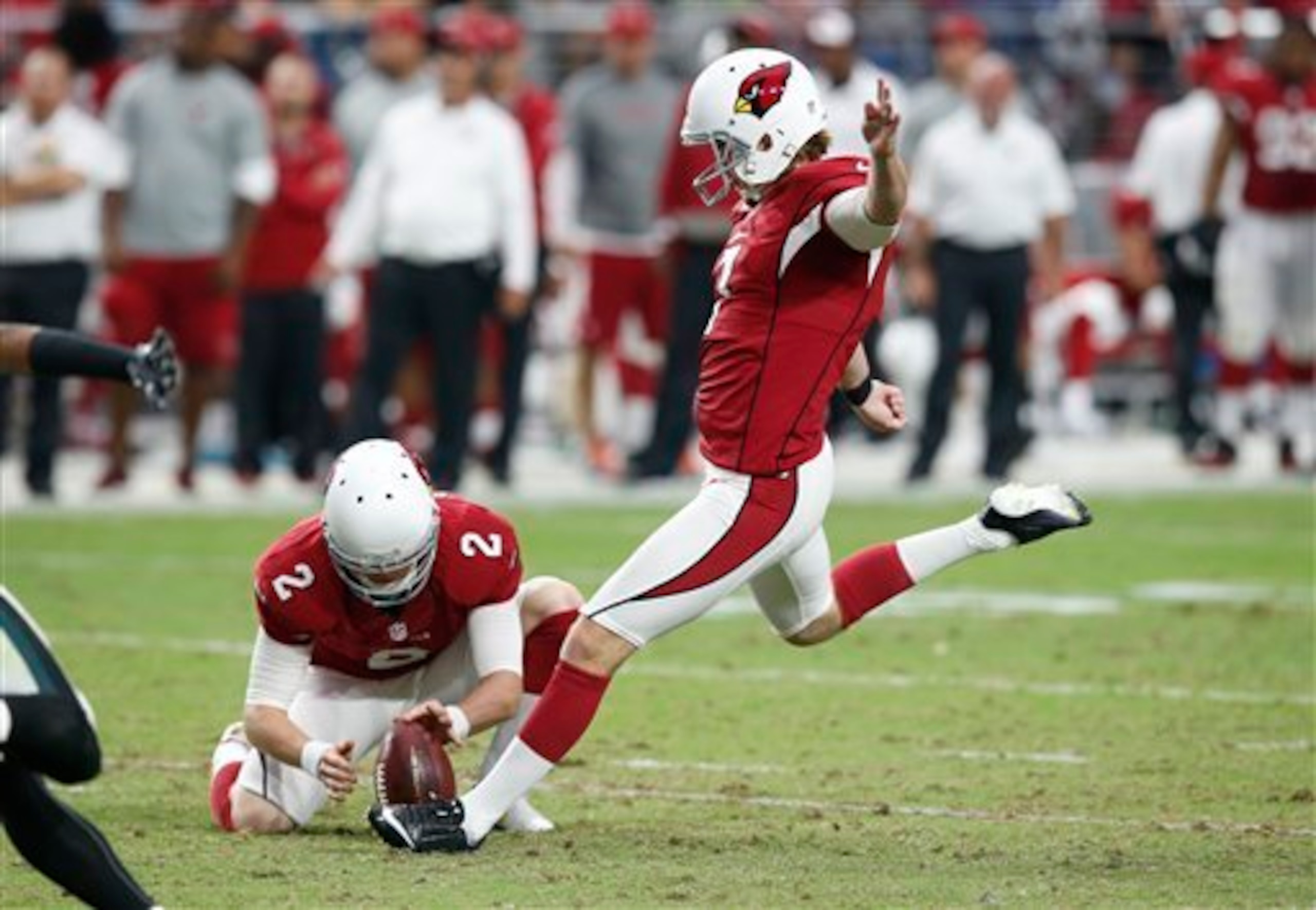
There’s not much to say here other than special teams did not shoot the team in the proverbial foot. Rookie kicker Chandler Catanzaro connected on his only field goal try, a 28-yarder that tied the game in the fourth quarter at 17-17.
He now owns the NFL record for most consecutive field goals made by a rookie to start a career (16). Next up is Washington kicker Kai Forbath’s NFL record of 18 straight to start a career by anyone—Forbath was in his second NFL season before he earned a job as a place-kicker.
Grade: B+
Coaching
9 of 10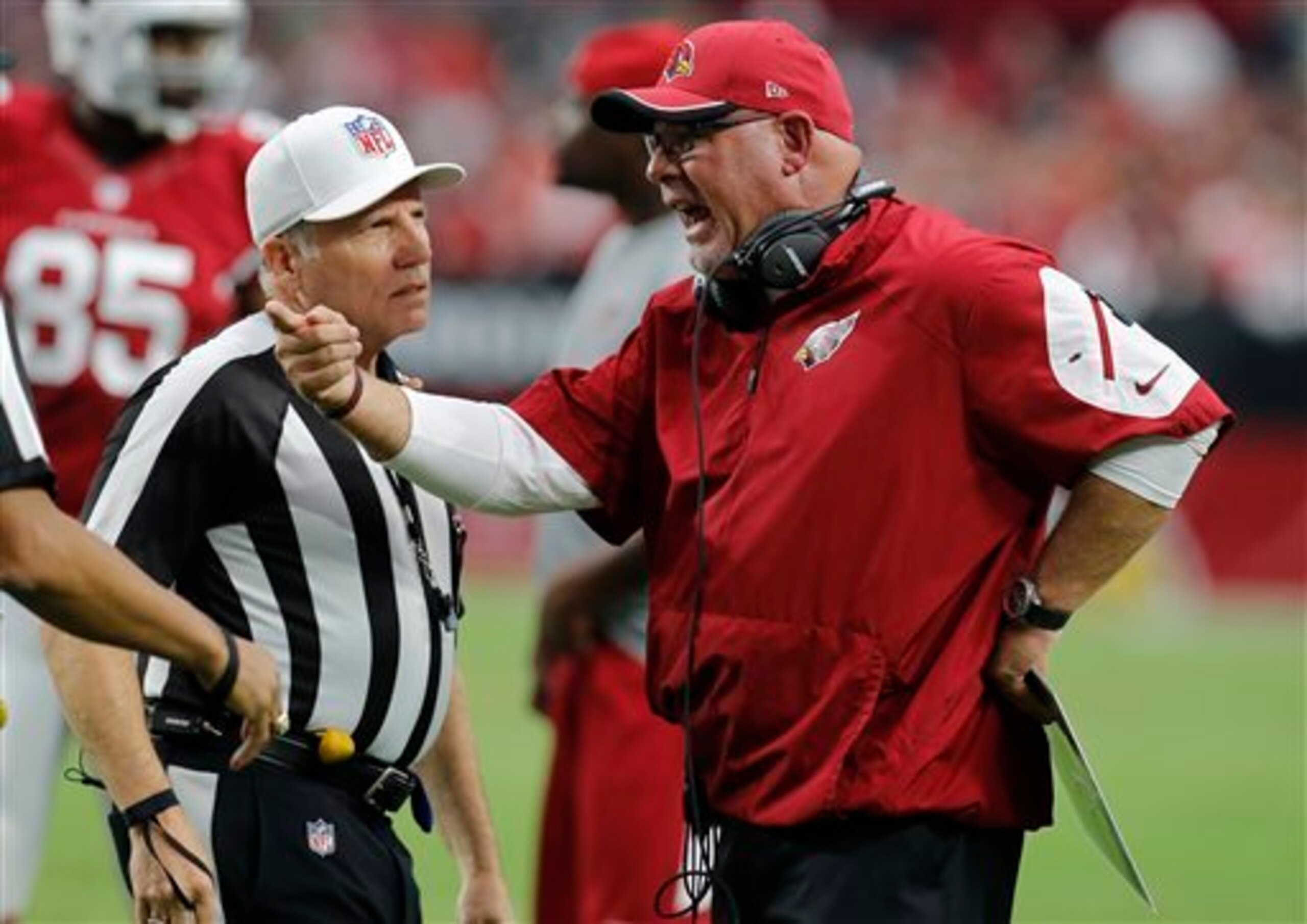
I’m going to be a bit harsh on this grade. Yes, the team beat a 5-1 Eagles team and has a two-game lead in the NFC West. But Arians needs to realize a couple of things regarding his offense.
The guard play is terrible. He cannot continue to ignore it and expect his team to continue pulling out these narrow wins. He’s continued to say virtually every week that the running game is “close” to breaking off big gains. What’s the problem on those runs that are “close”?
For the most part, it’s the play of the guards. Fanaika and Larsen struggle most on power runs—that is, when they have to pull to either side and be a lead-blocker for Ellington.
That’s not what they do well. Second-year guard Jonathan Cooper, however, was drafted to be that power-blocking guard able to pull to either side of the line and provide a running lane for the backs.
Why does Cooper ride the pine while Fanaika and Larsen stink it up in those situations?
Also, a couple of weeks ago, Arians stated the need to run the ball more in the red zone to help the offense be more successful in that area of the field. The Cardinals entered play on Sunday 31st in the NFL in red-zone scoring.
Ellington and Co. scored a touchdown in the second quarter from a yard out because they ran the ball in the red zone.
Why, in the fourth quarter, did Arians call three straight passing plays from the 10-yard line in a goal-to-go situation? He says the offense needs to run the ball more in the red zone to be more successful. He then has them run in the red zone against the Eagles to score an early touchdown before abandoning the run during—what was to that point—the most critical drive of the game.
It’s confusing.
Grade: C-
Final Grades
10 of 10
| Positional Unit | Grade |
| QB | B+ |
| RB | C+ |
| WR | C+ |
| OL | D |
| DL | C- |
| LB | D |
| Secondary | B- |
| Special Teams | B+ |
| Coaching | C- |
| Cumulative Grade | C+ |
You can't fault defensive coordinator Todd Bowles for calling so many blitzes—especially late in the game. It's what he does, and it's how this team creates pressure. Without blitzing, there would be no pressure at all. He doesn't have the personnel to allow him to get pressure on opposing quarterbacks without sending at least five rushers.
Some teams do; this team does not.
Bowles sending six or more rushers at the end of the game, which is really the only time Foles was under consistent pressure, is the only reason the Cardinals hung on. If he has the defense drop into coverage on that drive, the Eagles would very likely have walked away with a win.
That's the only reason the coaching grade is as high as it is. Arians' situational play-calling was questionable, as is his continued decision to keep his first-ever draft pick as a head coach, Jonathan Cooper, on the bench in favor of Fanaika and Larsen. Either one of them could be benched at this point for Cooper, and he will have earned it.
Arians owes it to the offense to give Cooper a shot at either guard spot. What's the worst that could happen? Cooper plays just as poorly as the man he replaced?
The chances of that happening are slim, if you ask me. Cooper's athleticism alone makes him a better option over either guard based on how often Arians asks his guards to pull in front of Ellington.
This is the bottom line: The Cardinals beat the Eagles on Sunday with the help of two great plays on offense and some timely defense—not to mention Philadelphia shooting itself in the foot repeatedly with 11 penalties. An Arizona performance like that in Dallas next week, and we may be looking at a repeat of the Denver game.
Arizona is 6-1 and on top of the NFC West by two games. But not all is as well as the record indicates.
All stats gathered from ESPN.com and Pro-Football-Reference.com
.jpg?w=2560 "Titans Colts Football")