New things aren't always shiny. Sometimes they're unpolished, raw and ineffective.
The New York Knicks defense is the latter.
So, their (triangle) offense must be the former—perfect in a way that is aesthetically and functionally pleasing, and capable of limiting the damage their defensive deficiencies are bound to inflict.

Swiss Cheese Defense
Presupposing that the Knicks will actually play insufficient defense isn't really a daring assumption. It's more of a foregone conclusion.
Anyone and everyone needing a refresher on New York's point-prevention potential was treated to an enlightening preseason loss against the Milwaukee Bucks on Monday night. The Bucks, owners of a bottom-five offense last season, torched the Knicks for 120 points on 59.7 percent shooting, including a 50 percent showing from behind the three-point line.
It was an ugly performance, but one The Wall Street Journal's Chris Herring maintains is an accurate preview of what's to come:
Last year, the Knicks ranked 24th in defensive efficiency, their standing the result of excessive switching and inadequate personnel. Early preseason returns don't indicate they'll improve much, if at all. They could wind up being even worse.
Opposing offenses are hitting 45.2 percent of their shots against the Knicks, which is slightly above the 44.9 percent they allowed in 2013-14. Yes, it's only the preseason, where defense is optional and third- and fourth-stringers taint small sample sizes, but that doesn't make their defensive ceiling any more encouraging.
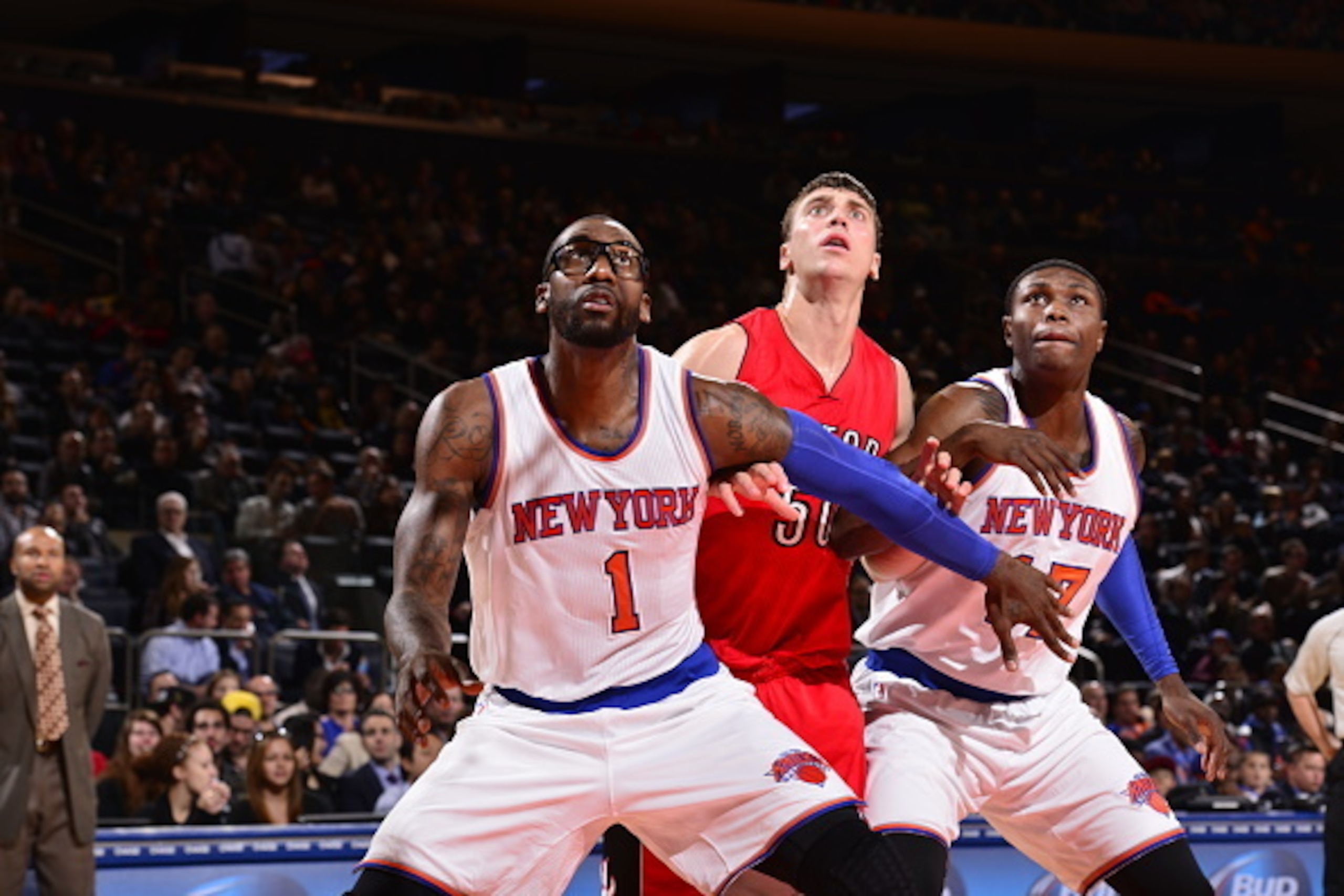
Liabilities remain prevalent up and down the roster. The Knicks still employ Andrea Bargnani—who hasn't played since Oct. 8—and Amar'e Stoudemire, two interior sieves; Jose Calderon is only an offensive upgrade over Raymond Felton; Carmelo Anthony won't suddenly defend like LeBron James for 48 minutes a game, 82 games a season; Samuel Dalembert ranked 109th in rim protection among qualified players who contested at least two point-blank attempts per game last year; Tim Hardaway Jr. still runs afoul on the perimeter; and J.R. Smith is a habitual gambler who mostly loses.
Shipping Tyson Chandler off to the Dallas Mavericks won't help in the long run, either. The Knicks certainly won't miss the Tyson Chandler of the last 18 months, but he was at least someone who could feasibly protect the rim and enhance an otherwise incompetent defense.
Iman Shumpert projects as their only proven and valuable defender. Often criticized for his passive offensive game and general disappearing acts, he continues to be a defensive rock:
That's one player, though. One player on a team of 12-to-15 isn't enough.
Nor is the Knicks defensive system—if you can even call it that—enough to mask their collective flaws, despite what new head coach Derek Fisher posits:
Help isn't an operative concept right now. Players aren't getting back on defense following misses, and the Knicks have been ill-prepared to guard against smaller lineups.
“J-Kidd felt how the game was going and went small ball,’’ Anthony said following the loss to Milwaukee, per the New York Post's Marc Berman. “It’s something we haven’t even worked on.”
Smaller lineups—which the Knicks have strayed from—force detrimental mismatches. If the Knicks stay big, Dalembert, Stoudemire or another tower is forced to defend against floor-spacing forwards. If the Knicks go small, they suddenly have guys such as Anthony and Shumpert defending out of position.
Neither situation is ideal, as the loss to Milwaukee reinforced. Even if the Knicks improve defensively, even if they implement some semblance of structure and system, they cannot rely on their preventive measures to help them.
This team, given its personnel, lack of rim protection and early efforts, cannot count on itself to be more than a bottom-feeding defensive unit.
Offensive Perfection: A Necessity, Not a Luxury.

In lieu of a dependable defense, the Knicks need an outstanding offense.
Thirteen of the league's 16 playoff teams finished in the top half of defensive efficiency last year. Of the three in the bottom 15—Brooklyn Nets, Dallas Mavericks and Portland Trail Blazers—two of them (Dallas and Portland) fielded Top Five offenses. The Knicks will need to achieve similar balance for a postseason return.
And that means perfecting the triangle.
Soon.
"It's going to take a few months," Smith said of the triangle, via ESPN New York's Ian Begley. "Over the course of the year, understanding where everybody is going to be, [understanding that] 'some like it here, [some] like it like that.' It's going to take a while."
Time isn't something the Knicks have in endless supply. They ran a Top Eight offense from Jan. 1 through the end of last season—Top Four from Jan. 23 on—and it still wasn't enough to catapult them into the Eastern Conference's wide-open playoff picture.
Starting slow once again puts them at a severe disadvantage. It's important their offensive learning curve isn't so steep. They need to be ahead of this months-long schedule. And there have been signs that an immediate jump is possible.
"More important than that is the ability to lose yourself in the action and not fall prey to basketball instinct," Yahoo Sports' Kelly Dwyer wrote of the triangle. "Those instincts tell even the most selfish player to shoot the ball the first time he touches it or the steadiest defender to jump at every pump fake, but one has to buy into something bigger if they want to work on Jackson’s team."
To this point, the Knicks have, for the most part, bought into the system. They have 105 assists on 165 made baskets through five preseason contests. Assisting on 60-plus percent of converted shots was unheard of last year; they ranked 27th in assist percentage.
Even Anthony is passing more. His 14 assists through 115 minutes of preseason play are the equivalent of 4.4 per 36 minutes, noticeably above his career average of 3.1.

Shooting and systematic deviations have been the Knicks' biggest issues thus far. Though their assist percentage is high, they're hitting just 42.2 percent of their shots, moving the ball almost to a fault—especially in transition.
Misunderstandings also abound. Anthony is already talking about taking fewer shots and scoring fewer points, according to Begley. And, like Pro Basketball Talk's Brett Pollakoff underscores, fewer points and shots aren't what the Knicks need from him at all:
"It’s a positive sign that Anthony is willing to take fewer shots if that’s what will help his team win, and the Triangle Offense is in fact one of equal opportunity; when run correctly, it should provide plenty of open looks for all five players on the floor.
But it also can provide enough options for a primary scorer to be the beneficiary of all of those actions...
...For the Knicks to be successful this season, Anthony will need to score at a similar clip as he has the past few seasons. It may feel like less of a burden with the new offense in place, and he may not need to be the one who takes the shot in every pressure-packed situation if the offense runs the way it should.
"
Michael Jordan averaged at least 25 points per game in all eight of the seasons he played under Phil Jackson. Kobe Bryant cleared the same benchmark nine times in 11 years. Shots will be there for Anthony in the triangle, and he must take them.
Avoiding them is part of the problem.
Anthony, like many of his peers, has developed a habit of over-passing. His teammates are more guilty of deferring excessively than him, and it's frequently left the offense looking disjointed.
Indeed, Anthony attempted 22 shots in 31 minutes against the Bucks. But many of those attempts—in the second half specifically—came within isolations or late in the shot clock, and the triangle isn't a blueprint for forcing action.
Opportunities are supposed to come organically, off fluid reactions to the defense and its spacing. The Knicks are struggling to grasp these core principles. While that's to be expected, they're making mistakes they cannot afford to make, generating offensive results they cannot afford to generate.
Progress for Sake of Success

Securing a postseason return is the goal for these Knicks. There are no substitutes.
Snagging a lottery pick they would actually keep does little to sell free agents and incumbent pieces on the future. Anything less than playoff basketball will be deemed failure.
It's on the offense to get them there, the one that's in its infancy and still needs to be honed and manipulated, then mastered if it's to fit within the modern-day, three-point-happy NBA. That's a tall order for any squad, but it's the Knicks' reality.
Meaningful games are on the horizon, and an ill-equipped defense has put pressure on the Knicks to strive for offensive preeminence, lest they lose another year to transition-taxed, lottery-fated basketball.
*Preseason stats courtesy of RealGM. Remaining stats via Basketball-Reference and NBA.com unless otherwise cited.

.jpg?w=2560 "NFL House in Paris Closes for Protests")
.jpg?w=2560 "Trevon Diggs Cut by Seahawks")