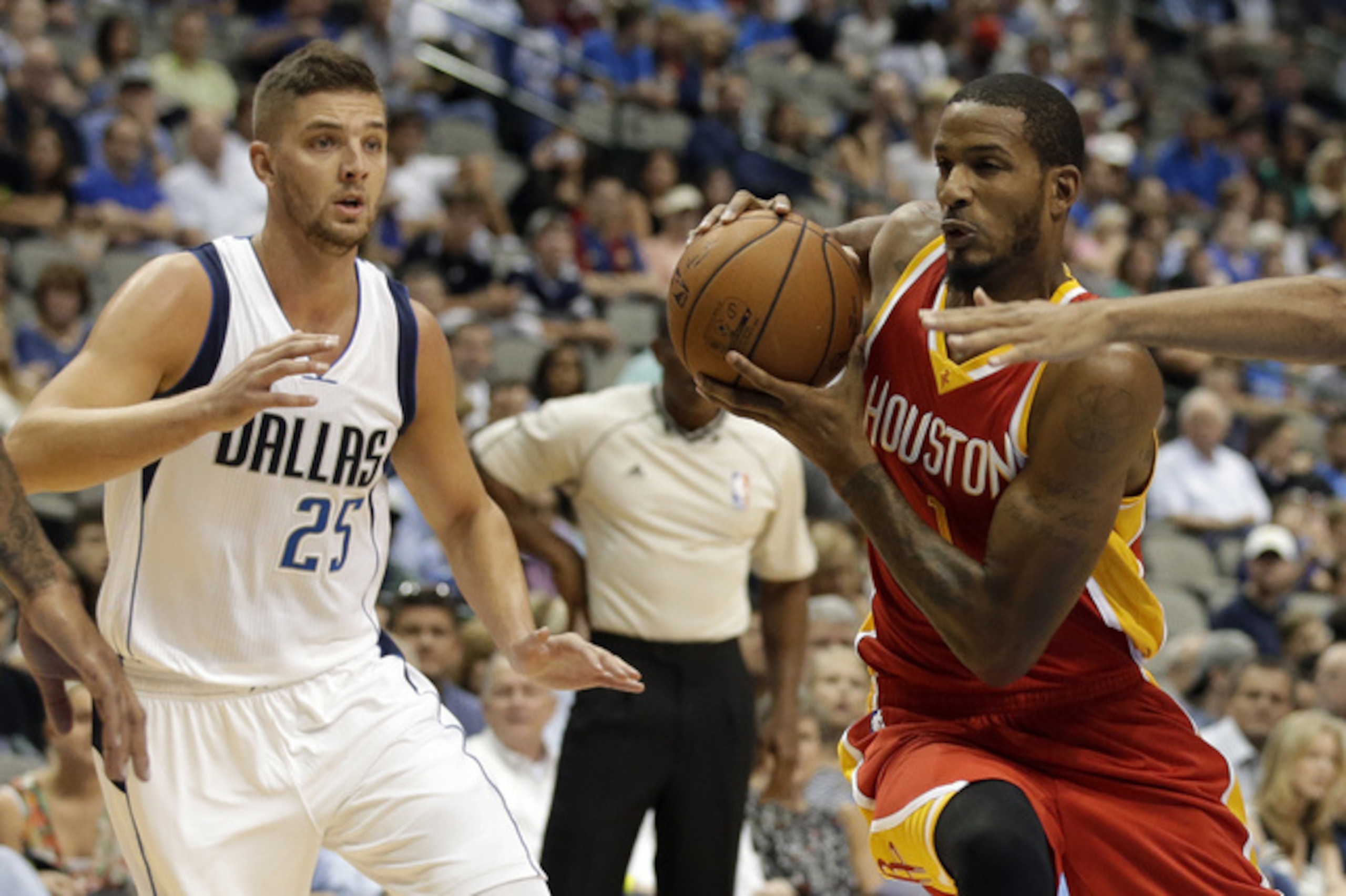

Back in Houston, Ariza Happily Finds Role That Right for Him, Rockets
HOUSTON -- From the moment Trevor Ariza first joined the Rockets and in some ways even in the months before he signed on that day in July, 2009, he was filling in for someone else. He had been fated to that no-win situation in the Rockets’ era of injuries, but that was what he wanted. It did not go well.
Months after the Rockets had finally escaped the playoffs’ first round and the Lakers team that eliminated them had rolled all the way to the 2008-09 championship, Ron Artest had jumped ship to Los Angeles, leaving a void for Ariza to fill in Houston.

It did not end there. Ariza was signed to the disabled player exception made available by the season-ending injury to Yao Ming. And when the season began, Tracy McGrady was still working his way back from microfracture surgery and on his way to playing just six more games with the Rockets.
For Ariza, that all offered an opportunity to expand his game beyond his role-player duties next to Kobe Bryant with the Lakers. He wanted that chance and pushed the limits of his game, hoping to become the star he could not be on Bryant’s Lakers or with Yao and McGrady.
Ariza had joined his fourth NBA team, but was still just 24-years-old and ambitious, confident from his breakthrough playoff run in that championship season. He was not, however, that kind of player. He was a very good supporting actor. He was a miscast leading man.
Ariza was traded after one season, playing in New Orleans and Washington before he signed as a free agent last summer to come back to Houston to fill the void left by Chandler Parsons’ departure. But as Ariza returns five seasons since his first in Houston, he will not attempt to be Parsons, any more than he could be Artest, Yao or McGrady.
“I learned my game,” Ariza said. “I learned what I can do. I know what I can’t do.”
Unlike that one season with the Rockets – and to a large degree, because of it – he has learned to simply be the player he has always been and to find a team that just needs that.
"He's very comfortable with who he is,” Rockets coach Kevin McHale said. “Whenever you get comfortable with who you are you end up being a very good player. You don't do what you don't do well and you do do what what you do well a lot more. He's very comfortable. Good defense. Makes the extra pass. Good shooter."
More than that, he has grown to accept who he is and understand how important that can be. The four-year, $32 million contract the Rockets gave him might have demonstrated that his contributions are valued, but the Rockets had signed him to a five-year, $33.8 million deal in 2009 when he was determined to “expand my game."
Ariza was so driven then to become more than he could be next to the sort of star he had played with before, he turned down the Cavaliers and a chance to play with LeBron James so he could play with the Rockets without Yao and McGrady.
"I think it was real important,” Ariza said of those lessons. “I got to understand what it was like to play without superstar players, which was tough to do, very stressful.”
He might have learned the hard way, but he did come to embrace his role and accept his limitations in order to make the most of his strengths. They are strengths as a 3-and-D small forward that fit the Rockets’ needs, but that might not have been able to stand out the way they now do had he not cut away the rest.
“He was still finding himself,” Rockets vice president Gersson Rosas, then the Rockets director of player personnel, said. “You see him now, he's found himself. He knows who he is. He's comfortable in his own skin. He understands what his strengths and his weaknesses are. And he understands and values the opportunity to get where he was before he got to us which was as an NBA champion.
“Seeing where we're at now compared to where we were his first time around (with the Rockets) and his understanding of the role we need him to play and what he does for us and how he can be such a great complement to James (Harden) and to Dwight (Howard), it's not even just a situation where he fits in well to it. He wants it and he's passionate about doing it.”
For a player to know his strengths and weaknesses requires that he acknowledges that he has weaknesses, an admission foreign to many NBA players, especially in those early, ambitious years in the league. The term “role player” is still treated as faint praise at best, when excelling in a few ways next to a star wins championship rings, including the one Ariza won with the Lakers.
“A lot of guys don't figure that out,” Rosas said. “A lot of guys never get the understanding of who they need to be. He's done it. And not only has he done it, but he's thrived. He's learned that what he does great is very valuable to help a team win.”
Ariza’s goals were not entirely noble. He wanted a way on the court and he was not going to get it by carrying a team’s offense. He does take pride in his defense and has steadily improved as a 3-point shooter. He considers his ability to get in passing lanes and disrupt an offense special.
The trick was honing those talents and finding a team that would value them.
"I don't think any player that is a competitor ever wants to be put in a box because once you're put in a box it's hard to get out, especially if you start to do something exceptionally well,” Ariza said. “One thing that always stuck with me is if you want to be on the court, you have to do something different. Everybody in the NBA can play basketball, but you want to make yourself special on the court.
“That's one thing I always thought about. I'm not naturally a great scorer, but I want to play. I'm a competitor. I felt like when I'm on the floor, I give my team a better chance to win. So I figured out other ways, other things to do to help my teams be good teams, to win.”
The Rockets have said that Ariza’s influence has been nearly as valuable. Parsons' ambition was good for the Rockets when they were the youngest NBA team through most of his three seasons in Houston. It was not enough to have reached the NBA. He and the players he helped lead wanted more.
With Ariza, the Rockets have moved to the mindset of a team and player that already knows what they can be and have learned to be happy with that.
“It's very refreshing," Rosas said. "Trevor always had a great heart, always was a great worker. His first time around he was trying to be the best he could be for us, for the needs that we had. Now our structure is set up a lot better for who he really is. It allows him to be genuine to himself and help us at the highest level which is refreshing for all of us."

.jpg?w=2560 "NFL House in Paris Closes for Protests")
.jpg?w=2560 "Trevon Diggs Cut by Seahawks")