Marshawn Lynch Taking New Role for Seahawks Offense as a Possession Receiver
When Golden Tate took his physically bruising approach at the wide receiver position to the Detroit Lions over the offseason, immediately there was a void in the Seattle Seahawks offense.
Not a general one, as between wide receivers Doug Baldwin, Jermaine Kearse, Percy Harvin and Ricardo Lockette, plenty of weaponry is still available for quarterback Russell Wilson.
This missing piece was specific. The Seahawks and their passing game that primarily focuses on gaining chunks after short throws no longer had a source of power on their wide receiver depth chart to bang bodies and blast through tackles.
TOP NEWS
.jpg?w=2560 "NFL Paris Football")
NFL House in Paris Closes for Protests
.jpg?w=2560 "Seahawks Chiefs Football")
Trevon Diggs Cut by Seahawks
.jpg?w=2560)
B/R's Expert Week 7 NFL Picks 🔮
That’s fine because there’s plenty of power elsewhere. It can be found at running back and with the brute, bullying force of Marshawn Lynch. He’s the ideal target in the open field and can adapt to whatever the situation presents, either hammering forward or being a slippery annoyance.
Early in the season Lynch has assumed a far greater presence as a receiver, taking on that Tate role of abusing defenders who are left flailing and later hurting. But before exploring Lynch’s increased passing-game usage, we first need to understand exactly what needed to be replaced and the Seahawks’ need for a pass-catcher cut from the Tate mold.
During Seattle’s championship season in 2013 Tate finished with 598 yards after the catch. That was the 15th-highest total in the league overall and the eighth-best among wide receivers. Tate’s trucking after the catch last year becomes even more impressive when we factor in the lack of footballs thrown in his direction compared to his peers.
Tate simply didn’t get a high volume of targets, which isn’t exactly shocking stuff in an offense that’s leaned heavily on the run under head coach Pete Carroll and finished 31st in pass attempts per game a year ago.
The seven receivers ahead of Tate in yards after the catch all had at least 20 more receptions. And that’s being conservative because several trumped Tate by a significant margin.
| Receptions | Total receiving yards | Yards after catch | |
| Demaryius Thomas | 92 | 1,430 | 704 |
| Pierre Garcon | 113 | 1,346 | 667 |
| Josh Gordon | 87 | 1,646 | 637 |
| Antonio Brown | 110 | 1,499 | 602 |
| Kendall Wright | 94 | 1,079 | 588 |
| Harry Douglas | 85 | 1,067 | 534 |
| Dez Bryant | 93 | 1,233 | 527 |
| Golden Tate | 64 | 898 | 520 |
Washington Redskins wide receiver Pierre Garcon leads that list with 113 receptions, a whopping 49 more than Tate. That makes his 147-yard advantage in YAC marginal given the far greater workload.
Broncos wideout Demaryius Thomas' yards after the catch—the most in the league—represented 49.2 percent of his total receiving yardage. That’s plenty, but Tate’s reliance on post-catch chugging was even higher at 57.9 percent.
He had nine games in 2013 where he accumulated at least 30 yards after his receptions, topping out at a single-game high of 75 YAC in Week 10, according to Pro Football Focus (subscription required).
Suddenly last March that source of muscle vanished. Power and physical force serve as the foundation for the Seahawks offensively, which is evident in how much of Wilson’s passing yardage comes through the air. Or rather, how much of it doesn’t come through the air.
Wilson can be creative and use his wizardry to leave defenders grasping at little more than air, which we saw in abundance Monday night.
But although he can heave it deep with accuracy—as he did against the Redskins with two completions for 30-plus yards—and has overall pinpoint precision (70.3 completion percentage), Wilson needs playmakers to churn out yards following screens and swing passes.
Of his total passing yards so far (852 yards) only 41.4 percent have come through the air, per PFF. That’s 25th among the 27 quarterbacks who have dropped back to pass at least 135 times this season.
Enter Lynch.
"Marshawn Lynch has already scored more receiving TDs this season than he has in any other season in his career.
— Mike Braude (@BraudeM) October 8, 2014"
Harvin has certainly done his share to replace Tate while running with authority and speed. But although he’s more than willing to move piles, that’s not an ideal position for him to be in often after missing 34 games over his past three seasons.
Lynch’s Skittle-infused style fits perfectly in a seek-and-destroy role. His passing-game usage was already growing even before Tate’s departure, as in 2013 he established a new single-season receiving yards high (316 yards) and a single-game high (78 yards in Week 6).
Through a quarter of this season the balls directed at his soft hands have increased further. A year ago after four games Wilson had targeted Lynch nine times, which included one game when he wasn’t targeted at all.
Now? He’s received 15 looks, catching 13 of them for 126 yards and three touchdowns. That’s setting a pace to shatter a few previous numbers into tiny pieces.
| 2013 | 36 | 316 |
| Current pace for 2014 | 52 | 504 |
At some point during the season we’ll surely see a course correction there. But given his swift uptick in receiving usage in 2013 and now even more early this season, there’s little reason to think Lynch won’t set a career high for the second straight year.
He’s already scored three times through the air on only those 13 catches. Over his previous eight NFL seasons Lynch’s 202 receptions resulted in five receiving touchdowns. Five.
As a receiver he’s mostly been used in three ways. The first, predictably, is as a bailout option during Wilson’s fire-drill situations when he controls chaos long enough to somehow find an open target.
That’s a common receiving role for a running back. But it’s even more critical to the Seahawks because of how often Wilson enters into his whirling wizardry mode. Wilson needs a short option who he’s familiar with and makes the same reads during moments of intense pass-rushing pressure.
Lynch is consistently that guy, as he was Monday night during a key third-down play in the fourth quarter to secure a win. Wilson should have been sacked by Redskins outside linebacker Ryan Kerrigan or any of the three pass-rushers closing in after the designed play (a screen to Harvin) was blown up immediately.
Instead he spun to escape Kerrigan, and while sprinting to his left a right-handed quarterback still managed to square his body and float one to Lynch, who then outran and evaded several tacklers for a 29-yard gain.
Just like that the Seahawks were in field-goal position when they should have been punting and giving the Redskins an opportunity to tie the game.
Lynch has also been used less conventionally and split out wide in the red zone.
In Week 3 Seattle was five yards away from a touchdown with only 17 seconds remaining in the second quarter of an eventual win over the Denver Broncos. They were in a position to have about two shots at the end zone before settling for a field goal, a significant difference in a game that went to overtime.
Instead of banging helmets straight ahead with Lynch, the alignment selected by Seahawks offensive coordinator Darrell Bevell didn’t feature a running back in the backfield at all.
The backfield was vacant, with Wilson alone in shotgun and a spread formation in front of him. Three receivers were bunched to his left, and Lynch was positioned wide to his right with tight end Zach Miller in the slot.
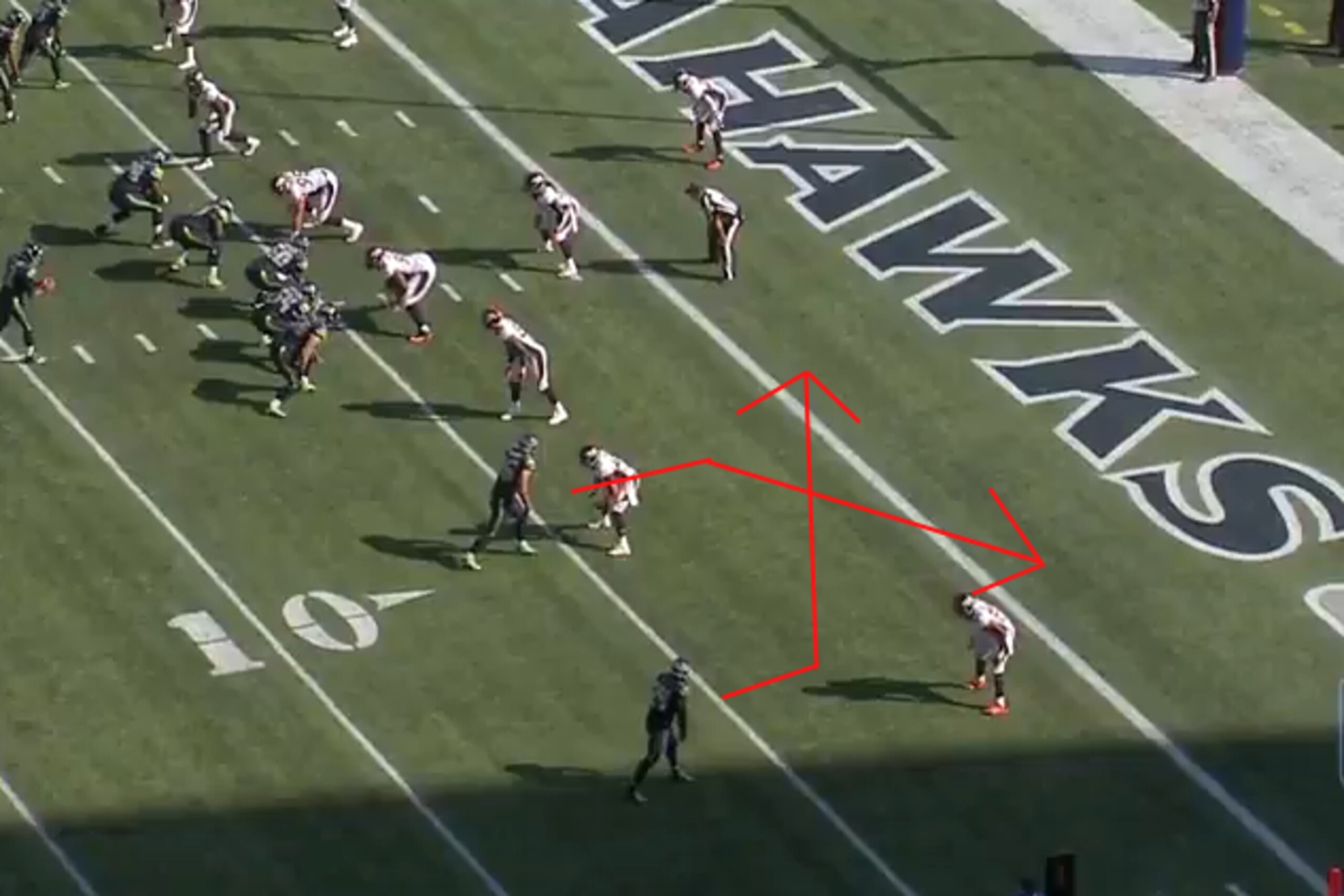
A “rub” was then executed, which is football vernacular for a legal pick.
Lynch set up Broncos linebacker Brandon Marshall—who was assigned to cover him and instead ended the play on his stomach—with a slight hesitation before running a slant inside. Before he made that cut Miller ran a corner route directly into Marshall’s path, completing the pick play.
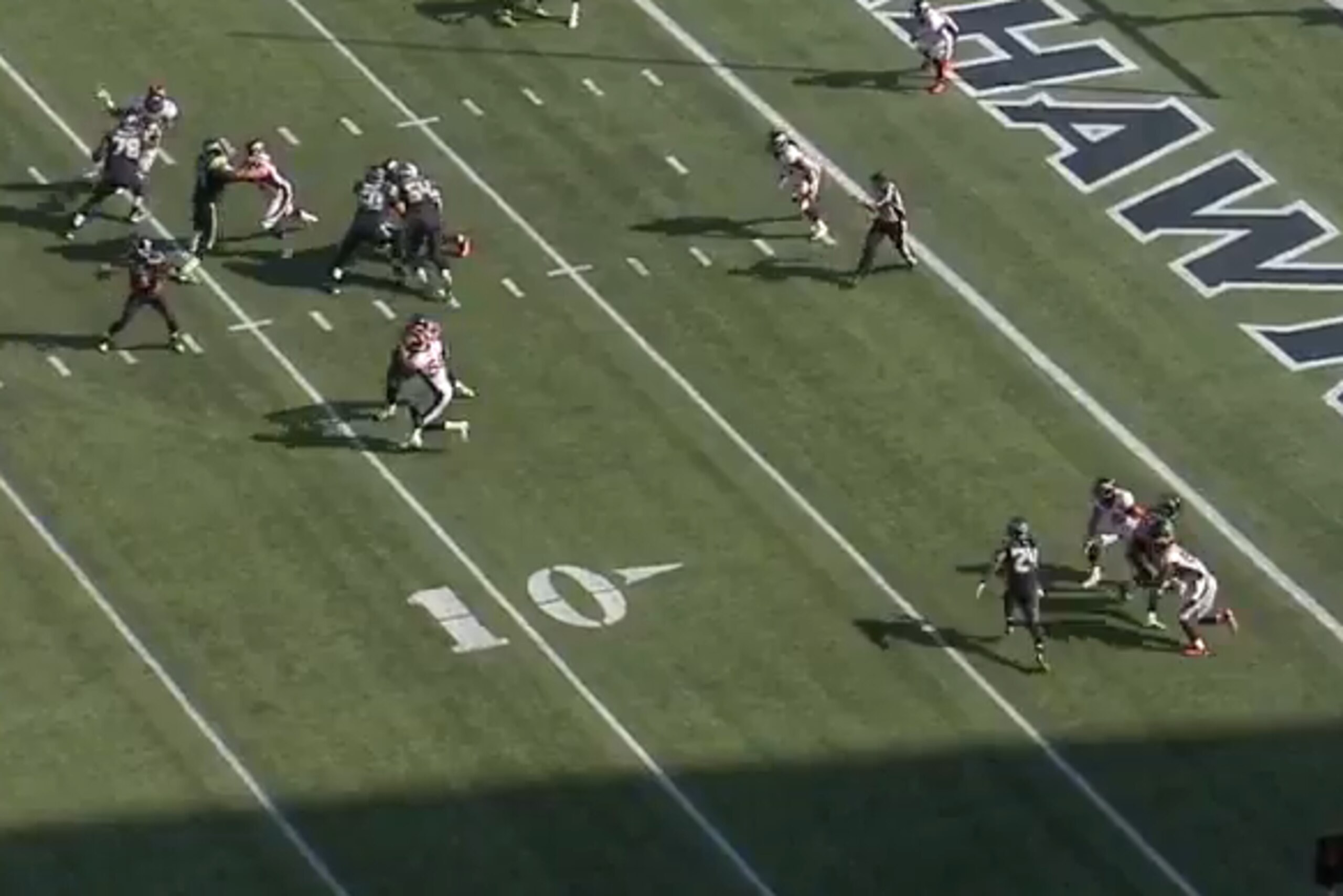
Though the end result looked easy, the play still required a steady set of hands for a catch up the middle in traffic. Just as Tate did last year, Lynch has those hands.
Lynch’s increased receiving activity combined with Harvin’s health for (hopefully) a full season will likely mean Baldwin and Kearse see limited targets.
So far they’ve played the most passing-down snaps of any Seahawks receivers, according to PFF (136 for Baldwin and 122 for Kearse). Yet often they’ve been asked to block for Lynch and Harvin.
Baldwin has been on the field for 58 more passing snaps than Lynch, and after Week 5 he's only one reception ahead of Seattle’s top running back. Kearse is behind Lynch by five catches even while being used for 44 more passing snaps.
Slowing the Seahawks offensively means containing both Harvin’s speed and Lynch’s physicality in the open field while also being mindful of Wilson’s creativity. Together the three give Seattle one of the most athletically dynamic offenses in football.
.jpg?w=2560 "Titans Colts Football")