Quarterback Nick Foles hasn't been the same, running back LeSean McCoy and wide receiver Riley Cooper have disappeared and Pro Bowl wideout DeSean Jackson is long gone. On the surface, that explains why the Philadelphia Eagles haven't been as dominant offensively as many expected they'd be in 2014.
But Jackson's been replaced offensively by Jeremy Maclin, who missed the entire 2013 campaign due to a torn ACL, as well as newcomers Jordan Matthews and Darren Sproles. Plus, second-year tight end Zach Ertz has taken on a larger role in the passing game.
So the real factor at play here is the decline in productivity from Foles, McCoy and Cooper, all of whom had career years in 2013. The quarterback led the league in passer rating, touchdown-to-interception ratio and yards per attempt, while the running back led the NFL in rushing.
TOP NEWS
.jpg?w=2560 "NFL Paris Football")
NFL House in Paris Closes for Protests
.jpg?w=2560 "Seahawks Chiefs Football")
Trevon Diggs Cut by Seahawks
.jpg?w=2560)
B/R's Expert Week 7 NFL Picks 🔮
But a quarter of the way through the 2014 season, Foles ranks in the bottom 10 among qualifying quarterbacks with a passer rating of just 81.7. With four interceptions, he's already doubled his total from last season, and his completion percentage and average have both dropped off significantly.
Meanwhile, McCoy's 2.7 average ranks 45th among 47 qualifying running backs. Only six backs in NFL history have been less productive on a per-carry basis on a minimum of 70 attempts during the first four games of a season. And only one of those backs (Eddie George, 2.70 yards per carry on 71 attempts in 2003) did so during the current century.
But watch the games and it's clear this has little to do with Foles and McCoy and the skill-position players, and almost everything to do with Philly's severely depleted offensive line.
The Eagles have seen their offensive productivity decline dramatically from Week 2 to Week 3 and from Week 3 to Week 4, which matches the trajectory at which the line has deteriorated.
| Week 2 | 458 | 7.0 | 1 | 60% |
| Week 3 | 379 | 5.7 | 1 | 43% |
| Week 4 | 213 | 3.8 | 4 | 40% |
When the line was ravaged by injuries in 2012, the Philly offense struggled and McCoy had a down year. And when all five starters played the entire season last year, everything was gravy. So we know how important continuity and chemistry are here.
With that in mind, it's easy to see how the line has become a major problem the last couple weeks.
Week 3: First sign of emergency
| LT | Jason Peters | 56 | 0.8 | Missed most of 4th Q |
| LG | Dennis Kelly | 74 | 0.0 | In for injured Evan Mathis |
| C | David Molk | 46 | -5.8 | Relieved injured Jason Kelce |
| RG | Todd Herremans | 74 | -3.5 | Only reg. starter to finish game |
| RT | Andrew Gardner | 74 | -6.9 | Third-string right tackle |
With All-Pro left guard Evan Mathis injured, and strong, young right tackle Lane Johnson suspended, the line was in trouble from the get-go. Things went from bad to worse in Week 3 when steady young center Jason Kelce suffered a sports hernia in the third quarter, and from worse to, um, worser when All-Pro left tackle Jason Peters was ejected in the fourth.
As a result, the patchwork line gave up a total of 20 pressures, according to Pro Football Focus (subscription required), which was the highest Week 3 total in the NFL. Foles was pressured on 47 percent of his dropbacks, but he managed not to take a sack on any of those plays.
The pressure and the hits still took their toll, though. Foles was constantly being flushed out of the pocket early, mainly because, in his second career start, Andrew Gardner could do nothing to slow down Redskins outside linebacker Ryan Kerrigan.
So Foles was forced to work under duress all day while dealing with a one-dimensional offense.
See, this is where the Eagles—who led the NFL last season with 2,566 rushing yards and were the only offense in football to average more than 5.0 yards per carry—forgot how to run.
McCoy had just 22 rushing yards on 19 carries against Washington. That 1.2 average was the lowest of his career, at least in games in which he's had at least 10 attempts.
There's only so much the guy can do when he's seeing walls like these as soon as taking handoffs...
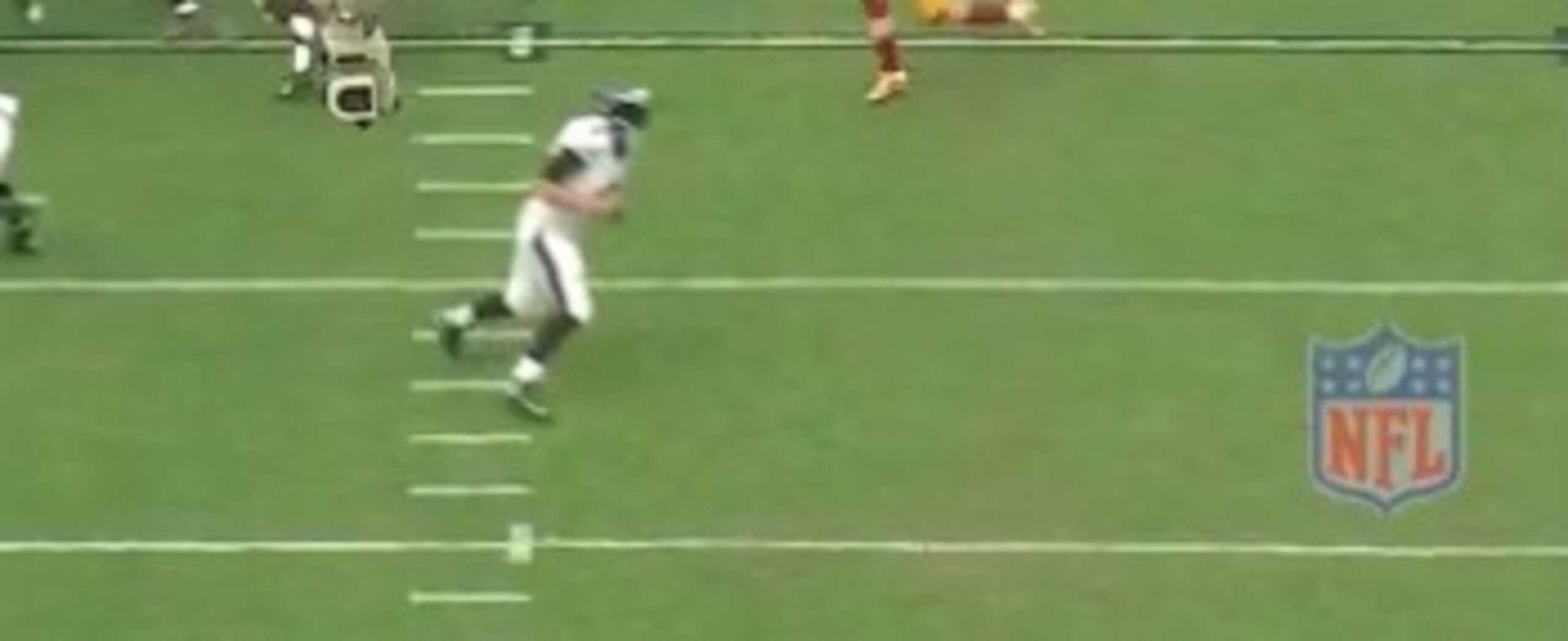
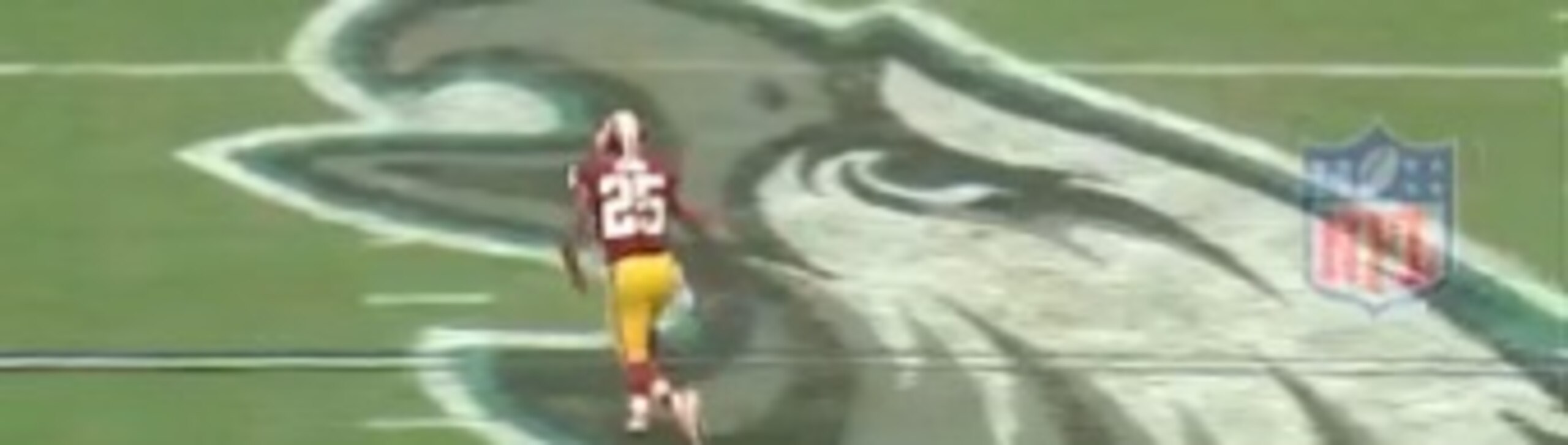

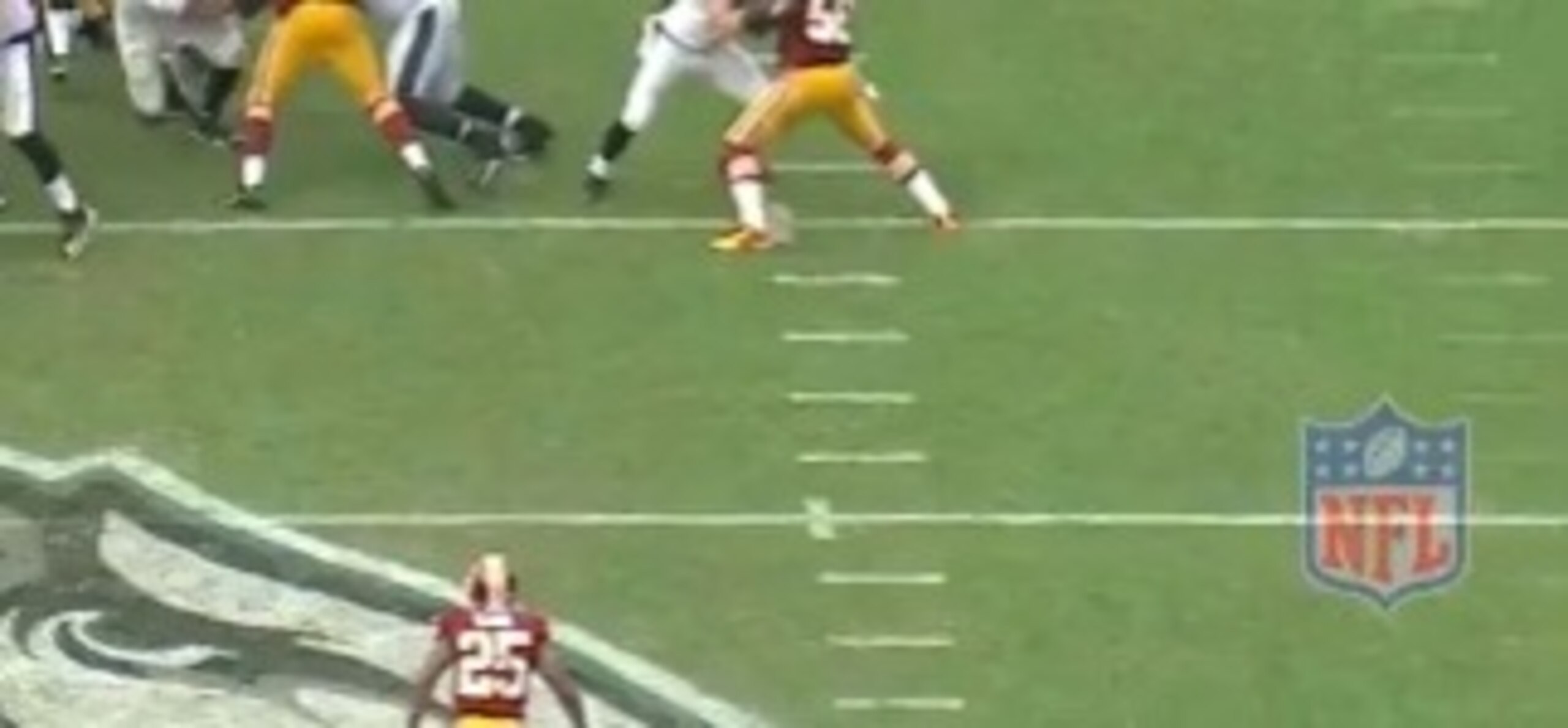
On that last play, center David Molk, who entered Week 3 with just 15 career snaps under his belt but was thrown into the game after Kelce's injury, was abused by Redskins defensive lineman Chris Baker. On the very next play, the deer-in-headlights Molk let Baker have this crack at Foles only two seconds after the snap...

Gardner, Molk and Dennis Kelly were all in over their heads, and it showed throughout the afternoon.
Sure, the Eagles held on for the victory, and they were getting Peters back in Week 4. But with Kelce now joining Mathis on the long-term injury list, it was clear they weren't going to be able to sustain themselves on offense under those conditions.
Week 4: Code red
| LT | Jason Peters | 59 | 2.2 | Only reg. starter to play reg. position |
| LG | Matt Tobin | 60 | 0.7 | First career NFL start |
| C | David Molk | 60 | -2.9 | First career NFL start |
| RG | Dennis Kelly | 60 | -0.8 | First career start at RG |
| RT | Todd Herremans | 60 | -0.2 | First start at RT since Nov. 2012 |
From a pass-protection standpoint, the line wasn't quite as bad against San Francisco. Per PFF, they gave up 11 pressures on 44 passing plays, with Peters putting forth his best game of the year. But against a depleted San Francisco defense that was without Pro Bowlers Aldon Smith and NaVorro Bowman, the running game was just as stagnant as it was the previous week against a very good Washington front seven.
McCoy and Sproles managed just 21 yards combined on 11 carries, which helps to explain why the Philly offense wasn't even able to get the ball into 49ers territory until late in the fourth quarter.
The undersized Molk continued to be bullied far too often, in this case by San Fran defensive linemen Justin Smith, Ian Williams and Ray McDonald.
Here in the second quarter, not even three seconds after the snap, he's already let Williams smash through and had drawn a holding penalty...
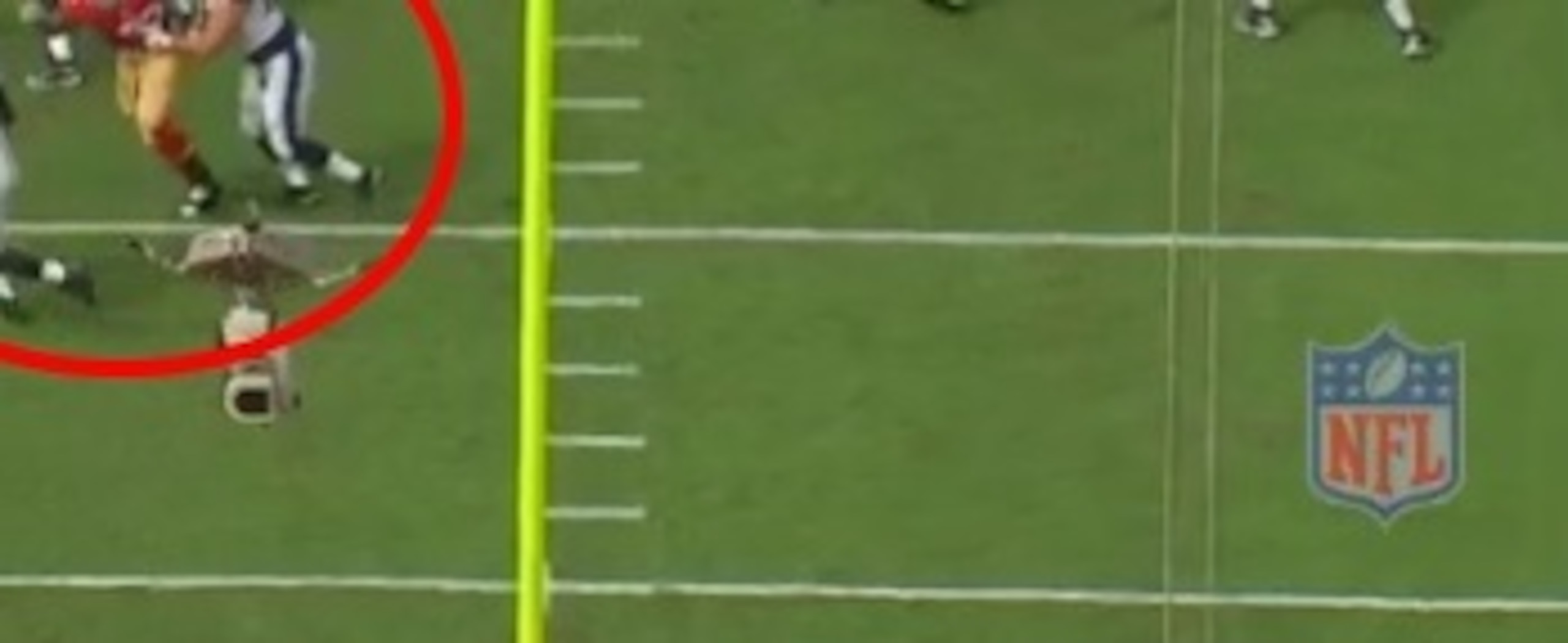
One thing Kelce—and really, the entire line when healthy—did particularly well was spring downfield to block on screens. An example from Week 2 against Indy:
But they're missing that right now. Here's Molk taking off to get ahead of Ertz on a screen late in the second quarter Sunday...
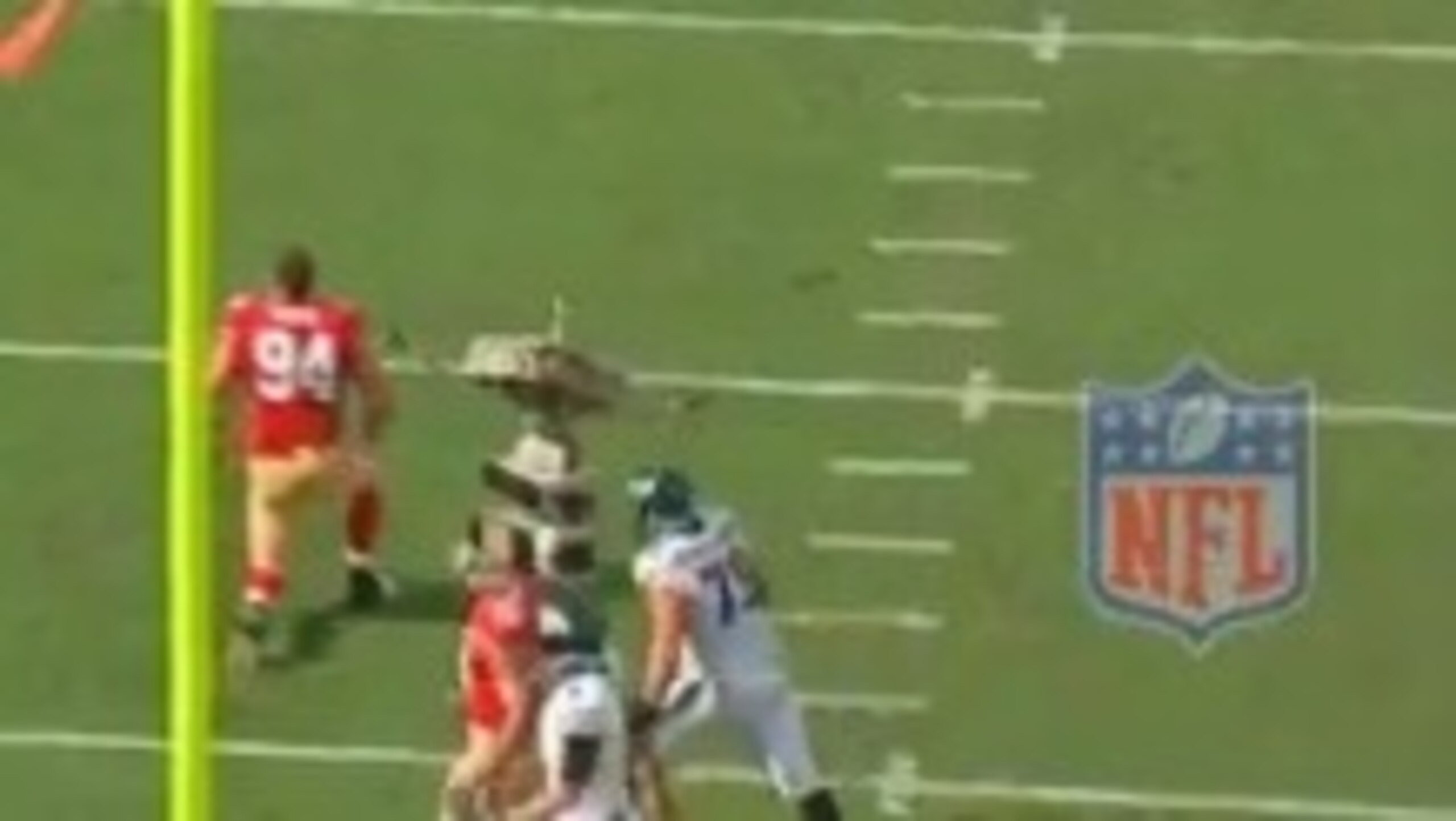
But he looks confused, takes a baffling angle toward his clear blocking target, 49ers safety Antoine Bethea, and fails to even lay a hand on anyone before Ertz is taken down by Bethea.

With Kelce out, they activated second-year undrafted free agent Matt Tobin, who stepped in at left guard. That gave them a chance to slide Kelly to right guard and Todd Herremans to right tackle, knocking the unstable Gardner out of the lineup.
But Tobin wasn't much more reliable. In the first quarter, Foles might have had Maclin deep had he not been hit on his throw by Smith, who was quite literally waved at by Tobin in pass protection.

That was one of many examples of what appeared to be communication breakdowns between a unit that lacks cohesion and familiarity. Certainly looked like Tobin thought Peters was going to pick up Smith, but they both watched as he sprinted toward Foles.
Later, Tobin was also embarrassed by Demarcus Dobbs while trying to block for McCoy, resulting in a four-yard loss...


Herremans is a 10-year veteran with plenty of experience at tackle, but he was moved out of that spot last year for a reason. He struggled for much of the day against rookie San Francisco outside linebacker Aaron Lynch. One glaring example in a big fourth-quarter spot...

"We’re not getting any movement," Herremans said, per ESPN.com's Phil Sheridan. "We’re not hitting our combos [combination blocks] correctly. We’re just not playing well."
The thing is, San Francisco blitzed Foles only four times, and defenses have figured out that they don't need to send extra rushers so long as his protection isn't crisp. Foles was blitzed on 29 percent of his dropbacks last season, according to PFF, but that rate has been cut nearly in half to 15 percent thus far this season.
Yet he's still been under pressure on 32 percent of his dropbacks, which is only down slightly from 34 percent in 2013.
“They created pressure with just a three- and four-man rush and played a lot of zone,” Kelly said, per Sheridan. “We got whooped up front. We’re not very good up front right now. We’ve got a lot of guys banged up. That’s not an excuse. That’s just the reality of it."
That might at least partially explain why Foles hasn't been hitting on as many deep balls. And it certainly helps to explain why head coach Chip Kelly chose to pass on 3rd- and 4th-and-goal from the 1-yard line with the game on the line in San Fran.
Unfortunately, on the last play, the line still screwed up. They were supposed to bring the San Francisco defense left, but Kelly inexplicably blocked right...

That left a little more of a crowd on the right side as Foles rolled out, making it nearly impossible for him to find someone in the end zone...

Kelly has admitted that his play-calling has been affected by the problems the line is having. Not only is a run-first team shying away from the run, but they also appear to be favoring the reliable Peters in a major way on the ground, thus avoiding holes up the middle and to the right.
| 2013 | 31% | 40% | 28% |
| 2014 | 36% | 40% | 25% |
Makes sense. As Football Outsiders has documented, Philly is ranked at or near the bottom of the league when running in pretty much every direction except outside the left tackle. Last year, the Eagles were actually at their best when running outside the right tackle (Johnson had a superb rookie season as a run-blocker) or up the middle.
The slight emphasis this year on one area just gives opposing defenses more opportunities to cheat, which is why the Eagles suddenly have one of the worst rushing attacks in the NFL.
Week 5: Some relief
| LT | Jason Peters | Never an issue |
| LG | Matt Tobin | Second career start |
| C | David Molk | Second career start |
| RG | Todd Herremans | Back to regular spot |
| RT | Lane Johnson | Back from suspension |
Johnson's back from suspension, which should help a line currently ranked dead last in the NFL by Football Outsiders. And as a result, they'll also benefit by moving Herremans back to his right guard spot. This will be the first time since Week 2 that they won't have to rely on a line featuring three or more scrubs.
Still, Mathis and Kelce were PFF's highest-rated players at their respective positions last season, so Tobin and Molk have their work cut out for them against a solid Rams defensive front on Sunday.
Let's also keep in mind that this isn't all on the line. Foles has simply been inaccurate far too often, especially when going deep, and regardless of pressure. McCoy has been handcuffed, but it's not as though he hasn't left some plays on the field. Same applies to Cooper.
The line needs to help those guys going forward, but those guys also have to help the line.
The silver lining
If you're going to get hit by the injury bug, better early than late, right? Plus, at least all five offensive line starters are expected to be back, with Mathis on the short-term injured reserve and Kelce aiming for a Week 10 return, per Jeff McLane of The Philadelphia Inquirer.
The schedule does get tough after a Week 7 bye, but at least Philly is at home and should still be favored in each of the next two weeks.
Nobody's about to run away with the NFC East, so while this might be the most trying stretch yet for Kelly's team, it might not be time to panic.
Brad Gagnon has covered the NFC East for Bleacher Report since 2012.
.jpg?w=2560 "Titans Colts Football")