
Complete Houston Rockets 2014 Training Camp Preview
After a failure of an offseason, the Houston Rockets will enter training camp with a less-talented roster in comparison to the 2013-14 campaign.
General manager Daryl Morey courted big names such as Carmelo Anthony and Chris Bosh, but he did not secure either player. That’s not necessarily damning, but the way in which management struck out is.
Houston traded away its second-string center (Omer Asik) and point guard (Jeremy Lin) in an effort to create cap space for a star free agent. Ouch.
What’s more, the Rockets lost Chandler Parsons, who signed a three-year, $46 million offer sheet with the Dallas Mavericks. Houston chose to exercise some financial restraint, and one could argue the team won’t be as good as last year because of that.
Luckily, the Rockets have two studs who will help mitigate some of those losses, but the rest of the roster comes with a few question marks.
Point Guard
1 of 5
The loss of Lin will be tough because the Rockets don’t have much of a viable option at point guard.
Patrick Beverley will start because of his tenacious defense and irritable tendencies—he gets under the skin of most—but he doesn’t bring much else to the table.
The 6’1’’ Beverley is not much of a playmaker, and he’s a bit of a wild card on offense. Sure, he made 36.1 percent of his treys last season, but he only shot 41.4 percent from the field.
He would be better suited at 2-guard where his lack of playmaking would be easier to accept (three assists per 36 minutes last year), but there’s an All-NBA first-teamer in that spot.
Luckily for Houston, it has a gem in Troy Daniels on the bench. He was called up from the D-League toward the end of the regular season and appeared in a total of nine games.
Daniels hit 48 percent of his treys in five regular-season contests and a sizzling 53.3 percent during four playoff games. Although the sample size is small, it’s hard to ignore the fact that he made shots in high-pressure situations, which tells me it was hardly a fluke.
The kid can shoot, and he will be a big asset on a team that will produce open shots as a result of double-teams sent Dwight Howard’s way.
On the flip side, Daniels won’t do much, if anything, as far as creating opportunities for teammates, and I highly doubt he will be able to defend starting-caliber point guards.
He has value on offense, but the Rockets will prefer Beverley as the starter because of his defensive intensity.
Head coach Kevin McHale might turn to third-string guard Isaiah Canaan every now and then, but he’s more of an emergency option.
In his first-year season with Houston and in the NBA, he averaged 3.1 assists per 36 minutes and converted 35.6 percent of his field goals. Neither figure is good, which makes it somewhat unlikely he’ll get any type of significant minutes during the 2014-15 campaign.
2-Guard
2 of 5
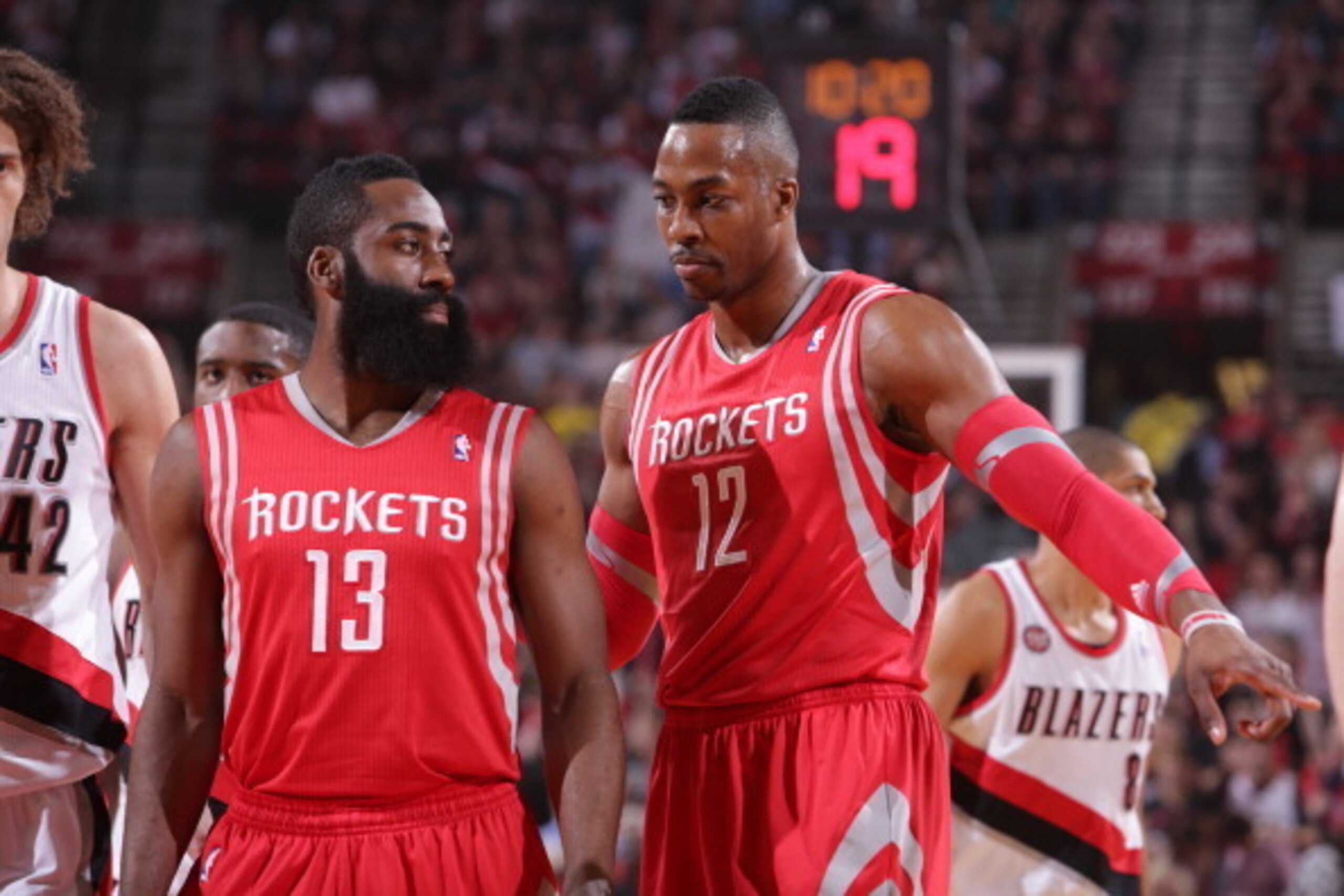
There won’t be a battle for the starting spot at 2-guard because James Harden has already won it. He’s arguably the best player on the team and gives Houston a multitude of things it doesn't get from other positions.
Last year, Harden was asked to create for his comrades (5.8 assists per 36 minutes), score (24 points per 36 minutes) and deliver in late-game situations (finished sixth in total clutch scoring per NBA.com).
Harden delivered at every turn and might actually improve on his impressive 2013-14 season based on his self-assessment: “I'm the best all-around basketball player in the NBA," Harden said during an interview promoting the NBA 2K15 video game.
A better version of Harden allows Houston to compensate for the downgrade in talent, but I’m not sure what else he plans to bring to the table other than defense. Harden was a matador last year, and unless he’s changed his entire thought process, this will hold true again.
Despite his shortcomings, the 2-guard position in Houston got better in the offseason with the acquisition of Jason Terry in a trade with the Sacramento Kings. The Rockets shipped out Alonzo Gee, Scotty Hopson and two second-round picks in the swap.
Terry, 37, is a career 37.9 percent long-range shooter, and he’s played point guard before in spots. He’s a good ball-handler and decent setup man as evidenced by his career 4.9 assists per 36 minutes.
Terry struggled shooting the ball last year with the Brooklyn Nets—36.2 percent overall field goal—but that was likely a product of the isolation offense the team ran.
In Houston, Terry will get an abundance of open looks via drive-and-kicks, which will bode well for the Rockets.
Although I don’t foresee him starting at point guard alongside Harden, he will play some minutes next to him and possibly even close out games.
McHale will use Terry against second-unit players in an effort to preserve his legs during the regular season and minimize the opportunities when he’s called upon to defend elite guards.
The third 2-guard spot will go to Nick Johnson, who was selected with the No. 42 pick in the draft. At 6’3’’, he’s undersized and will struggle to match up against backcourt players.
Also, he only converted 35.9 percent of his treys during his college career, which is noteworthy because the NCAA three-point line is shorter than the NBA’s.
Small Forward
3 of 5
In the face of Parsons’ defection, Houston quickly snatched up Trevor Ariza from the Washington Wizards, and he will start at small forward.
At 6’8’’, Ariza is long and bothersome for opponents, which makes him a defensive pest. McHale will rely on him to blanket the opposition’s best perimeter scorer, and he should do well in this spot.
Offensively, Ariza is a bit of a year-to-year mystery. His three-point stroke comes and goes, and that makes him a bit of a question mark.
He’s athletic enough to finish over the top of defenders, and that’s really the only thing Ariza does well with any semblance of consistency.
If he’s proficient from downtown during the 2014-15 campaign, the Rockets will give him the bulk of the minutes. If not, he will still get called upon because Houston will need someone to guard top wing players, but the coaching staff won’t get too attached to Ariza.
Instead, McHale will turn to Francisco Garcia. He’s not a great defender, but he competes hard and does just enough to bother opponents. On offense, he’s a bit of a gunner, which can be problematic on a team that needs to get the ball to Harden and Howard.
Granted, when Garcia gets going, he stretches defenses and opens up the floor for teammates. When he’s off, though, Garcia can shoot his team out of the game.
Houston won’t have much of a choice here because the other backups are either journeymen who have yet to secure a spot in the league (Jeff Adrien) or young players who have yet to demonstrate they belong (Robert Covington).

Power Forward
4 of 5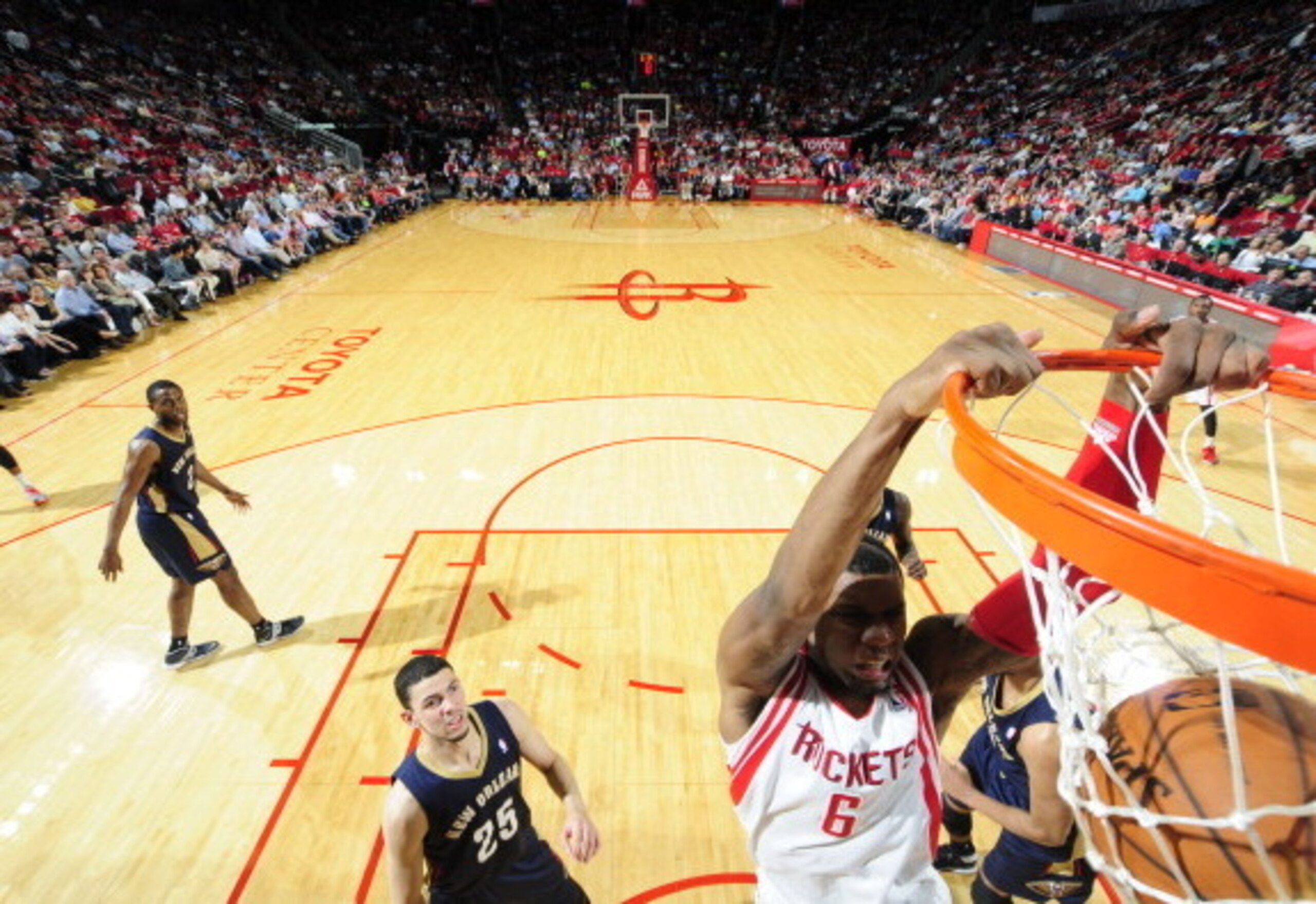
This is easily the weakest position on the team. Terrence Jones started 71 games last season and averaged an impressive 16 points and 9.1 rebounds per 36 minutes.
Jones attacks the rim with ferocity and uses his athleticism to snag rebounds. However, teams often rotated off him and conceded jumpers that he wasn’t always willing to take.
Also, he offered practically zero resistance against power forwards and registered a meager -1.90 figure in defensive plus-minus, ranking 79th among power forwards.
As bad as that is, there isn’t a better alternative. Omer Asik had instances last season where he shared the court with Howard (you could pick either one as the power forward), which helped defensively given their respective abilities.
However, Asik’s departure leaves Donatas Motiejunas as the other option at the 4.
Motiejunas posted a respectable 12.9 points and 8.5 rebounds per 36 minutes, but he didn’t give Houston enough production to justify his court time.
McHale utilized him as a stretch 4 but watched in horror as Motiejunas made a mere 25 percent of his treys. Further exacerbating issues, he got bullied on the boards and in the low-post area.
The only option is Josh Powell, who appeared in one stinking game last year. Keep in mind, his strength is mid-range jump shooting, and Houston is allergic to those shots.
The Rockets emphasize three-point shooting, paint scores and free-throw attempts, none of which are in Powell’s wheelhouse.
Center
5 of 5
Howard owns this spot and won’t relinquish it any time soon. He made the All-NBA second team last season and will challenge for the first team in 2014-15.
He’s a terror in the pick-and-roll because of his finishing ability, and he does a good job of scoring with his back to the basket.
Defensively, Howard is a great anchor because he’s quick enough to thwart the pick-and-roll and recover back to his man while patrolling the paint.
Howard’s not the monster he once was with the Orlando Magic, but he’s still a load to deal with in this setting. He erases and changes shots at the basket, and he’s good at defending low-post players.
Houston’s starting center is the best in the league, and he should make the Rockets a formidable unit. On the flip side, there’s no one to mitigate the eventual disaster called “Howard Resting.”
The power forwards can barely manage against players their size, which means it’s unlikely they’ll be able to masquerade as centers even for a few minutes on average. The other option?
.jpg?w=2560 "Mahomes Told Teammate to Leave Meeting")
.jpg?w=2560 "🚨 Week 8 AP Top 25 Poll")



.jpg?w=2560 "Updates from EVERY NFL Game 🏈")
.jpg?w=2560 "Baker Gets Glove From Rays 🧤")