

The One Flaw in Tim Hardaway, Jr.'s Game That He Must Fix
If his first season in the NBA was any indication, New York Knicks shooting guard Tim Hardaway Jr. is a gunner.
During runs of hot shooting, the bunches of points he poured in sparked the Knicks offense and carried the team. But when he cooled off, the shot volume didn't change.
If he ever wants to develop into a truly great player, he'll have to address his shot selection when he's having a poor shooting night.
TOP NEWS

Power Ranking Every NBA Team's Starting Lineup 🔢

Worst NBA Predictions 🫣

Jokic says booing fans not welcome in Denver
It's said that great shooters have no conscience and short memories. The Ray Allens of the league trust their mechanics and keep firing, knowing that they'll get a few shots to drop eventually.
But turning around cold streaks isn't about powering through them; it's more crucial to find shots in the flow of the offense that don't disrupt rhythm.
With Hardaway's all-around offensive game, it's understandable why he rarely encounters a shot he doesn't like.
His lethal outside touch, both off the dribble and in catch-and-shoot situations, has defenders guarding him closely all over the floor. His ability to penetrate and finish with strength punishes defenders who crowd his space.
No coach will ever fault Hardaway for attacking the rim or letting fly a wide open three-pointer. It's the difficult floaters, one-dribble pull-ups, and mid-range fadeaways that get him in trouble, especially early in the shot clock.
Former Knicks guard Beno Udrih saw this troublesome sign early last season (via The New York Times): "Sometimes he’s so excited to be here, his shot selection can hurt him. But he’s confident, and that’s always a good thing."
Before being drafted by the Knicks, DraftExpress also noted that "Some of Hardaway's struggles were due to his less than stellar shot selection."
At least a part of the blame for Hardaway's difficulty in choosing the right shots can be assigned to a Knicks offense that crumbled in the latter half of the season.
The focus on Carmelo Anthony and J.R. Smith isolations with little weak-side movement quickly bred a selfish attitude among non-primary ball-handlers. With very few touches left for the remaining players, it was hardly surprising that Hardaway's trigger finger became that much more itchy.
Hardaway's final season at Michigan was the real birth of this trait. His 460 field-goal attempts only trailed teammate Trey Burke, despite his 43.7 field-goal percentage ranking worst among players with significant minutes averages.
In his rookie year on the Knicks, the statistical trend continued but shifted to the three-point line. Despite only playing 23.1 minutes per game, Hardaway still found time to jack 4.4 three-pointers per game while only knocking them down at a 36.3 percent clip.
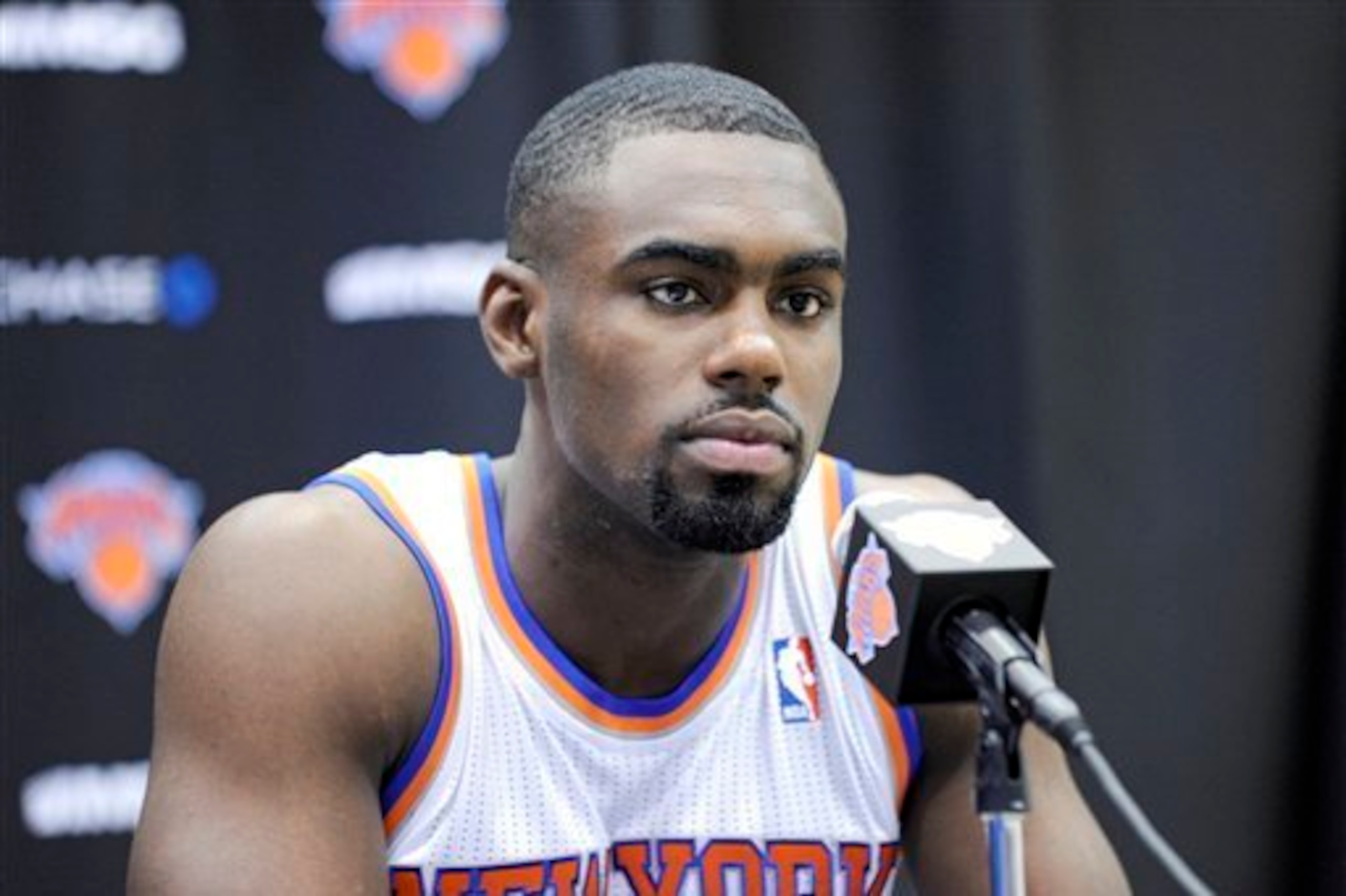
Further cementing the problem was Hardaway's reliance on off-the-dribble jumpers. Though his 38.9 shooting percentage on such attempts, according to Synergy Sports (subscription required), was actually well above league average, his willingness to hoist the lowest-percentage shot type in the game drove down his overall efficiency.
With 23.1 percent of his shots coming off the dribble, Hardaway's percentage of those types of shots was extremely high for a non-primary scorer. Compare that to Anthony, arguably the best off-the-dribble shooter in the game, whose 25.2 percent of attempts preceded by a dribble was only slightly higher.
Considering their respective roles in the offense, the difference should have been far greater.
This isn't to say that dribbling before shooting is necessarily a bad thing for role players. Sometimes overzealous closeouts on catch-and-shoot three-point shots fuel easy pump fakes, a quick dribble and an open pull-up.
Here's Hardawday doing just that against the Chicago Bulls, when a double-team of Amar'e Stoudemire leads to multiple ball swings. When it lands in Hardaway's hands in the corner, his feet are set and he's ready to shoot.
Chicago's Kirk Hinrich knows of his shooting prowess and runs him off the three-point line, almost baiting Hardaway into dribbling past him. Hardaway obliges and properly pulls up, as the rotating defenders protecting the rim would make any drive and finish difficult.
Everyone can live with these types of shots. It was Hardaway's inability to make the right (or any) pass and his penchant for cutting short basket attacks in favor of pull-ups that got him in trouble, leading to a flurry of difficult and guarded shots.
Take a look at this play from last season against the Brooklyn Nets, when Hardaway receives the ball in a similar closeout situation and is able to slip by his defender, Marcus Thornton. Even the minimal penetration draws a second defender in Jorge Gutierrez, who abandons Shannon Brown.
A quick dribble and pass would have led to an open three-pointer for Brown, but Hardaway elects to rise up for a fadeaway with 10 seconds on the shot clock.
Even though he does miss the easy pass here, it's not the end of the possession. Hardaway could have quickly felt out the isolation opportunity against the smaller defender in Gutierrez and moved the ball if it failed. There was still time to generate something better.
Hardaway's predatory attitude has him capitalizing on any opening to get his shot off. In some sense, this relentless and attacking mentality can really plague defenders who can't guard him.
But Hardaway's not quite at that level offensively to beat multiple defenders, and more often than not he's caught taking bad shots against help defense once he gets past his original man.
What's even more frustrating about Hardaway's game is his unwillingness to completely attack creases in the defense with his dribble. He just loves that pull-up a bit too much and settles too quickly.
In the play below against the Miami Heat, a confused Miami defense has three players triple-teaming Stoudemire in the post. Stoudemire recognizes this quickly and gets rid of the ball to Hardaway, who now has Ray Allen sprinting at him.
Hardaway smartly pump fakes and slides around him, with a gaping hole in the Heat defense now staring him in the face. With a quick left-to-right crossover, Hardaway can get all the way to the rim or draw more defenders to set up a teammate.
Instead, he settles for that pull-up. Because he's slightly leaning left and Allen is bothering him from behind, what appears to be an open and easy shot isn't quite that.
To be fair, Hardaway isn't a great ball-handler. With time he'll improve this aspect of his game, but he'll always be a perimeter shooter first. Still, that doesn't excuse his aversion to probing defenses more.
In pick-and-roll situations, Hardaway has mostly limited himself to jump shots. In an NBA that features more and more defenses with bigs dropping to the rim, teams are encouraging these off-the-dribble, mid-range shots.
Hardaway, thus far into his career, is playing right into the defense's hands. The Toronto Raptors ran this dropping scheme in the pick-and-roll below involving Hardaway and Jeremy Tyler, and Hardaway takes the space given to him as an opportunity to shoot.
When he lets the ball go, there are 17 seconds left on the shot clock.
Part of the learning curve for all NBA players is understanding shot types in terms of time and score. In the simplest sense, this means that the first available shot is not always the best one.
The best players, and typically the best scorers, have mastered how and when shots become available. Pull-up jump shots off the pick-and-roll, contested three-pointers or isolations are possible at virtually any time.
If an offense has to resort to these shot types due to a shrinking shot clock, so be it. Avoiding them at all other times, however, tends to be a major offensive key.
Early in the shot clock, better players explore pick-and-rolls with multiple dribbles and pass the ball, or they back it out and try something else. Allowing a possession to mature gives the best option time to reveal itself or the defense an opportunity to make a mistake.
Though Hardaway is certainly capable of hitting any type of shot, that doesn't mean any shot he takes is a worthwhile look.
If he hopes to improve his shooting percentage and role within NBA offenses, it won't be about drilling hard in the offseason to strengthen his skill set or scoring more points in games.
It will be about efficiency and shot selection. Sometimes less is more.
.jpg?w=2560 "Mahomes Told Teammate to Leave Meeting")


.jpg?w=2560 "🚨 Week 8 AP Top 25 Poll")


.jpg?w=2560 "Updates from EVERY NFL Game 🏈")
.jpg?w=2560 "Baker Gets Glove From Rays 🧤")