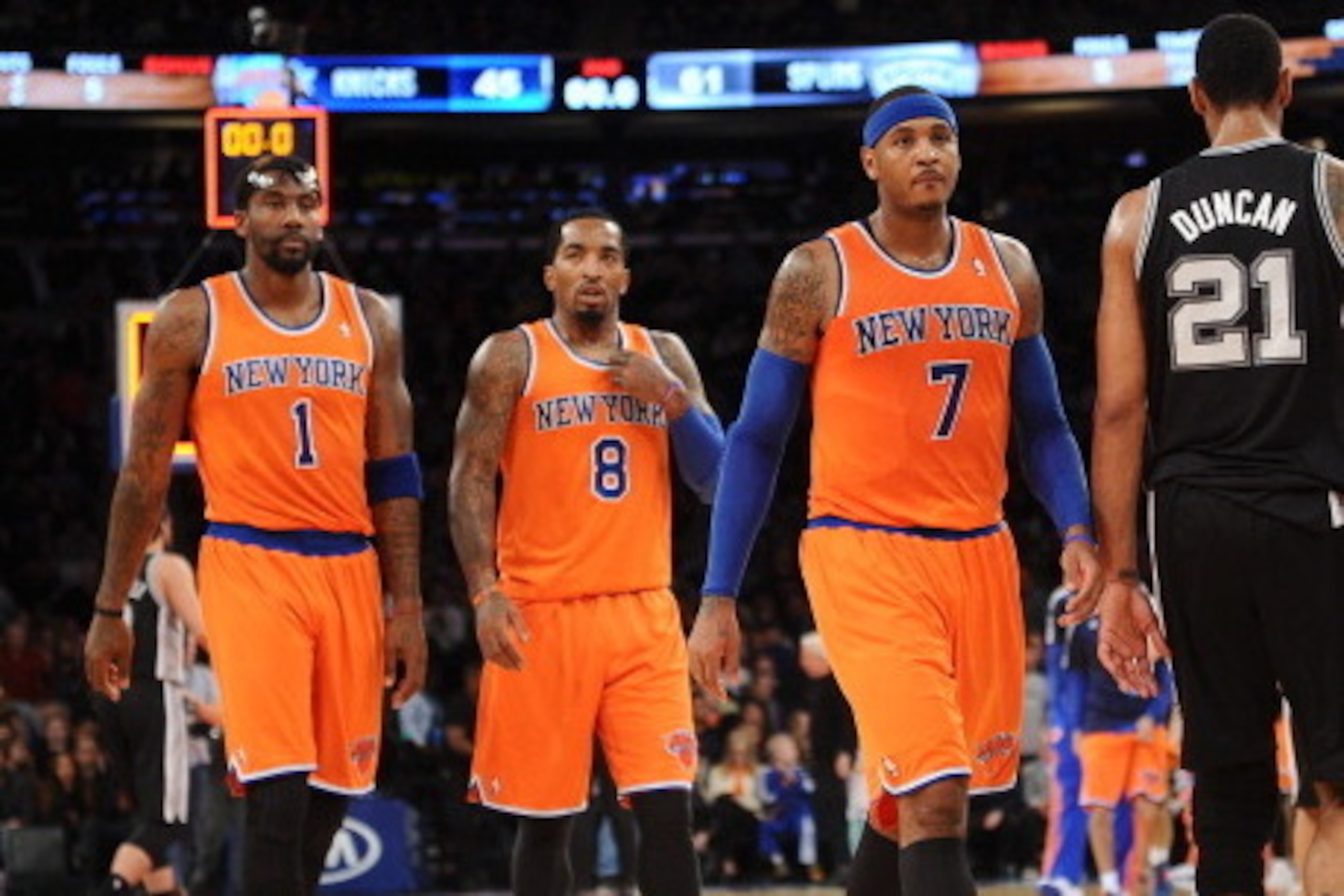

Grading Each Position Going into NY Knicks' 2014 Training Camp
The New York Knicks roster essentially consists of Carmelo Anthony, a bunch of guards and a trio of tall forwards who struggle on defense. Add to that a rookie head coach and a brand new offensive scheme familiar to most fans from postseason losses to the Chicago Bulls, and the position grades do not shape up in particularly promising fashion for the Knickerbockers, but there's room for optimism as well.
While grading requires a certain degree of prognostication and pigeon-holing to place each player at one specific position, the Knicks' roster makeup also dictates usage in the rotation to a certain degree. These grades represent a rating of the position as a whole, without spiking the rating based solely on a single player. Experience, depth, chemistry and potential all factor in on the decision for these grades.
New Yorkers do not often entertain delusion—aside from the relative largeness of their apartments—and these grades paint a realistic portrait of a Knicks team that dreams optimistically about playing a first-round playoff series on the road.
Point Guard: B
1 of 5
Pros: Veteran experience, good court vision, accurate perimeter shooting
Cons: Lack of depth, lack of athleticism, shaky defense
The Knicks may well have the most efficient set of three-point-shooting point guards in the league, as Jose Calderon and Pablo Prigioni each ranked in the top five for long-range shooting percentage among point guards. In a triangle system oriented around ball movement and finding open shots, the Knicks have two strong catch-and-shoot point guards to punish defenses beyond the arc.
While Calderon launched more than three times as many attempts from downtown as did Prigioni, Fisher will likely lay out a clear mandate with the offense, which will include Prigioni shooting any and all wide-open looks from long range.
Calderon will be locked in as the starter, and he represents a significant upgrade from Raymond Felton. Calderon's defense has been a focus for concern, but it's hardly for lack of trying. He simply lacks the athleticism and quickness to compare to many of his peers.
Masking this liability with team defense will be a key challenge, as New York has become used to routine scorchings from opposing point guards. Fortunately, Prigioni offers competent D, most often drawing the label "pesky."
Shane Larkin will turn 22 before the season begins, but he will not grow beyond his 5'11" frame by then, and he may not find a role on the court for the Knicks. An undersized guard with a knack for shooting, Larkin will look to carve out a role with tenacity to balance his short stature.
He shined in four D-League games last season (15.3 points, 8.3 assists, 5.3 rebounds and 2.0 steals per game) and impressed Knicks coaches over five games at the 2014 Las Vegas Summer League (12.2 points, 4.2 rebounds, 3.4 assists and 3.0 steals per game).
Coach Derek Fisher said of Larkin's play in Vegas, via NBA.com: "In a lot of ways, he was our most stable and consistent performer." With two much older and slower point guards in front of him, there's a possibility Larkin could grow into a meaningful rotation role this season.
Shooting Guard: B-
2 of 5
Pros: Plenty of ability, solid depth
Cons: No clear starter, disparate skill sets
In some iteration of the future, Tim Hardaway Jr. could very well be the Knicks' starting shooting guard. However, that future is not now, and there is still a question as to who exactly will start at the 2-guard. Hardaway comes off a very successful rookie season scoring 10.2 points in 23.1 minutes per game and hopes to improve on those results, but the sophomore faces stiff competition.
J.R. Smith has the most ideal skill set for the position, as Hardaway would present a substantial defensive liability alongside Calderon in the starting backcourt. Smith offers average defense with plus scoring, and he improved dramatically down the stretch last season after a thud of a start.
As noted by ESPN New York's Ian Begley: "After being inserted into the starting lineup for the final 22 games, Smith averaged 18.1 points per game as the Knicks finished the season 16-6."
With Smith's knee strengthening after surgery, he seemed to find a groove down the stretch. His adjustment to Fisher's offense will be of unique interest, but all the physical tools that powered the 2012-13 Sixth Man of the Year appear to be at 100 percent.
Iman Shumpert's defense remains unassailable, but he must show some degree of consistency on offense; otherwise, he will end up as this generation's Thabo Sefolosha, a solid defender with little to offer offensively. Shumpert's shooting has regressed, and he posted career lows on field goals and free throws last season.
Small Forward: B-
3 of 5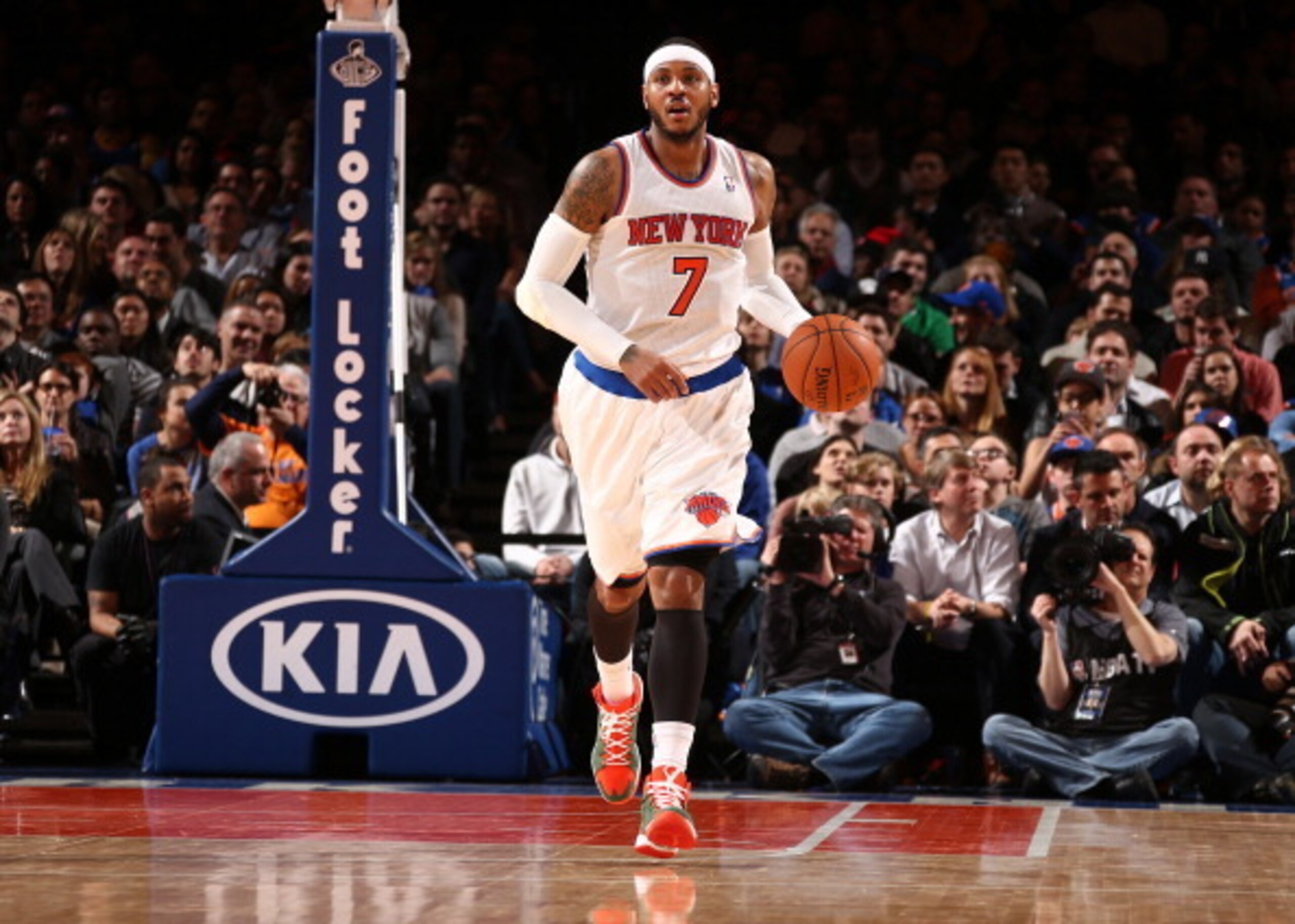
Pros: Carmelo Anthony
Cons: Lack of depth
Carmelo Anthony will score a ton of points—that much is certain. Where he will play and how the rotation will complement his world-class abilities remains murky. The starter at power forward had been Melo under Mike Woodson, which led to great individual statistical success and a scoring title. But the current roster makeup suggests Carmelo Anthony belongs at small forward.
In mid-August, the New York Post's Marc Berman noted an Instagram photo Anthony posted in which he looked decidedly slimmer. Berman quoted an "Anthony confidant" as saying of Melo: "He wants to be as athletic as he was when he was a rookie. Plus he wants to be a facilitator in the triangle, and speed will help that."
Anthony had made a meal of opposing power forwards thanks to his quickness, but he still enjoys the benefit of a mismatch with an ability to shoot over the top of most small forwards. It will be an intriguing and entertaining offensive transition to watch as Anthony adapts to Fisher's system, but the team's star player has made a commitment to stay, and a slimmer frame should encourage his longevity.
That leaves declining, injury-plagued veteran Travis Outlaw and second-round rookie Cleanthony Early as the only true options at small forward. Outlaw had two very good seasons with the Portland Trail Blazers a half-dozen years ago, but he has slid down a steep incline of injuries, age and ineffectiveness since then.
Early projected as a first-rounder, so he brings promise for the Knicks as the No. 34 pick. Then again, he's a first-round talent who slipped to the second round, which comes as a tacit condemnation of his NBA potential.
Quincy Acy, a 6'7" trade acquisition from the Sacramento Kings along with Outlaw, has the body of a 'tweener forward: He's a bit bulky to play the 3 and slightly short for the 4. Other preseason signings at the end of the roster include three undrafted rookies: forwards Orlando Sanchez from nearby St. John's and Travis Wear from UCLA, as well as Saint Joseph's point guard Langston Galloway. It's an unimpressive jumble at the 3.


Power Forward: B-
4 of 5
Pros: Strong scoring instincts, plenty of size
Cons: Poor defense, injury concerns, only one ball
The Knicks are blessed with five players standing at least 6'11" in Amar'e Stoudemire, Andrea Bargnani, Jason Smith, Samuel Dalembert and Cole Aldrich. The first three of those big men bring an offensive-minded game to the floor, while Dalembert and Aldrich offer some actual defense in the middle. Despite the height at the position, really, none of the first three are proper centers, and the Knicks face serious questions about where exactly the team defense will come from.
Stoudemire, Bargnani and Smith profile as power forwards almost by default, as they have no other fit in the starting five or larger rotation. None of the three can rebound or protect the rim particularly well, and they will be called upon primarily to score. Each has a sufficient offensive inclination, but they make for a very a shaky defensive trio in the frontcourt.
Last season, the Knicks were 8.5 points better with Stoudemire off the court and "only" 8.1 points better with Bargnani off the floor, per Basketball-Reference. Smith turned in status quo numbers for his on/off court ratings, and Phil Jackson could prove wise once again if Smith outperforms either of his overpaid teammates on expiring contracts.
Ultimately, all three players have missed significant time during recent seasons with various ailments, and that could invite trouble should the injury bug come calling.
Center: C
5 of 5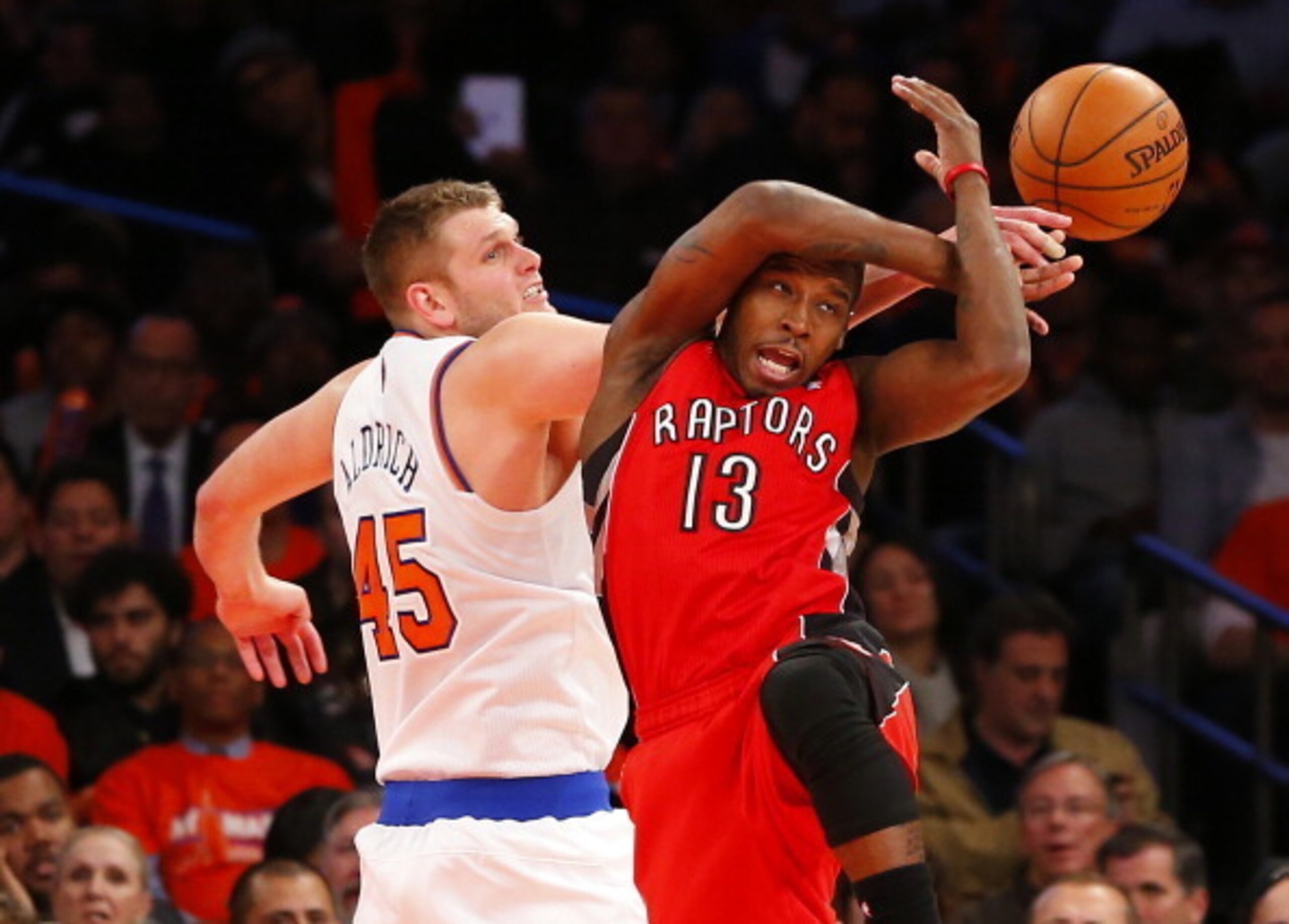
Pros: Solid defense, strong rebounding, above-average rim protection
Cons: Aging starter, lack of depth, subpar offense
Veteran Samuel Dalembert, 33, will feel right at home in New York, as the Haitian-born center attended high school in Elizabeth, New Jersey, and played college ball at nearby Seton Hall.
However, Dalembert cannot log starter's minutes at this point in his career after averaging just 19.9 minutes per game over the last three seasons. Still, the Knicks will absolutely sign up for 20 minutes per game of the production Dalembert gave the Dallas Mavericks a season ago: 11.8 points, 12.1 rebounds and 2.1 blocks per 36 minutes, via Basketball-Reference.
His backup, 25-year-old Cole Aldrich, has little in the way of offensive instincts. That will force one of the Knicks' sizable but defensively deficient power forwards to play pivot at times. Looking at Aldrich's per-36 stats in 2013-14, he excelled with 10.0 points, 14.1 rebounds and 3.3 blocks in 46 games but only saw 7.2 minutes per game.
While Aldrich should be in line for an increased role backing up Dalembert instead of Tyson Chandler, he has yet to prove himself a worthy NBA rotation player and has never averaged more than nine minutes per game in a season.
.jpg?w=2560 "Mahomes Told Teammate to Leave Meeting")
.jpg?w=2560 "🚨 Week 8 AP Top 25 Poll")



.jpg?w=2560 "Updates from EVERY NFL Game 🏈")
.jpg?w=2560 "Baker Gets Glove From Rays 🧤")