Jacksonville Jaguars vs. Washington Redskins: Creating Washington's Game Plan
The Washington Redskins can't make the mistake of underestimating the Jacksonville Jaguars. The plucky AFC South club pushed the Philadelphia Eagles all the way on the road in Week 1.
Head coach Gus Bradley's team certainly has the defensive chops to cause problems for a Washington offense that was largely abysmal in a 17-6 loss to the Houston Texans.
Beginning with that offense, rightly under a microscope after Week 1, here's what the Redskins have to do to tame the Jags.


.jpg?w=2560 "Commanders Eagles Football")
Stay Away from the Jags' "Lightning" Package
It's important to manage the down and distance in every game, but Redskins head coach Jay Gruden will be particularly mindful of that need in Week 2. He'll know that any time his offense is caught in obvious pass mode, the Jags are unlikely to unleash a dangerous sub-package.
It's known as "lightning" and features at least three "Leo-style" pass-rushers. Leo is the name the Jags give to the hybrid rushers on their defensive front, the players who align either as defensive ends or linebackers.
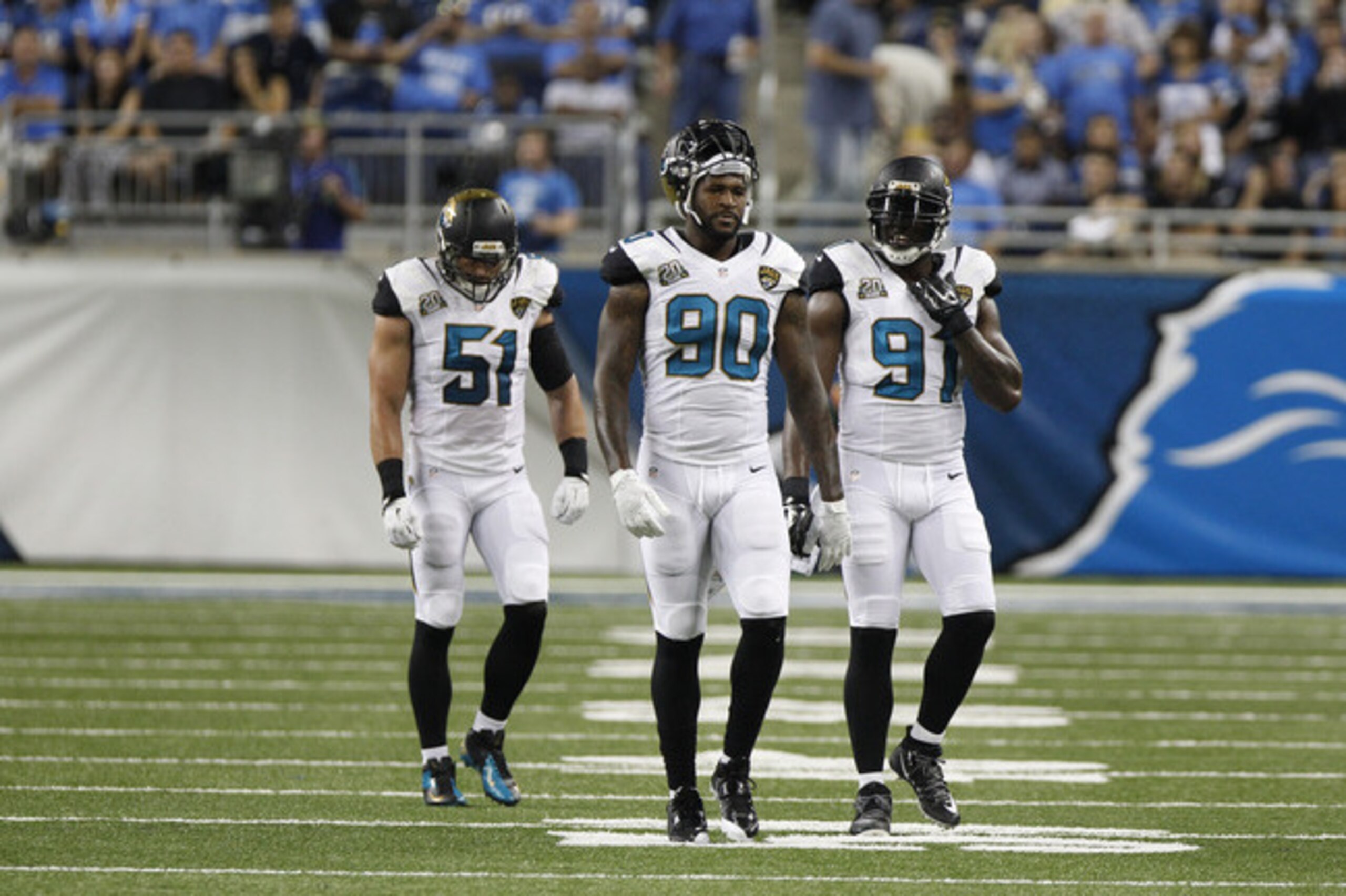
Technically, the lightning package features four Leos, as ESPN.com Jaguars reporter Michael DiRocco noted during preseason:
"The Jaguars debuted their lightning package during 11-on-11 scout-team work when the offense was running some of Tampa Bay’s offense. It’s a lineup that features four Leos on the field at the same time: Chris Clemons, Andre Branch, Ryan Davis and rookie Chris Smith. The 260-pound Davis lines up inside as a defensive tackle.
"
Even though the Jags used three Leos against the Eagles, this package still created havoc. It was the chief reason Jacksonville logged five sacks against a normally solid offensive line. Let's take a closer look at the scheme in action.
The first example begins with the personnel grouping Washington doesn't want to see up front. Andre Branch (90) and Chris Clemons (91) are the bookends. Inside, Sen'Derrick Marks (99) and hybrid rush end Ryan Davis (59) are positioned in the guard-tackle gaps (B-gap):

What the Jags have here is pure speed along the front. This group can collapse the pocket around the quarterback in an instant. Branch and Clemons prevent escape around the edges, while Marks and Davis deter quarterbacks from stepping up to avoid the pressure off the corners.
That's always the starting theory for this scheme. But because these hybrid athletes are so flexible, they can switch and exchange rush lanes in a blur.
As this play developed, Davis drew a double-team in the middle. That gave Clemons an inside rush lane. He pushed his blocker out wide and then slipped off to close on Philly quarterback Nick Foles:
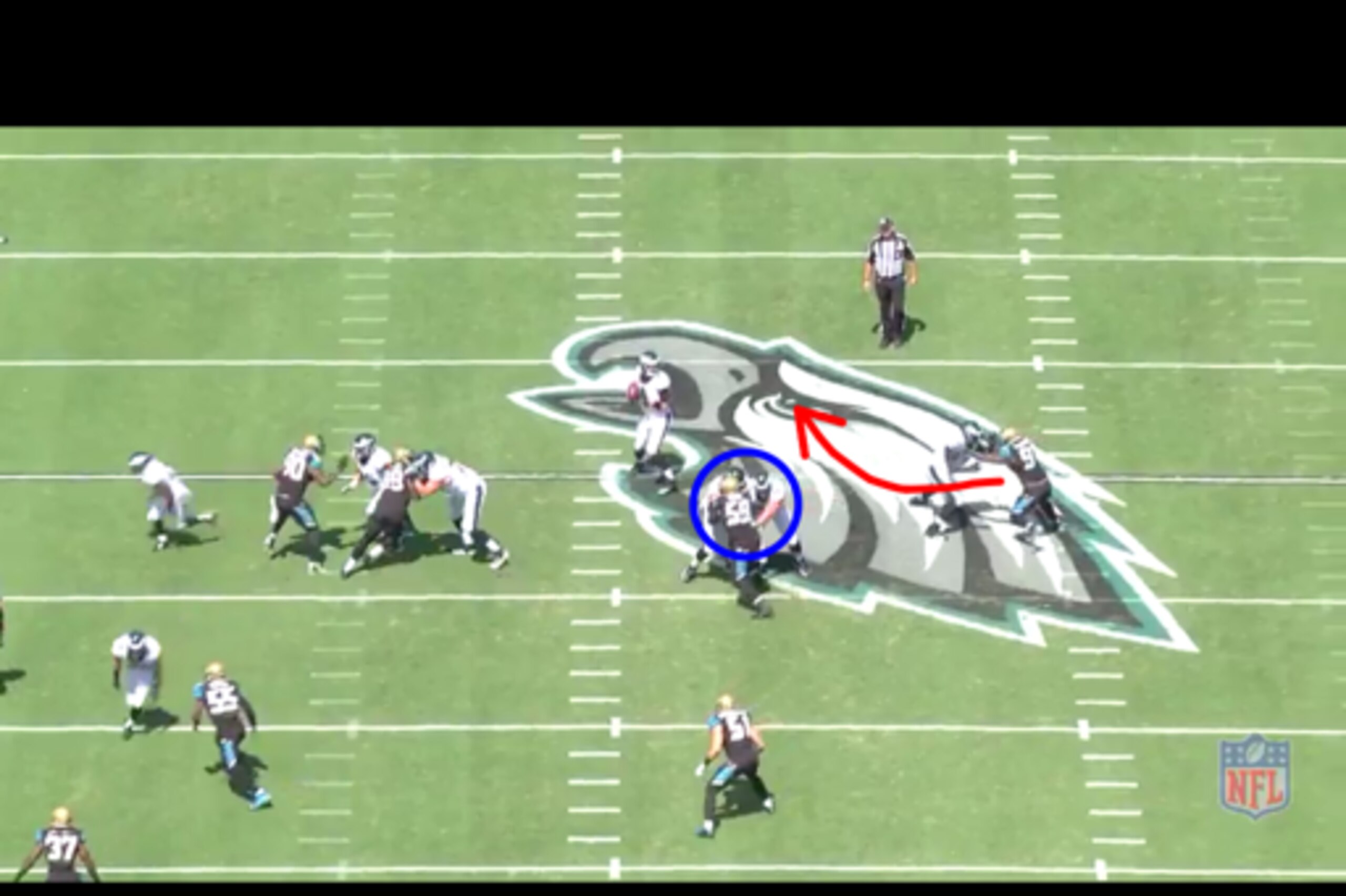
Clemons made the hit on Foles and knocked the ball loose in the process:
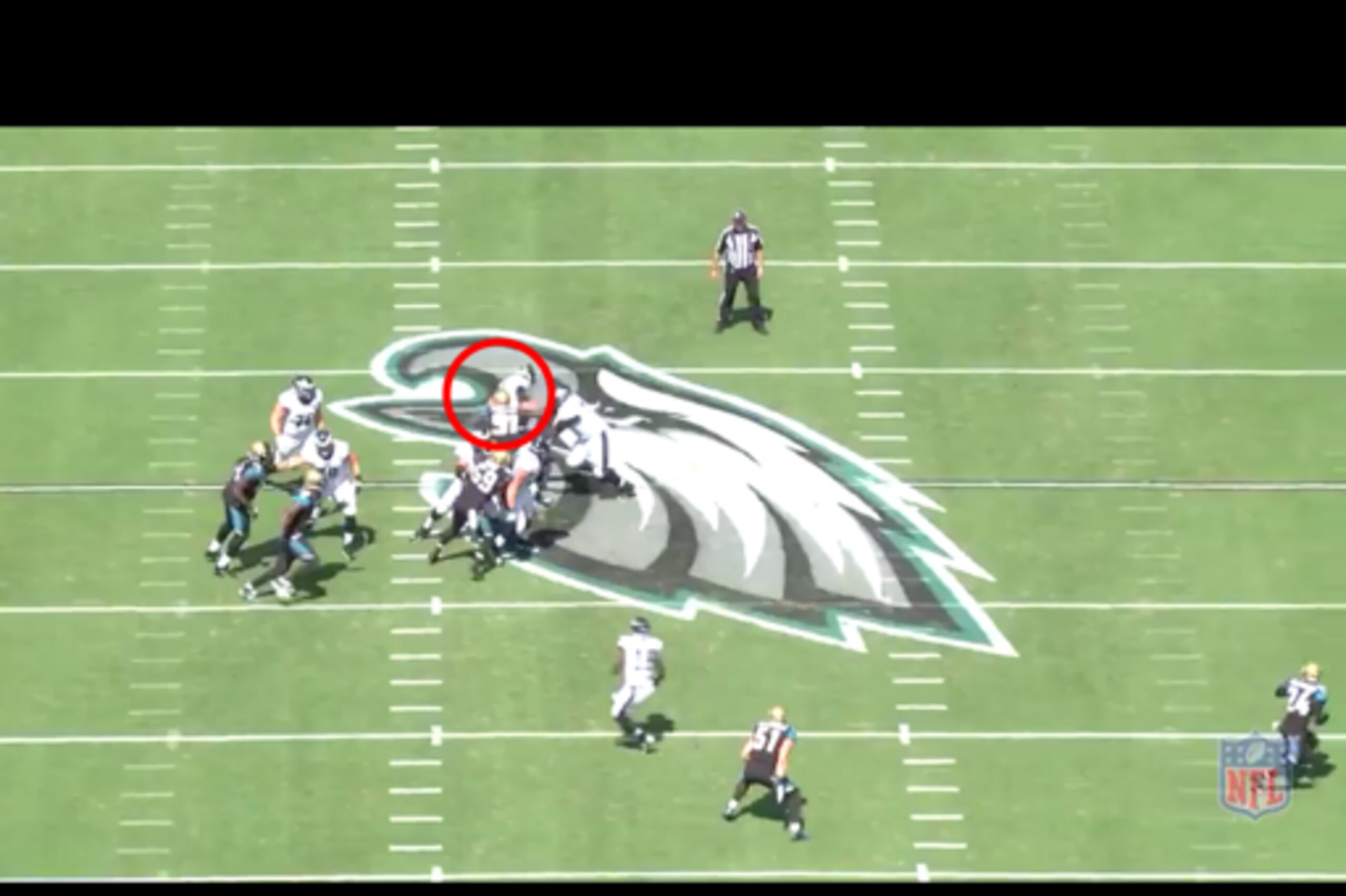
Davis was on hand to quickly scamper to the loose ball:
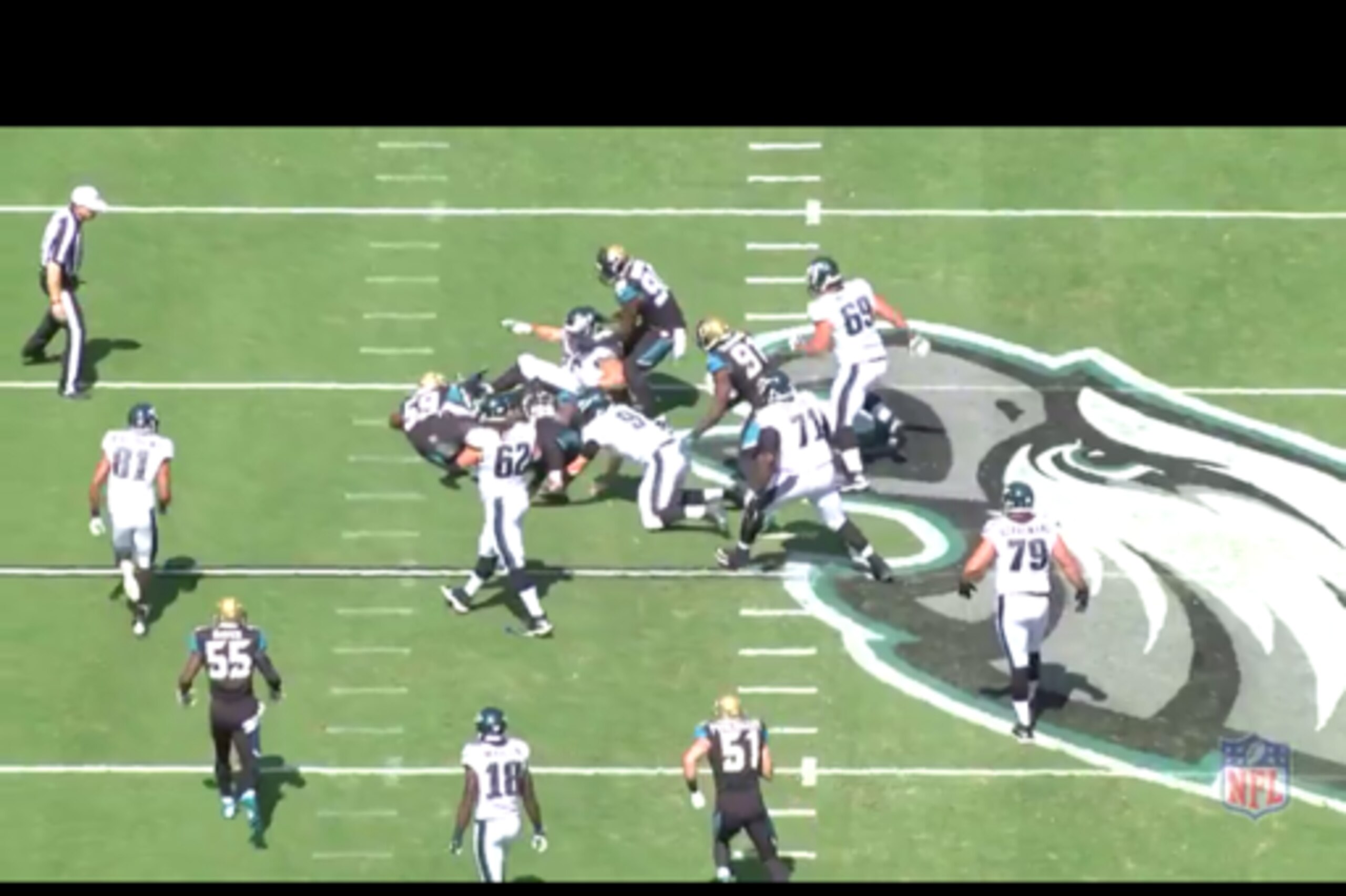
The Jags turned this play into a touchdown pass to Allen Hurns. It was one of two scoring throws set up by turnovers.
One other reason the pressure was so effective was because of how well the Jaguars covered behind the rush. They had deep safety help on either side of the formation and defended the inside of the field first.
This enabled the defense to bracket the receivers underneath and take away the deep ball at the same time:
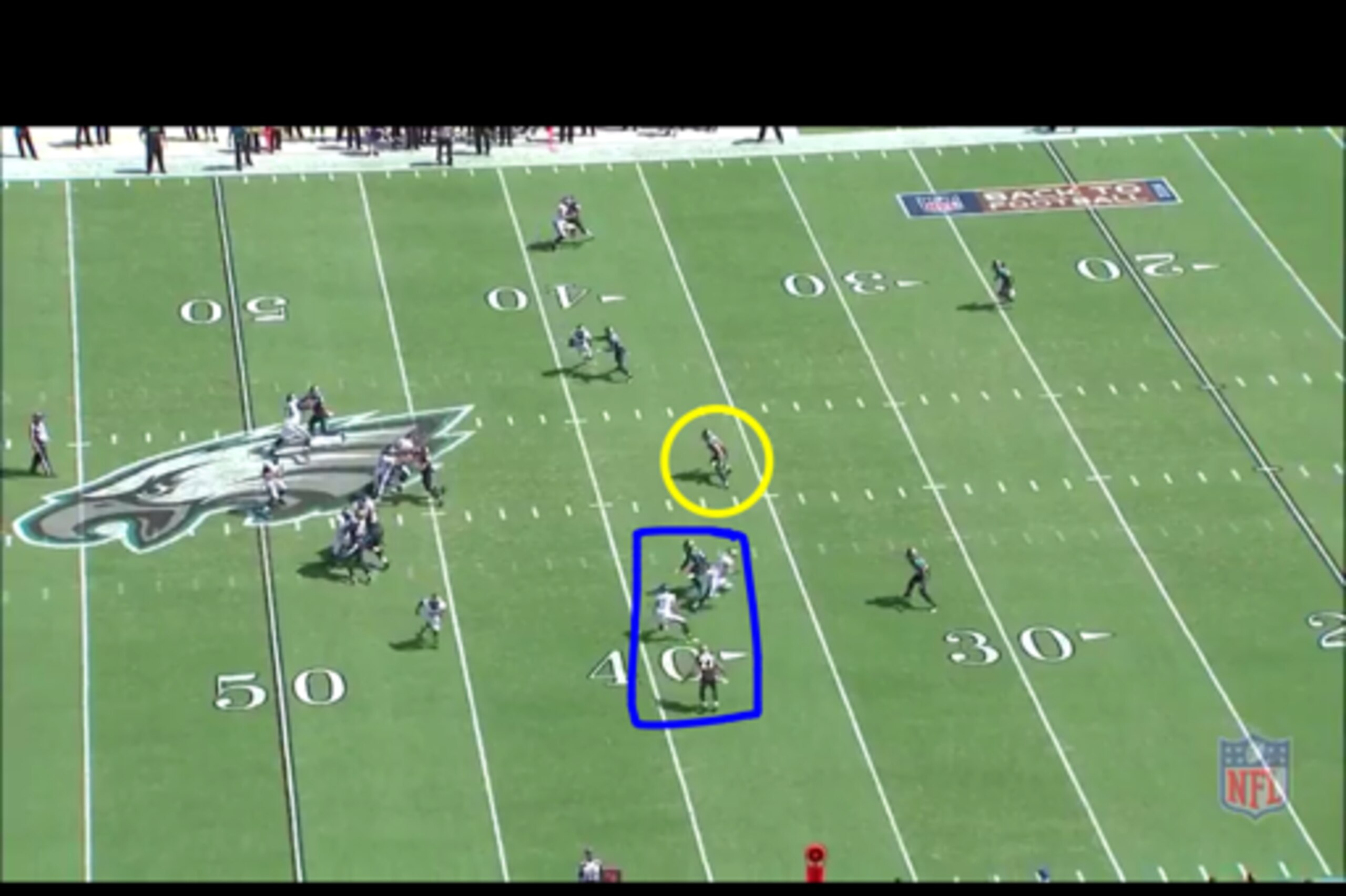
Faced with this tight a coverage shell, Foles had to hold onto the ball. But against a lightning-fast rush, that's a fatal error.
This is the bind the Jags put an offense in on long-yardage downs. They have tremendous speed up front and have become experts at boxing receivers into crowded zones.
Here's another brilliant example of how they do it. Let's begin the play with the coverage aspect first.
The Jags aligned in a 4-2-5 standard nickel scheme headlined by their lightning-style front. At the snap, seven covering defenders would rotate into zones.
The two linebackers and the slot corner would bail underneath and simply spot drop. Meanwhile, the safeties would rotate into a two-deep shell to take away the big play:
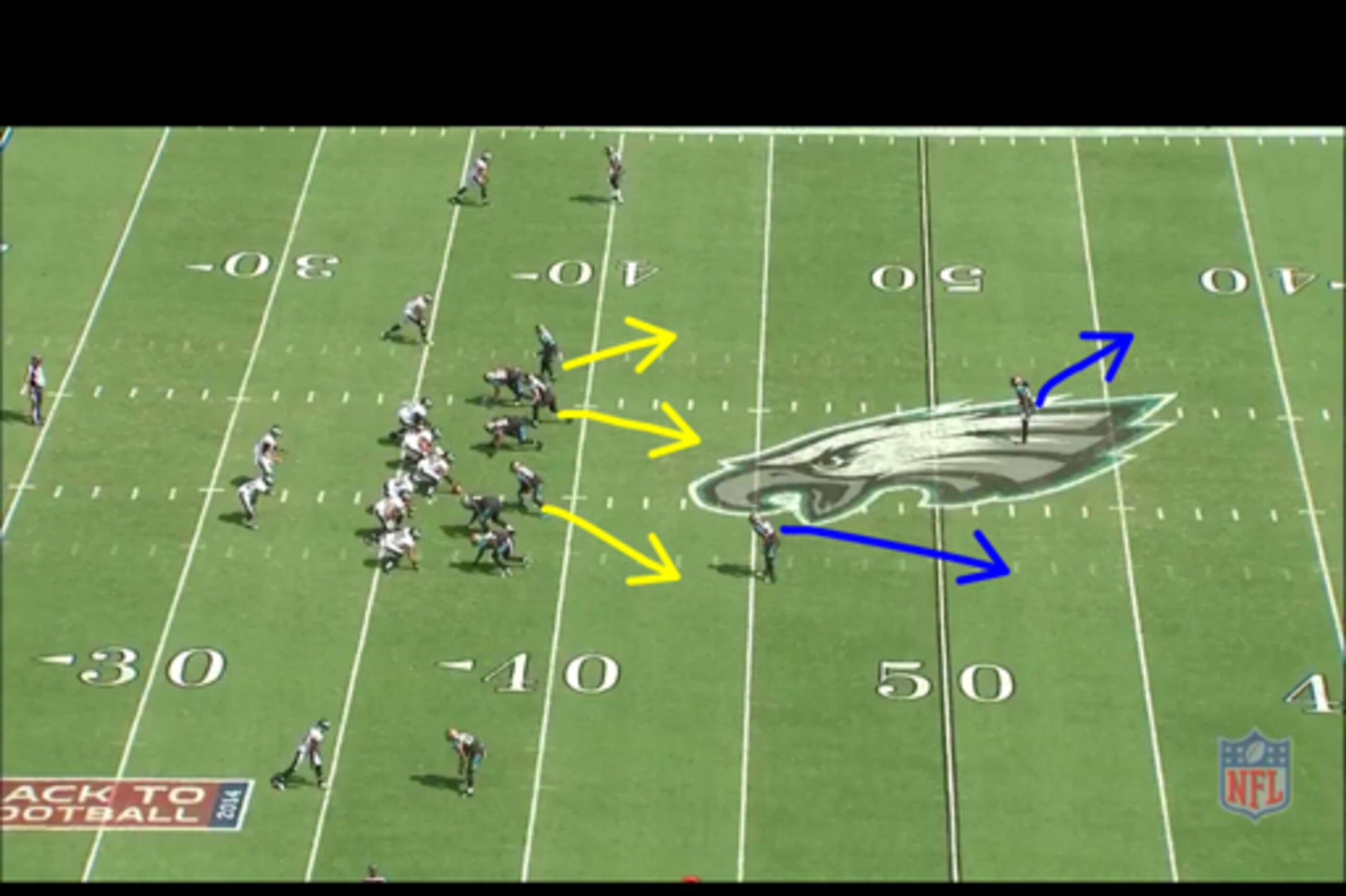
Once the Eagles receivers were out of their breaks, look how effectively the Jags established two clear lines of coverage:
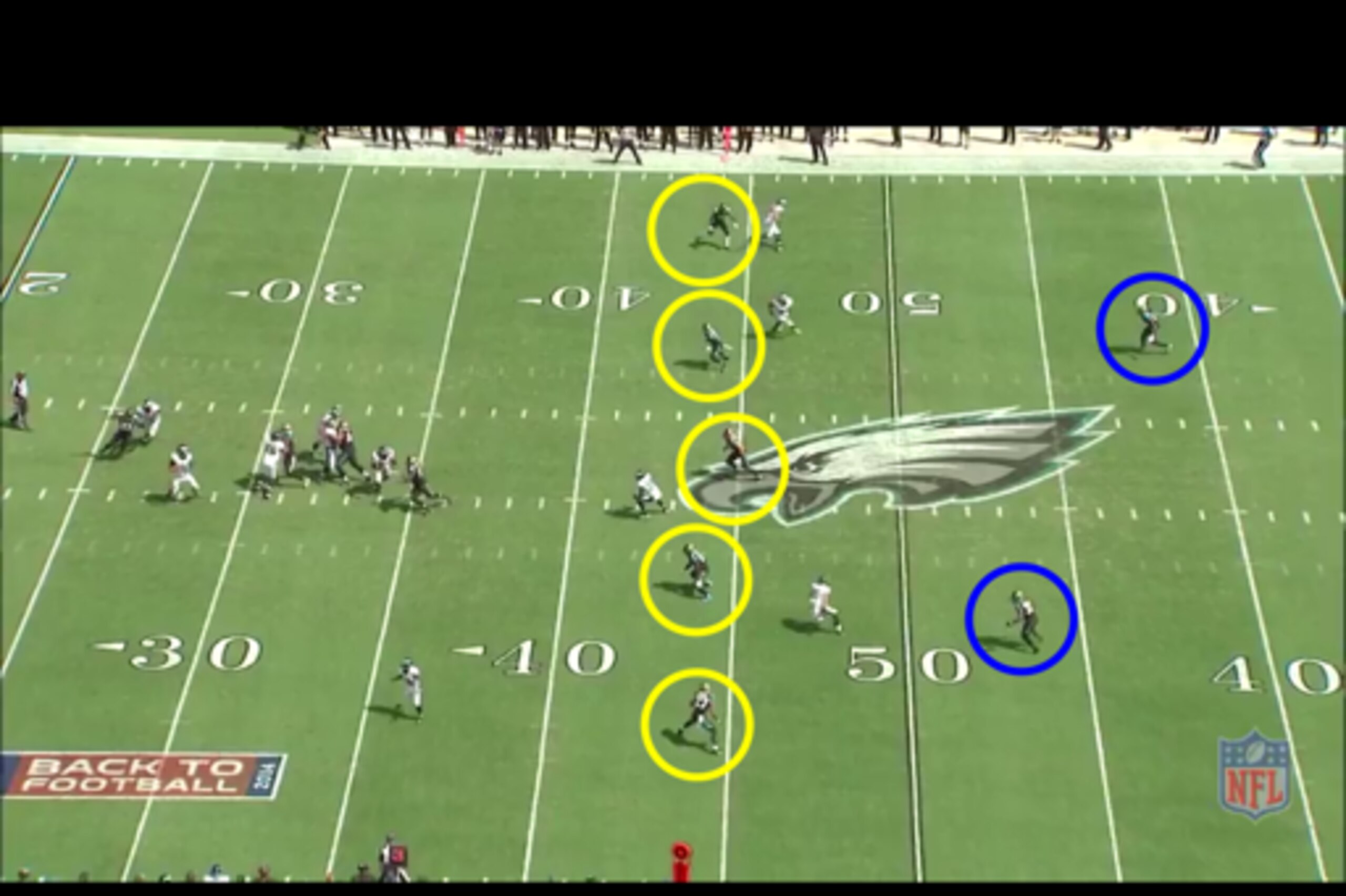
They kept underneath receivers in front, where each could be tackled for a short gain. At the same time, the help over the top eliminated the deep ball.
Now, you play quarterback for a second. Faced with this look, where are you going to throw the ball? Not easy, is it?
But perhaps you've made up your mind? Trouble is you only have a split second to move from thought to action and release your pass before Jacksonville's quartet of front-line speedsters gets to you.
Foles wasn't quick enough here. The same group of pass-rushers swarmed around him, and Clemons hit his hand as he threw to force an incomplete pass:
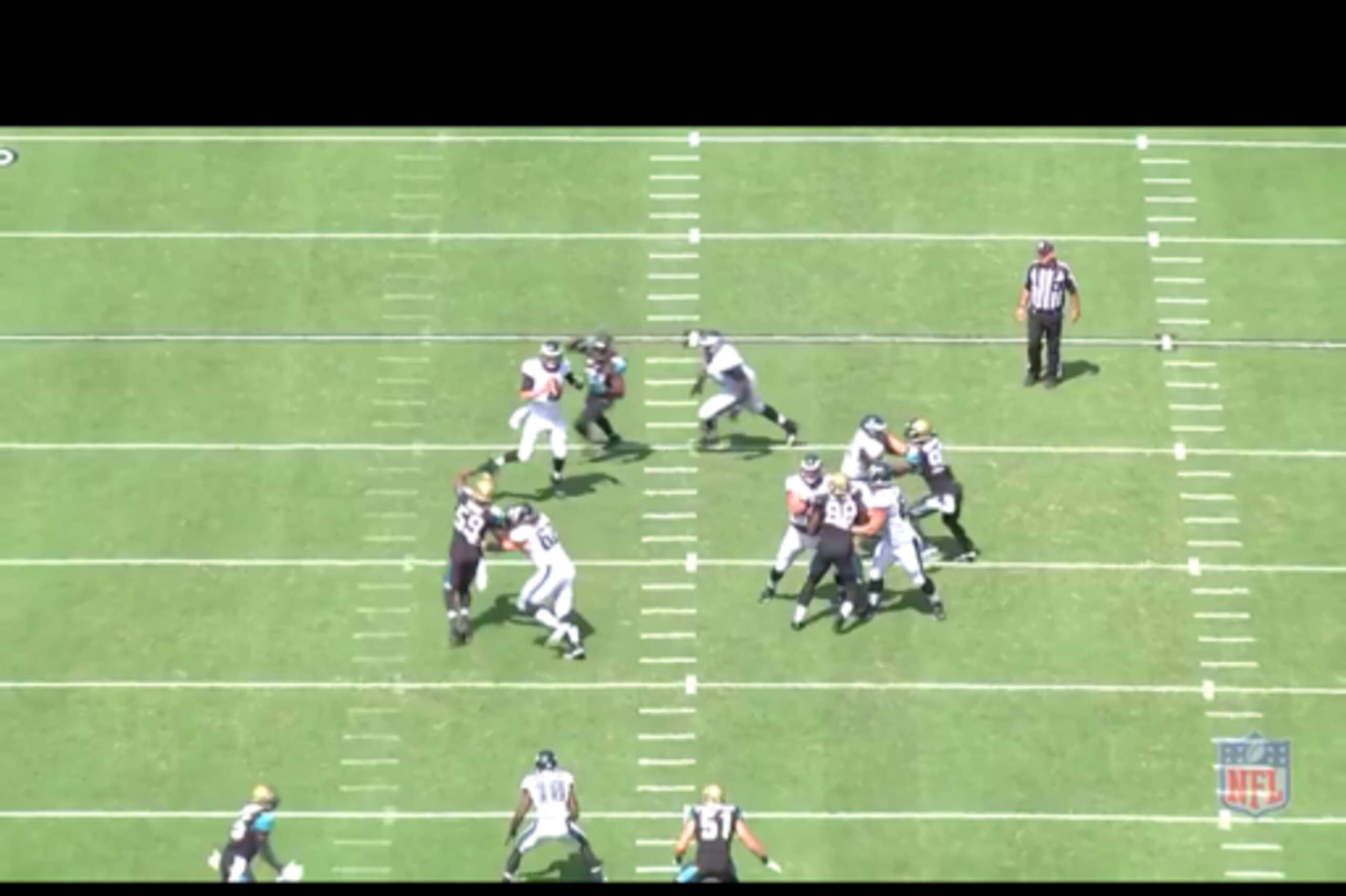
This wonderfully simple yet brilliantly executed combination of rush and coverage is certain to cause the Washington offense problems. The Texans game showed how much the O-line still struggles to contain speed and power up front, as defensive end J.J. Watt and outside 'backer Brooks Reed ran riot.
This scheme will also force quarterback Robert Griffin III to make the kind of quick reads and coverage recognitions he's often struggled with. Griffin won't have time to hold onto the ball, and he certainly can't make the mistake of forcing it into the zones.
If the Redskins find themselves trapped in a 3rd-and-long, they must use some maximum protection looks against this front. At the very least, Gruden must have a tight end and a back available to chip the D-ends.
On both plays detailed here, the Eagles just used their five down linemen to block and paid a heavy price for it. Washington can't make the same mistake.
Of course, the best way to help Griffin will be to manage the early downs more effectively. That means efficient play-calling with an emphasis on the running game.
Gruden's willingness to lean on the run has been a hot-button topic this week. The coach admitted he made a mistake going away from it in Week 1, per the team's official Twitter feed:
Gruden can't fall into that trap again, not after the way Alfred Morris and Roy Helu Jr. dominated in Houston. The pair combined for 137 yards on 18 carries.
That should encourage Gruden that his offense can run on a Jaguars defense that surrendered 145 yards on 32 runs by the Eagles.
Hit Big Plays off Play Action
Emphasizing the run early can help this offense get back to one of its core strengths—namely, hitting big plays off play-action passes. That's something Gruden has challenged his offense to do this week:
It's also something the Jags struggled to cope with in Philadelphia. The Eagles used an option-style run look to create a huge play in the fourth quarter.
The Eagles were in "12" personnel, one running back, two tight ends, two wide receivers. But they aligned one tight end, Zach Ertz, flexed in the slot and also put both wideouts on that same side.
As a counter to this three-receiver look, the Jags moved safety Winston Guy down into man coverage (red circle). He was covering Jeremy Maclin. The Eagles would now challenge deep safety Chris Prosinski (blue circle):

That involved flooding Guys' side of the field with two vertical routes. Maclin and Ertz would both stretch the defense with deep patterns.
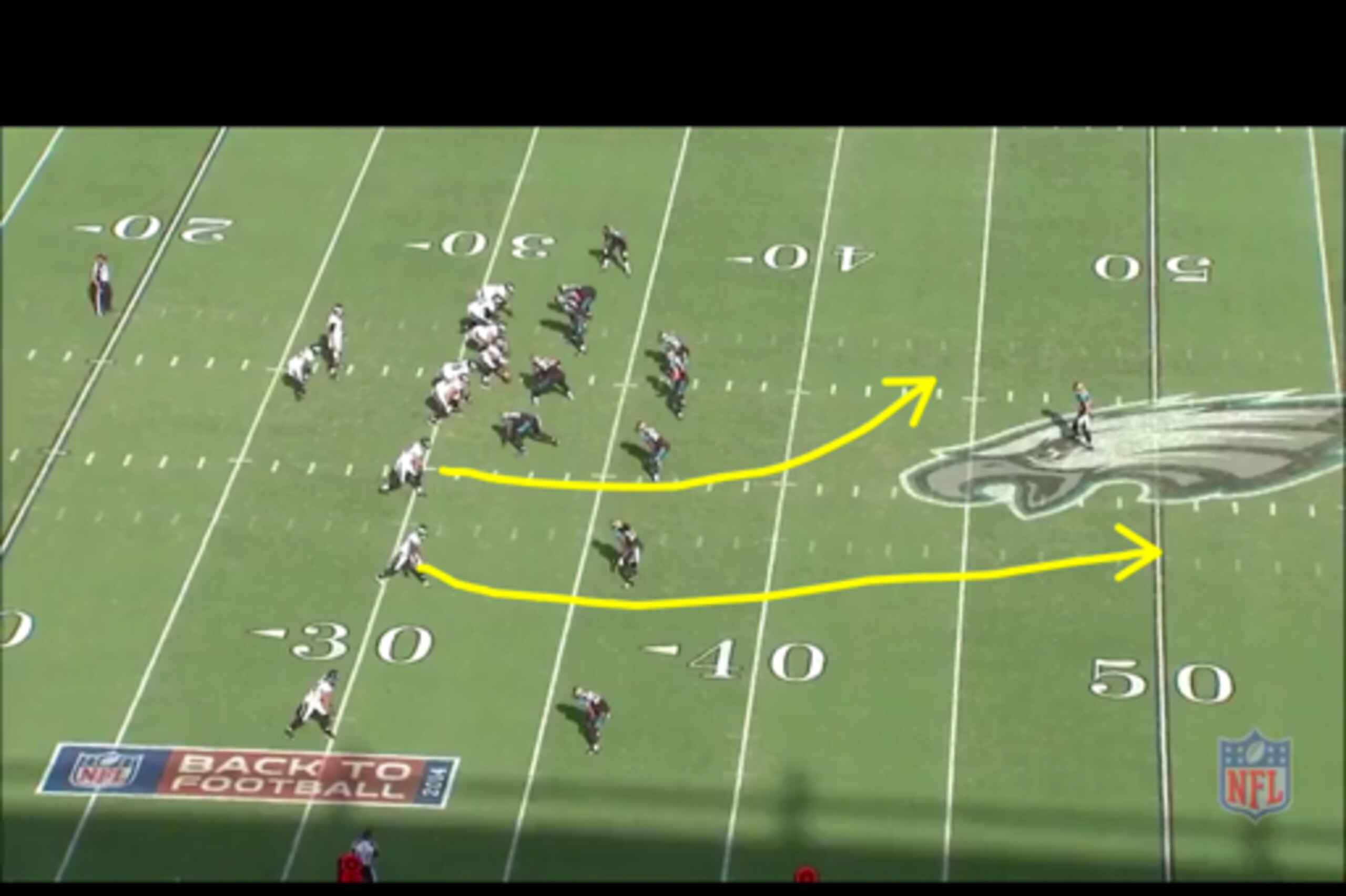
That meant Prosinski would have to make a choice. Either he would stay over the top to cover any vertical release from a wide receiver, or he would rotate down to pick up Ertz on the deep cross.
Prosinski went straight for Ertz. This left a huge void for Maclin to run into behind the defense:

That void was in part created because Guy and the cornerback on his side couldn't decide who was covering the underneath receiver, running an out to the flat, and who was picking up the vertical.
But the real key to the play was getting the linebackers to ignore Ertz and forcing Prosinski into action. This was achieved by a play-action fake between Foles and running back LeSean McCoy.
Foles stuck the ball into McCoy's gut option-style and delayed his next action. Notice how this drew the attention of all three linebackers.
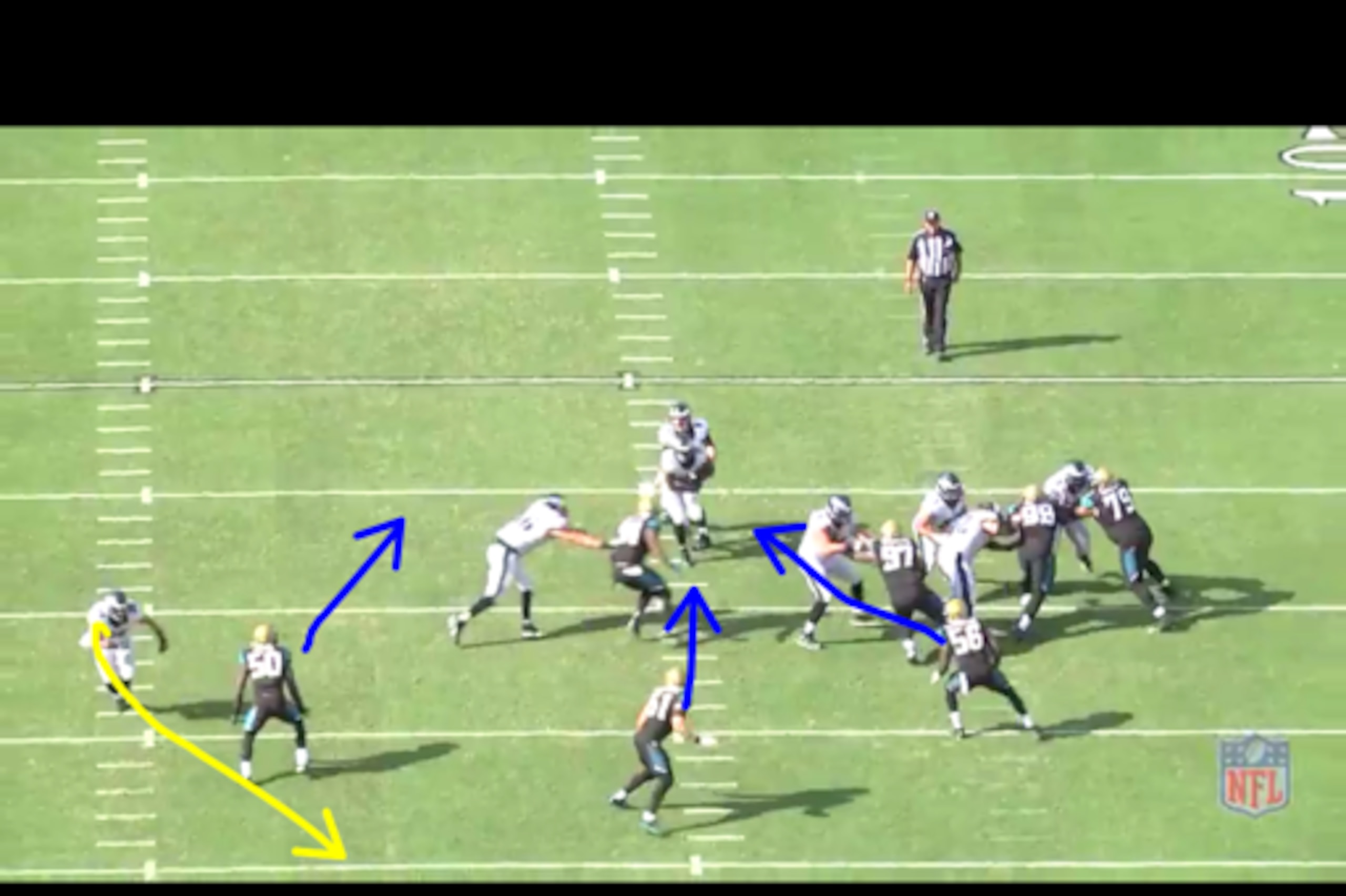
Their preoccupation with McCoy allowed a free release behind the second level for Ertz. That meant Prosinski had to take action. He couldn't very well leave Ertz. However, he soon rued leaving Maclin.
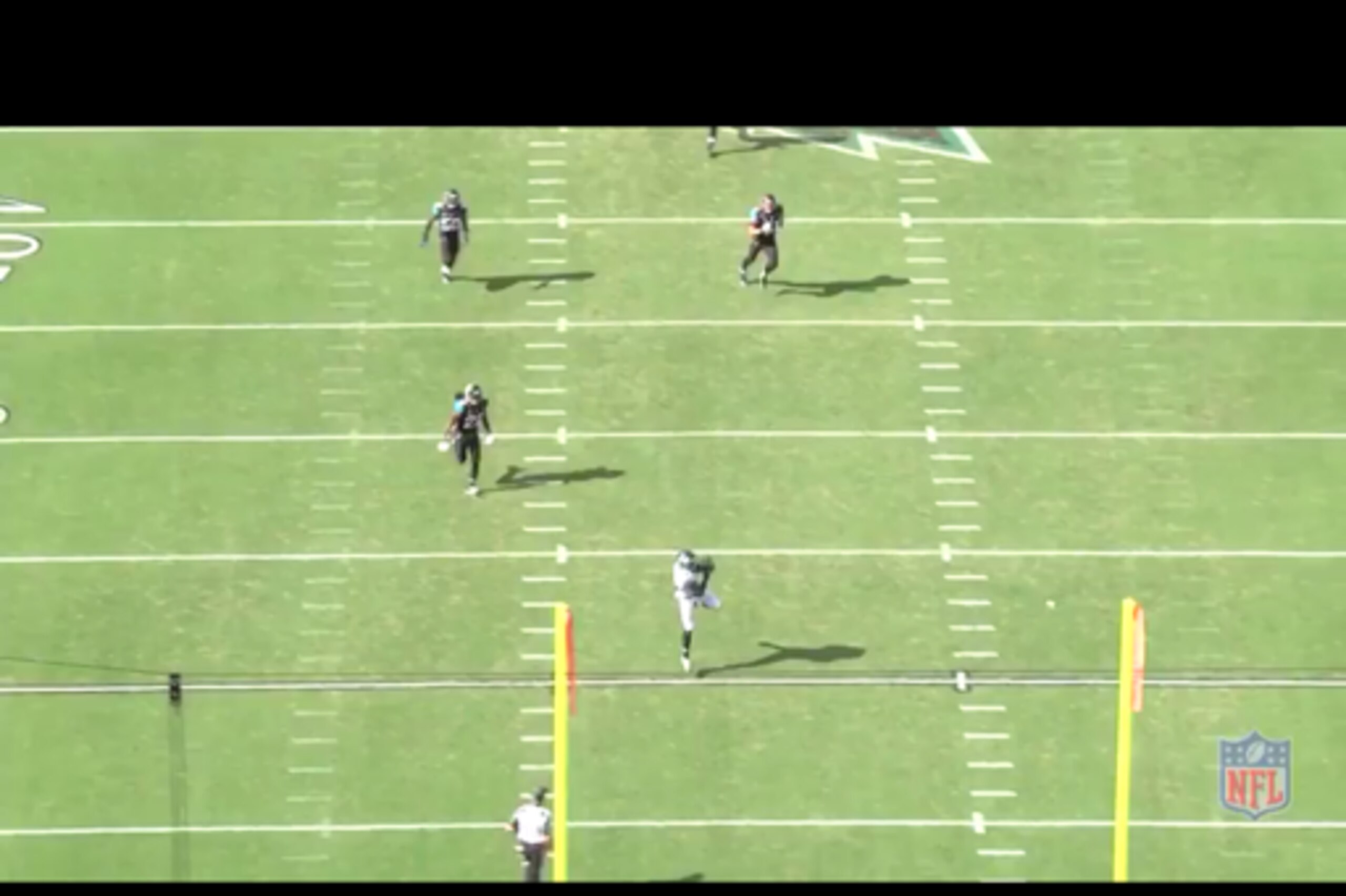
This is why it's so important for Gruden to establish the run as the central weapon of the offense. The Eagles had been destroying the Jags with option-style runs.
Darren Sproles had bolted for a 49-yard score to lead Philadelphia's comeback, a play minutely detailed by Bleacher Report's Matt Bowen. So Jacksonville had little choice but to overplay the supposed handoff to McCoy.
This play challenged the Jags' ability to see through deception and make coverage adjustments on the fly. They failed miserably on both accounts.
Another great aspect of this play, one very applicable to Griffin, was the use of a moving pocket. The Eagles rolled Foles out off the play action.

This got him away from the pass rush, which had been fierce all day. By shifting the pocket, the Eagles also gave Foles a clean lane to throw from.

In two separate articles this week, we've examined the need for Gruden to adapt the offense to both move Griffin around more and incorporate read-option looks in his play-calling. This play is a great example of why he should.
Not only can it get Griffin away from pressure and ease the burden on the O-line, but it can also open up the deep game. That's something Griffin is very keen to do, per Mike Jones of The Washington Post:
"When you have weapons like Pierre and DeSean and Andre, these guys can really go deep down the field. You want to get them opportunities and we had a couple in the game. We just didn’t come down with them. Yeah, we have got to find ways to open those guys up more down the field. Don’t think that’s any secret. You want to be able to be efficient and hit the underneath stuff, but you also have to get those home-run shots in every now and then. We’ll work on getting that.
"
Gruden will need vertical concepts to break up the Jags' zones.
Flood Zones with Vertical Routes
Washington can challenge Jacksonville's heavy reliance on zone coverages and deep safeties via multiple vertical routes. That's the best way to force those safeties into some tricky decisions.
The Eagles showed how to do it on a 3rd-and-10 play. The Jaguars were in a standard Cover 2 look. Philly head coach Chip Kelly challenged it with three vertical routes, two of which were run on the same side of the formation:
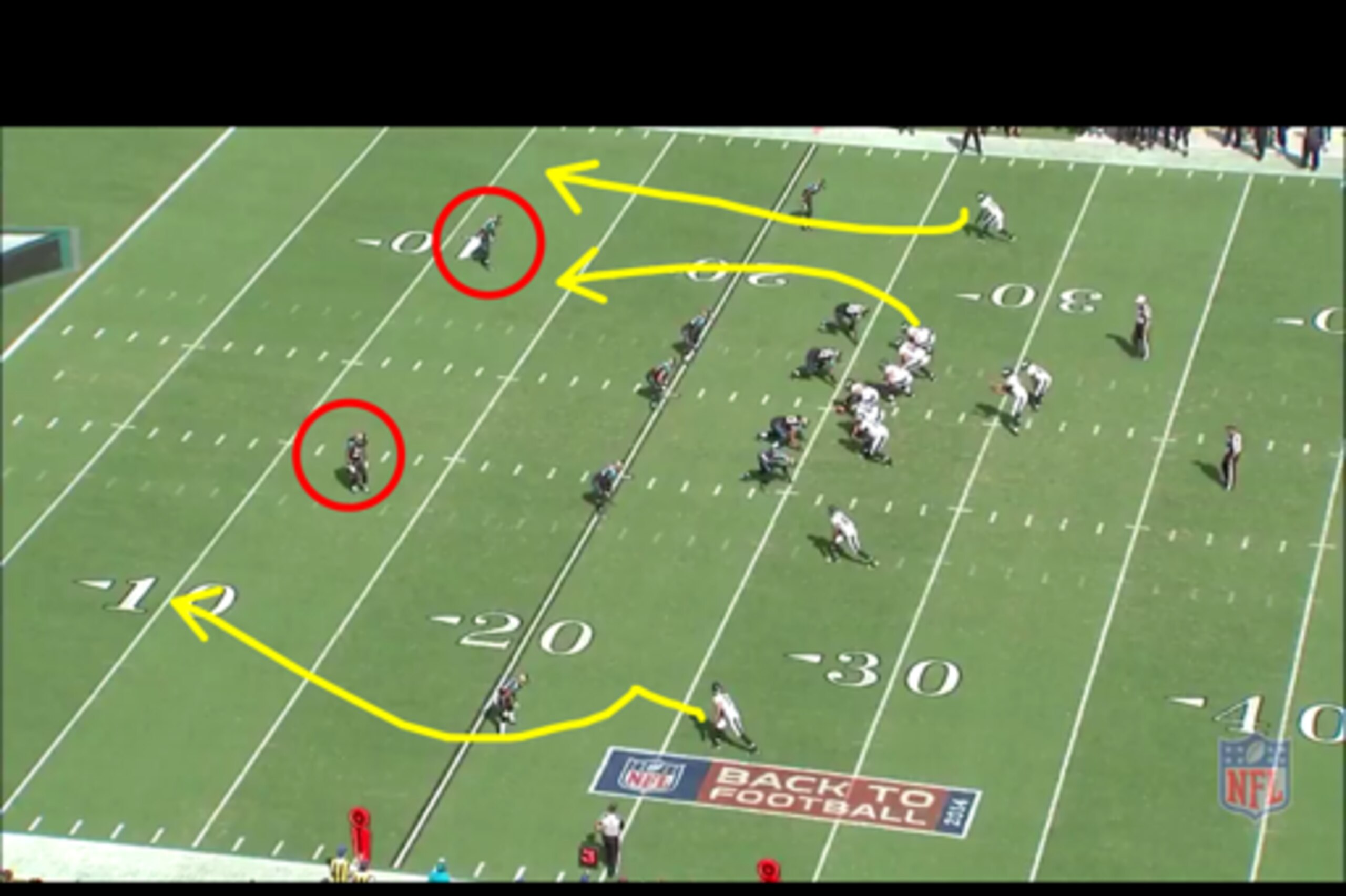
The overload provided an immediate dilemma for the safety on that side. He could either go for tight end Ertz or the outside wide receiver.
On this occasion, he went straight for the receiver. The cornerback had passed off his deep release to the safety, which is standard operating procedure in a Cover 2 scheme.
The problem was that it left linebackers to trail Ertz vertically. The Jags attempted to drop "Mike" linebacker Paul Posluszny into the deep middle in a Tampa 2-style coverage.
But by the time he made his drop, the quick and athletic Ertz was beyond him:

Posluszny could not get help from the other safety, because he had been drawn over by Riley Cooper's vertical pattern on that side. Notice the alarming size of the gap Ertz could run into in the middle:
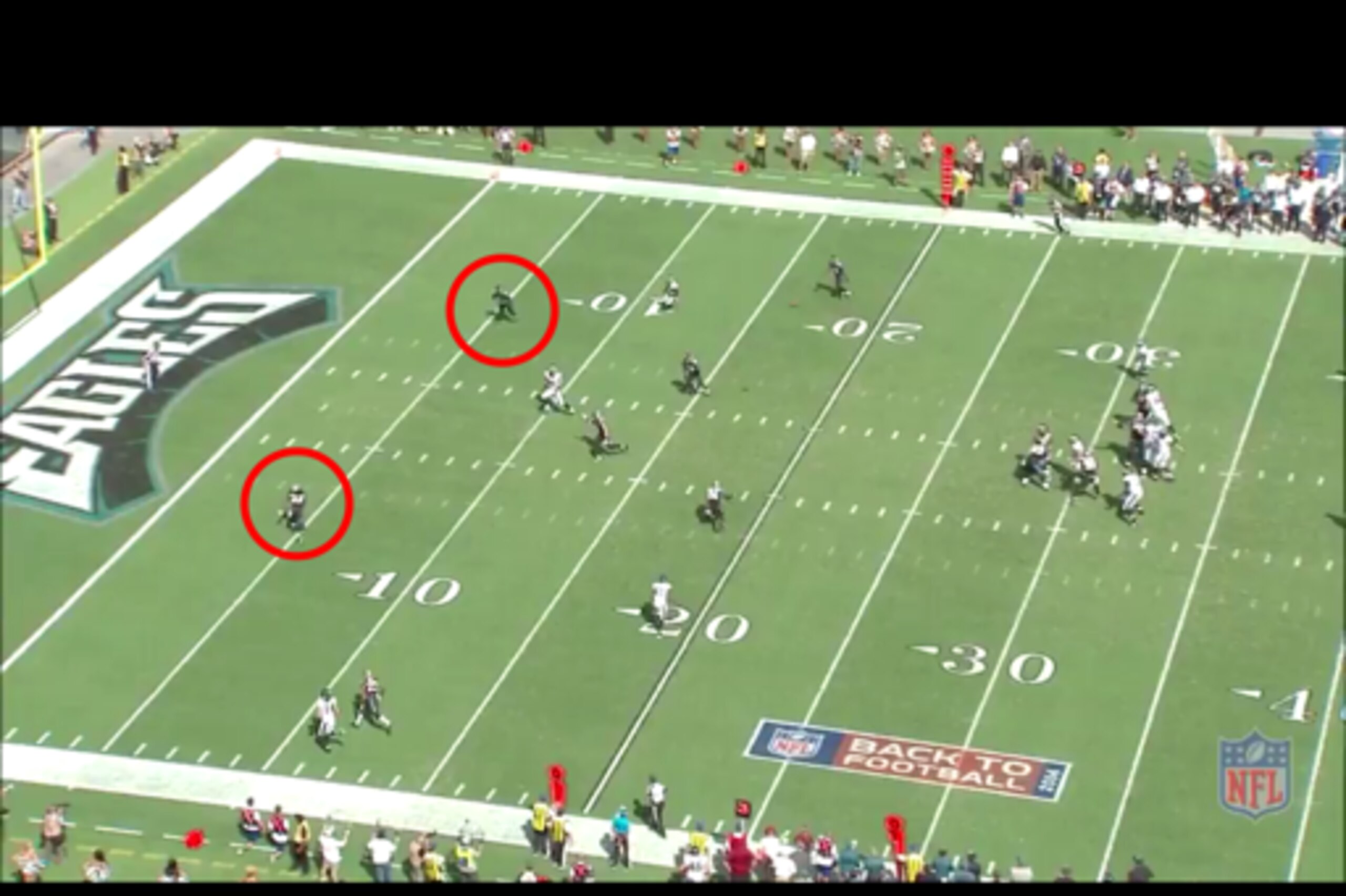
He caught the pass between the two safeties with Posluszny (51) helplessly trailing. This was a classic example of how to beat Tampa 2-style zone coverage:
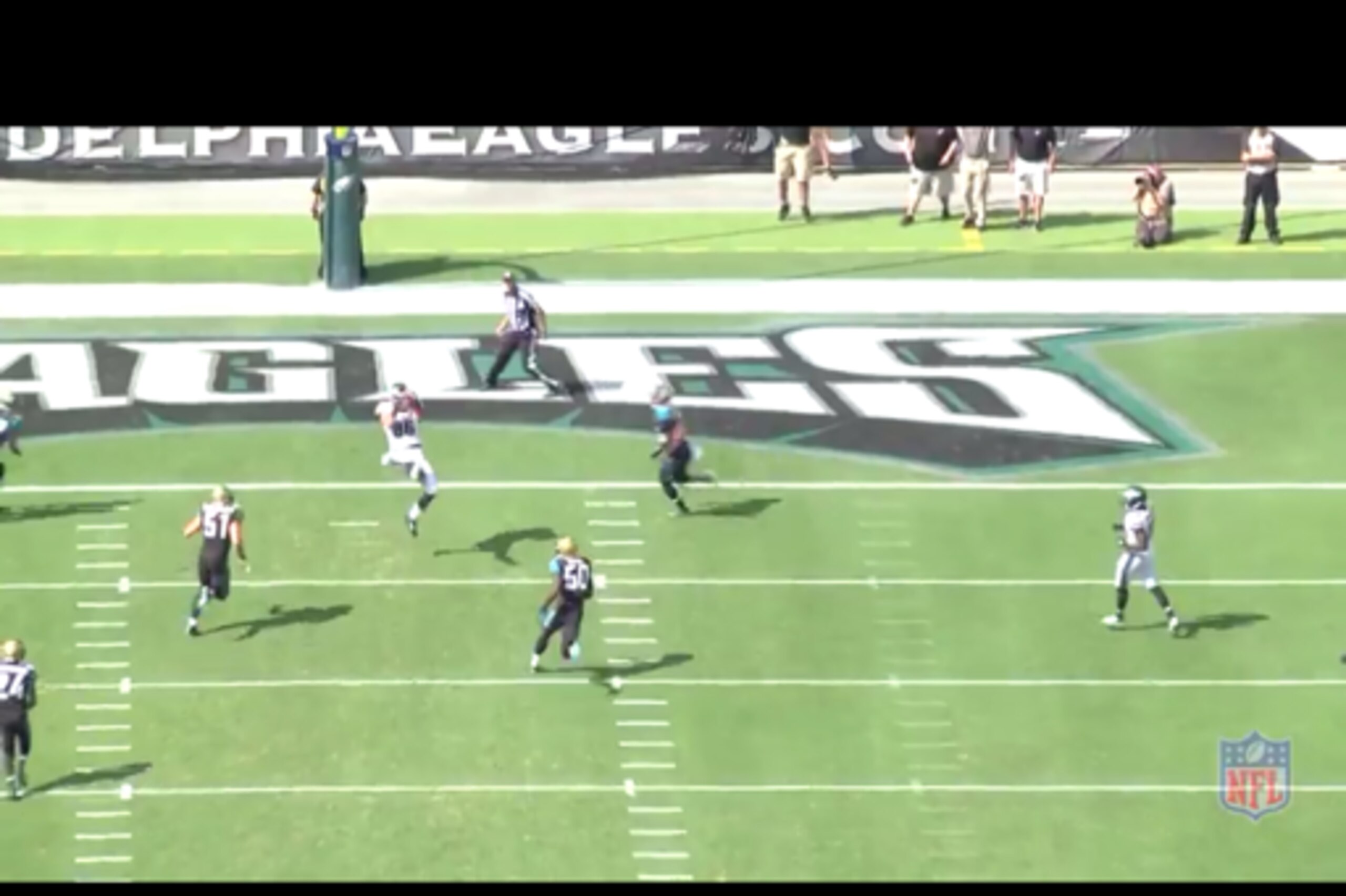
It's something Gruden has to have in the playbook this week. Sadly, his cause won't be helped by the potential absence of dynamic "move" tight end Jordan Reed, who is suffering from a hamstring injury.
He's just the kind of fleet-footed hybrid pass-catcher who could exploit this coverage. Unfortunately, Reed is likely to be sidelined, per Zac Boyer of The Washington Times:
Even without Reed, Gruden has the receivers to challenge this defense. He could run wide receivers Pierre Garcon, Andre Roberts or rookie Ryan Grant from the slot.
Gruden could even align the speedy and sure-handed Helu on the inside and have him stretch the coverage. Whoever he turns to, Washington's head coach must be prepared to expand the passing game to fracture Jacksonville's zones.
The Jaguars secondary could look very inviting if the unit is again without top safety Johnathan Cyprien. He missed the Eagles game due to a concussion and remains a doubt for Week 2, per Ryan O'Halloran of The Florida Times-Union:
Blitz Chad Henne into Quick Throws and Mistakes
Washington has had to get used to defenses blitzing Griffin to force quick throws and mistakes. Week 2 represents a great opportunity to turn the tables.
Defensive boss Jim Haslett must send blitzers after Jacksonville passer Chad Henne. His defense was effective on the blitz in Houston.
Let's take a look at two key examples. The first was a staple zone blitz run out of a 4-2-5 nickel front.
Inside linebacker Keenan Robinson and free safety Ryan Clark would both blitz to overload the gap between the right tackle and the right guard. The gap would be widened by D-tackle Jarvis Jenkins slanting across the face of the guard:
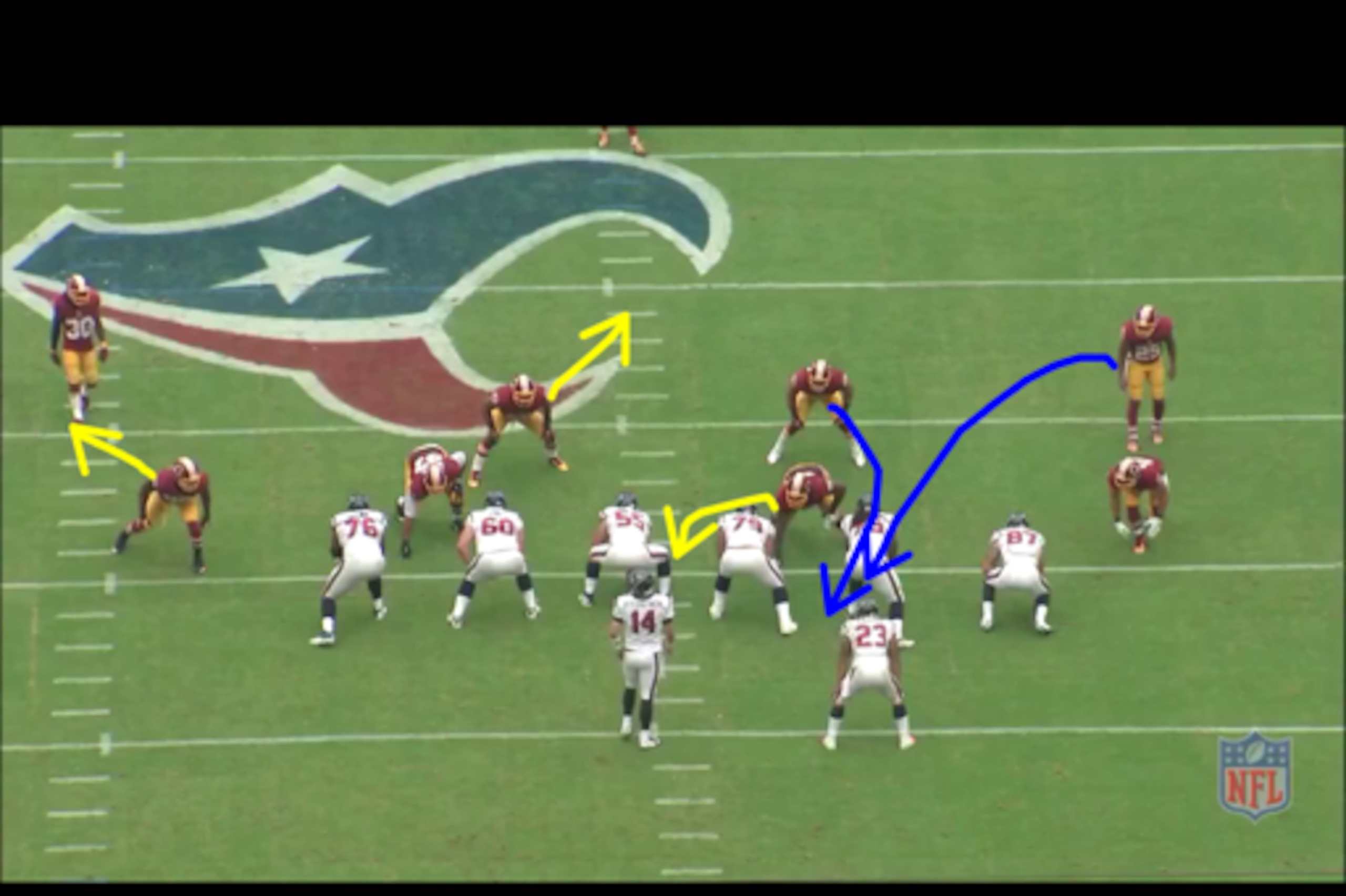
At the same time, rush end Brian Orakpo would drop out to cover the hook and curl zones on the other side. Meanwhile, Robinson's fellow linebacker Perry Riley Jr. would drop off to cover the middle zone. Nickelback E.J. Biggers (30) had to get depth to help cover the deep zones.
As the play developed, the droppers helped the Redskins adopt a three-under, three-deep coverage shell. That's the classic coverage for the majority of fire-zone pressures:
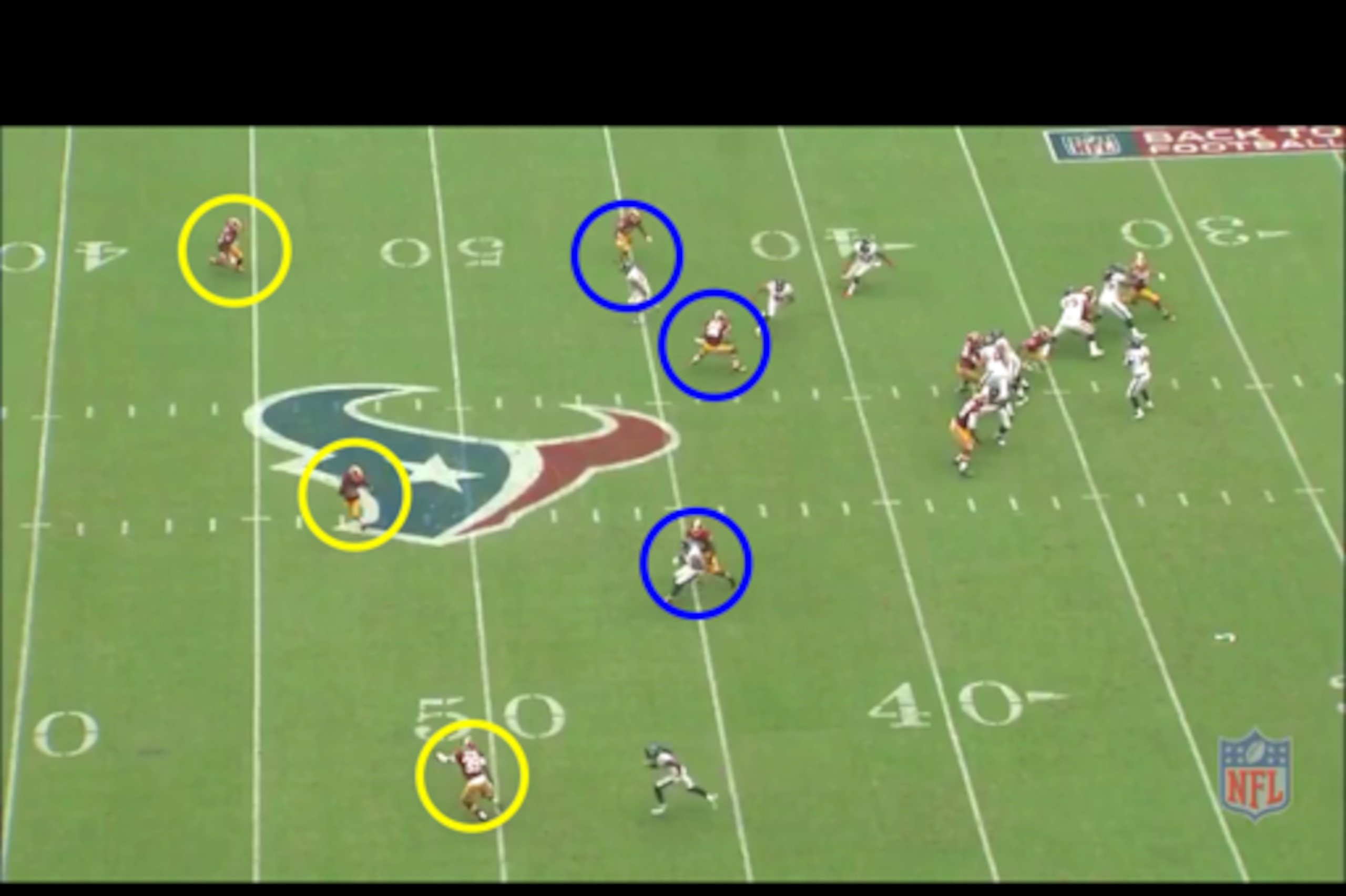
With Fitzpatrick hesitating trying to find a gap in the zones, Robinson came through clean to deck him as he threw. Tackle Jason Hatcher also tipped the pass, which fluttered harmlessly to the ground:

In the third quarter, Haslett showed Fitzpatrick a full-house pressure with nine defenders in the box, all positioned on the line of scrimmage:
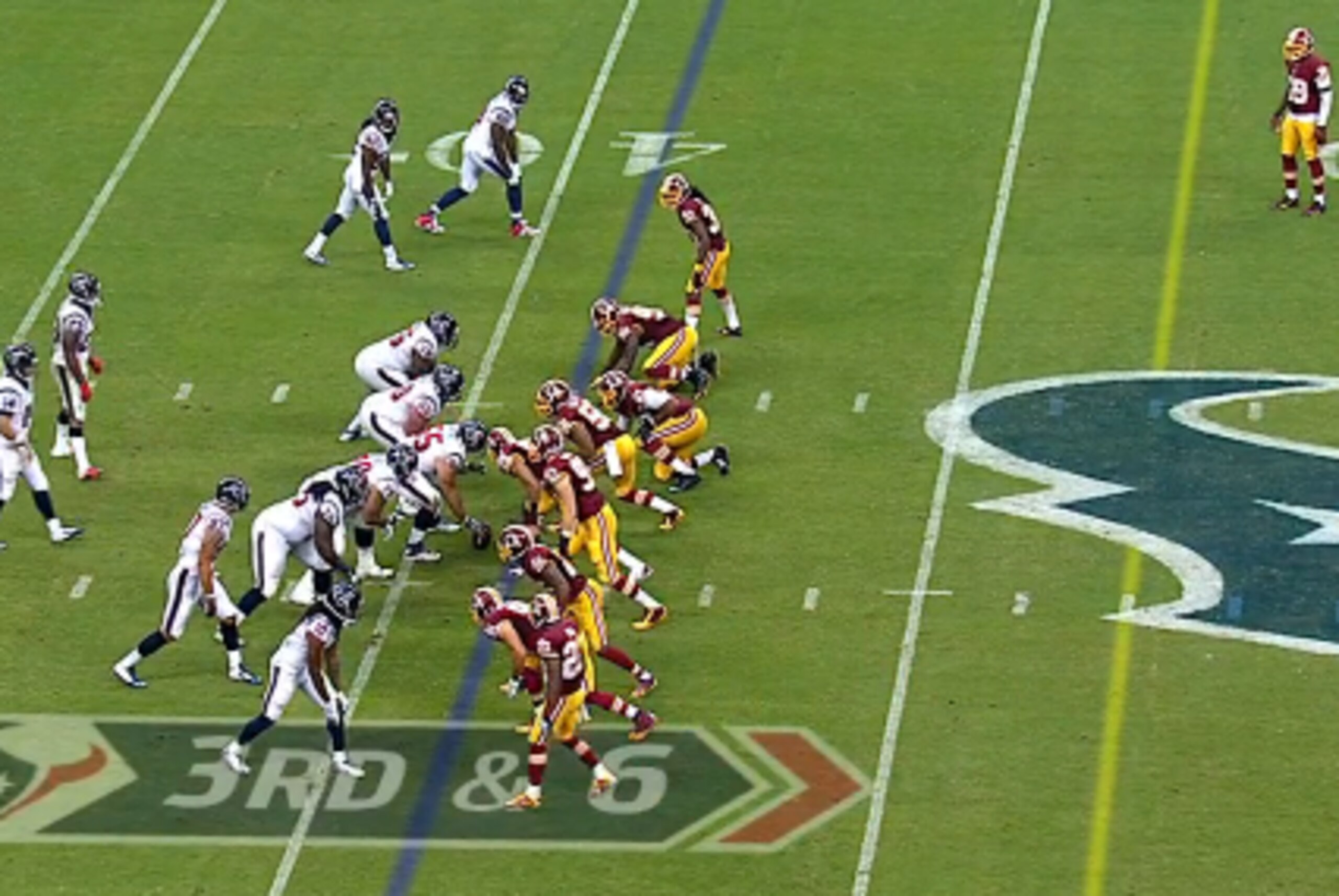
Just prior to the snap, Clark moved off the line and positioned himself underneath to cover the slot:

When the ball was snapped, Riley and Biggers also dropped out into coverage. That left Ryan Kerrigan, Trent Murphy, Robinson, Hatcher and Orakpo to rush:
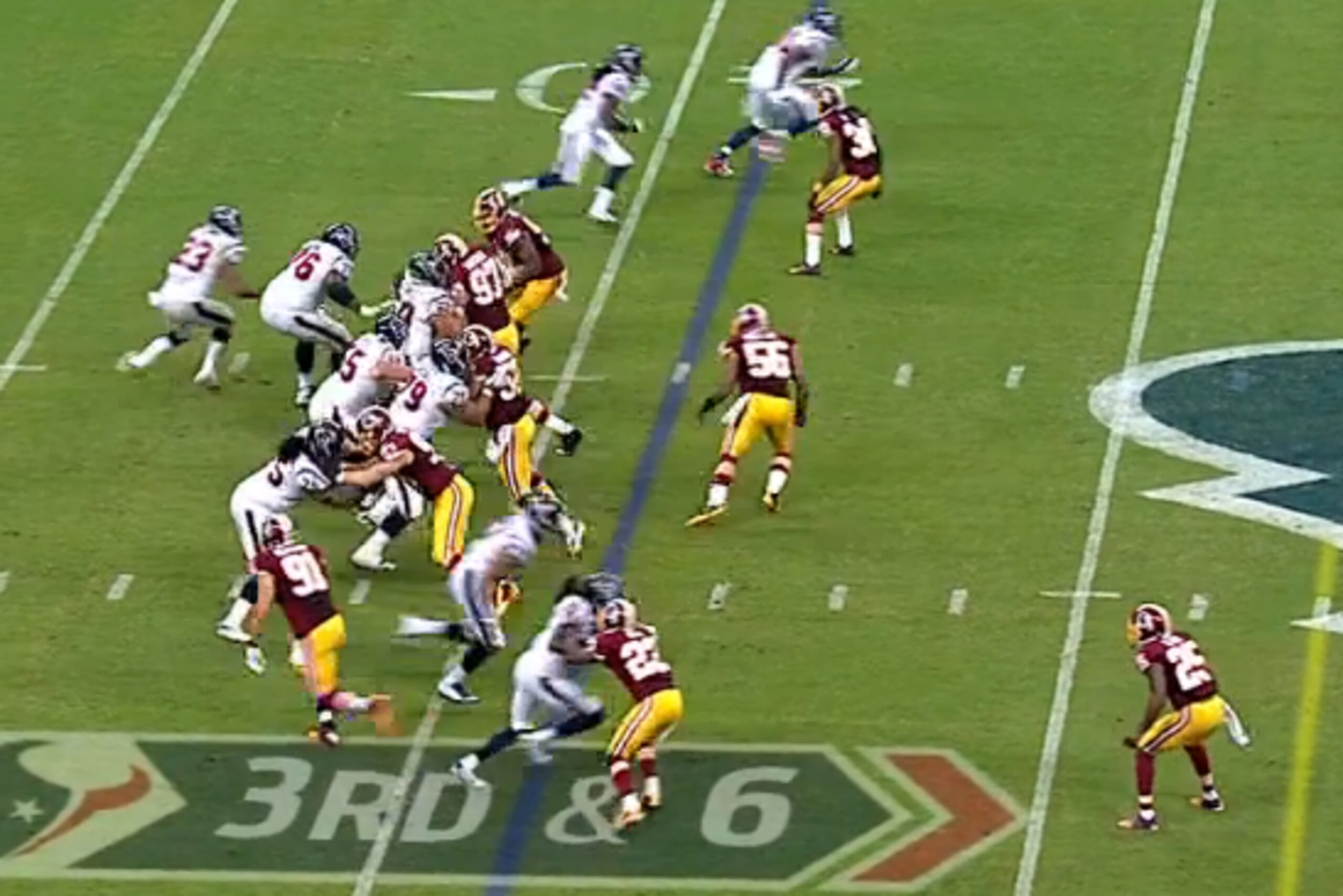
Because the Texans had slanted to where Riley and Robinson had both been aligned in the middle, nobody blocked Kerrigan (91):

He came free to hit Fitzpatrick as he threw. The initial pressure had already rushed Fitzpatrick into a quick and errant pass, which is the whole point of this defense.
Aside from getting a free rusher to the quarterback, one of the most pleasing aspects of this play was the coverage. Haslett protected his blitz concept by starting with a deep safety and then dropping three defenders underneath.
You can see from the last image how Washington had a covering defender for every one of Houston's eligible receivers.
Considering how often he's been burned with this concept in the past, it's great to see Haslett adding a layer of security to what was once a Cover O pressure. He must unleash this scheme against Henne, who is erratic from the pocket.
Haslett should be able to risk pressure against a passing game without many field-stretchers. The Jags lost rookie deep threat Marqise Lee to a hamstring injury sustained in practice, per Hays Carlyon of The Florida Times-Union. Carlyon also noted that Cecil Shorts III is currently nursing an injury.
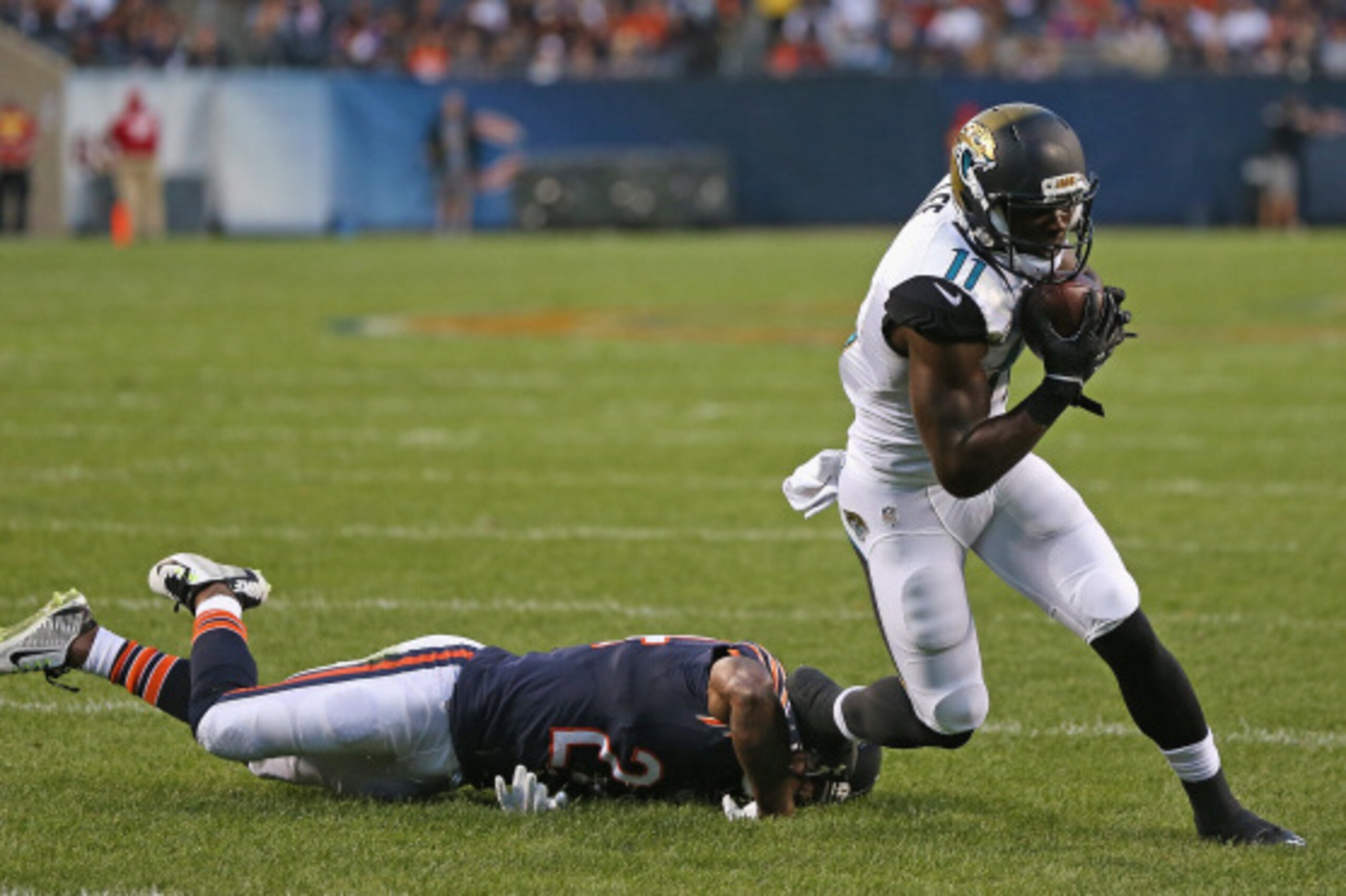
Without their burners to break deep, the Jags won't be able to exploit the gaps behind blitz designs. That will leave Henne at the mercy of a potentially strong Washington pass rush.
Washington can rebound from the struggles in Houston if Gruden directs a plan that emphasizes the team's strengths on both sides of the ball.
That means heavy running and letting Griffin throw on the run from a moving pocket to receivers attacking vertically. It also means turning the defense loose to stymie Henne.
Follow that simple formula, and this team will have evened its record by the close of business in Week 2.
All screenshots courtesy of CBS Sports, Fox Sports and NFL.com Game Pass. All statistics via NFL.com.
.jpg?w=2560 "Chiefs Dolphins Football")


.jpg?w=2560 "Love's Body Already 'Tired'")