Jets Offensive Line Key to New York's Week 1 Victory over Oakland
For a win that was littered by 11 penalties, the New York Jets have a lot of reason to have confidence in their 2014 outlook, particularly from an offensive perspective. The side of the ball that has haunted Rex Ryan during his six-year tenure as head coach was sneakily efficient on Sunday against the Oakland Raiders, racking up 402 total yards.
The skill position players will have the yards and accolades assigned to them, but in truth, the offensive line paved the way for the Jets' dominant-yet-somehow-close 19-14 win over the Oakland Raiders.
.jpg?w=2560 "Commanders Eagles Football")


Geno Smith is an ascending quarterback, just like Chris Ivory and Chris Johnson are quality running backs—but the fact that Smith is ascending along with his running game is no coincidence. The offensive line took care of business from start to finish, giving Smith the time he needed to make comfortable throws while giving Ivory and Johnson the wide-open lanes they needed to make plays like this:
The only aspect of offensive play on par with the Jets' run-blocking was their pass protection. Just as he did in Week 3 of the preseason against the New York Giants, Smith was able to easily get into a rhythm, allow his routes to develop and operate like the game was a glorified version of a seven-on-seven drill.
Any quarterback performs better when provided greater protection, but the difference is even more pronounced in Smith's case. As Bleacher Report's Erik Frenz's research indicates, Smith was a much better player in the absence of pressure:
| Yes | 95 | 207 | 45.9 | 1,172 |
| No | 152 | 235 | 64.7 | 1,856 |
Behind great pass protection against the Raiders, Smith missed on just five of his 28 passes.
If Smith never gets the time he needs to get comfortable or the explosive running plays to supplement the Jets offense, they lose games like these. For the Jets, quality offensive line play is not a luxury—it is a necessity.
At the dawn of the 2014 offseason, the Jets would have been content with simply treading water on the offensive line, never mind turning it into the base of their offense. Left guard Brian Winters was coming off a quietly disastrous rookie season, right tackle Austin Howard escaped in free agency, and right guard Willie Colon underwent knee surgery just a few months after tearing a biceps muscle.
The only two "sure things" about the Jets since 2006, tackle D'Brickashaw Ferguson and center Nick Mangold, only continue to age as they enter their inevitable declines.
To his credit, general manager John Idzik acted swiftly to find a comparable (and cheaper) replacement for Howard in Breno Giacomini. While Idzik may have been initially reluctant to bring back such an injury-prone veteran still in the middle of rehab, Colon is back in the starting lineup and playing at a high level.
Not satisfied with the production from their third-round guard, the Jets encouraged competition for Winters by moving tackle Oday Aboushi to guard. Aboushi replaced Winters in the starting lineup for Week 2 of the preseason, sending a clear message to Winters that his job was anything but secure.
The message was well-received, as Winters has played quality football since the manufactured benching. He allowed just one quarterback hurry the following week and made several key blocks that sprung Ivory and Johnson against the Raiders on Sunday.
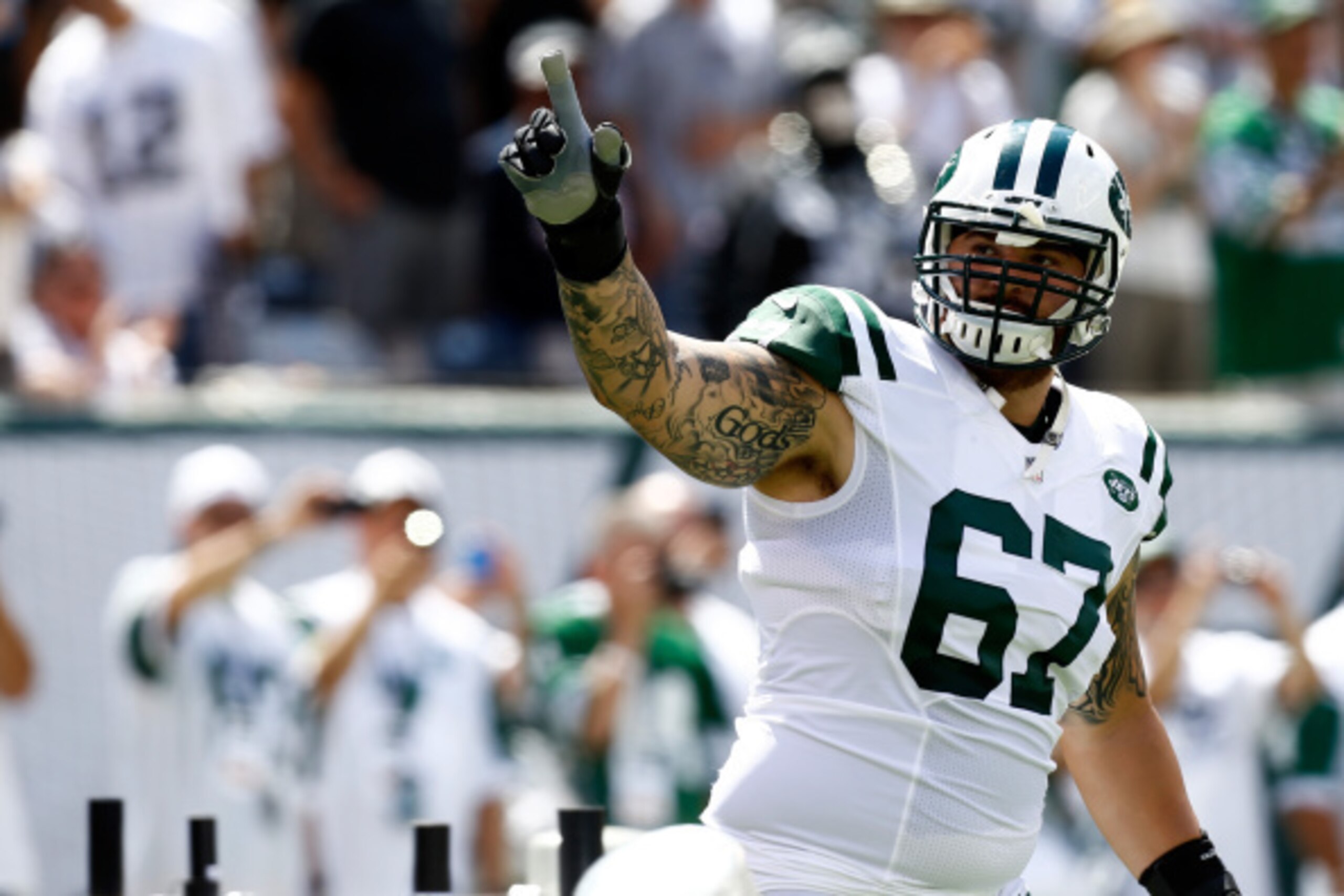
The Jets' newfound strength on the offensive line was no accident. As soon as Idzik took the job, using line play to set the tone within the organization has been a priority. More than half of his first draft class in 2013 was composed of offensive or defensive linemen.
Now, the Jets don't just have a strong starting five—they have quality depth behind them. After challenging for the starting left guard job, Aboushi fits in nicely as a swing tackle, utilizing his former experience at tackle from the University of Virginia perfectly. Dalton Freeman replaces Caleb Schlauderaff at backup center after allowing just one sack in the preseason.
So far, Idzik's philosophy of building from the inside out is going to plan. This season, it must be executed to near-perfection for the Jets to get back into the playoffs.
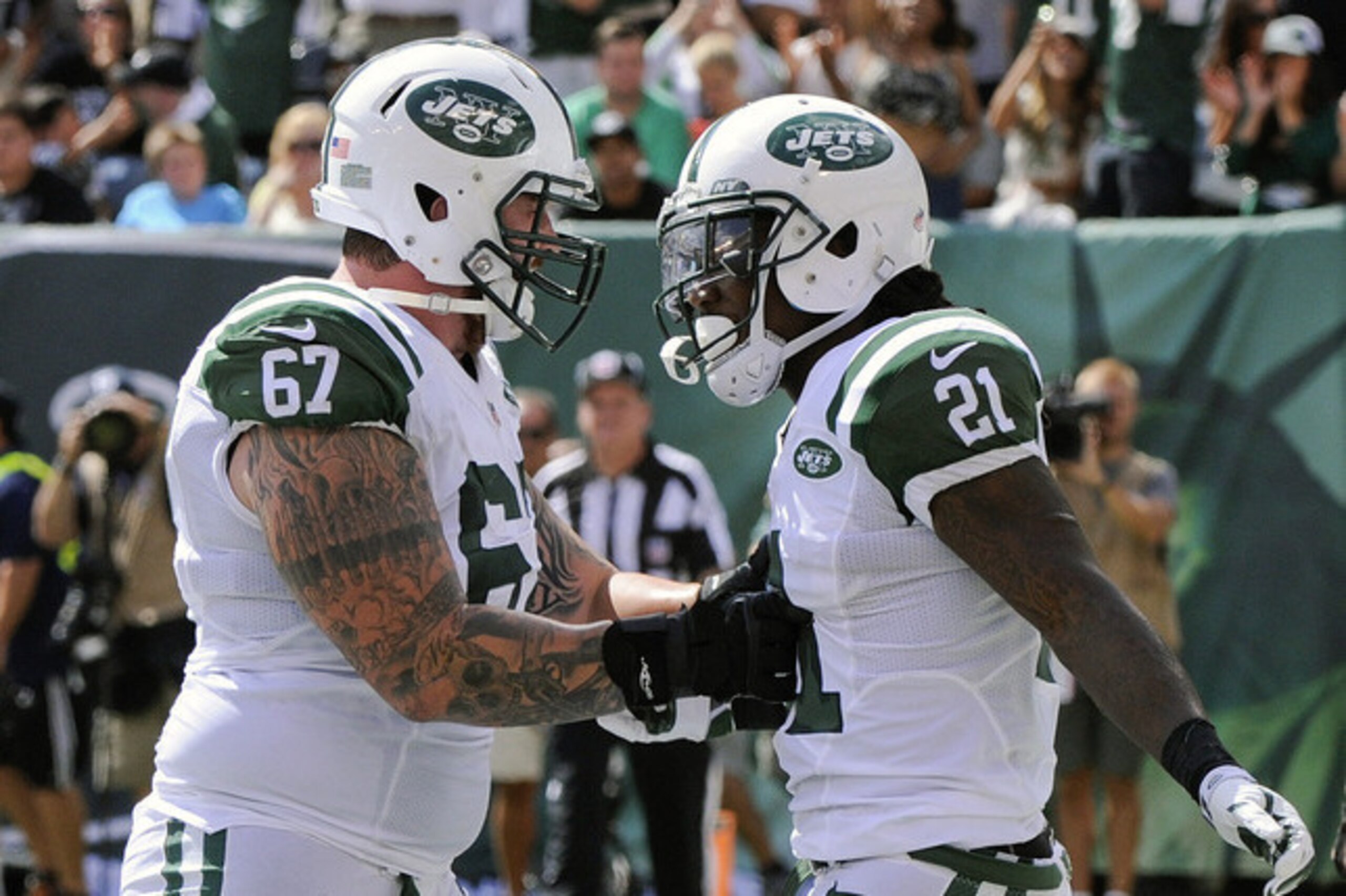
At the skill positions, there is no question that the Jets have improved. However, the combination of Eric Decker, Greg Salas, Jeremy Kerley and David Nelson is not going to scare defenses stiff. At quarterback, Smith is improving, but he has still yet to breach even the middle tier of quarterbacks.
In other words, the Jets don't have skill players that gives them a distinct matchup advantage on a weekly basis—which is where the offensive line comes in.
If the Jets are going to beat teams like the Green Bay Packers, Denver Broncos or New England Patriots, they will need to do it through their offensive line. Giving Smith an inordinate amount of protection and making craters in defensive lines can change the course of a game, even if an absolute number cannot be assigned to an effective block.
If the Jets offensive line can maintain this level of play for the long term, it will have a positive rippling effect on the team. The running game will be more effective, making life easier on Smith (who will enjoy quality pass protection). In turn, this takes pressure off a defense and keeps them away from the field for longer periods of time.
Quarterbacks (and cornerbacks) will comprise most of the headlines surrounding the Jets, but in reality, it is the "big uglies" up front that will shape what is a monumental season for the green and white.
Advanced statistics provided by Pro Football Focus (subscription required).
.jpg?w=2560 "Chiefs Dolphins Football")
.jpg?w=2560 "Texans-Mixon Released Football")


.jpg?w=2560 "Love's Body Already 'Tired'")