

What Went Wrong for the Green Bay Packers Against Seattle in the Opener?
A number of mental mistakes, personnel deficiencies and errors forced by the still hungry and confident defending champions led directly to the Seattle Seahawks' 36-16 rout of the Green Bay Packers during Thursday night's season opener.
Needing a mostly perfect performance to beat the Seahawks in Seattle, the sloppy Packers got none of the sort.
The offense made critical blunders and struggled to take advantage of limited opportunities. The defense failed to make disruptive plays, missed tackles at an alarming rate and was generally no match for the Seattle run game. Add in a crucial injury, a handful of ill-timed penalties and an electric atmosphere at CenturyLink Field, and a 17-10 game at halftime eventually turned into a blowout win for the class of the NFC.
TOP NEWS
.jpg?w=2560 "Chiefs Giants Football")
Mahomes Told Teammate to Leave Meeting

Geno Explains Wilson Exchange

McCarthy Wins 1st Giants Start
The gap between Green Bay and the reigning champions remains clear and conspicuous.
Here's a closer look at what went wrong for the Packers in Seattle.
Middle Defense
The Packers should leave Seattle with serious doubts about their ability to defend the middle of the field.
Starting nose tackle Letroy Guion, who played just nine preseason snaps, was bullied to no end by the Seahawks offensive line. After struggling to maintain one gap with the Minnesota Vikings, Guion is now being asked to occupy two. He didn't look capable of handling the assignment in Seattle. Many assumed losing B.J. Raji wasn't a huge loss, because he would have been a part-time player most games. But the drop-off from Raji to Guion looks substantial, and Raji hasn't been an impact player in almost three years.
Against a Green Bay's front, the Seahawks ran for 207 yards and averaged 5.6 yards per carry. Marshawn Lynch made a living between the tackles and attacking the soft underbelly of the Green Bay defense.
| M. Lynch | 20 | 110 | 5.5 | 2 | 21 |
| P. Harvin | 4 | 41 | 10.3 | 0 | 16 |
| R. Wilson | 7 | 29 | 4.1 | 0 | 13 |
| R. Turbin | 6 | 27 | 4.5 | 0 | 7 |
| TOTAL | 37 | 207 | 5.6 | 2 | 21 |
To the surprise of very few, the Packers still have problems at inside linebacker.
Brad Jones likely played the worst game of his career in Seattle. He didn't come off the field, playing all 70 defensive snaps, per Pro Football Focus (subscription required). His contributions included three missed tackles, two killer penalties, zero stops and a dropped interception on the first series. Can the Packers get over the hump in the NFC with Jones playing significant snaps at a prime position?
Based on Thursday night, that answer is a definitive "no."
At safety, rookie Ha Ha Clinton-Dix suffered through a few "welcome to the NFL" moments, including a missed tackle on Ricardo Lockette's touchdown in the first half. He can play, but the growing pains are going to be there. Morgan Burnett, who also played all 70 snaps, looked like the same hesitant player he was a year ago. The Seahawks completed all three passes targeted against him for a perfect 158.3 passer rating.
Good defenses are built up the middle. Just look at Seattle: Brandon Mebane, Bobby Wagner, Earl Thomas, Kam Chancellor. The Packers' personnel isn't even in the same stratosphere.
Bryan Bulaga Injury
Losing Bulaga, the offense's starting right tackle, was a crippling blow. Former first-round pick Derek Sherrod held his own during the first half, but the whole operation came crumbling down during a nightmare final 30 minutes.
Sherrod was beat silly off the edge on back-to-back plays that swung the game. On the first, Sherrod allowed Cliff Avril to essentially come untouched around the corner and sack Aaron Rodgers on fourth down. A play later, Michael Bennett made easy work of Sherrod, strip-sacking Rodgers and forcing a safety.
According to Pro Football Focus, Sherrod finished Thursday night with a minus-6.4 rating, the worst overall on the Green Bay offense. He was asked to be a pass-blocker 30 times, and he allowed two sacks and two hurries.
Who knows how the game would have played out had Bulaga not left the contest. Maybe the same, considering he had already allowed two hurries on just nine pass-blocking snaps before the injury. But it's clear that Sherrod's struggles in his place contributed directly to the game's final outcome.
Missed Tackles
The Packers couldn't tackle the two players they needed to get on the ground most: Lynch and Percy Harvin.
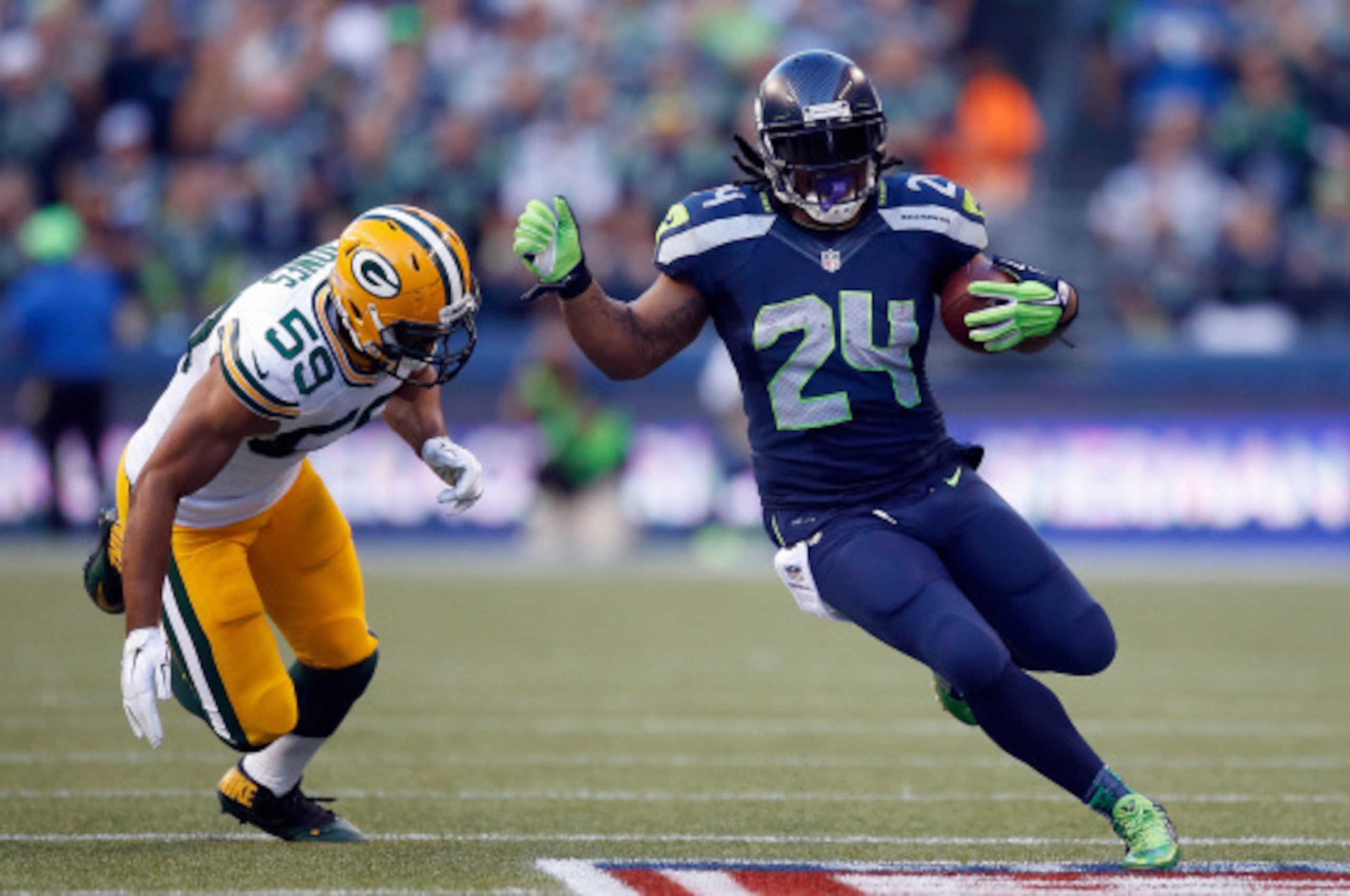
Granted, both players are among the most difficult at their respective positions to corral. Lynch led the NFL in forcing missed tackles a year ago. In 2012, Harvin forced 27 misses in just nine games. Both are powerful, aggressive runners with the football. Harvin can make anyone miss in the open field.
On Thursday, the pair forced 10 of Green Bay's 16 missed tackles.
Lynch was especially difficult to get to the ground. The Packers whiffed on eight tackle attempts against him, which allowed Seattle's bulldozing back to gain 50 of his 110 yards after contact. Harvin didn't force a missed tackle over his seven receptions, but his four carries netted two misses. He finished with 41 yards.
Seahawks defensive end Michael Bennett had a stinging assessment of Green Bay's tackling effort, especially against Lynch.
"I saw supposedly some of the best players in the league not want to tackle Marshawn Lynch," Bennett said, via Dan Hanzus of NFL.com.
Ten different members of the Packers defense missed at least one tackle. Jones and slot cornerback Casey Hayward both missed three; Guion, Clinton-Dix and Tramon Williams missed two a piece.
Lynch's highlight reel shows the tentativeness of the Packers in tackling the 215-pound back:
Aaron Rodgers
The Seahawks held Rodgers to uncharacteristically low numbers across the board.
Rodgers' 5.7 yards per attempt ranked as the eighth-worst finish of his 95-game starting career. Overall, his career average is 8.2.
His 81.5 passer rating was just the 16th time he's finished a regular-season start under 82.0. He is No. 1 all time in passer rating—by over seven points—at 104.7.
Thursday also marked just the 13th time he's been held under 200 passing yards during a game he both started and finished. Since 2008, he's averaged almost 275 a contest.
A Seahawks defense featuring athletic linebackers and the best secondary in football forced Rodgers to dink-and-dunk all night. According to PFF, he attempted just 11 passes over 10 yards, completing only three for 50 yards and a passer rating of 8.1.
He was picked off on one of those 11 attempts when he missed Jordy Nelson on a throw he typically makes in his sleep. The turnover gave Seattle three points.
"This is the Seattle Seahawks," Rodgers said, via Rob Demovsky of ESPN.com. "They're a great defense. You don't expect to be able to move the ball effectively every down on every drive. But you need to make the most of your opportunities."
Rodgers was outplayed by his counterpart, Russell Wilson, who threw for two scores and had a passer rating of 110.9.
Give credit where credit is due. In the Super Bowl and Thursday's opener, the Seahawks have held two of the best quarterbacks of this generation to just 5.7 yards per attempt and a passer rating of 76.7. Rodgers wasn't the first quarterback the Seahawks have suffocated, and he certainly won't be the last.
One-Dimensional Offense
Last February's Super Bowl showed the football world that even Peyton Manning—a quarterback who threw 55 touchdown passes for the highest scoring offense in NFL history—can't beat Seattle without a running game. The Denver Broncos rushed for a grand total of 27 yards on 14 carries in that game, leaving the Seahawks defense to focus all their attention on stopping Manning and the passing game.
The same storyline eventually played out Thursday night.
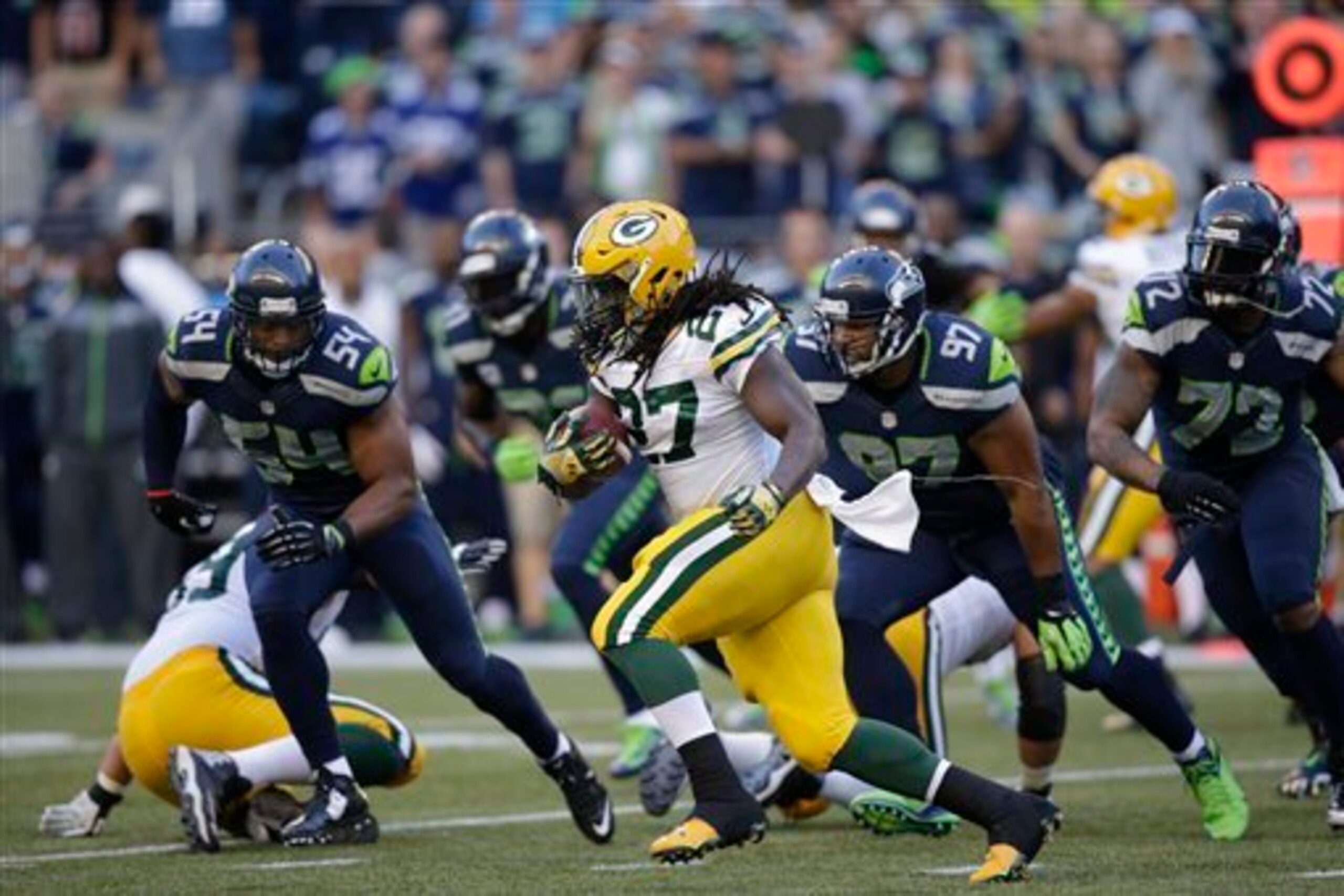
Eddie Lacy had a 15-yard run on Green Bay's first series, but he finished the contest with just 34 yards on 12 carries. Overall, the Packers ran for just 80 yards on 21 carries. However, 27 of those yards came on two carries—15 from Lacy and a 12-yarder from James Starks in the fourth quarter—meaning the other 19 carries produced just 53 yards.
The result was five 3rd-and-long situations with that at least eight yards needed to convert.
Once the Seahawks took away Lacy and the running game, the Packers offense sputtered. Green Bay scored on just three of 10 drives.
Sans a balanced effort on offense, the Packers were probably fortunate to score 16 points.
Green Bay's first 10 points were aided in large part by a muffed punt and a 44-yard defensive pass-interference penalty. The offense finally put together a long march with the Seahawks up 29-10.
Empty Blitzes
Green Bay defensive coordinator Dom Capers spent all preseason hiding whatever new wrinkles he added to his defense, but the shroud of secrecy did nothing once the lights came on. The Packers showed 4-3 looks and brought exotic blitzes. Nothing worked.
The blitzes especially came up empty.
According to PFF, Wilson was 8-of-12 passing for 80 yards and a touchdown against Packers' blitzes. He did not take a sack, and his passer rating was a sparkling 113.2.
Capers certainly tried. The Packers played a variety of formations and players moved all over the defense. Clay Matthews occasionally blitzed from inside linebacker. Matthews and Julius Peppers were sometimes lined up on the same side of the field. Capers even showed the "amoeba" front, where rushers floated around in the pre-snap period so as not to give away the intentions of anyone on the blitz.
Overall, Wilson was under pressure on just eight of his 32 dropbacks. The Packers managed just one sack and one quarterback hit.
Meanwhile, all three of Seattle's sacks came off standard four-man rushes. Rodgers was blitzed just three times.
Mental Mistakes, Doubt?
Brad Jones dropped an interception on the first series. Mike Daniels ran into the punter on fourth down. Sam Shields bit hard on Wilson's first touchdown pass. Rodgers uncharacteristically missed a throw that led to a turnover. The offense rushed a fourth-down play near midfield. Jones wiped out an all-important fourth-quarter stop with a holding penalty. Casey Hayward gave away 15 yards by grabbing Wilson's facemask.
A team can't make this many mental mistakes and still expect to compete on the road against a club like the Seahawks.
Back in Week 12 of the 2010 regular season, the Packers felt like they gave away a game in Atlanta against the Falcons. A few months later, Green Bay returned and all but burned the Georgia Dome to the ground. Thursday's loss won't qualify as anything similar to the defeat in Atlanta.
The loss in 2010 inspired belief. This one has planted doubts.
More than likely, the Packers will need to go back to Seattle and beat the Seahawks at some point in January. The road to Super Bowl XLIX looks again primed to run through the Pacific Northwest. The Packers will need to be considerably closer to perfection to win any rematch between these two clubs in the postseason.
Zach Kruse covers the NFC North for Bleacher Report.
.jpg?w=2560 "🚨 Week 8 AP Top 25 Poll")


.jpg?w=2560 "Updates from EVERY NFL Game 🏈")
.jpg?w=2560 "Baker Gets Glove From Rays 🧤")