

NFL Free Agency 2014: Why Anthony Collins Is Better FA Bet Than Branden Albert
This guy just said Anthony Collins is better than Branden Albert. What an idiot! You just thought that to yourself, probably. Don’t lie, the NSA can read your mind*.
Am I an idiot, or am I a genius?
Well, neither. But I do intend to prove that former Cincinnati Bengals tackle Anthony Collins is better than former Kansas City Chiefs tackle Branden Albert. If, after you’re through reading this, you’re not convinced that Collins is better than Albert is, tell me why and we’ll hash this out like real men—in the comments section.
.jpg?w=2560 "Commanders Cowboys Football")
And pay close attention, because we will be going over a bunch of stats, some game film and more along your journey to enlightenment.
Plenty of teams will have offers for these two talented left tackles. The Arizona Cardinals reportedly have high interest in Albert and need an upgrade in the worst way; the Miami Dolphins are looking for a long-term replacement for Jonathan Martin and also reportedly have interest in Albert; and the Oakland Raiders could lose Jared Veldheer to free agency and have ungodly cash to spend—an NFL-high $64.9 million according to Spotrac.
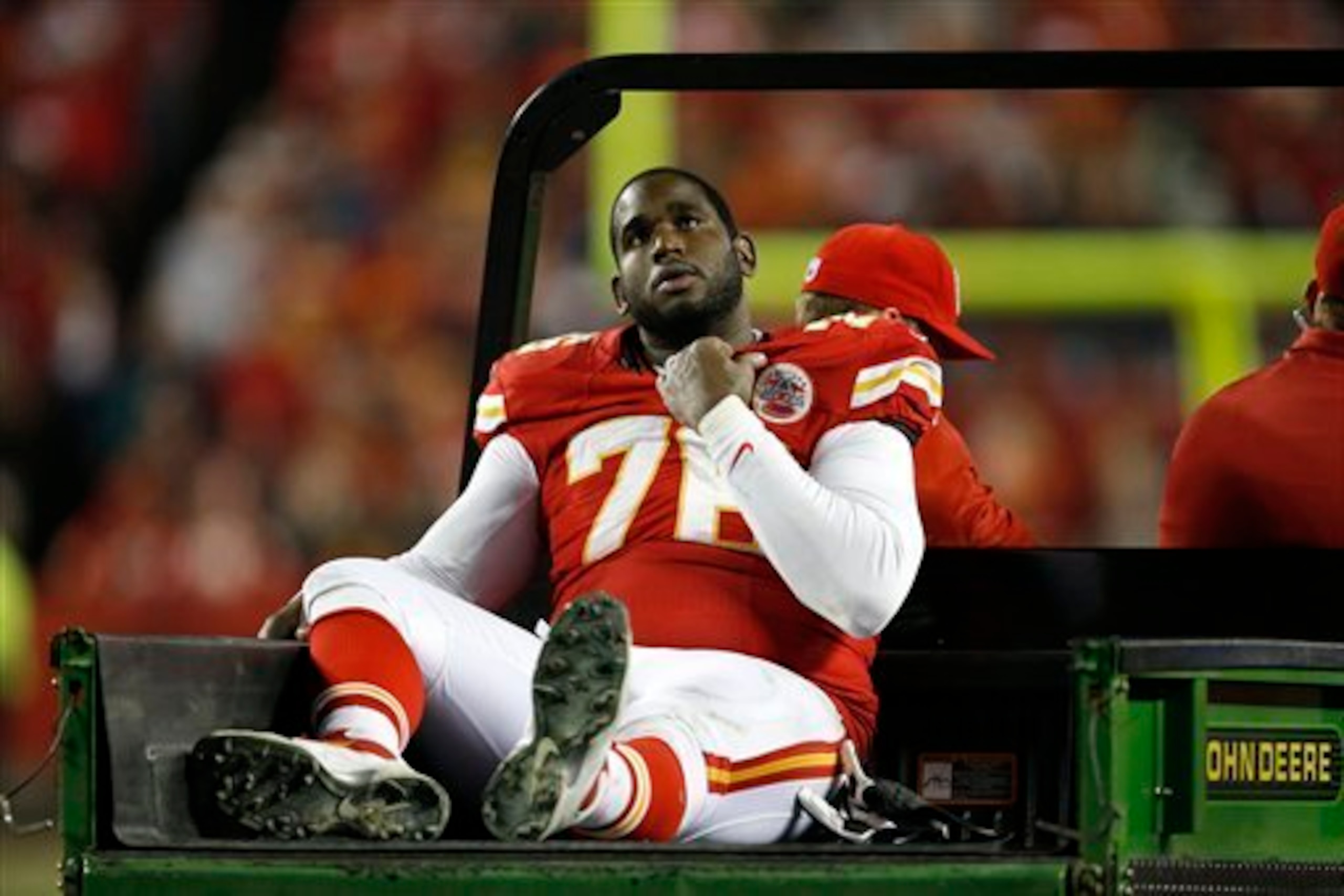
I asked B/R NFL Draft Lead Analyst Matt Miller for his opinion of these two veterans of the 2008 draft class, and he responded with essentially the same sentiment I gravitated toward the deeper I researched the two.
“I would say Albert is the better player right now,” Miller said, “but he'll likely be twice as expensive, and you have to worry about injuries.”
Albert missed seven games over the past two seasons with various injuries, including a knee injury that forced him out of four games in 2013.
“When building a team," Miller continued, "I'd rather pay Collins, get a top-10 caliber tackle and a guy with no injury questions."
He concluded by reiterating that for now, “Albert’s probably better.”
If Albert is better than Collins right now, it's not by much and may only be because of experience. Albert has started 85 games since the Chiefs made him a first-round pick, while Collins—a fourth-round pick—has started only 26 games. Comparing Collins to Albert in a host of different areas provides evidence that Collins, not Albert, is the better free agent—if not now, certainly for the future.
These are my findings.
Film Shows More Mistakes from Albert
I decided comparing the two would be best done by looking at similar opponents. Collins and Albert had two similar opponents in 2013: the San Diego Chargers and Indianapolis Colts. Albert faced the Chargers in Week 12 and the Colts on Wild Card Weekend; and Collins faced the Colts in Week 14 and the Chargers twice, in Week 13 and on Wild Card Weekend.
Scouring those games in search of domination and of mistakes, I found that Albert made too many silly mistakes that resulted in being beaten by his opponents.
Don’t get me wrong, Albert is a very good left tackle. There is a reason he started 15 games as a rookie and has been penned into the starting lineup for all but one game in which he has played.
But on tape, he makes too many mistakes. On one play, he will show why the Chiefs picked him 15th overall in 2008. Then on the next play, he will show a lack of concentration and get beaten badly.
Collins, on the other hand, is a technician. He has great form and posture when blocking, and when he is beaten, it’s usually not because he made a mistake—it’s because someone beat him. That’s not to say he’s perfect, because he's not. The three games I watched produced a few minor gaffes.
Take this play, for example.
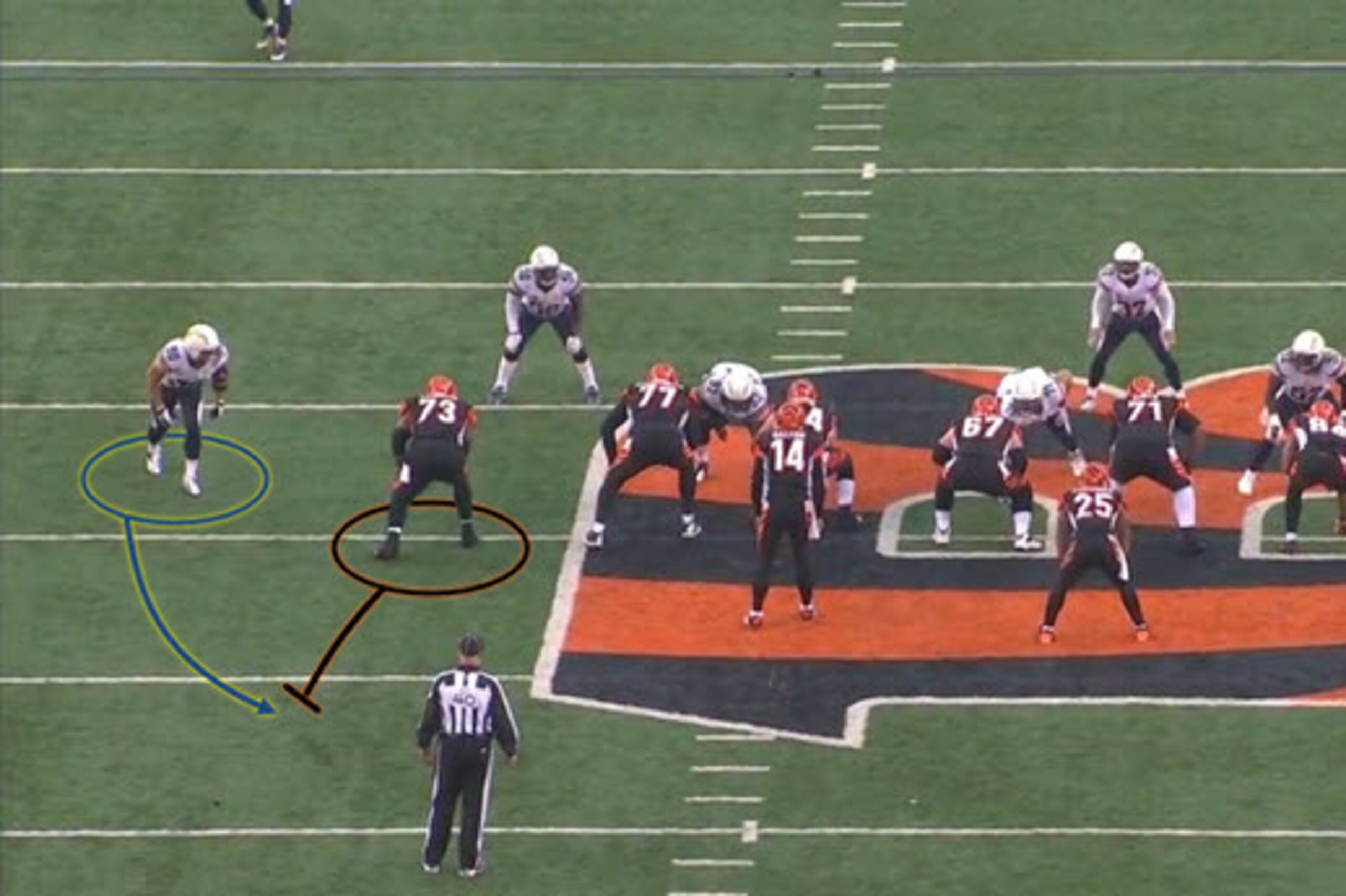
Down by 10 with just five minutes, 37 seconds to go in the Bengals’ Wild-Card loss to the Chargers, quarterback Andy Dalton set up in the shotgun near midfield. Collins lined up against backup outside linebacker Thomas Keiser.
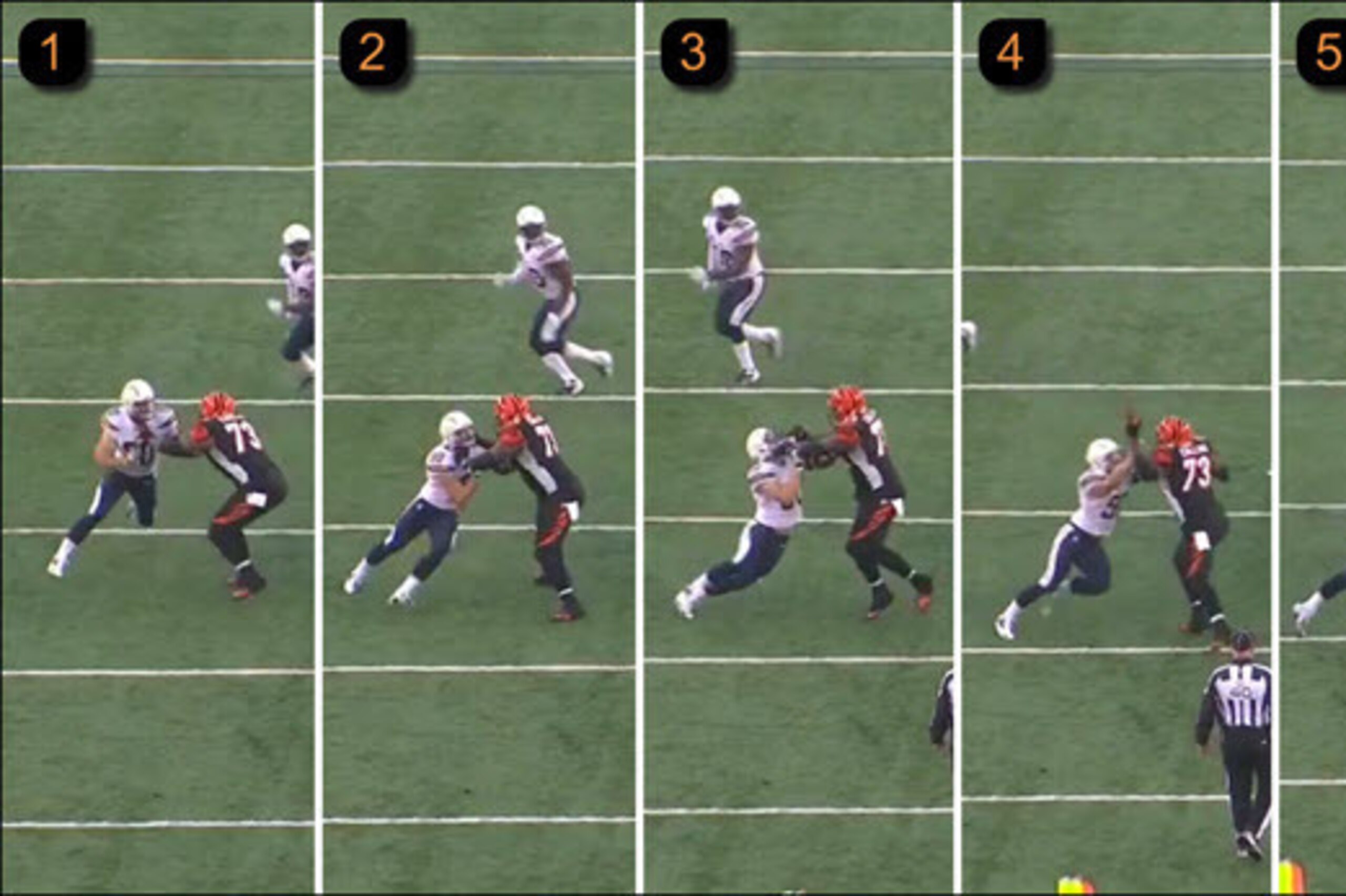
The left tackle initially had a solid base, good leverage and had his shoulders square to Keiser. But between the first and second frames, Collins stood upright and lost all leverage, which led to him being lifted off the ground as Keiser walked him back and nearly into Dalton.

You can see from the GIF that Andrew Whitworth stopped an assured sack by helping Collins with Keiser. That sort of thing doesn’t happen often with Collins; in fact, I was surprised to see it from him. He is usually the one driving people backwards, not the other way around.
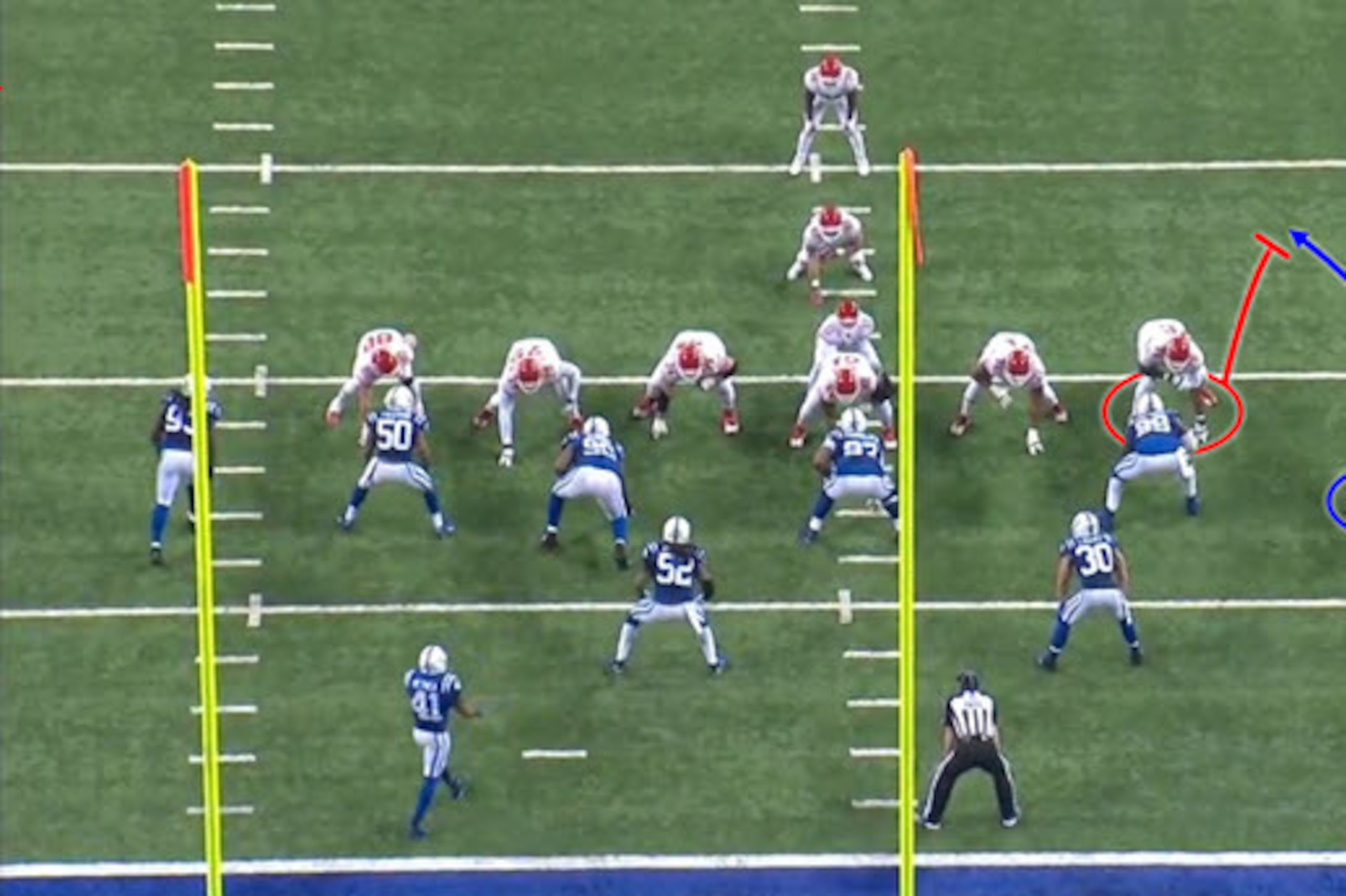
Keeping along the same lines, we’ll move to Albert and show what happens when a left tackle stands up and reaches for a defender.

Here, tight end Anthony Fasano will run a route, meaning Albert must kick out wide to pick up a rushing Erik Walden. This kind of action is easy for Albert, who has quick feet and is athletic enough to cut off pass-rushers as they turn the corner.

Albert and Walden met a few yards in the backfield. But as you can see, Albert stood too tall and was too far away from Walden and had to bend at the waist to reach for him. The left tackle was off balance by doing that, meaning Walden was about to win with one simple action—the blue arrow shows Walden knocking Albert’s arms away.

With Albert’s arms out of the way and his momentum carrying him toward the line of scrimmage, Walden had a free run at quarterback Alex Smith.

The only thing that kept this play from being a sack was that Smith had rolled slightly to his right. Had he dropped straight back, Walden likely would have planted him into the Lucas Oil Stadium turf.
Albert also shows a tendency to play with light hands, meaning that he sometimes lacks punch when engaging a defender. That was embarrassingly apparent on multiple instances against the Chargers during Week 12.
For the sake of brevity, you'll see only the worst one.
In this GIF, note Albert’s hand placement. As an offensive lineman, it’s common to have one hand in a defender’s chest and one hand outside the body. This allows the lineman to counter any moves made by the defender (which you’ll see from Albert in a minute).

But Albert failed to get either of his hands into Keiser’s chest (there’s that guy again), which resulted in a clean tackle for the linebacker and an embarrassing highlight for Albert.
For comparison’s sake (why are we here again?), this is where your hands should go if you’re an offensive lineman.

This play could have ended up a lot like the GIF we just saw had Collins reached for outside linebacker Melvin Ingram’s shoulders. But instead, he punches Ingram’s chest pad with both hands, grabs hold and doesn’t let go. The result is a win for Collins.
As mentioned above, Albert did do a lot of things right. This is one of them.
Colts defensive end/outside linebacker Robert Mathis learned the spin move from legendary spinner Dwight Freeney, and Mathis has made many left tackles look foolish with it—even Albert.
But this time, Albert played the spin move perfectly.

He began by getting his entire upper body on Mathis, with one hand in front while keeping his backside hand free to counter the spin. Mathis began his spin in the second frame, and Albert countered by leaning on him while repositioning his free hand to the middle of Mathis’ back. That allowed Albert to shove Mathis away mid-spin and gave the big left tackle time to recover and cut off Mathis as he completed the spin move.
Touching briefly on the run game, both players are about average in run-blocking—nothing spectacular, but nothing glaring, either. Here are a couple quick GIFs that illustrate both can dominate at times, especially while down-blocking near the goal line.

The first is Albert providing the lane through which running back Jamaal Charles ran for a touchdown against the Chargers. He moved defensive end Corey Liuget clear out of the way, and he did so in a hurry.
The second—of Collins—consists of two plays from the same drive against the Colts.

In the first play, Collins knocked Mathis to the ground after driving him roughly seven yards down the line of scrimmage. And in the second, he does the same to defensive tackle Fili Moala.
OK, enough from the film room. Let’s dig up some stats to see who is better.
Stats Show Collins More Dominant
They say numbers never lie. While that’s true, those who compile numbers and statistics can manipulate them—numbers can be formatted and presented to say anything you want if you know what you’re doing. Do I know what I’m doing when researching and presenting football statistics?
You bet I do.
I once compared former Cardinals quarterback John Skelton to Hall of Fame quarterback John Elway using a bevy of comparative stats—again, you can twist numbers to help you say anything you want.
That’s not happening here, however. These are raw numbers intended only to compare the two players against each other and against other offensive tackles.
We begin by comparing the pass-blocking careers of Collins and Albert.

First, focus on the number of pass-blocking snaps each player has been a part in six NFL seasons. Albert has very nearly tripled the total snaps in pass protection as Collins has. He has been the guy since his rookie year with the Chiefs while Collins was a spot-starter with the Bengals—even last season, Collins didn’t start consistently until starting left tackle Andrew Whitworth kicked inside to replace left guard Clint Boling, who went down with an injury and missed the final four games of the season.
The next numbers of note are the quarterback pressures themselves and the percentage of snaps that resulted in a pressure. Bulk stats are no good most of the time; averages and percentages are the way to go, as they tell more of the story. If you look at the total pressures allowed for each player, you would think Albert has serious issues and probably shouldn’t be in the NFL.
But when looking at career averages and percentages for pressures, Collins and Albert compare closely to one another. Collins has the edge in the majority of the numbers, which are elite, but Albert’s numbers are still very good.
The final set of numbers to draw your attention to are penalties and the immense difference between Collins and Albert.
Note that over his career, Collins has been called for a penalty essentially once every 244 snaps. Here are his penalties:
- (3) Offensive holding
- (2) False start
- (2) Illegal formation
- (1) Unnecessary roughness
Just two of eight (25.0 percent) penalties were false starts, with both coming at home. And three holding calls in over 1,000 pass-block snaps is really good.
Despite his infrequent opportunities, Collins has shown the discipline you want from a starting left tackle. That’s tough to do because, as a part-time player along a solid offensive line, he didn’t always know when—or if—his number would be called during game action.
Albert, on the other hand, has had issues with discipline, having been called for a penalty about once every 127 snaps (about twice as often as Collins). Here is a breakdown of his penalties.
- (27) False start
- (12) Offensive holding
- (3) Illegal formation
- (1) Facemask
- (1) Chop block
Of his 44 penalties, 27 (61.4 percent) were false starts, and of those, 13 (48.1 percent) came at home. That’s a problem. As a player, you have to have more discipline than that. He had the fifth-most false start penalties two of the past three seasons according to NFLPenalties.com, being guilty of five in 2013 and six in 2011, respectively.
Now we’ll turn to just the 2013 season and put the wide-angle lens on the camera, focusing on a broader base of offensive tackles and where these two—and other free agents—rank in pressure percentage. After all, that’s what it’s all about for offensive linemen: How well can you protect the quarterback?
This list compiles the 62 tackles who registered at least 300 pass-block snaps during the 2013 regular season; they are ranked by lowest percent of pass-blocking snaps that resulted in a quarterback pressure (a hit, hurry or sack).
Note: Unrestricted free agents are highlighted; penalty numbers include playoffs (for accurate total snaps per penalty statistic); pass-block snaps include only those from the tackle position.
| 1 | Anthony Collins | CIN | 317 | 12 | 3.79% | 2 | 336.5 |
| 2 | Orlando Franklin | DEN | 621 | 24 | 3.86% | 11 | 101.3 |
| 3 | Joe Staley | SF | 471 | 20 | 4.25% | 2 | 572.0 |
| 4 | Branden Albert | KC | 475 | 23 | 4.84% | 10 | 88.3 |
| 5 | Joe Thomas | CLE | 751 | 37 | 4.93% | 10 | 114.9 |
| 6 | Tyron Smith | DAL | 629 | 31 | 4.93% | 4 | 255.8 |
| 7 | Cordy Glenn | BUF | 606 | 30 | 4.95% | 6 | 176.7 |
| 8 | Trent Williams | WAS | 691 | 35 | 5.07% | 4 | 292.5 |
| 9 | Zach Strief | NO | 647 | 33 | 5.10% | 5 | 242.6 |
| 10 | Eugene Monroe | JAX/BAL | 467 | 24 | 5.14% | 4 | 200.3 |
| 11 | Jordan Gross | CAR | 554 | 29 | 5.23% | 0 | N/A |
| 12 | Chris Clark | DEN | 605 | 32 | 5.29% | 8 | 162.9 |
| 13 | Andrew Whitworth | CIN | 334 | 18 | 5.39% | 5 | 203.6 |
| 14 | Duane Brown | HOU | 582 | 32 | 5.50% | 7 | 139.0 |
| 15 | Andre Smith Jr. | CIN | 629 | 35 | 5.56% | 4 | 300.3 |
| 16 | King Dunlap | SD | 333 | 19 | 5.71% | 3 | 266.0 |
| 17 | Nate Solder | NE | 607 | 35 | 5.77% | 3 | 412.3 |
| 18 | Tyler Polumbus | WAS | 692 | 41 | 5.92% | 2 | 586.0 |
| 19 | Demar Dotson | TB | 573 | 34 | 5.93% | 4 | 266.5 |
| 20 | Joe Barksdale | STL | 454 | 27 | 5.95% | 1 | 838.0 |
| 21 | David Bakhtiari | GB | 648 | 39 | 6.02% | 10 | 113.8 |
| 22 | Phil Loadholt | MIN | 575 | 36 | 6.26% | 3 | 323.3 |
| 23 | Tony Pashos | OAK | 415 | 26 | 6.27% | 1 | 735.0 |
| 24 | Jason Peters | PHI | 555 | 35 | 6.31% | 4 | 274.8 |
| 25 | Doug Free | DAL | 630 | 40 | 6.35% | 6 | 170.8 |
| 26 | Erik Pears | BUF | 606 | 39 | 6.44% | 4 | 295.0 |
| 27 | Anthony Davis | SF | 502 | 33 | 6.57% | 6 | 198.7 |
| 28 | Don Barclay | GB | 546 | 36 | 6.59% | 5 | 195.8 |
| 29 | Austin Howard | NYJ | 559 | 38 | 6.80% | 2 | 535.5 |
| 30 | Jake Long | STL | 469 | 32 | 6.82% | 4 | 218.0 |
| 31 | Austin Pasztor | JAX | 483 | 33 | 6.83% | 3 | 269.3 |
| 32 | David Stewart | TEN | 483 | 33 | 6.83% | 2 | 406.5 |
| 33 | Kelvin Beachum | PIT | 416 | 29 | 6.97% | 4 | 184.5 |
| 34 | Gosder Cherilus | IND | 656 | 47 | 7.16% | 4 | 306.3 |
| 35 | Michael Roos | TEN | 612 | 44 | 7.19% | 3 | 362.7 |
| 36 | Riley Reiff | DET | 650 | 49 | 7.54% | 5 | 225.4 |
| 37 | D'Brickashaw Ferguson | NYJ | 561 | 43 | 7.66% | 3 | 357.7 |
| 38 | Donald Penn | TB | 573 | 44 | 7.68% | 3 | 354.7 |
| 39 | Anthony Castonzo | IND | 657 | 51 | 7.76% | 7 | 174.4 |
| 40 | Matt Kalil | MIN | 627 | 49 | 7.81% | 3 | 353.0 |
| 41 | Marcus Gilbert | PIT | 582 | 46 | 7.90% | 8 | 120.6 |
| 42 | LaAdrian Waddle | DET | 315 | 25 | 7.94% | 2 | 276.5 |
| 43 | Jeremy Trueblood | ATL | 409 | 33 | 8.07% | 4 | 160.3 |
| 44 | D.J. Fluker | SF | 564 | 47 | 8.33% | 7 | 169.4 |
| 45 | Charles Brown | NO | 584 | 49 | 8.39% | 9 | 108.2 |
| 46 | Tyson Clabo | MIA | 618 | 52 | 8.41% | 2 | 481.0 |
| 47 | Byron Bell | CAR | 545 | 46 | 8.44% | 4 | 270.8 |
| 48 | Justin Pugh | NYG | 613 | 52 | 8.48% | 3 | 347.3 |
| 49 | Mitchell Schwartz | CLE | 751 | 65 | 8.66% | 2 | 575.0 |
| 50 | Khalif Barnes | OAK | 404 | 35 | 8.66% | 9 | 81.7 |
| 51 | Jermon Bushrod | CHI | 630 | 55 | 8.73% | 5 | 214.0 |
| 52 | MIchael Oher | BAL | 638 | 56 | 8.78% | 6 | 187.5 |
| 53 | Bryant McKinnie | BAL/MIA | 635 | 59 | 9.29% | 2 | 522.0 |
| 54 | Eric Winston | AZ | 612 | 58 | 9.48% | 8 | 135.8 |
| 55 | William Beatty | NYG | 609 | 59 | 9.69% | 6 | 169.8 |
| 56 | Lane Johnson | PHI | 582 | 57 | 9.79% | 6 | 197.7 |
| 57 | Eric Fisher | KC | 469 | 47 | 10.02% | 6 | 135.2 |
| 58 | Derek Newton | HOU | 497 | 50 | 10.06% | 7 | 121.1 |
| 59 | Cameron Bradfield | JAX | 483 | 50 | 10.35% | 4 | 202.8 |
| 60 | Lamar Holmes | ATL | 694 | 76 | 10.95% | 11 | 97.7 |
| 61 | Jordan Mills | CHI | 607 | 78 | 12.85% | 2 | 511.0 |
| 62 | Bradley Sowell | AZ | 457 | 59 | 12.91% | 2 | 421.0 |
Collins and Albert did particularly well in this category, both finishing among the top five overall. Collins tops the group, allowing pressure on just 3.79 percent of pass-block snaps. Albert finished fourth, at 4.84 percent. Anything below 7.24 percent is above average among the bunch.
But there is another column you should notice. All the way on the right is snaps per penalty for last season. It’s not sorted, but if it were, Collins would place a respectable 19th among the 62 tackles. Other key free-agent tackles like Zach Strief (32nd) and Eugene Monroe (38th) are a bit further down the list, but Albert ranks next to last at just 88.3 snaps in between penalties; only Khalif Barnes (81.7) ranks worse.
Again, that speaks to Albert’s lack of discipline.
Conclusion
The bottom line is this: Over their careers, Collins and Albert have both shown a good ability to protect their respective quarterbacks. While Albert has been consistent, playing in 86 of a possible 98 games (with 85 starts, playoffs included), the penalties are concerning.
From the tape, I gathered that Albert was more prone to mistakes than Collins was. That doesn’t mean Albert is a poor left tackle, and it doesn’t mean he is unworthy of a big payday in free agency.
Collins played sparingly during his first six seasons, but stats show he was impressive when given a chance. His averages and percentages are better across the board than Albert’s are, which speaks to technique, discipline and probably coaching.
Longtime Cincinnati offensive line coach Paul Alexander has coached two Pro Bowl left tackles, including four-time Pro Bowler and three-time All-Pro Willie Anderson (a potential future Hall of Famer) and current blindside blocker Andrew Whitworth.
Given that Collins makes fewer mistakes on film and is also more dominant and more disciplined than Albert is, the edge goes to Collins in free agency.
*The NSA cannot read your mind. Hopefully you didn't need to read this sentence to understand that the third sentence of the article was a joke.
All statistics provided by ProFootballFocus.com (subscription required)
.jpg?w=2560 "49ers Seahawks Football")

.jpg?w=2560 "WWE Raw Live Grades 🔠")
.jpg?w=2560 "Harbaugh's Jameis Comps 🤨")