

How Could Ronaldinho Fit into a Barcelona Side Containing Messi, Suarez, Neymar?
Some players will always be remembered by their former clubs, and some players will always be remembered by the entire footballing world.
Former Brazil international Ronaldinho is one of the latter, with his skills, individual technique, trademark smile and penchant for spectacular goals winning admiration and outright love from fans all over the globe, not just at his former clubs such as Gremio, Paris Saint-Germain and Barcelona.
It was at the Camp Nou that he most frequently made the world sit up and take notice, though, with his wizardry on the ball and haul of trophies making for an impressive watch on and off the pitch.


Ronaldinho caused a stir, per ESPN Brasil (h/t Sport) when he recently suggested that he preferred the front line he featured in—along with Lionel Messi and Samuel Eto'o—to the current triumvirate of Messi, Luis Suarez and Neymar.
He has since clarified via Barca's official YouTube channel (h/t Eurosport) that the modern trident is "phenomenal" and that he would have scored "twice as many goals" if he had teamed up with them—a mouthwatering thought for any fan.
But just how would Barcelona fit Ronaldinho into their XI at the same time as the MSN front line?
Ronaldinho's Trident
Ronaldinho was at the Camp Nou from 2003 to 2008, winning La Liga twice and the Champions League once in that time.
The peak campaign in 2005/06—when they did the double under Frank Rijkaard—saw Barcelona's 4-3-3 look not hugely dissimilar to the current setup, in terms of the attack at least. Ronaldinho was on the left, the dribbling genius who added goals; Eto'o was the lethal central striker who stretched teams and was dead-eye with his finishing; and Ludovic Giuly was on the right and later replaced by Messi.

Messi, Eto'o and Ronaldinho then combined in 2006/07, with Thierry Henry eventually ousting the Brazilian on the left in his final campaign.
Ronaldinho was capable of playing in a central role himself, as he did with AC Milan, PSG and Brazil, but at Barca he was almost always a starter from the left—until it came to later in the match and they needed some extra magic, when he was shifted infield.
The Straight Swap
To get Ronaldinho into this Barcelona side, for some it would be pretty straightforward—take Neymar out and slot his compatriot in.

Neymar is one of the planet's most gifted individuals, has years ahead of him to improve further and has already proved his big-game mentality. But he also has a habit of having a streak during each season—for a month or two—when his form struggles and the goals stop flowing.
In those instances, it's easy to see why Ronaldinho might be the better choice of the two; consistency was rarely a problem for him, with only off-field issues clouding performances more often towards the end of his career.
However, there have been spells of matches when his team needs him most—or the majority of entire tournaments with Brazil—where Neymar elevates his game to a level of maturity, responsibility and determination that Ronaldinho perhaps never attained on a regular basis.
We're also trying to fit all four in together, so while switching one or the other would work, it's not ideal. And it's not necessarily right that the elder Brazilian takes the place of the younger man.
Messi the Playmaker?
So, to fit in all four, one has to drop out of the forward line. While Ronaldinho was generally seen as an "attacking midfielder" and Lionel Messi is predominantly seen as a "forward," it's the Argentinian who would seem more suited to a role from central midfield.
While we don't want to take his game outside the final third, Messi's quick, short-passing game is more reliable than Ronaldinho's was, and he also has more aggression to his game.
Messi isn't asked to track back for Barcelona to preserve his energy for moments of attack, but he is more likely to at least fill in positions to close off passing lanes centrally than his former team-mate.
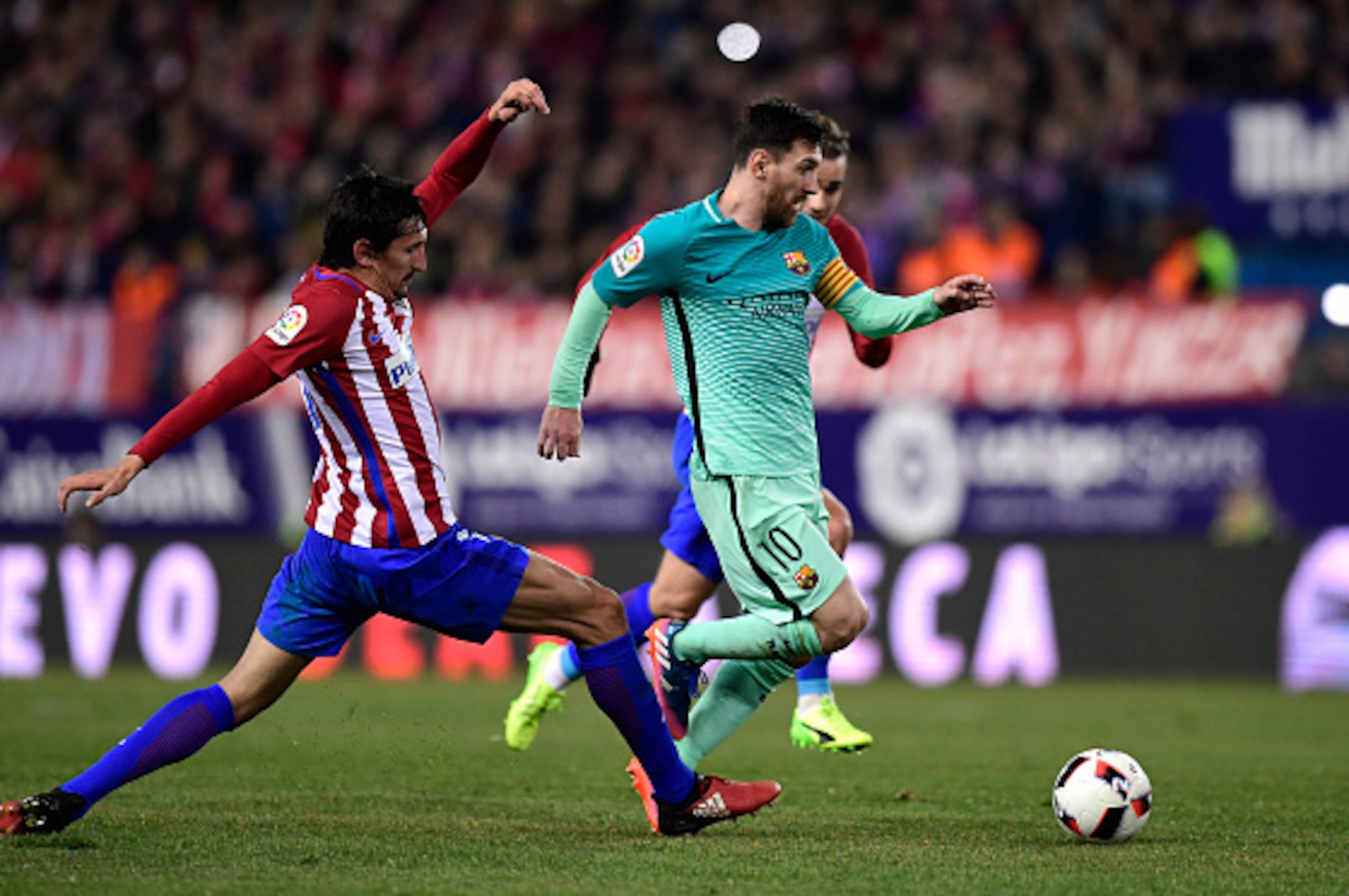
In playing a midfield double pivot, Messi could operate as somewhere between a No. 8 and a No. 10 in the team, leaving Neymar and Ronaldinho out wide and Suarez as the striker.
There would be room for rotation positionally, particularly between Messi and Ronaldinho when in possession, with either one dropping deep to act as the fulcrum for buildup play, thanks to the creativity, vision and execution of through balls both possess (or possessed, in Ronaldinho's case).
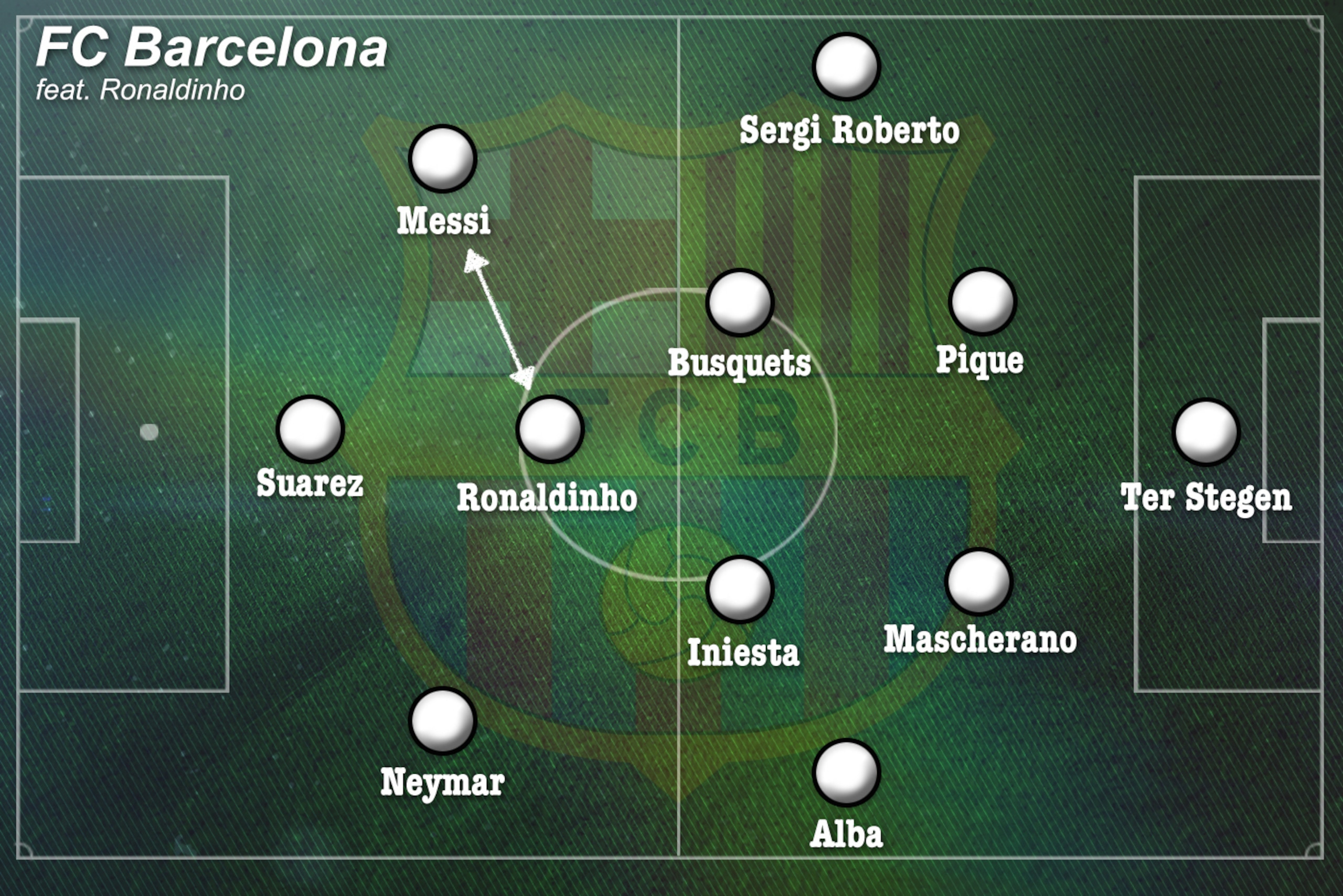
Messi acts as a chance-creator as well as goalscorer in Luis Enrique's team, and asking him to perform the former function with more regularity would naturally see his goal tally decrease. And since he has hit greater heights than any of his team-mates in front of goal, there's an argument that it's Ronaldinho who should be the deepest of the quartet, with the Argentina international still operating in the front three.
Either way, we're confident there's balance in the team when in possession, but the double pivot in midfield needs a great deal of athleticism, positional responsibility and defensive acumen to counterbalance having four offensive-minded players further upfield, as well as the full-backs pushing on as much as they do.
Sergio Busquets and Andres Iniesta should fit the bill, but a more aggressive, athletic figure such as Ivan Rakitic or Rafinha would also have a big part to play in this side.
Taking Advantage of Suarez
Defensive concerns have blighted Barcelona at times this season, and while it's too easy to level the blame on a front three who don't track back in the manner of other clubs' wingers or wide forwards, numbers in the defensive third and having players put in the hard yards is an obvious point of contention.
It's one thing to outscore teams with a talented attack, but it's quite another to control the game and have enough possession in the first place to do so—especially against the bigger or better teams in La Liga and Europe.
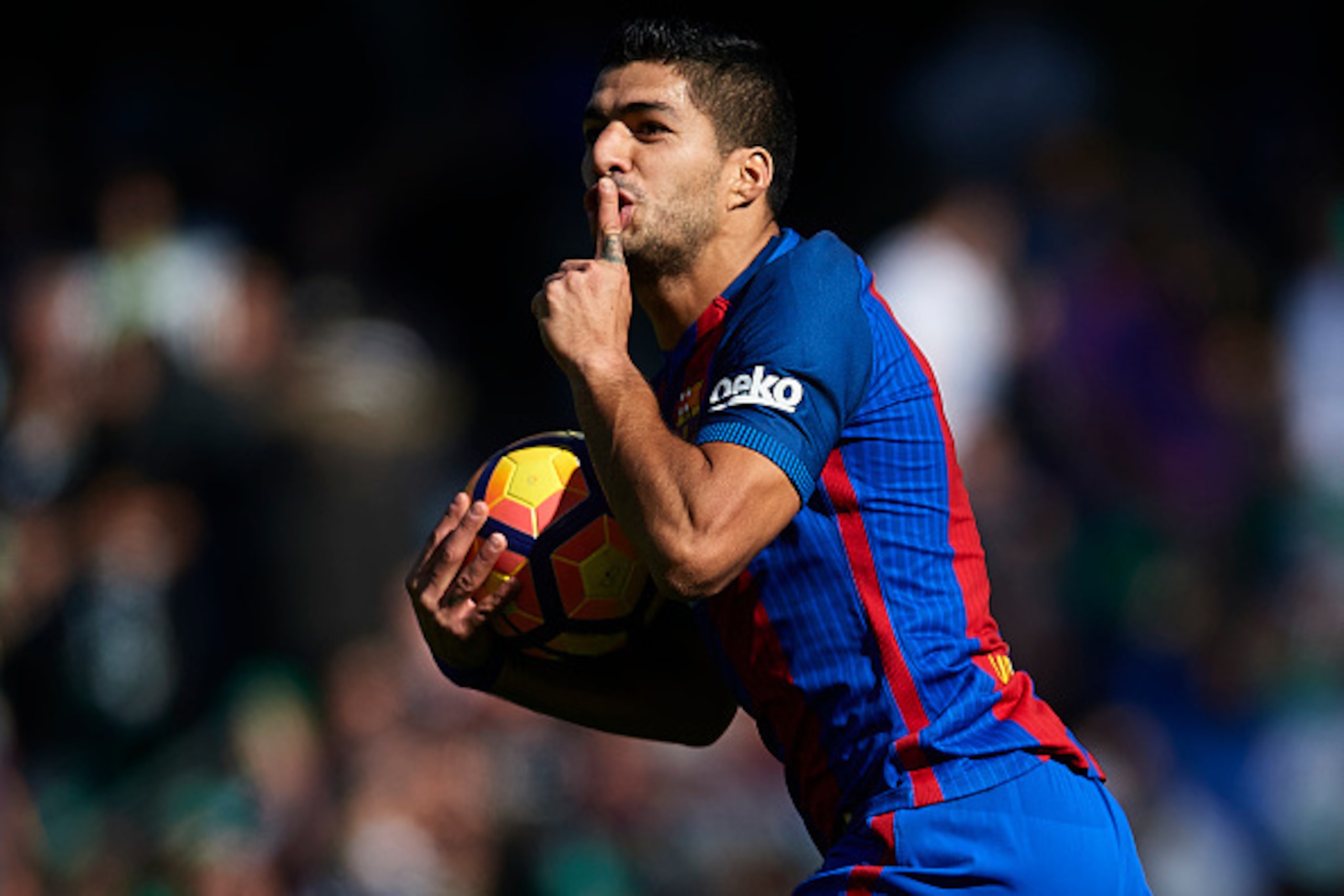
While Messi might not have the physical capacity to do plenty of leg work, Neymar gets frustrated and Ronaldinho never really showed the appetite, the fourth member of the team has everything required. Suarez is a team player, is relentless in his determination to win back the ball and has the physicality and the stamina to charge, surge, sprint and challenge all game long.
He's the world's best No. 9, so moving him out of the role isn't ideal, but for the good of the team, he's an option to pull wide and help balance out the side off the ball in certain situations or fixtures.
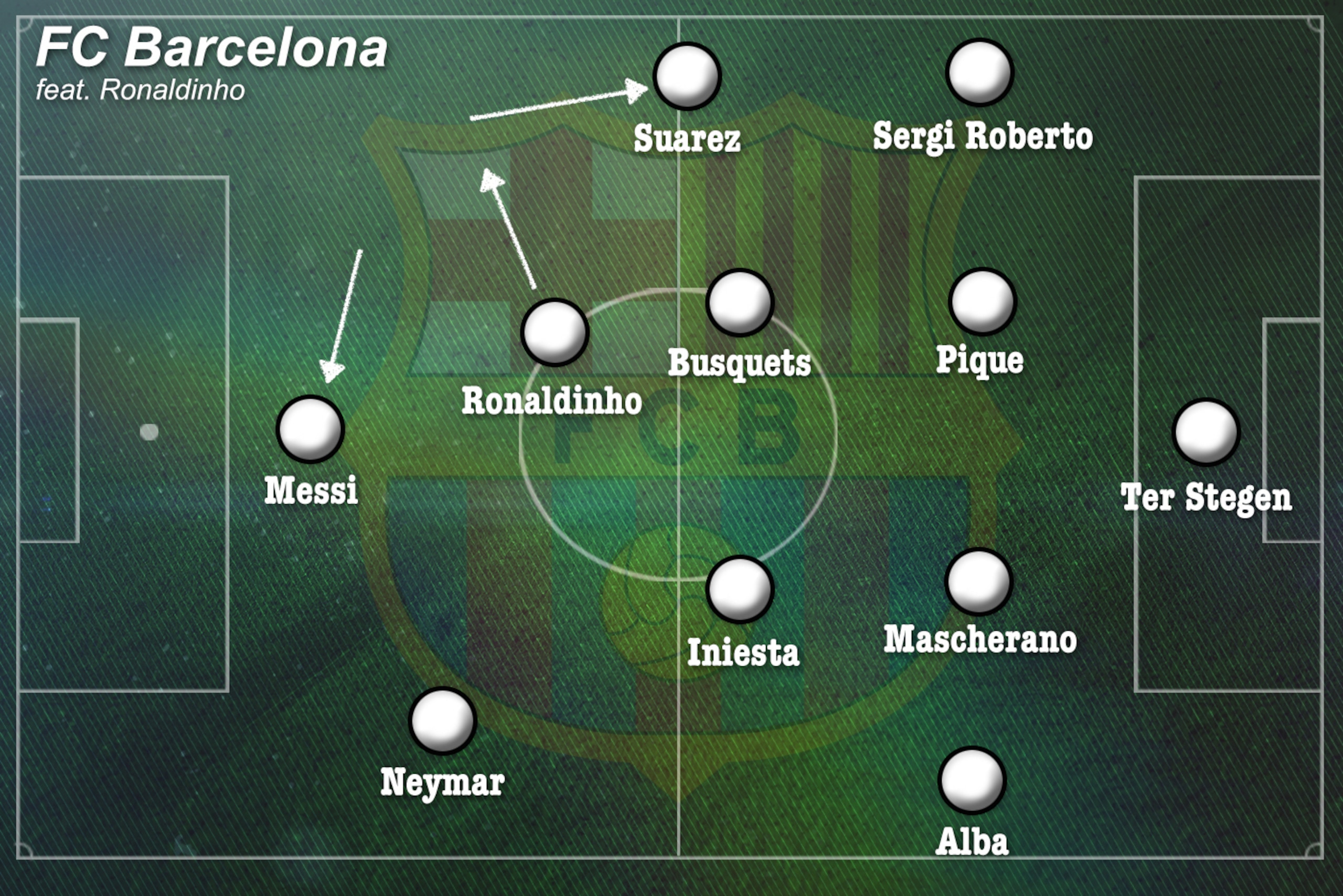
With Ronaldinho, Neymar and Messi left as a front three, Suarez can track back taking one flank, leaving two other central midfielders to close out spaces and protect the defence.
At Liverpool, Suarez would often play from the right, attacking whenever possible but also offering a block for the right-back; his work rate and tenacity were imperative in this regard.
There's no reason to regard Suarez fourth-best and therefore the least important member of this would-be quartet, but he has the different attributes to his game to make it work for the benefit of the entire side, helping us fashion what could have been an even more spectacular Barcelona team than the current one or Ronaldinho's.

.jpg?w=2560 "NBA Gambling Charges")

.png?w=2560 "Week 8 Winners & Losers 📊")

.jpg?w=2560 "Aikman Blasts Cowboys WR 🫣")
.jpg?w=2560 "Jonathan Taylor Landing Spots")