

OKC Thunder's Clutch Issues Can Improve with Russell Westbrook as Lone Star
The 2016-17 NBA season is to be one of drastic change for the Oklahoma City Thunder. Offseason upheaval will force the team to become more modern on the floor, with an emphasis on ball and player movement.
But how the Thunder perform in the final five minutes of close games will impact where they finish at season’s end.
The burden will fall squarely on the now undisputed face of the franchise: Russell Westbrook.
TOP NEWS

LeBron's Special Helicopter Deal

MJ Makes Record-Setting Donation 🙌
Shams: KAT, Hart Could Be Trade Names
So far, so good. The Thunder saw a new and improved Westbrook as Oklahoma City trailed 87-85 Wednesday night versus the Philadelphia 76ers with five minutes remaining. He played under control, nailing three key shots and setting up teammates, as he guided them to a 103-97 victory.
That kind of result would be a welcome change moving forward.
The Thunder as a whole have underperformed during clutch situations in recent history, and while Westbrook hasn’t been solely to blame, he’s been complicit in the crimes.
“Clutch Time” refers to the last five minutes of a game when the point differential is five points or fewer. The Thunder had 44 games last season with clutch situations and won half of those contests.
It was the worst winning percentage among playoff teams.
Westbrook’s relentless (and often reckless) style is what makes him an All-NBA superstar, but his inability to tame that style during the final few minutes has previously been a detriment.
It’s not just the inaccuracy of his shots—41.7 eFG% last season—that’s problematic. Westbrook’s selection in the clutch has left a lot to be desired. Those looks are often contested or too early in the shot or game clock. He's often seemed more concerned with creating contact on pressure shots than actually making the shot.
Occasionally he gets the call, which only encourages him to try it again the next time.
Couple that with former Thunder star Kevin Durant's predilection for similar decisions, and the dueling isolation banjos routine didn't always sound that great.
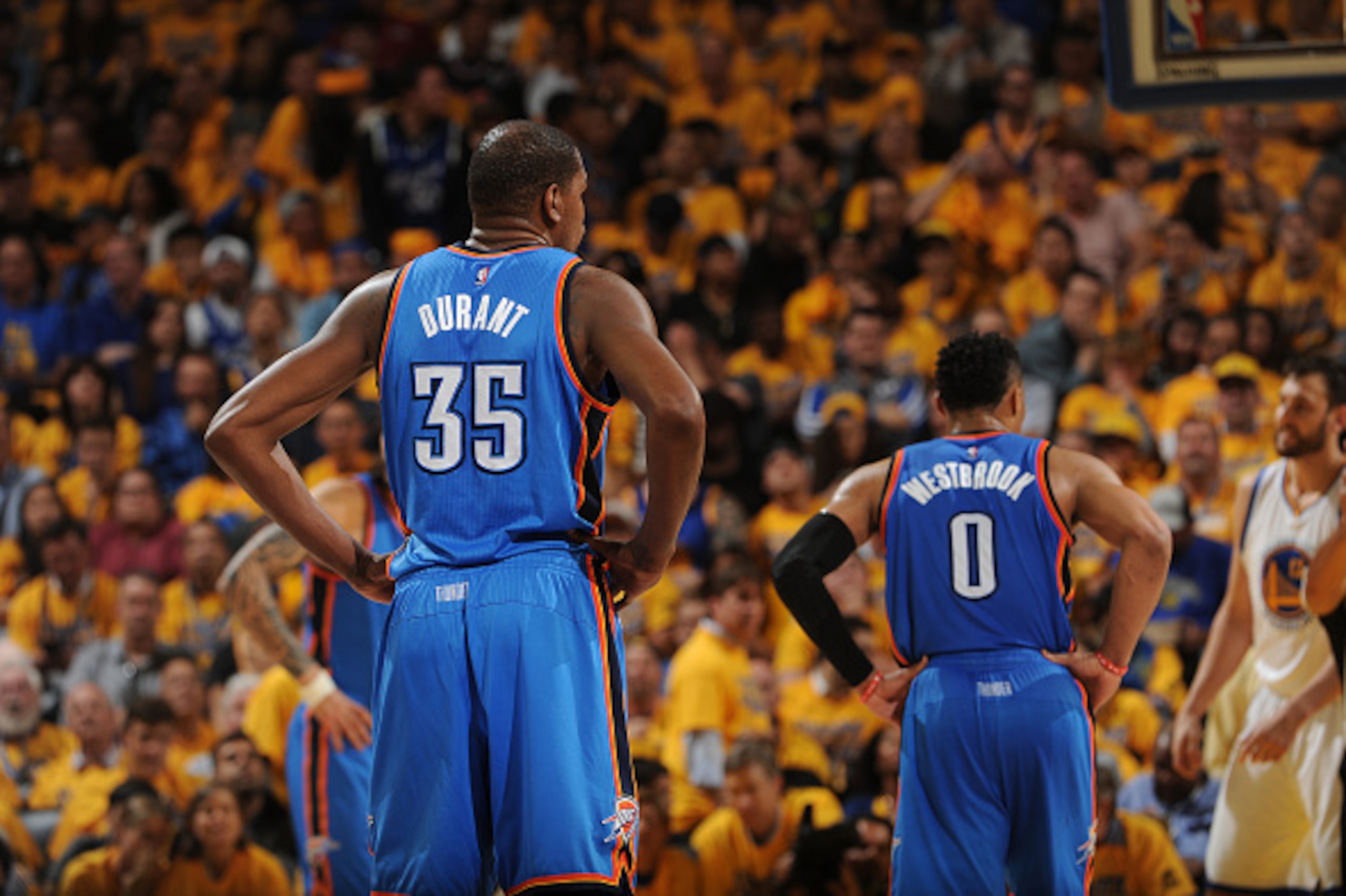
OKC caught grief in 2015-16 for blowing a number of fourth-quarter leads. While technically true—the team lost 14 games when leading after three quarters—the reality was much more nuanced. The Thunder were 41-5 when leading by five or more going into the fourth quarter and 30-1 when they led by at least 10.
Thus, OKC didn’t have its issues with comfortable leads but rather a tendency to fall apart late in tight games. Coach Billy Donovan acknowledged this prior to Wednesday night’s game.
“If you want to close games out, you’ve gotta be able to get back in transition, you’ve gotta be able to defend without fouling, you’ve gotta be able to keep the ball out of the paint and you’ve gotta be able to rebound,” Donovan explained. “There were some times last year we did struggle in that. Hopefully it’s something we can continue to progress and get better at.”
He is correct: The defensive rating swelled to a woeful 115.9—sixth-worst in the league—during clutch time last year. That led to a net rating of minus-8.3 points, which is (obviously) less than ideal if the goal is to win tight basketball games.
Yet, the Thunder’s issues weren’t all defensive-related, either. The ball stopped moving even more than normal on offense too, something lamented by the stats and plenty of eye tests.
The team’s assist percentage—the number of field goals made that were assisted by a teammate—fell from a below-average 55.8 percent to a very sticky 40.5 in the clutch. This was an artifact from the Scott Brooks era that didn’t correct itself.
OKC shot the ball very well overall in the regular season, posting the league’s third-best effective field-goal percentage at 52.4 (effective field-goal percentage, or eFG%, is a stat that adjusts for made three-point shots). But that number plummeted to 44.5 in the clutch.
In sum, Oklahoma City hemorrhaged points defensively late in close games and became far too predictable and individual offensively. That’s a nearly impossible combination to overcome, and the woes were systemic.
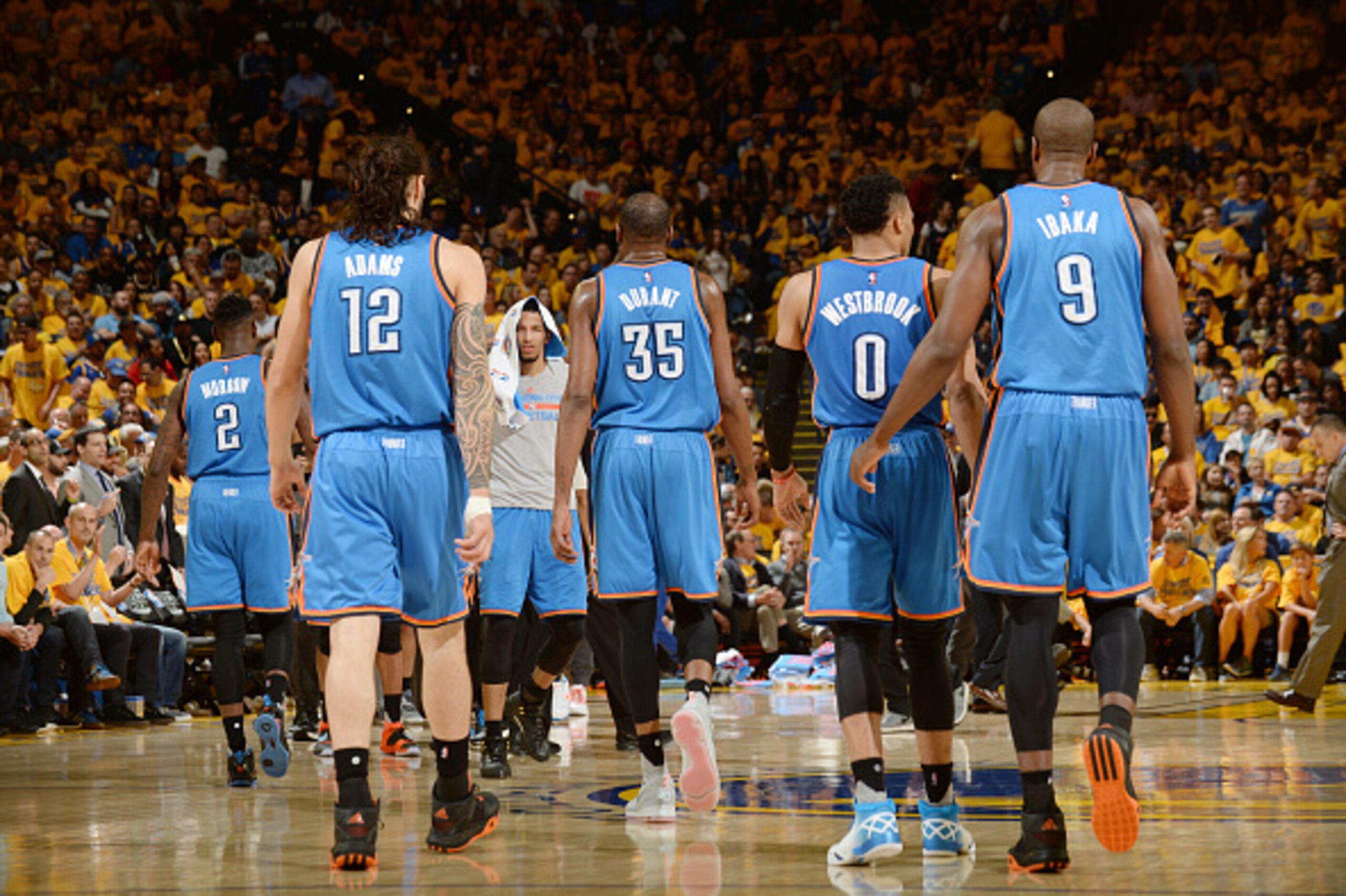
Only one Thunder rotation player, Steven Adams, posted a positive net rating in clutch time last season. Some of the defensive calamity can be pinned on giving big (and key) minutes to non-defenders like Anthony Morrow (-19.7 Clutch NetRtg) and Enes Kanter (-28.7). More alarmingly, the malady also struck the Thunder’s best stoppers: starters Andre Roberson and (the now-departed) Serge Ibaka:
| Starter's Name: | Position: | 2015-16 Clutch Net Rating |
| Steven Adams | C | 7.7 |
| Kevin Durant | F | -5.4 |
| Russell Westbrook | PG | -7.3 |
| Serge Ibaka | F/C | -8.1 |
| Andre Roberson | SG | -22.2 |
Rewind back further to the 2013-14 campaign and the tail end of the Scott Brooks era, and the Thunder posted a net rating of plus-8.2 in the clutch. The ball still didn’t move much and the shots still didn’t fall as accurately, but at least the defense wasn’t slipping as the game climaxed.
At least, up until the All-Star break.
When games resumed, the Thunder lost both of its defensive stalwarts, Kendrick Perkins and Thabo Sefolosha, for an extended stretch. Adams and Roberson, both in their second seasons, weren’t quite ready to fill the void, and none of the other Thunder players took ownership of the defense. Oklahoma City’s clutch time net rating plummeted to minus-10.4 and never recovered.
Adams and Roberson are older and wiser now. They will assume larger roles this season and be part of many closing lineups. They have an opportunity to right the Thunder’s end-game ship. Roberson did his part against Philadelphia with a key block on a Gerald Henderson jump shot with 15 seconds remaining.
The Thunder can exceed expectations this season by heeding Donovan’s defensive advice in clutch situations. But also, Westbrook must place more trust in his teammates and find a way to play within himself, as he did Wednesday night. Trusting offensive sets can open up better looks for Westbrook as the game tightens; he must resist the urge to take on the world alone.

Likewise, his teammates need to prove to Westbrook that they can execute (and be relied upon) in crunch time.
Thanks largely to the departure of Durant, the Thunder will likely find themselves in more close games than they’ve seen in the past. OKC can no longer afford to be a .500 club in the clutch like last season.
Snagging a few extra victories can help this team separate itself from the middle of the Western Conference pack.
All quotes obtained firsthand unless otherwise noted. Advanced stats courtesy NBA.com.

.jpg?w=2560 "Grading WWE Raw 🔠")

.jpg?w=2560 "Bijan's INSANE 1st Half 🤩")
.jpg?w=2560 "Viral Rams Coach Vid 🖕")
.jpg?w=2560 "Injury-stricken Seahawks signing veteran RB")

.jpg?w=2560 "2 NFL Officials Suspended")