

Donnel Pumphrey: San Diego State's Tiny Terror Is Ready to Move Up
Oh, he is small. Let’s make that clear.
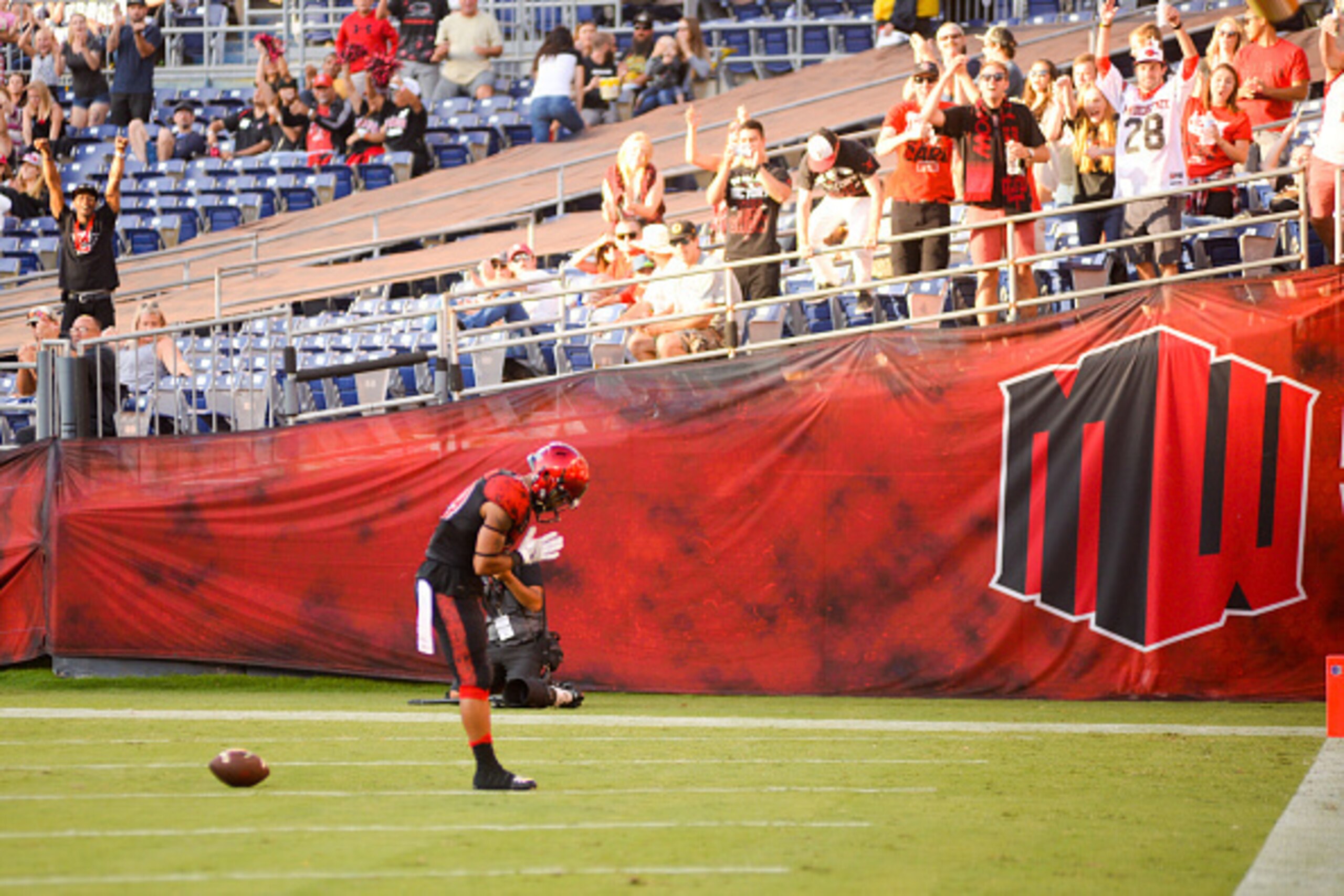
It’s been an hour since Donnel Pumphrey, the most productive running back in football, passed Marcus Allen and Thurman Thomas on the NCAA career rushing list. He is finally at rest, free of his helmet and protective outer shell.
His tattooed arms aren't crazily muscled. His lean, compact upper body has a matching lower half. His shoulders are slender, especially for someone who has carried the ball more than 700 times the last two-and-a-half seasons.
The athleticism is there even if the size isn’t: This is where that speed comes from. And yet, one can’t help thinking that this frame was constructed to do something other than play such a violent game.
This is not a groundbreaking revelation. Pumphrey has heard it before. It’s how he ended up at San Diego State despite being one of the most explosive high school players in the country. It’s why one of the greatest college careers in history has gone mostly unnoticed.
And over the next six months, this conversation will continue. It will grow louder. NFL scouts and personnel people will spend hours dissecting him.
"Productive for sure," a top team executive said. "But very, very small."
"He’s a terrific college talent, but I don’t know where you play him in this league," an AFC scout added. "He’s 5'9" and 20 pounds shy of 200. He’s not going to play running back; he can’t take the pounding. So where do you play him? Receiver? I just don’t see it."
Size is not the only issue. One of the other snags is that the nation’s leading rusher rarely has an audience.
Pumphrey plays in the Mountain West Conference, which means less time on television and less national interest. Many of his games start late at night, too. His legend grows after hours against lesser competition.
"Sometimes I feel overlooked, mainly because of the conference we play in," Pumphrey says.
And even when he plays at reasonable times, his biggest performances take place in towns far from the national spotlight—places like DeKalb, Illinois.
The Saturday after he ran for 281 yards and three touchdowns against Cal—in a game carried by CBS Sports Network that started at 10:30 p.m. ET—he burned Northern Illinois for 220 yards and three more scores.
This encore performance did not come in some sort of college atmosphere bursting at the seams. It came in a place where cornfields and wind turbines stretch out as far as the eye can see—where the nearest game of consequence was hundreds of miles away. It came in a stadium that holds fewer than 30,000 fans.
By the end, there were more empty seats than fans. But there was plenty to see that day, even if there weren’t many there to witness it.
With San Diego State’s 28-point lead cut to seven, the clock bled under eight minutes in the fourth quarter. For the first time all day, Northern Illinois had hope. The Huskies needed a stop.
The defense knew where the ball was going on second down. So did the press box. So did the hundreds of diehards streaming the game from their couches.
Pumphrey took the ball from his quarterback, lifting hands from both knees and bursting forward.
Masked by his offensive line, an opening appeared on the left side. Safety Brandon Mayes, seeing this doomsday scenario unfold, barreled toward him. At 5'11", 190 pounds, Mayes rarely has size on his side. But it was this time, as it almost always is for defenders trying to bring Pumphrey down.
Pumphrey cemented his right foot into the ground, cutting back so violently that the safety collapsed into one of his own players, his hand scraping uselessly across the running back’s hip on his way down. From there, all that was left was open space.
The next 79 yards were covered in choppy, trademark strides. The stadium unleashed a collective groan as the outcome was decided. There it was, in all its brilliance.
"We’ve been relying on him for four years," San Diego State head coach Rocky Long said of Pumphrey following the win. "It’s no different now. The sad deal is that sooner or later he’s going to play in the NFL and not play for us."

On his university bio, Pumphrey is listed at 5'9", 180 pounds. Those figures feel wildly ambitious.
This is not Leonard Fournette or Royce Freeman or another 230-pound battering ram with a Bugatti engine. That mold, once so unusual for the position, is becoming more common these days. Pumphrey is not that kind of back.
Speed is unquestionably his most sought-after asset. It blends seamlessly with a natural wiggle—a mix of cuts and open-field improv that is deadly in space.
"He can get into the hole quick," Long says. "I’d hate to be the safety that has him one-on-one about five yards deep in the secondary."
This combination of traits also allows him to escape most hits that would jar someone of his size, though when he does get hit he tends to brush it off without an issue. Power will never be his trademark, but he has no problem with contact when it’s time.
He is rarely the one inducing these on-field car crashes. But he always pops up full of life. It’s as if he enjoys them.
One would assume that physics would have some say in all of this: that a much larger player will inflict pain and injury on someone much smaller. But Pumphrey has logged at least one carry in every single game of his collegiate career thus far, and at least 20 carries in 24 of his last 29 games.
The smallest back in the nation is also the sturdiest.
This durability has allowed Pumphrey to crack the top 15 of the NCAA’s list of all-time-leading rushers and become the school’s top rusher. He passed Marshall Faulk during the Cal game.
With 5,163 rushing yards, he’s 863 yards away from cracking the top five. With seven regular-season games remaining—plus a potential conference championship game and a bowl—such production should not be assumed. But the opportunity to reach those heights is real.
Along the way, more giants will fall. Herschel Walker, LaDainian Tomlinson and Archie Griffin are among those Pumphrey figures to pass if he stays healthy.
In 2016, he has rushed for 891 yards in only five games, tops overall nationally. His average of 6.9 yards per carry is the best of his career. His nine rushing touchdowns are tied for third nationwide.
He’s accomplished all of this while playing alongside Christian Chapman, San Diego State’s sophomore quarterback, who's still searching for a rhythm.
At his current pace, Pumphrey will eclipse 2,000 yards rushing sometime deep in the regular season. He will put an exclamation point on one of the most productive careers a running back has ever had.
"There are a lot of great running backs out there," Pumphrey says. "But I feel like I can compete with them."
These running backs Pumphrey speaks of, the ones he is nothing like, play a role in all of this, too.
Before each game, Pumphrey takes time to watch LSU’s Fournette and Stanford’s Christian McCaffrey. By watching some of the game’s most gifted backs operate, he is able to find his zone.
Their popularity, however, isn’t what drives him. That’s not what he’s after. It’s the versatility of these two backs—the way they can conquer defenses in multiple ways—that inspires him.
That theme is consistent with the player Pumphrey has modeled his game after, although this source of motivation is not actually a running back.
When former West Virginia wideout Tavon Austin had the ball in his hands, he was the most dangerous player in the sport. Even at 171 pounds, there was no one more dangerous in space.
"He’s kind of my size," Pumphrey says. "I try to model my game after him and the way he played college football. He’s a playmaker. I try to do the exact same things he did."
Austin, like Pumphrey, didn’t single-handedly torch defenses with brute force. People will be talking about Austin's 2012 game against Oklahoma for generations, but his record-breaking performance—572 all-purpose yards, including 344 on the ground on 21 carries—was not a product of his power.
It was a showcase of his abilities: as a wide receiver, a running back and on special teams. It was the night he proved to the world that the word "receiver" would no longer suffice.
Pumphrey is trying to do the same at his position. He sees it as a way to become a more complete back and enhance his value. Last season, on top of running for 1,653 yards, he led the team in receptions and was second in receiving yards.
He’s focused extensively on what he can do when he’s not carrying the ball. The goal is to present a skill set so deep and atypical that it outweighs his stature. It’s what he has done for as long as he’s been playing a position where many thought he would never last.
"A lot of coaches looked past me based off my size," Pumphrey says. "But I’ve always been this size."
When Hunkie Cooper first met his star running back at Canyon Springs High School in North Las Vegas, he was 128 pounds.
"I had to order extra-small pants for him," Cooper says.
The two have reunited in Southern California. An Arena Football Hall of Famer as a wide receiver, Cooper went on to become one of Nevada’s most respected high school coaches. He had many chances to leave but waited for the right opportunity.
That came earlier this year. Cooper had played for Aztecs offensive coordinator Jeff Horton at UNLV, so when he was offered the chance to reunite with a former coach and a former player, Cooper jumped, joining San Diego State as the wide receivers coach.
In North Las Vegas, Cooper had seen something special in Pumphrey. It simply had to be harnessed with a steady diet of protein shakes and peanut butter sandwiches, not to mention long hours in the weight room.
By his senior year, Pumphrey was named the Gatorade Nevada Football Player of the Year. No longer tipping the scales at 128 pounds, he was still considered undersized by most major programs.
Those schools would drop by from time to time and see what one of the state’s best running backs was up to. After they got a good look at him, there'd be silence.
"I won’t name the schools that said he was too small," Cooper says. "But I look back at them now and here he is: the leading rusher in the country. He’s still durable. He’s still breaking records.
"A lot of people missed out on him because they were looking at size rather than ability."
San Diego State decided he was worth a shot. Cooper lobbied Horton to see beyond Pumphrey's height and weight. San Diego State was the first to offer.
"I took it," Pumphrey says. "They were real with me from Day 1."
Since arriving, Pumphrey has rewarded the program with startling production. Before South Alabama upset San Diego State 42-24 on Oct. 1—a game in which Pumphrey still ran for 151 yards—he had led the Aztecs to 13 straight wins.
Every metric and statistic that is valued for running backs is there. This is not just a stretch over a handful of games, or a season, for that matter. This is a four-year sample size. Pumphrey averaged six yards a carry as a freshman.
But he'll be under-viewed as long as his career is limited to Saturdays.
"He will never get the credit he deserves until he does what he’s doing at the next level," Cooper says. "And the team that gives him that opportunity—that GM and that head coach—are going to see something they don’t see anymore."
Phil Savage has faced these decisions before. The executive director for the Senior Bowl—one of the year’s biggest NFL draft showcases—was once the general manager for the Cleveland Browns.
Savage also logged years in various scouting departments around the league, immersing himself in the process of projecting talent.
When he scouted Warrick Dunn at Florida State—an undersized running back with tremendous wiggle—he was intrigued, knowing that Dunn was different from the traditional mold.
"He could go through a car wash and not get wet," Savage wrote on the scouting report, citing his incredible burst.
Size at the position is not necessarily a requirement. Dunn and others have proved there are ways to produce without the prototypical build. But that build is still the dominant working theory as to what a running back should look like.
"It’s going to be a challenge for him," Savage says of Pumphrey. "Scouting is essentially all about comparisons. There is just not a ton of history of these kinds of players having long careers. He’s going to be an exception beyond the rule, and he’s going to need a sponsor within an organization—someone who is willing to jump on the table for him."
For as much as Pumphrey has accomplished, the skepticism about his transition to the NFL will be widespread. At this point, it’s not a matter of what else he accomplishes in college. It’s merely a matter of time.
He knows it’s coming, although he hasn’t allowed himself to be consumed by it yet.
"That’s business," Pumphrey says of the NFL. "I’m not going to get this moment back."
No matter how well Pumphrey nails his interviews, no matter how fast he runs a straight line, no matter how many times he lifts a weighted bar off his chest, it won’t be good enough for many.
A robust catalog of production will give way to measurables. Extraordinary game tape will no longer be acceptable currency. All of it—the yards and the touchdowns and the open-field brilliance—will have to answer to the scale, the tape measure and the stopwatch.
Many teams, like the universities that refused to recruit him, will get one look at his frame and decide it’s not for them.
They will then seamlessly shift to the next running backs: players with nowhere close to the same production but bodies and skill sets they think will hold up better in the NFL.
"It doesn’t have to be 32 teams that are married to him," Savage says. "It just takes one. And there might be just one scout that really has a belief in him that can sell him to an organization."
In the meantime, you might want to become familiar with one of the most dynamic running backs to ever play. There is still yardage out there. There is still history to be made with each and every carry.
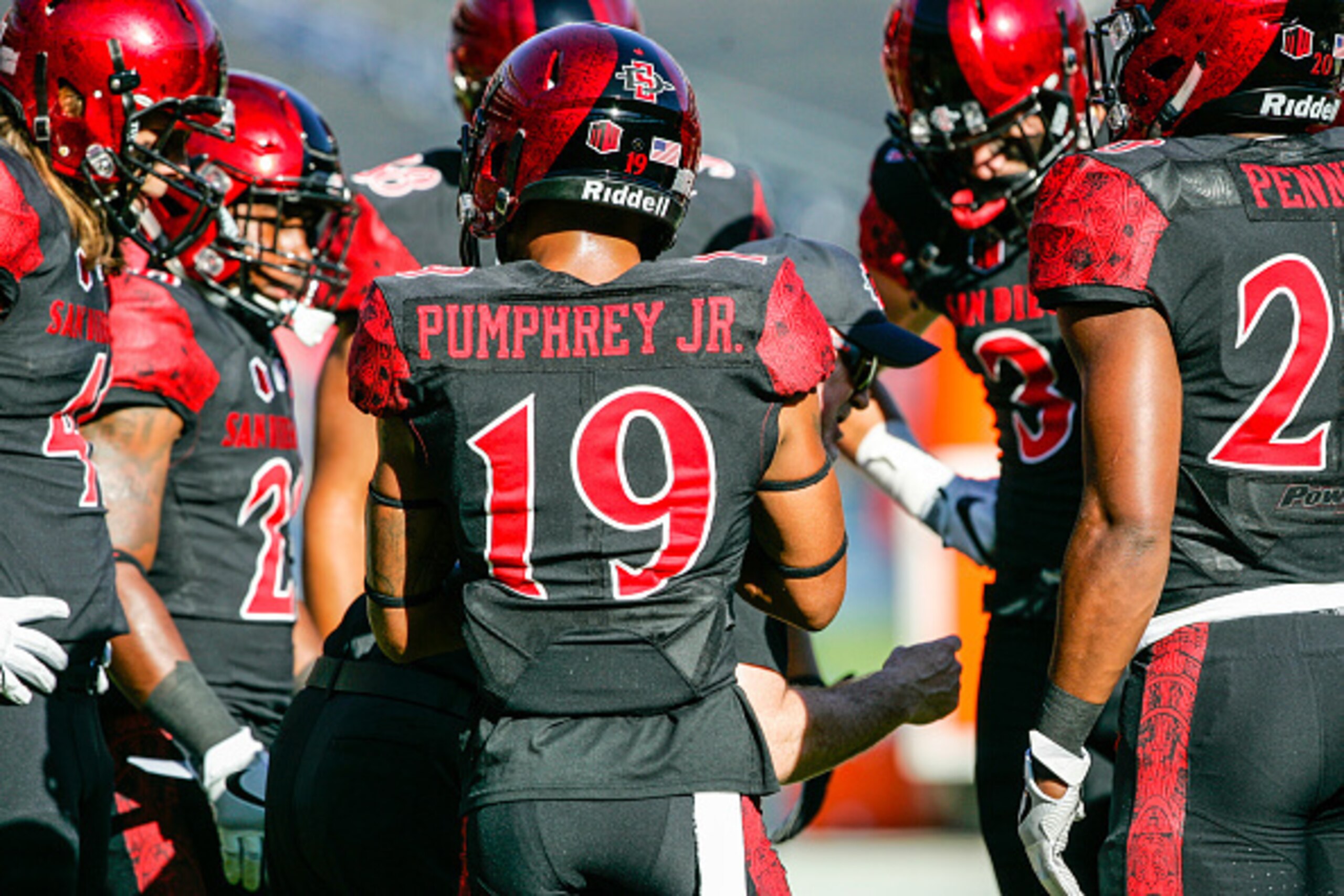
He wears No. 19. He plays deep into the night, often on a channel many didn’t know existed. And he’s almost always the smallest human being on the field. You can’t miss him.
All quotes and information obtained firsthand except as noted.

.jpg?w=2560 "🚨 LIONS GIVE GIBBS RECORD DEAL")
.png?w=2560 "CJGJ Fired Up to Face Texans😤")
.png?w=2560 "JB Threw Phone After Trade 😳")
