
Marcus Mariota Has Ability to Overcome Flaws to Become True Franchise QB
2012 was a big year for dual-threat quarterbacks, passers who use their running ability enough to influence the looks defenses can field on any given down.
It was the year in which the Washington Redskins mortgaged their future for eventual Offensive Rookie of the Year Robert Griffin III; the year the Seattle Seahawks stole Russell Wilson, a rookie Pro Bowler, with the 75th overall pick; and the year Colin Kaepernick took the San Francisco 49ers' starting job from Alex Smith, leading to a Super Bowl berth.
All of that followed the 2011 season, when Cam Newton, who vaulted out of nowhere at Auburn to become the first overall pick, earned a rookie Pro Bowl nod with 21 passing touchdowns and 14 rushing scores.
TOP NEWS

New NFL contenders starting to emerge after Week 4
.jpg?w=2560 "Cardinals Giants Football")
NFL investigating 2 referees for separate viral exchanges
.jpg?w=2560 "Hill Injury Update Football")
Report: Chiefs Contact Hill's Agent
Since that two-season stretch, the NFL's preference for statuesque pocket quarterbacks has shifted, at least for individual franchises if not league-wide.
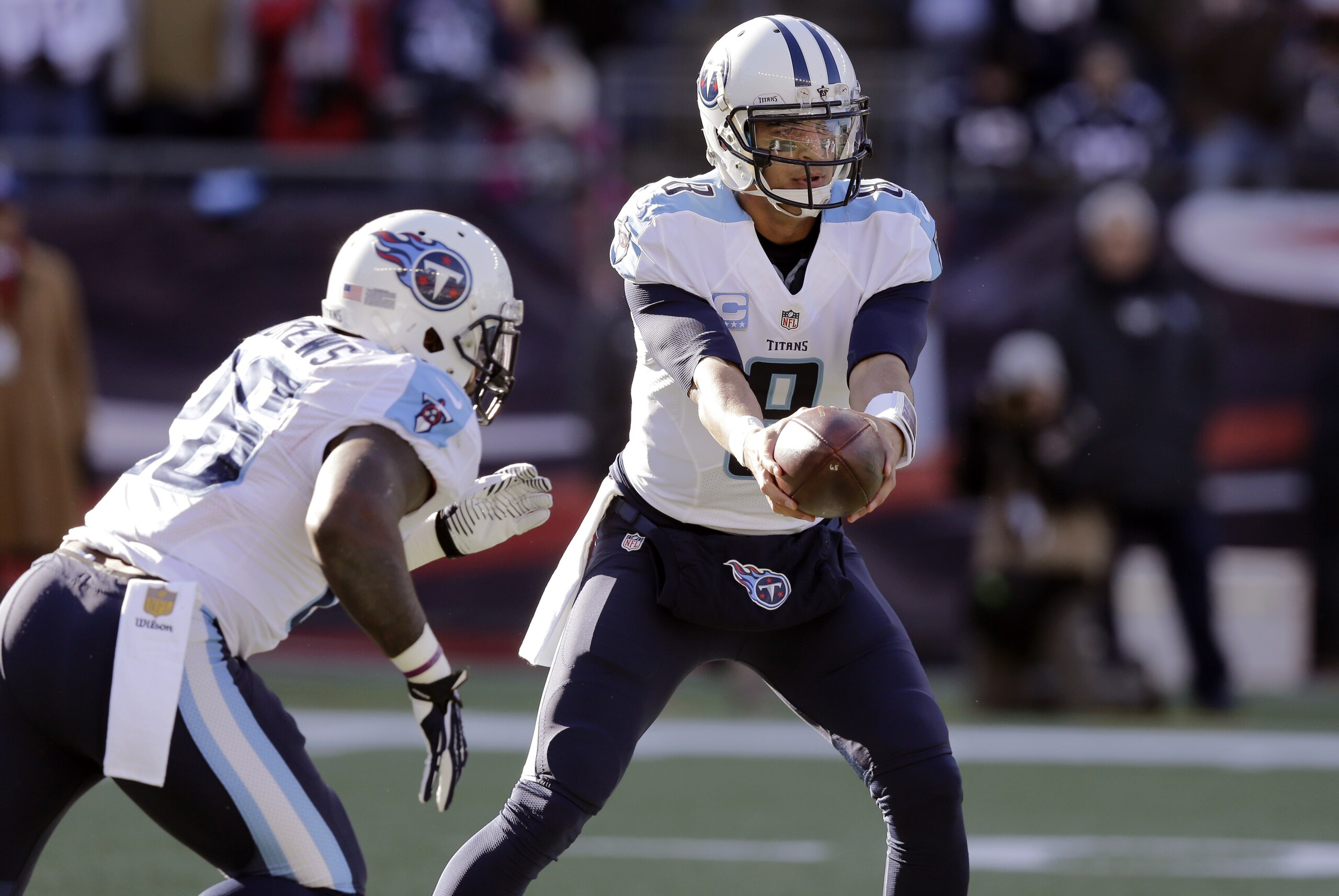
When the Tennessee Titans drafted Marcus Mariota second overall in 2015, he was supposed to be the next dual-threat signal-caller cut from the cloth of those early-career stars.
The just-under 6'4" quarterback ended his college career with a 105-14 touchdown-interception ratio, a Heisman Trophy and a national championship berth. According to Mock Draftable, his 4.52-second 40-yard dash at the NFL scouting combine in Indianapolis is in the 96th percentile for the quarterback position.
On paper, he's all you could have asked for in this era of NFL football, when spreading defenses out and taking advantage of numbers in and out of the box is how you win ballgames.
Still, if you dug deep enough, you realized he had flaws. Remember, Mariota was still the second quarterback drafted out of his class, behind Jameis Winston, who won the Heisman Trophy a year before Mariota did. The former Oregon Duck's issues were simple: He couldn't hit the deep ball, and he fumbled often when he was sacked.
Despite only throwing 14 interceptions in his career as a three-year starter at Oregon, Mariota put the ball on the ground 27 times, nearly doubling his turnovers. In his rookie season with the Titans, he had 10 fumbles—about par for his college track record and the same number of interceptions he had on the year.
Mariota's deep ball didn't improve in his first NFL campaign either. He threw 40 passes of 20 yards or more, ranking him 24th in the league, behind risk-averse passers such as Sam Bradford, Teddy Bridgewater and Alex Smith. The rookie threw four passes of 40 yards or more, placing him in a four-way tie for 30th in the league, alongside the likes of Johnny Manziel and Brock Osweiler, who combined for 13 starts in 2015.
As of now, Mariota isn't a peak Griffin-level quarterback, one who many thought would revolutionize the game. The flaws he had coming out of college are the same, but his positives developed with the passing year.
In a lot of ways, Mariota is a "take what you can get" quarterback. He doesn't want to force passes; he'd rather take the path of least resistance for an easy completion, which is why so many of his throws end up on short routes or in the hands of his running backs.
He's still the same running threat in the NFL as he was in the Pac-12. Mariota's 7.4-yard average on the ground only ranks behind Tavon Austin's 8.3-yard average for a 2015 ball-carrier with more than 10 attempts.
Mike Mularkey, the Titans assistant head coach and tight ends coach to start the 2015 season, took over as the interim head coach in-season, and Tennessee gave him a full-time head coaching offer this offseason. With his presence still on the offensive side of the ball, we shouldn't expect too many schematic differences between the 2015 and 2016 Tennessee football teams.
"Mariota converting on a third and one inside zone read. pic.twitter.com/YxbH6HORuN
— Justis Mosqueda (@JuMosq) June 21, 2016"
Mariota will again be put in a situation to succeed. In short-yardage looks, defenses will be forced to load the box, as the team used Mariota as an option runner. The adjustment of adding numbers in the tackle box means coverage will be softer for the quarterback to pick apart.
"RPO reading the LB in the A-gap. Get the ball off quick and eat the hit. pic.twitter.com/Uhq52RlAP5
— Justis Mosqueda (@JuMosq) June 21, 2016"
Not only did the team run inside and outside zone option plays under Mularkey, forcing defensive ends to hesitate to take run steps, but their run-pass option plays, also known as "packaged plays," put the fear of God in linebackers. They somehow have to account for the running back, quarterback or an inside breaking receiver handling the ball a split-second after the snap.
Freezing perimeter box defenders has led to big plays at the college level, and despite the hash mark difference in the NFL, it should do the same in the pro game. So why hasn't it spread across the league?
First, there aren't enough quality passers and ball-carriers to go around. Second, the risk of injury at the quarterback position can be too great to follow through with a full-time option approach.
Mariota missed four games during his rookie season, and he suffered knee injuries at the University of Oregon. Griffin, another passer built like a receiver, saw his career enter a downward spiral after knee injuries. Wilson, whose baseball background might assist in his sliding and ability to avoid contact, and Newton, who is listed as a 245-pound tank, are the only shining lights left from those early 2010s draft classes that were so promising.
So how exactly does being an option quarterback assist in the passing game on non-option plays? The best game to use as an example would be the NFC Championship Game in January 2015, when the Green Bay Packers blew a multi-score lead late against the Seattle Seahawks.
With just over two minutes to go, the Packers were up 19-7 against the home Seahawks. What changed the course of the game was when Seattle began to run option and packaged plays, forcing more Green Bay defenders into the box. Despite a 14-of-29 night, Wilson ended the game in overtime with back-to-back 35-yard passes, the second scoring a sudden-death touchdown.
If we're projecting a ceiling for Mariota long-term, he shouldn't be looking at Griffin, who put himself in a position to get injured often, or Newton, who has a natural size Mariota didn't enter the league with. His model should be Wilson, who uses his legs sparingly to survive a 16-game season but enough to make a difference in crucial parts of individual games.
"Mariota's biggest issues coming out of college were the deep ball and fumbles. 61-yard TD should have been an INT. pic.twitter.com/TijIU86Ka0
— Justis Mosqueda (@JuMosq) June 21, 2016"
Mariota needs to learn how to calibrate his deep-ball accuracy. Coming out of a spread system in college has hurt him some. He still throws off his back foot too often, putting too much air under his passes or sailing throws over his receivers' heads.
Newton also had this issue fresh out of Auburn, but in 2015, his first MVP season in the NFL, he was able to fix it. It's not an impossible feat, but it may take about three-and-a-half years to work out, as Carolina Panthers fans can vouch.
This coming season will tell us a lot about Mariota. Right now, he's similar to Smith or Ryan Tannehill in terms of style, though he may have an edge on both in pure talent. Is that the player the Titans need him to be, though?
For reference, the Minnesota Vikings traded the 40th and 108th picks to land Bridgewater, who has been noted as a game manager over his two-year NFL career. According to Peter Schrager of Fox Sports (h/t Inquisitr's Danny Cox), the Philadelphia Eagles, then headed by Mariota's first head coach at Oregon, Chip Kelly, offered the Titans two first-round picks, a second-round pick, any quarterback on their roster and any defender on the roster for Mariota.
Those players would likely have been Sam Bradford and Fletcher Cox, who signed a $102 million contract this offseason. Point-blank, you don't turn down that deal for a game-manager quarterback. The team expected Mariota to be a savior like Wilson and Newton, and he's going to be graded on that relative scale.
He's perfectly fine attacking anywhere on the field where he doesn't have to throw over the head of one of his targets. If that continues to be the case, though, he's going to hurt his team, which won't have a counterpunch to defenses' loading up the box against the dual threat.
Last year, the Packers lacked a vertical threat and struggled with the deep ball, leading to their 23rd-place rank in the league in total offensive yards. That was with Aaron Rodgers, who some would say is the most talented quarterback ever.
If you have a fatal flaw in the NFL, you'll be exposed. This is what Mariota has to battle.
He's proved himself to be an NFL quarterback, but to be a franchise quarterback, he's going to need to tighten up his attempts of 25 air yards and deeper. If not, his peak may be a Matt Ryan type of passer, a quarterback who thrives on the timing of deep-breaking routes but can't hit the home run ball with any consistency.
Eight years into his career, Ryan has never been to a Super Bowl. The Titans organization didn't turn down four or five potential high-impact players for Mariota to settle for an apex of mid-playoff losses.
Health, taking advantage of streaking receivers and keeping the ball in his hands during contact will determine the trajectory of Mariota's career in 2016.
.jpg?w=2560 "Titans Giants Football")
.jpg?w=2560 "Dolphins Bills Football")



.jpg?w=2560 "Greenlaw Talks Payton Exchange")